• KZT/USD = 0.00219
  • TJS/USD = 0.10860
  • UZS/USD = 0.00008
  • TMT/USD = 0.29850
  • KZT/USD = 0.00219
  • TJS/USD = 0.10860
  • UZS/USD = 0.00008
  • TMT/USD = 0.29850
  • KZT/USD = 0.00219
  • TJS/USD = 0.10860
  • UZS/USD = 0.00008
  • TMT/USD = 0.29850
  • KZT/USD = 0.00219
  • TJS/USD = 0.10860
  • UZS/USD = 0.00008
  • TMT/USD = 0.29850
  • KZT/USD = 0.00219
  • TJS/USD = 0.10860
  • UZS/USD = 0.00008
  • TMT/USD = 0.29850
  • KZT/USD = 0.00219
  • TJS/USD = 0.10860
  • UZS/USD = 0.00008
  • TMT/USD = 0.29850
  • KZT/USD = 0.00219
  • TJS/USD = 0.10860
  • UZS/USD = 0.00008
  • TMT/USD = 0.29850
  • KZT/USD = 0.00219
  • TJS/USD = 0.10860
  • UZS/USD = 0.00008
  • TMT/USD = 0.29850
21 November 2026

Viewing results 1 - 6 of 2

Turkish Official Questions Tokayev’s Proposal for OTS Observer Status for Russia

Kürşad Zorlu, a senior official in Türkiye’s ruling Justice and Development Party, has questioned Russia’s eligibility for observer status in the Organization of Turkic States (OTS), citing its language requirements. At the OTS summit in Ankara on October 30, Kazakh President Kassym-Jomart Tokayev proposed inviting Russia to participate through the OTS+ cooperation framework or as an observer. He argued that closer engagement with Moscow would enhance the organization’s international standing. The OTS brings together Türkiye, Azerbaijan, Kazakhstan, Kyrgyzstan, and Uzbekistan as full members. Its work now covers trade, transport, energy, and political coordination alongside linguistic and cultural cooperation. Zorlu, a deputy chairman responsible for the party’s relations with Turkic states, cited observer-status rules adopted at the 2021 Istanbul summit in comments to Anadolu Agency on November 3. Under those rules, he said, a country seeking observer status must recognize a Turkic or related language as a state or official language used in government correspondence nationwide. Recognition in individual regions is insufficient. Hungary was granted observer status in 2018, before the rules were adopted. Russia has several republics with substantial Turkic-speaking populations, and some Turkic languages have official status within them. Russian remains the country’s sole state language at the federal level. On November 2, Kremlin spokesman Dmitry Peskov said Russia’s participation in the OTS would be appropriate, although Moscow had not received an official invitation. Zorlu pointed instead to OTS+, a framework introduced in 2025 to develop relations with countries outside the organization’s formal membership and observer arrangements. It allows meetings with third countries at the level of foreign ministers or heads of state, provided all member states agree. This offers Moscow a channel for cooperation without changing the language requirements for observer status. He linked other countries’ growing interest in the OTS to the strategic importance of the Middle Corridor, a trade route connecting China and Europe through Central Asia, the Caspian Sea, Azerbaijan, Georgia, and Türkiye. Zorlu also proposed reviving cultural cooperation between Russia’s Turkic republics and the International Organization of Turkic Culture (TÜRKSOY). Founded in 1993, TÜRKSOY promotes cultural exchanges among Turkic-speaking communities. Its website lists six Russian republics as observers: Altai, Tuva, Khakassia, Bashkortostan, Sakha (Yakutia), and Tatarstan. Zorlu said their cooperation with TÜRKSOY had been effectively frozen since 2015. That year, Russia’s Culture Ministry called for a halt to contacts amid a sharp deterioration in relations after Türkiye shot down a Russian military aircraft near the Syrian border. The Ankara summit also took place without Azerbaijani President Ilham Aliyev, despite a personal invitation from Turkish President Recep Tayyip Erdoğan. Azerbaijan was represented by Foreign Minister Jeyhun Bayramov. Azerbaijani media attributed Aliyev’s absence from the summit to scheduling commitments. The meeting came amid tensions between Ankara and Baku over Azerbaijan’s restrictions on headscarves in schools and its close ties with Israel. Baku has not officially linked his absence to those disagreements.

Kazakhstan and Türkiye: Partners Across the Middle Corridor

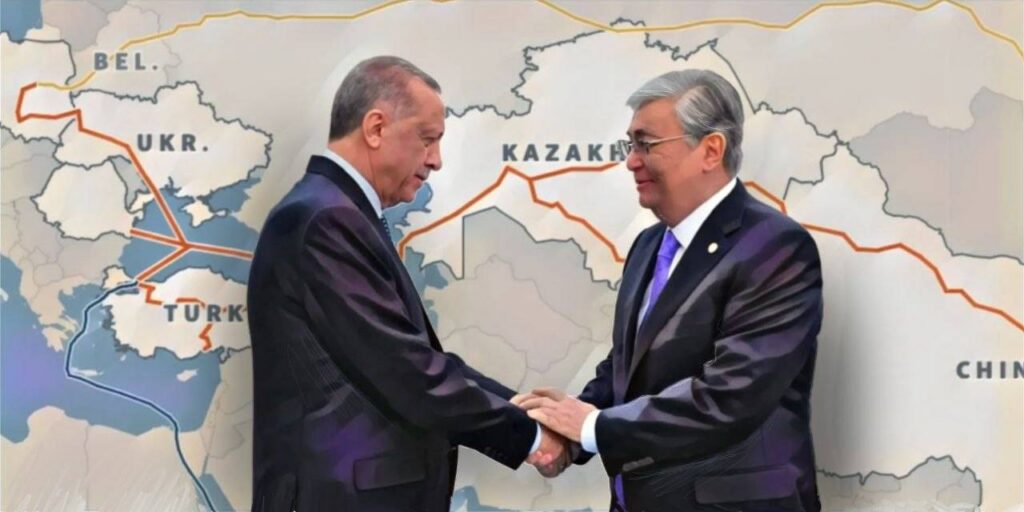
On October 28 in Ankara, Kazakhstani President Kassym-Jomart Tokayev and Turkish President Recep Tayyip Erdoğan held talks in a narrow format and then with their delegations. They met less than six months after chairing the sixth bilateral High-Level Strategic Cooperation Council in Astana on May 14, suggesting a more intensive phase of presidential engagement. The agenda covered transport and logistics, energy, agriculture and investment. Erdoğan reaffirmed the ambition to raise bilateral trade to $15 billion. The Middle Corridor remains central to bilateral cooperation, alongside trade, energy production and corporate investment linking both countries. Complementary Commercial Roles The partnership supports cargo flows both westward to Europe and eastward from Türkiye. In May, KTZ Express and Pasifik Eurasia organized a train carrying 50 forty-foot containers of refrigerators from Izmir toward Chengxiang in China via Aktau and Altynkol. KTZ Express reported an 83-hour transit on the Aktau–Altynkol leg within Kazakhstan. The companies are developing eastbound backhaul, coordinating schedules and transit arrangements to balance cargo flows. Turkish exporters gain a route through Kazakhstan toward Chinese customers, while the operators seek cargo to sustain services in both directions. Kazakhstan’s inland rail network and Türkiye’s connections to European markets give the two countries complementary roles along the corridor. After crossing the Caspian, the Middle Corridor offers shippers an overland continuation through Türkiye alongside maritime routes through Georgian Black Sea ports. KTZ Express also cooperates with Maersk on Black Sea logistics. Azerbaijan and Georgia connect the Kazakhstani and Turkish sections of this route. Ankara and Astana share an interest in attracting cargo through Türkiye within this network of alternative routes. Kazakhstan’s inland rail investment supports the route toward Türkiye. According to the Asian Infrastructure Investment Bank’s 2026 project appraisal, the second track on the Dostyk–Mointy line has been completed. A further project would construct a new Mointy–Kyzylzhar section, bypassing congestion in central Kazakhstan to improve corridor alignment and capacity. Farther west, rail services reach Kazakhstan’s Caspian ports, where cargo transfers to maritime transport. Added rail capacity benefits bilateral services insofar as ports and vessels can accommodate the resulting flows. Connecting the Route Azerbaijan’s ports and railways connect Kazakhstan’s Caspian services with routes through Georgia to Türkiye. Crossing between rail networks separated by sea requires coordination of trains, vessels, and port handling. Kazakhstan’s container traffic uses Aktau, while Kuryk handles rail and road-vehicle ferries serving Alat in Azerbaijan. Kazakhstan and Türkiye therefore need cooperation with Azerbaijan and the operators responsible for transferring cargo between rail and sea. Work on the Georgian section of the Baku–Tbilisi–Kars railway was completed in 2026. In June, Türkiye’s Transport Ministry described the completion as a new operational stage for the line, which opened in 2017. The railway carries cargo arriving through Azerbaijan across Georgia into Türkiye. At the June ceremony, Transport Minister Abdulkadir Uraloğlu emphasized regular cargo flows, operational coordination, and reliable service. Türkiye’s rail improvements toward the Bulgarian border strengthen its European connection and extend the corridor’s commercial reach. The Çerkezköy–Kapıkule section opened in October as part of the wider Halkalı–Kapıkule project;...