• KZT/USD = 0.00222
  • TJS/USD = 0.10820
  • UZS/USD = 0.00009
  • TMT/USD = 0.29760
  • KZT/USD = 0.00222
  • TJS/USD = 0.10820
  • UZS/USD = 0.00009
  • TMT/USD = 0.29760
  • KZT/USD = 0.00222
  • TJS/USD = 0.10820
  • UZS/USD = 0.00009
  • TMT/USD = 0.29760
  • KZT/USD = 0.00222
  • TJS/USD = 0.10820
  • UZS/USD = 0.00009
  • TMT/USD = 0.29760
  • KZT/USD = 0.00222
  • TJS/USD = 0.10820
  • UZS/USD = 0.00009
  • TMT/USD = 0.29760
  • KZT/USD = 0.00222
  • TJS/USD = 0.10820
  • UZS/USD = 0.00009
  • TMT/USD = 0.29760
  • KZT/USD = 0.00222
  • TJS/USD = 0.10820
  • UZS/USD = 0.00009
  • TMT/USD = 0.29760
  • KZT/USD = 0.00222
  • TJS/USD = 0.10820
  • UZS/USD = 0.00009
  • TMT/USD = 0.29760
13 September 2026

Viewing results 1 - 6 of 4

Almaty and Astana Set to Retain Central Asia’s Economic Lead

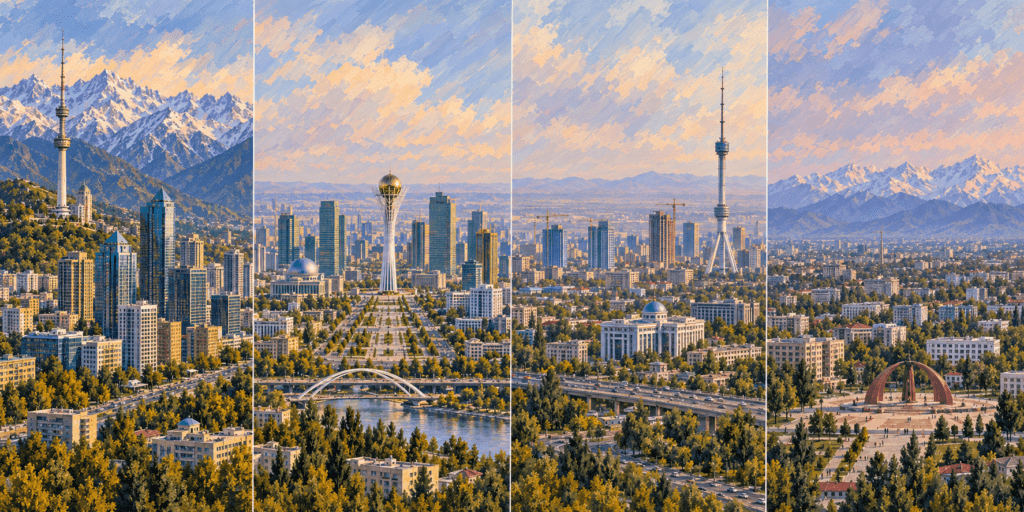
Almaty long combined Kazakhstan’s political and commercial functions and established itself as Central Asia’s leading business center. After Astana became Kazakhstan’s capital, the two cities developed increasingly complementary roles, with Almaty remaining the region’s largest business and financial hub while Astana accumulated political, institutional and corporate weight. Kazakhstan’s updated figures put Astana’s growth at about 10% and Almaty’s at about 5%. Together, the two cities generated roughly $107 billion in 2025. Together, they have become a two-city engine anchoring much of Central Asia’s commerce. Almaty and Astana benefit from an economic scale unmatched elsewhere in Central Asia. Kazakhstan alone accounts for more than half of the region’s GDP and roughly two-thirds of its inward FDI stock, according to TCA’s Central Asia Balance Sheet. That scale helps generate the fiscal resources needed to build and maintain the municipal infrastructure that supports business activity. Kazakhstan also has Central Asia’s most developed capital markets. The combination of the Kazakhstan Stock Exchange (KASE) in Almaty and the Astana International Financial Centre (AIFC) and Astana International Exchange (AIX) in Astana gives companies access to equity, debt, institutional investors and financial infrastructure at a scale no other market in the region currently matches. Kazakhstan is also the only Central Asian country with an investment-grade sovereign rating, lowering the country-risk premium and helping reduce financing costs for companies and projects relative to lower-rated regional markets. These advantages have been reinforced over decades. Almaty and Astana have long served as regional bases for major global companies, creating an established ecosystem of corporate management, finance, professional services and skilled labor. That track record, in turn, strengthens their ability to attract further investment and regional headquarters. Tashkent and Bishkek are also growing rapidly Then there is Tashkent. Uzbekistan’s political and commercial capital had an economy of about $29 billion in 2025, about 40% the size of Almaty’s and three-quarters that of Astana. Tashkent has also experienced rapid growth, with its economy growing by 11.3% in real terms in 2025, according to preliminary national figures. Tashkent benefits from Uzbekistan’s demographic scale. The country’s population is almost twice Kazakhstan’s, giving its capital access to a much larger domestic market and labor pool. But that scale also raises the need for sustained job creation and continued investment in housing and infrastructure. If productivity and investment fail to keep pace with population growth, the demographic advantage could increasingly act as a constraint rather than help Tashkent close the gap with Almaty and Astana. Almaty and Astana, meanwhile, generate substantially more economic output per resident. In 2025, Gross Regional Product (GRP) per capita was approximately $29,900 in Almaty and $23,700 in Astana, compared with about $9,300 in Tashkent, using reporting-year average exchange rates. These figures measure output per resident, not labor productivity, household income or living standards. Like Tashkent, Bishkek combines the roles of political capital and principal economic center. On the reporting years used here, however, its economy is only about 30% as large. Its economy grew by 15.8% in 2024, according to Kyrgyzstan’s...

A Little Bit of America at the World Nomad Games

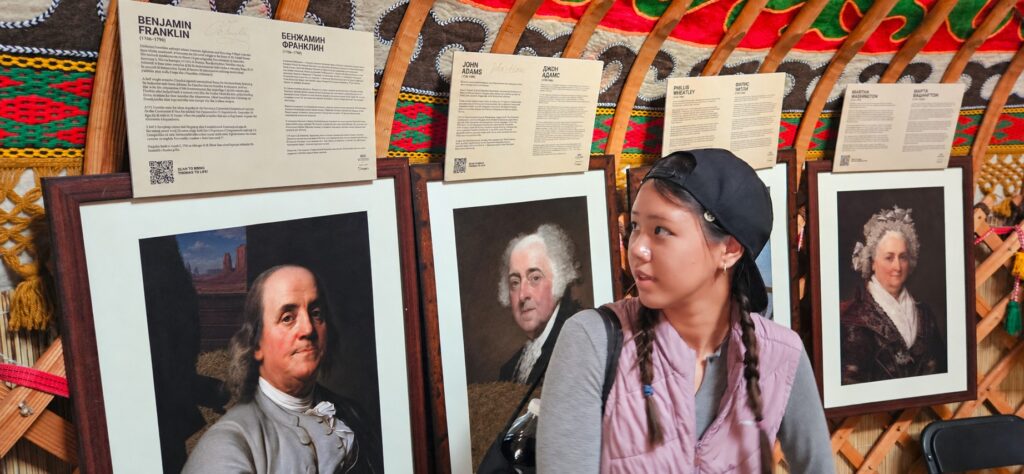
The “Universe of Nomads” ethno-town at the 6th World Nomad Games contains roughly 500 yurts spread across the mountain pasture at Kyrchyn, beneath the forested slopes of the Kungey Ala-Too Mountains. Among them, visitors may be surprised to come across the Stars and Stripes flying beside the Kyrgyz flag at the entrance to one particular yurt. Nearby, a cardboard cowboy with a hole where the face should be invites them to poke their heads through for a photograph. Inside, a Kyrgyz host in a cowboy hat welcomes visitors and introduces them to the Founding Fathers and, indeed, Mothers of the United States before inviting them to pose on a bale of hay beside a cutout of George Washington and a covered-wagon backdrop. The U.S., it turns out, is represented by two adjacent yurts, and Katarina Lage Ramos, a diplomat and spokesperson for the U.S. Embassy in Bishkek, is on hand to explain their purpose. The historical display marks 250 years since U.S. independence. Ramos is attending the World Nomad Games for the first time, although she said the embassy has taken part in previous editions held in the country. She explained that a Blackfeet drum in the yurt had been donated by the Montana National Guard and would later be presented to Kyrgyz military representatives following a joint disaster-preparedness exercise. The Montana National Guard and Kyrgyzstan have worked together since 1996 through the State Partnership Program, with joint training in disaster relief and border security. Next door, another yurt houses a small makerspace with a 3D printer brought from the American Center in Bishkek. Ramos said such spaces give young people practical experience with programming and digital design. Based at the Bayalinov Republican Youth and Children’s Library, the center “started out as a little corner,” Ramos said, and has since expanded onto the second floor. Its 160-square-meter Maker Space was upgraded in 2019 and offers free, hands-on technology programs. Alumni and exchange participants can also organize events there without charge. A U.S. State Department grant funded an elevator at the library in 2024, allowing people with disabilities to access the American Center and its programs independently. Outside the two yurts, Kyrgyz visitors, young and old, eagerly try cornhole and a mini, kid-sized lacrosse game. Cornhole is a simple DIY game in which players throw beanbags toward a hole cut into a wooden board. With roots in games played by Indigenous peoples of North America centuries before European contact, lacrosse is a convenient tie-in with the World Nomad Games. While interest in the Games grows among Western tourists, including those from the U.S., the embassy brings to Kyrchyn what Ramos called “a little bit of America.” For more from our World Nomad Games 2026 special coverage, click here.

Kyrgyzstan Expands Security Cooperation with the U.S.

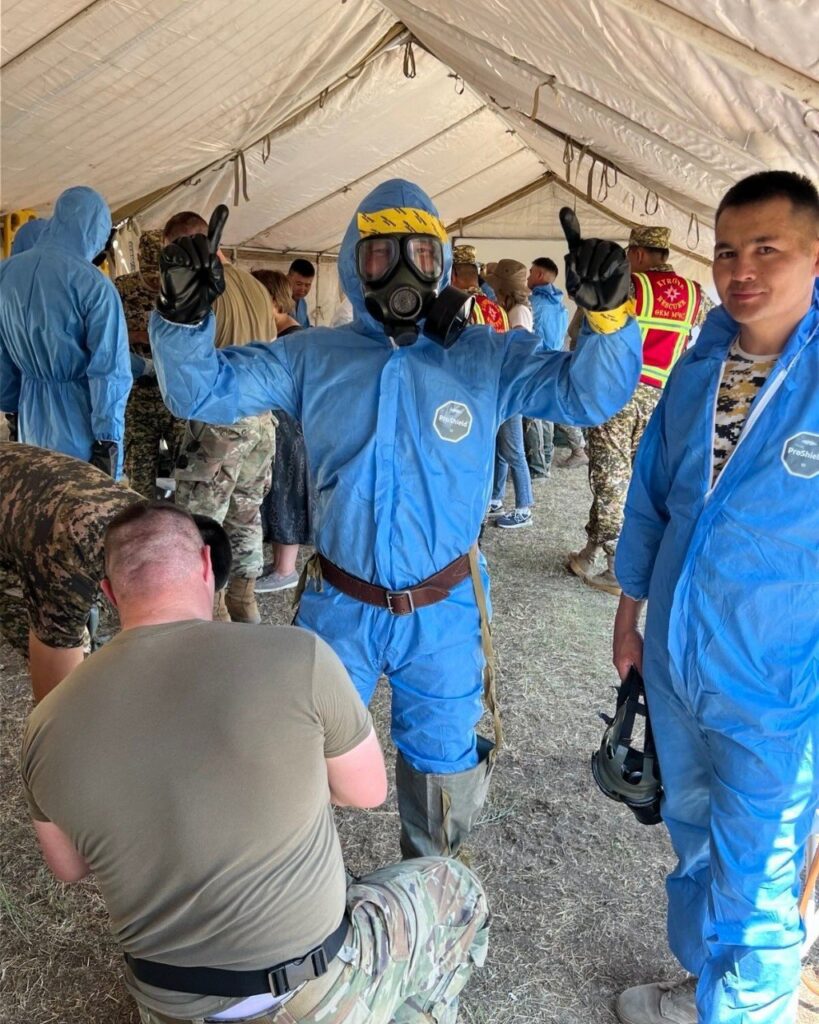
Alongside U.S. business leaders and government officials who arrived in Bishkek for the B5+1 business forum, security representatives from U.S. Central Command, the U.S. Air Force, and the Montana National Guard also visited the Kyrgyz capital, according to the U.S. Embassy in Bishkek. At a meeting held at the Kyrgyz Ministry of Defense in the village of Koy-Tash, both sides discussed military cooperation plans for the 2027 fiscal year. Participants carried out detailed planning of joint activities, focusing on experience-sharing and establishing common objectives for the near future. “We thank the Ministry of Defense of the Kyrgyz Republic for organizing this event. The participants joined forces to promote our regional goals aimed at enhancing security and stability,” the U.S. Embassy stated. U.S. Chargé d'Affaires Les Zentos emphasized that over the past 30 years of Kyrgyzstan's independence, a strong partnership has developed between the Montana National Guard and the Kyrgyz Ministry of Defense, as well as with the Ministry of Emergency Situations and the Border Service. This relationship, he noted, is based on trust and a commitment to shared goals. [caption id="attachment_43371" align="aligncenter" width="960"] Image: kg.usembassy.gov[/caption] “We hope to improve and optimize plans for military contacts in 2026 and 2027. Today's meeting is important for strengthening mutual understanding and finding common ground,” Zentos said. This is not the first visit by representatives of the Montana National Guard and the U.S. Air Force to Kyrgyzstan. Approximately six months ago, the two sides held joint military exercises under the name “Ak-Shumkar-2025.” According to U.S. officials, the drills facilitated exchanges of expertise in humanitarian operations, disaster relief, air medical evacuation, search and rescue, and border security. The Montana National Guard has maintained a long-standing relationship with Kyrgyzstan since 1996, under the U.S. National Guard Bureau’s State Partnership Program. The U.S. Embassy also noted that bilateral military cooperation extends beyond this program. It includes participation in regional exercises organized by U.S. Central Command, which bring together countries from Central and South Asia to pursue shared security objectives.

U.S. Senate Confirms Julie Stufft as Ambassador to Kazakhstan

On October 7, the United States Senate confirmed Julie Stufft as the new U.S. Ambassador to Kazakhstan, approving her nomination by a vote of 51 to 47, and marking the first new U.S. envoy to Astana under President Donald Trump. A career diplomat and Senior Foreign Service Minister-Counselor, Stufft previously served as Deputy Assistant Secretary for Visa Services. During her July 2025 confirmation hearing, Stufft outlined her priorities, citing the security of U.S. citizens, energy cooperation, and critical minerals partnerships as top priorities. “If confirmed, my primary task will be to ensure the safety of all Americans in Kazakhstan, including my embassy and consulate staff,” she said. Stufft emphasized Kazakhstan’s strategic importance as a key U.S. partner in Central Asia, highlighting opportunities for expanded economic cooperation, particularly in energy and critical minerals. “Today, we stand on the threshold of a new era of trade and energy cooperation with Kazakhstan, a world leader in uranium production, a major oil exporter, and a holder of vast reserves of critical minerals,” she said. Stufft added that she intends to collaborate with the Bureau of Economic, Energy, and Business Affairs, the U.S. International Development Finance Corporation, the Export-Import Bank, and the private sector to deepen bilateral economic ties and promote U.S. prosperity. Stufft’s confirmation received some bipartisan support, with Senators Jeanne Shaheen (D-NH) and Steve Daines (R-MT) praising her professional experience and diplomatic capabilities. She succeeds Daniel Rosenblum, who retired in December 2024 after 28 years of service in the State Department. Her nomination was formally submitted by the White House and approved by President Donald Trump in the summer of 2025. Stufft is a career diplomat and a member of the Senior Foreign Service. Before her appointment, she served at the Bureau of Consular Affairs. Her previous overseas postings include assignments in Russia, Poland, Ethiopia, Moldova, and Djibouti. She also served on the National Security Council, coordinating efforts to protect Americans during the COVID-19 pandemic. Stufft holds degrees from Case Western Reserve University and Duke University. She speaks Russian, Romanian, French, and Polish. In 2023, she received the Presidential Award for Distinguished Service and has earned seven State Department awards over her career. “We must actively oppose violence against women and girls,” she said, underscoring her commitment to gender equality as part of U.S. foreign policy. Stufft is a fellow of the International Women's Forum (2021-2022) and participated in the MIT Center for International Studies’ Seminar XXI program (2014-2015).