Every region has cities that pull people and money toward them. New York, London, Dubai, and Singapore became places where ambitious people went to make careers, companies went to find talent, and investors went to put money to work. Once that concentration takes hold, it feeds on itself. More companies create more jobs, more talent attracts more companies, and banks, lawyers, consultants, airlines, schools and restaurants grow around them.
Central Asia has developed its own version of that gravitational pull. Almaty has long been the region’s main commercial center and was Kazakhstan’s capital until 1997. It remains effectively tethered to Astana by intense passenger traffic and the constant movement of businesspeople, officials and professionals between the two cities. Astana has grown around government, international finance, technology and diplomacy. Together, they function as a two-city economic and political engine.
The numbers explain much of this. The Times of Central Asia’s Central Asia Balance Sheet puts Kazakhstan at $306.2 billion of the five Central Asian economies combined $543.4 billion in GDP, or 56.4%. Its share of accumulated foreign investment is even larger. The Balance Sheet puts Central Asia’s inward foreign direct investment (FDI) stock at $235.6 billion at the end of 2025, of which Kazakhstan held $156.4 billion, or 66.4%. FDI stock represents capital accumulated over years rather than announced agreements or one unusually strong year of inflows.
Almaty and Astana Play Different Roles
Almaty accounted for 22.7% of Kazakhstan’s GDP in 2025 and Astana another 12.3%, putting their economies at roughly $69 billion and $38 billion respectively. Together they produced around $107 billion.
Almaty is Kazakhstan’s main business and financial center. Kazakhstan’s largest banks, investment firms, multinational offices, lawyers, accountants and consultants are concentrated there. The Globalization and World Cities research network (GaWC) placed Almaty in its Gamma+ group in 2024, alongside Austin, Antwerp, and Kuwait City. GaWC bases the classification on the networks of major international business-service firms, offering a measure of how closely a city is connected to the global corporate economy.
Consistent with that ranking, multinational companies have also chosen Almaty as a base for regional operations. Mars runs its eleven-country regional headquarters from Almaty, covering all five Central Asian states, the South Caucasus, Belarus, Mongolia, and Turkey. Mastercard describes Almaty as a regional hub and the heart of its consulting operations for the CIS, Central and Eastern Europe.
Kazakhstan is unusual in Central Asia in having two major hubs. In functional terms, Astana complements Almaty much as Washington D.C. complements New York: Almaty is the deeper commercial center, while Astana concentrates government, sovereign institutions, diplomacy, and national policy.
Astana has also developed regional corporate operations of its own. Alstom runs its Western and Central Asia cluster from the capital, and Mercuria opened a regional office there in 2026 headed by its CEO for Central Asia and the Caspian region. U.S. rail company Wabtec has made Astana a regional locomotive production and engineering base, reinforced by its $4.2 billion agreement as Kazakhstan expands its Middle Corridor links to Europe.
Astana also hosts prominent political and business gatherings. The Astana International Forum draws heads of state and senior international officials, while Astana Finance Days brought more than 5,500 participants from 82 countries in 2025. Together, they have made Astana a regular venue for high-level political and business engagement.
That international reach is reinforced by aviation. Almaty and Astana airports handled 11.93 million and 9.2 million passengers respectively in 2025, while OAG data put Kazakhstan at more than half of Central Asia’s scheduled airline capacity.
Astana Hub now has more than 2,200 registered companies with an ecosystem including Higgsfield AI, the Kazakhstan-linked generative-video company valued at $5.4 billion in August 2026. Its Silkway Accelerator with Google for Startups has helped 73 companies raise more than $48 million. The Alem.ai International Artificial Intelligence Center provides a base for education, research, startups, and government applications, with Telegram and Presight among the international companies operating AI laboratories there.
Three Decades of Foreign Investment
Much of Kazakhstan’s early foreign investment was concentrated in oil, gas, and mining, helping build a professional-services base in Almaty. PwC arrived in 1993, Dentons’ predecessor Salans in 1994, and KPMG in 1996, when it opened its first Central Asian office. Over time, they helped develop local legal, accounting and advisory expertise. When Astana became the capital, parts of that ecosystem followed, leaving major international firms with a presence in both cities.
Kazakhstan also invested heavily in technical skills. Vocational programs were aligned with industry needs, while the Bolashak scholarship trained more than 12,500 specialists abroad. According to Atameken chairman Kanat Sharlapaev, Kazakhstan produces about 3,000 geologists a year, and S&P Global’s Wesley Monteiro says foreign companies often fill technical and managerial roles locally instead of relying primarily on expatriates.
The same process spread beyond oil and gas. Mining expanded, followed by new investment in manufacturing, consumer goods, and technology. Each industry created demand for more suppliers, engineers, managers, logistics and finance, broadening the labor market and deepening the business ecosystem. Concurrently, the government expanded road and rail infrastructure and developed the regulatory institutions needed to support a more complex economy.
Establishing that ecosystem lowered the cost of entry for later investors. In Almaty and Astana, companies can find professionals accustomed to international compliance requirements with the technical skills to support large enterprises. That level of capacity helps explain why businesses have chosen Kazakhstan for their regional headquarters and management functions.
Kazakhstan has also repeatedly changed its laws and institutions to attract investment. The Astana International Financial Centre, with its English-common-law-based framework, independent court, arbitration center, regulator and exchange, is one example.
By mid-2026, the AIFC had 6,014 registered companies, 45% with foreign participation. Almaty-based Kazakhstan Stock Exchange (KASE) ended 2025 with equity market capitalization of about $77.6 billion, more than three times the reported level of the Tashkent exchange, the second largest exchange in the region.
Three decades of multinational presence have also given investors a record of how contracts are enforced, regulators behave, disputes are handled and foreign companies are treated in practice. A long-term presence and reinvestment are key indicators, because investors judge the rule of law through experience as well as legislation.
Tashkent and Bishkek Expand Their Regional Roles
Tashkent’s regional-headquarters ecosystem is newer than Almaty’s, although it is beginning to attract companies with wider regional mandates. Huawei chose Uzbekistan in 2026 as the base for its Central Asian office, managing operations across nine countries in Central Asia and the Caucasus, while iFLYTEK expanded into Tashkent the same year. The China-Kyrgyzstan-Uzbekistan railway is intended to strengthen both Uzbekistan’s and Kyrgyzstan’s roles as China-facing logistics hubs, with Bishkek hosting the joint company developing the Kyrgyz section.
Uzbekistan is also developing its own financial-center model and has studied Kazakhstan’s experience. Delegations from its Presidential Administration visited the AIFC twice in 2026 while developing the Tashkent International Financial Centre, examining its institutional architecture, legal framework and regulatory model. The AIFC Green Finance Centre has also expanded into Bishkek. GFC Bishkek, established jointly with Kyrgyz financial institutions, was its first foreign subsidiary.
Tashkent and Bishkek have both recently posted high growth rates, with Tashkent’s economy expanding by 11.3% in 2025 and Bishkek’s by 15.8% in 2024. As TCA noted in a recent study, Tashkent would need sustained faster growth to close the economic-size gap with Almaty and Astana.
The chart below compares the gross regional product (GRP) of the four cities, showing both total economic output and output per resident.
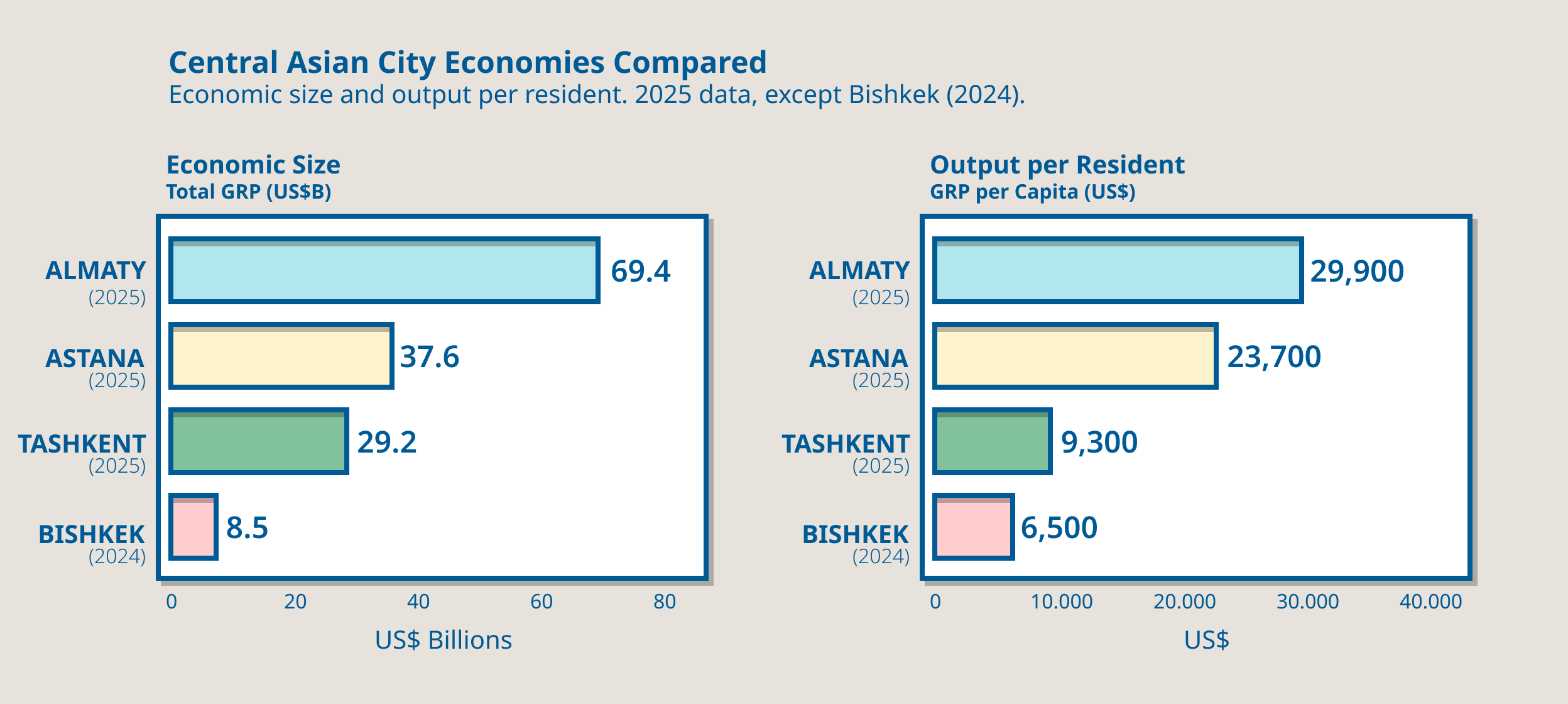
Note: Current-price figures are converted to U.S. dollars at annual-average exchange rates and rounded, without adjustment for purchasing power. GRP per capita measures output per resident, not household income or labor productivity. Tashkent figures are preliminary.
Sources: Kazakhstan statistics, Uzbekistan statistics, Kyrgyzstan statistics.
Exchange rates: NBK via KTZ, Central Bank of Uzbekistan, IMF.
An Advantage Built Over Time
Almaty and Astana’s lead rests on business ecosystems built over decades. Investment, infrastructure development, education, and institutional reform helped create the companies, talent, and professional networks that newer regional centers are still developing.
For companies choosing a Central Asian or broader regional headquarters, Almaty and Astana remain the region’s two most established business centers. Each functions as a regional hub in its own right, while their different strengths reinforce Kazakhstan’s broader position.