
• KGS/USD = 0.01144 0%
  • KZT/USD = 0.00212 0%
  • TJS/USD = 0.10894 0%
  • UZS/USD = 0.00008 0%
  • TMT/USD = 0.28490 0%
  • KGS/USD = 0.01144 0%
  • KZT/USD = 0.00212 0%
  • TJS/USD = 0.10894 0%
  • UZS/USD = 0.00008 0%
  • TMT/USD = 0.28490 0%
  • KGS/USD = 0.01144 0%
  • KZT/USD = 0.00212 0%
  • TJS/USD = 0.10894 0%
  • UZS/USD = 0.00008 0%
  • TMT/USD = 0.28490 0%
  • KGS/USD = 0.01144 0%
  • KZT/USD = 0.00212 0%
  • TJS/USD = 0.10894 0%
  • UZS/USD = 0.00008 0%
  • TMT/USD = 0.28490 0%
  • KGS/USD = 0.01144 0%
  • KZT/USD = 0.00212 0%
  • TJS/USD = 0.10894 0%
  • UZS/USD = 0.00008 0%
  • TMT/USD = 0.28490 0%
  • KGS/USD = 0.01144 0%
  • KZT/USD = 0.00212 0%
  • TJS/USD = 0.10894 0%
  • UZS/USD = 0.00008 0%
  • TMT/USD = 0.28490 0%
  • KGS/USD = 0.01144 0%
  • KZT/USD = 0.00212 0%
  • TJS/USD = 0.10894 0%
  • UZS/USD = 0.00008 0%
  • TMT/USD = 0.28490 0%
  • KGS/USD = 0.01144 0%
  • KZT/USD = 0.00212 0%
  • TJS/USD = 0.10894 0%
  • UZS/USD = 0.00008 0%
  • TMT/USD = 0.28490 0%

Viewing results 1 - 6 of 160

Kazakhstan to Receive 3.7 Billion Cubic Meters of Syr Darya Water in 2025

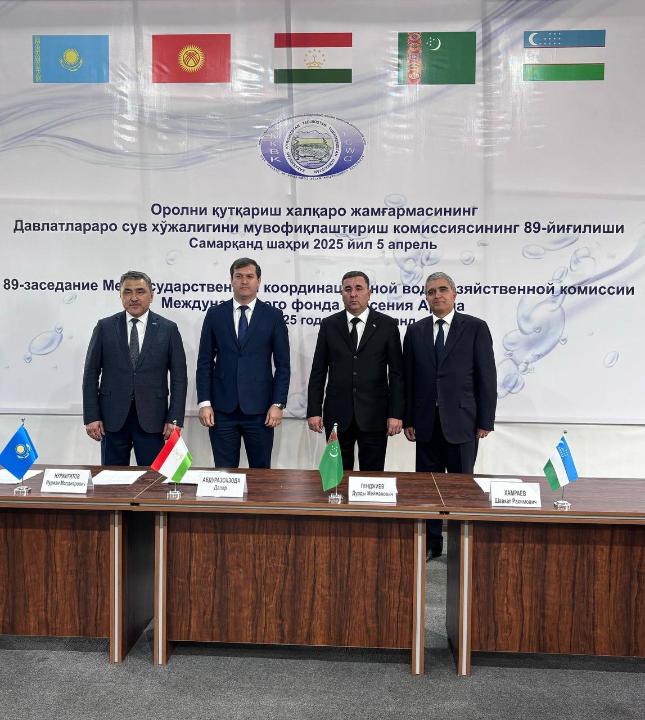
In the 2025 irrigation season, Kazakhstan is set to receive approximately 3.7 billion cubic meters of water via the Syr Darya River. The agreement was finalized during negotiations involving officials from Tajikistan, Turkmenistan, and Uzbekistan. The deal was reached at the 89th meeting of the Interstate Water Commission of Central Asia, held in Samarkand, Uzbekistan. As part of the agreement, Kazakhstan will receive 909 million cubic meters of water through the interstate Dostyk Canal during the irrigation period. Additionally, 975 million cubic meters are slated for transfer to the Northern Aral Sea. “We began negotiations last year, we must prepare for the water season in advance, particularly in the southern regions where every drop counts. All water from the Syr Darya will be collected in the Shardara Reservoir and directed toward agricultural needs. At present, we are channeling floodwaters into lakes and rivers and storing them in reservoirs,” said Kazakhstan’s Minister of Water Resources and Irrigation, Nurzhan Nurzhigitov. A day earlier, Nurzhigitov also addressed a climate forum in Samarkand. He noted that Uzbekistan had supplied 12.6 billion cubic meters of water to Kazakhstan from October of last year through April 1, exceeding the planned amount by 1.7 billion cubic meters. Earlier reporting by The Times of Central Asia highlighted that eight regions in Kazakhstan face a heightened risk of spring flooding.

New Report Urges Local Irrigation Equipment Production to Tackle Water Scarcity in Central Asia

The Eurasian Development Bank (EDB) and the United Nations Industrial Development Organization (UNIDO) have jointly released a report titled Irrigation Equipment Production in Central Asia: Industrialising the Water Sector, highlighting the urgent need to localize irrigation equipment manufacturing in the region. The publication argues that establishing a domestic irrigation equipment manufacturing sector could serve as a strategic response to mounting water challenges in Central Asia. It calls for coordinated action by regional governments, international organizations, and private sector actors to implement investment and policy frameworks aimed at reducing reliance on imports and fostering a self-sufficient production ecosystem. Heavy Dependence on Imports The report identifies irrigation equipment as a key strategic area for bolstering food security and managing water resources more efficiently. Currently, the regional market for such equipment is valued between $130 million and $200 million, with over 90% of this demand met through imports. Despite this dependency, governments across Central Asia are taking proactive steps to modernize agriculture. Substantial financial and non-financial support is being extended to farmers, and plans are underway to expand irrigated farmland and adopt advanced irrigation technologies. According to the study, the irrigated area in Central Asia is projected to grow to 10.6 million hectares by 2040. This expansion is expected to drive demand for up to two million units of irrigation equipment, with the potential to generate $426 million annually in local production. The report further estimates the annual market for new sprinklers at $114 million and for drip irrigation systems at $220 million. Cluster-Based Development To address these needs, the publication proposes a cluster-based approach to developing local irrigation equipment production hubs. Nikolai Podguzov, Chairman of the EDB Management Board, emphasized the economic potential of localization: “The region’s demand for irrigation equipment could more than double by 2030. Localizing production will not only help retain investments within the local economy but also stimulate the development of precision irrigation technologies, digital water management tools, engineering labs, and knowledge-sharing centers focused on best practices in irrigation and water use.”

Uzbekistan and Turkmenistan Reach Agreement on Amu Darya Water Usage

A delegation from Uzbekistan’s Ministry of Water Resources visited Turkmenistan on March 13-14 to discuss bilateral cooperation on water management, Dunyo reports. Officials from both countries met in Turkmenabat to address key issues, including the maintenance and modernization of water infrastructure, flood prevention, riverbank reinforcement, and efficient water use. As part of the discussions, the sides reaffirmed their commitment to implementing agreements reached during the fourth Uzbek-Turkmen intergovernmental meeting on water management. They agreed to collaborate on hydrotechnical projects aimed at minimizing water losses in the Amu Darya River and optimizing resource use. The two countries also plan to conduct joint research on shared water bodies, exchange expertise on water-saving technologies and digital management systems, and enhance training programs for water management specialists. During the visit, the Uzbek delegation toured the Tuyamoyin hydroelectric complex, where representatives discussed potential improvements to its operations. Previously, The Times of Central Asia reported that Kazakhstan is set to receive 11 billion cubic meters of irrigation water by April 2025 under an agreement signed in Dushanbe. Meanwhile, on World Rivers Day of Action, environmental groups raised concerns about growing threats to Central Asia’s rivers and lakes. Organizations such as Rivers Without Boundaries and Friends of the Earth US have called on international financial institutions to reconsider funding for hydropower projects in the region.

Four New Reservoirs to Be Built in Kazakhstan

Kazakhstan’s Ministry of Water Resources and Irrigation plans to begin construction of four new reservoirs in the west and south of the country this year, Minister Nurzhan Nurzhigitov announced at a government meeting. Kazakhstan regularly faces two conflicting water-related challenges: the risk of spring floods inundating settlements and a summer water shortage for agricultural irrigation. To address both issues, construction of the new reservoirs will begin in 2025. The Akmola and Kalguty reservoirs will be built in the Zhambyl region in southern Kazakhstan, while the Karaozek reservoir will be located in the Kyzylorda region in the southeast. The Bolshoi Uzen reservoir will be built in the West Kazakhstan region. "The Akmola, Kalguty, and Karaozek reservoirs will ensure water supply for 22,500 hectares of irrigated crops during the growing season, while the Bolshoi Uzen reservoir will help retain flood and meltwater, preventing flooding in two settlements with a combined population of 5,000," Nurzhigitov said. In addition to the new reservoirs, the government plans to reconstruct the Ters-Ashchybulak and Karakonyz reservoirs in the Zhambyl region, as well as the Koskorgan reservoir and the Koksarai counter-regulator in the Turkestan region in 2025. As part of an irrigation infrastructure modernization program, 115 canals covering a total of 3,452 kilometers will be upgraded across six regions: Almaty, Zhambyl, Zhetysu, West Kazakhstan, Kyzylorda, and Turkestan. Additionally, new structures will be built to replenish the Astana reservoir. "By the end of the year, 12 projects for the construction and reconstruction of group water pipelines will be completed, providing 153 villages, home to 423,000 people, with access to quality drinking water. At the same time, 52 settlements will be connected to a centralized water supply system," Nurzhigitov added. Flood Preparedness Concerns Meanwhile, Kazakhstan’s ruling AMANAT party held a meeting of its Party Control Committee, which sharply criticized the country’s flood preparedness. According to party officials, 1,223 settlements across Kazakhstan are currently at risk of flooding. The country has 1,395 hydraulic structures designed to control water flow, but 564 of them require repairs, including 20 that are in critical condition. In the event of their failure, 536 settlements, home to more than 1.3 million people, could be at risk of severe flooding. The party emphasized that public concerns over flood preparedness remain high, with approximately 100 complaints submitted this year regarding the condition of dams, drainage channels, and other protective infrastructure. As The Times of Central Asia previously reported, Kazakhstan began releasing water from reservoirs as early as January to maximize storage capacity ahead of the flood season. 

Kazakhstan to Launch Production of 1,000 Sprinkler Irrigation Machines Per Year

Kazakhstan has begun domestic production of sprinkler irrigation machines under the SU BEREKE brand, with the ADAM Group of Companies manufacturing 30 units in 2024, according to the Ministry of Agriculture. Sprinkler irrigation systems help distribute water evenly across fields, reducing consumption by 30% to 40%. This year, ADAM plans to scale up production. By April, the company will open a second plant in East Kazakhstan, increasing output to 1,000 sprinkler machines annually. The new facility is expected to reduce Kazakhstan’s dependence on imported equipment. Locally manufactured sprinklers will also be exported to neighboring Central Asian countries. President Kassym-Jomart Tokayev has previously criticized the slow adoption of water-saving practices in Kazakh agriculture, citing annual water losses of up to 40% in some regions. He has set a national target to introduce water-saving technologies on 150,000 hectares of land each year. To support this initiative, the Ministry of Water Resources and Irrigation and the Ministry of Agriculture raised subsidies for farmers investing in water-saving irrigation systems from 50% to 80% in 2023. Additionally, the government increased subsidies for farmers using such technologies, covering 85% of irrigation water costs. Kazakhstan’s agricultural land spans 23.3 million hectares, of which 1.9 million hectares are irrigated, primarily in the arid southern regions. However, the adoption of water-efficient technologies remains limited. In 2023, only 17% of irrigated land (312,000 hectares) used these systems, with drip irrigation covering just 84,000 hectares.

Kazakh and Kyrgyz Prime Ministers Discuss Trade, Transport, and Water Cooperation

On February 24, Kazakhstan’s Prime Minister Olzhas Bektenov held talks in Astana with Adylbek Kasymaliyev, Chairman of the Cabinet of Ministers of Kyrgyzstan. The visit marked Kasymaliyev’s first official foreign trip since his appointment as Kyrgyzstan’s prime minister in December last year. Expanding Trade and Economic Cooperation The discussions covered trade, transit, water and energy cooperation, investment, and cultural ties, according to the Kazakh government’s press service. Bektenov noted that bilateral trade reached $1.7 billion last year, underscoring Kazakhstan’s role as one of Kyrgyzstan’s key trading partners. Kasymaliyev reaffirmed both governments' commitment to raising trade volume to $3 billion by 2030, a goal set by the presidents of both countries. He also revealed that Kazakhstani companies invested nearly $49 million in Kyrgyzstan’s economy in the first nine months of 2024. New Industrial Trade and Logistics Complex Kasymaliyev emphasized the importance of the Industrial Trade and Logistics Complex at the Kyrgyz-Kazakh border, which aims to streamline cargo transportation and enhance trade efficiency. The complex, located near the Karasu and Ak-Tilek road checkpoints, will be one of the largest cargo hubs in Central Asia, facilitating consolidation, processing, and distribution of goods. Land plots have already been allocated, and the Alatau industrial zone has been established in Kazakhstan’s Zhambyl region to support the project. Energy Cooperation and Food Security Kasymaliyev highlighted the potential duty-free supply of Kazakh oil to Kyrgyzstan, which would bolster Kyrgyzstan’s energy security and lower fuel costs for consumers. Additionally, both sides discussed building a trade and logistics warehouse in Kazakhstan’s Almaty region to store and distribute fruits and vegetables, ensuring stable fresh produce supplies and improving food security. Kasymaliyev stressed that these initiatives would create jobs, attract investment, and strengthen economic cooperation. Improving Transport and Border Infrastructure In the transit and transport sector, both governments focused on modernizing automobile checkpoints to boost cargo capacity at the Kazakh-Kyrgyz border. Water Cooperation Water resource management was another key topic, particularly irrigation water supplies from Kyrgyzstan to Kazakhstan for the upcoming growing season. Discussions centered on the Shu (Chu) and Talas rivers, which are crucial for agriculture in both countries. Tourism and Education The talks also explored expanding cross-border tourism, including: Developing eco-routes Improving active tourism infrastructure Attracting investment in the hotel industry Additionally, the two leaders discussed preparations for opening branches of Kazakh universities in Kyrgyzstan to enhance educational cooperation. The meeting underscored Kazakhstan and Kyrgyzstan’s commitment to deepening economic, energy, and infrastructure ties, while also addressing key water and environmental concerns. The successful implementation of these initiatives will boost regional integration and economic growth for both nations.
