• KGS/USD = 0.01144 0%
  • KZT/USD = 0.00212 0%
  • TJS/USD = 0.10432 -0.29%
  • UZS/USD = 0.00008 0%
  • TMT/USD = 0.28571 0.28%
  • KGS/USD = 0.01144 0%
  • KZT/USD = 0.00212 0%
  • TJS/USD = 0.10432 -0.29%
  • UZS/USD = 0.00008 0%
  • TMT/USD = 0.28571 0.28%
  • KGS/USD = 0.01144 0%
  • KZT/USD = 0.00212 0%
  • TJS/USD = 0.10432 -0.29%
  • UZS/USD = 0.00008 0%
  • TMT/USD = 0.28571 0.28%
  • KGS/USD = 0.01144 0%
  • KZT/USD = 0.00212 0%
  • TJS/USD = 0.10432 -0.29%
  • UZS/USD = 0.00008 0%
  • TMT/USD = 0.28571 0.28%
  • KGS/USD = 0.01144 0%
  • KZT/USD = 0.00212 0%
  • TJS/USD = 0.10432 -0.29%
  • UZS/USD = 0.00008 0%
  • TMT/USD = 0.28571 0.28%
  • KGS/USD = 0.01144 0%
  • KZT/USD = 0.00212 0%
  • TJS/USD = 0.10432 -0.29%
  • UZS/USD = 0.00008 0%
  • TMT/USD = 0.28571 0.28%
  • KGS/USD = 0.01144 0%
  • KZT/USD = 0.00212 0%
  • TJS/USD = 0.10432 -0.29%
  • UZS/USD = 0.00008 0%
  • TMT/USD = 0.28571 0.28%
  • KGS/USD = 0.01144 0%
  • KZT/USD = 0.00212 0%
  • TJS/USD = 0.10432 -0.29%
  • UZS/USD = 0.00008 0%
  • TMT/USD = 0.28571 0.28%

Viewing results 1009 - 1014 of 3184

Iran’s Non-Oil Exports to Uzbekistan Rise by 18%

Iran’s non-oil exports to Uzbekistan increased by 18% in value and 14% in weight during the first nine months of the current Iranian year (March 20 - December 20, 2024), compared to the same period last year (March 21 - December 21, 2023), Trend reported, citing data from the Iranian Customs Administration. According to the report, Iran exported 414,000 tons of non-oil goods worth $292 million to Uzbekistan during this period. In the corresponding months of the previous Iranian year, exports totaled 364,000 tons, valued at approximately $248 million. Key Iranian Exports to Uzbekistan Iran’s main exports to Uzbekistan included: Milk and dairy products Petrochemicals Various types of pipes Glass containers Agricultural equipment Overall, Iran’s total trade turnover with Uzbekistan during the nine-month period reached 444,000 tons, valued at $358 million. Expanding Trade Ties with Kazakhstan In addition to strengthening economic relations with Uzbekistan, Iran is also deepening trade ties with Kazakhstan. As The Times of Central Asia reported, on January 30, Iranian Vice President Mohammad-Reza Aref met with Kazakh Prime Minister Olzhas Bektenov in Almaty to discuss trade and transport cooperation. Kazakhstan’s trade with Iran reached $296 million in 2024, an 8.1% increase from the previous year. Notably, Kazakhstan’s exports to Iran grew by 29.1%, reaching $100.6 million. Kazakhstan plans to expand exports of wheat and barley, while both sides discussed increasing cargo traffic and upgrading port terminals to facilitate trade.

Kyrgyzstan Builds National Center for Aquaculture and Fisheries Development

Construction of Kyrgyzstan’s National Center for the Development of Aquaculture and Fisheries is underway in the village of Bokonbaevo on the southern shore of Lake Issyk-Kul. The project is a joint initiative of the Kyrgyz Ministry of Water Resources, Agriculture, and Processing Industry and the Korea Maritime Institute. The center will provide training in fish farming technologies for farmers, students, and researchers. According to the ministry, a well has been drilled to a depth of 180 meters, and pumping equipment and water purification systems have been installed to supply water for the center’s incubation workshop. The facility is scheduled for completion by December 2026. It will include fish incubation workshops, laboratories, residential quarters, a canteen, and other necessary infrastructure. The center is designed to boost Kyrgyzstan’s fishing industry. Currently, the country produces about 30,000 tons of fish annually, of which only 5,000 tons are exported. However, experts estimate that Kyrgyzstan has the capacity to produce up to 105,000 tons and export 50,000 tons of fish. According to official statistics, in 2023, Kyrgyzstan produced 33,600 tons of fish and exported 5,556 tons of fish and fish products, mainly to Russia, Kazakhstan, Uzbekistan, and Lithuania. Fish farming in Kyrgyzstan, particularly trout production, is carried out in artificial ponds and fishery farms at lakes Issyk-Kul and Son-Kul.

China’s AgiBot to Produce Robots in Kazakhstan

Chinese robotics company AgiBot plans to establish a joint venture in Kazakhstan to manufacture and deploy robots at industrial facilities across the country. The company also aims to introduce artificial intelligence (AI) solutions as part of its expansion strategy. An agreement of intent was signed between AgiBot and Kazakhstan’s Ministry of Digital Development, Innovation, and Aerospace Industry during the Digital Almaty 2025 forum. Qazaqstan Investment Corporation JSC, a private equity fund founded in 2007 to support private equity and venture capital development, will also participate in the project. To implement the initiative, AgiBot has partnered with EWPartners, a private investment firm specializing in cross-border collaborations with leading Chinese industrial companies. AgiBot, founded in February 2023, focuses on the development and production of general-purpose humanoid robots for industrial and domestic use. Kazakhstan is the first country in the region where AgiBot plans to localize production and expand exports. As part of the partnership, the company is expected to launch a “data factory” for training robots and robotic systems. Qazaqstan Investment Corporation and EWPartners will contribute to financing this project. Additionally, a joint R&D center and an exhibition of AgiBot prototypes are set to be established at the Alem AI International Center for Artificial Intelligence. AgiBot also intends to collaborate with Kazakhstani universities to develop joint research projects and train students in robot assembly. “Partnership with an advanced company like AgiBot is an important milestone in the history of Kazakhstan’s robotics industry. I would especially like to highlight that this agreement includes the localization of robot production in Kazakhstan. This will not only help launch a facility in one of the most promising branches of mechanical engineering but also strengthen local expertise and create a domestic center of competence in robotics,” said Zhaslan Madiev, Kazakhstan’s Minister of Digital Development, Innovation, and Aerospace Industry. As previously reported by The Times of Central Asia, Kazakhstan exports IT products and services to 95 countries. With AgiBot’s involvement, the country may soon add robot exports to its growing digital economy.

Prospects for the Development of Kazakhstan’s Maritime Trade Gateways

A container hub will be built in the Aktau seaport. The maritime harbor is expected to become a center for cargo consolidation and distribution, facilitating Kazakhstan’s deeper integration into the global trade and transport system. How will this impact port operations, regional development, and the global supply chain through the Caspian Sea? The project in Aktau will primarily allow for the formation of a container park on its territory, serving Kazakhstan, Caspian region countries, and Central Asia. It will provide a full range of services, including container transshipment and warehousing. The hub’s construction marks a new phase in the port’s development, establishing it as a major logistical center. The hub can become not only a component of Kazakhstan’s transportation system, but a key link in the regional and global transport chain. For this project, investment has been secured from Lianyungang Port Group Co. Ltd., which operates one of China’s largest ports, with a corresponding agreement having been signed with the company. Growth Projections and Capacity Expansion According to many industry experts, Kazakhstan needs to actively develop container cargo transport. Currently, the country’s containerization level is quite low, standing at only about 7%. As Abay Turikpenbayev, Chairman of the Board of the Aktau International Sea Commercial Port public company, explained to TCA, oil and containers are ideal cargo for the harbor due to their swift transport, quick unloading, and rapid railcar turnaround. “It’s a different matter when bulk cargo arrives at the port. Bulk materials take longer to unload and congest the port infrastructure, preventing the acceptance and accumulation of a large number of railcars. The use of containers allows for an increased cargo flow,” Turikpenbayev stated. According to Turikpenbayev, unloading bulk cargo takes 2-3 days, and an additional 2-3 days is required for loading. In contrast, container unloading and processing take less than 24 hours. According to World Bank estimates, by 2030, cargo volumes transported via the Trans-Caspian International Transport Route through the Caspian Sea will reach 11 million tons. The new container hub is expected to help handle these volumes and attract additional cargo flows, increasing the port’s container transshipment capacity to 140,000 TEUs per year. Addressing the Caspian Sea Water Level Decline A critical issue that deserves attention is the declining water levels in the Caspian Sea. According to the Caspian Sea Hydrometeorological Research Department of RSE Kazhydromet, since 2006, the level of the Caspian Sea has dropped by approximately two meters. This decline has significantly affected navigation in the region. To address this, dredging work is planned in the Aktau port this year. Turikpenbayev stated that around 1.6 million cubic meters of heavy sediment will be removed from the harbor’s waters. “The dredged material will be used to create new territories and extend the port area southward. This will allow the port’s land area to expand from 60 to 100 hectares in the future,” Turikpenbayev explained. In addition to the construction of the container hub, further port expansion plans include building an additional berth for bulk cargo,...

Kazakhstan, Turkmenistan, Russia, and Iran to Boost Cargo Transport Along North-South Corridor

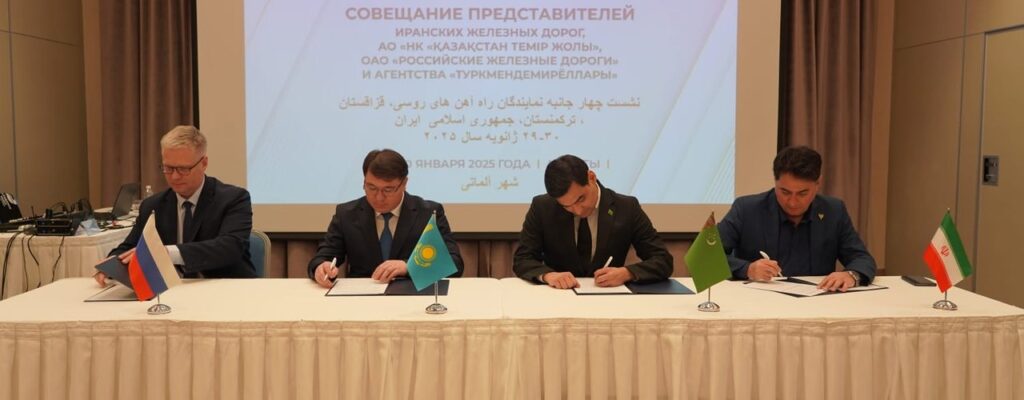
Kazakhstan, Turkmenistan, Russia, and Iran have reaffirmed their commitment to increasing cargo transportation along the North-South transport corridor. Representatives of national railway companies from the four countries met on January 30 in Almaty to discuss ways to enhance the corridor’s attractiveness and establish favorable end-to-end tariffs for shipments passing through Russia, Kazakhstan, and Turkmenistan to Iran’s Bandar Abbas port. According to Kazakhstan Temir Zholy (KTZ), the country’s national railway company, the meeting also addressed cargo transportation across Kazakhstan, particularly through the Bolashak rail station, located on the border between Kazakhstan and Turkmenistan. In 2024, 1.6 million tons of cargo was transported via this station. The North-South corridor, linking Russia, Kazakhstan, Turkmenistan, and Iran, has an annual capacity of 10 million tons of cargo. In July 2024, Kazakhstan hosted its first international meeting on the North-South transit and trade corridor, bringing together delegations from Azerbaijan, Armenia, Afghanistan, Kazakhstan, Russia, Belarus, Turkmenistan, the UAE, Iran, Iraq, Oman, and Uzbekistan. During that meeting, Kazakhstan, Iran, Turkmenistan, and Russia signed a roadmap for the eastern route of the corridor. The plan aims to expand the corridor’s capacity to 15 million tons annually by 2027 and 20 million tons by 2030. By connecting Russia and Belarus to Iran’s Persian Gulf ports, with further access to India, the North-South corridor is expected to enhance trade opportunities and further solidify Kazakhstan’s role as a key transit hub in the region.

Uzbekistan Aims for Self-Sufficiency in Potato Production by 2027

Uzbekistan plans to fully meet its domestic potato demand through local production by 2027. Although potatoes are among the most consumed food products in the country, a portion of the supply still comes from imports, despite being cultivated on 290,000 hectares of land. Government Initiative to Boost Production Current potato varieties and yields are falling short of expectations, prompting the government to take action. The Potato Research Institute has been tasked with developing high-yield varieties adapted to Uzbekistan’s climate. The institute will produce three million tubers annually using the in-vitro method, a technique where plant samples from the upper shoot are cultivated under artificial conditions in test tubes or glass containers. To support these efforts, the government will allocate 400 billion UZS (USD 30.85 million) from the Agricultural Fund this year for potato farming development. Additionally, imported seed potatoes will be exempt from customs duties for the next three years. Authorities have also been instructed to provide farmers with potato cultivation and processing equipment, offering affordable leasing options. Impact of Regional Potato Supply Disruptions The announcement comes amid rising potato prices in Central Asia. Recently, Kazakhstan suspended potato exports to non-EEU countries, including Uzbekistan, for six months due to increasing domestic prices. This restriction has already caused difficulties for Uzbek importers. Additionally, a shipment of 43 wagons of potatoes from Kazakhstan’s Pavlodar region was stopped at the Uzbek border a few days ago for a phytosanitary inspection. The delay left the potatoes in storage for over 10 days, causing them to freeze and spoil. “Look, it’s rotten. Water is leaking, everything is ruined. First, it froze, then it melted - now it’s useless. There were 68 tons in one wagon,” said businessman Azamat Serikbayev. The Kazakh entrepreneurs, who had sold the shipment before the export ban took effect, expressed frustration, arguing that all necessary documents had been issued in mid-January. They claim the cargo was unjustly delayed and is now unsuitable even for animal feed. Representatives of five affected companies say they intend to sue officials over their losses.