• KGS/USD = 0.01143 -0%
  • KZT/USD = 0.00192 -0%
  • TJS/USD = 0.10820 0.19%
  • UZS/USD = 0.00008 0%
  • TMT/USD = 0.28575 0%
  • KGS/USD = 0.01143 -0%
  • KZT/USD = 0.00192 -0%
  • TJS/USD = 0.10820 0.19%
  • UZS/USD = 0.00008 0%
  • TMT/USD = 0.28575 0%
  • KGS/USD = 0.01143 -0%
  • KZT/USD = 0.00192 -0%
  • TJS/USD = 0.10820 0.19%
  • UZS/USD = 0.00008 0%
  • TMT/USD = 0.28575 0%
  • KGS/USD = 0.01143 -0%
  • KZT/USD = 0.00192 -0%
  • TJS/USD = 0.10820 0.19%
  • UZS/USD = 0.00008 0%
  • TMT/USD = 0.28575 0%
  • KGS/USD = 0.01143 -0%
  • KZT/USD = 0.00192 -0%
  • TJS/USD = 0.10820 0.19%
  • UZS/USD = 0.00008 0%
  • TMT/USD = 0.28575 0%
  • KGS/USD = 0.01143 -0%
  • KZT/USD = 0.00192 -0%
  • TJS/USD = 0.10820 0.19%
  • UZS/USD = 0.00008 0%
  • TMT/USD = 0.28575 0%
  • KGS/USD = 0.01143 -0%
  • KZT/USD = 0.00192 -0%
  • TJS/USD = 0.10820 0.19%
  • UZS/USD = 0.00008 0%
  • TMT/USD = 0.28575 0%
  • KGS/USD = 0.01143 -0%
  • KZT/USD = 0.00192 -0%
  • TJS/USD = 0.10820 0.19%
  • UZS/USD = 0.00008 0%
  • TMT/USD = 0.28575 0%
13 December 2025

Viewing results 547 - 552 of 2337

Opinion: China–Central Asia Partnership – Seeking Opportunity in a World of Uncertainty

Leaders from China and the five Central Asian countries will gather in Astana on Monday, two years after their inaugural summit in the Chinese city of Xi’an. However, as Chinese President Xi Jinping has often noted, “Our world is undergoing profound changes unseen in a century." The geopolitical landscape is markedly different from that of their first meeting, with both China and the Central Asian nations now facing a world of increasing uncertainty. In April, foreign ministers from China and the Central Asian countries convened in Almaty, Kazakhstan, where Chinese Foreign Minister Wang Yi expressed concern over the rising tide of protectionism and unilateralism. He criticized the United States for launching a tariff war against more than 180 countries, saying it undermines international trade and destabilizes the global economy. Wang reaffirmed China’s commitment to openness. “China will consistently promote a high degree of openness, share opportunities with the world, and take responsibility for upholding international norms,” he said. Wang’s remarks were echoed by the Central Asian representatives, who voiced strong support for China’s vision of building a “community with a shared future” and pledged to deepen cooperation under the Belt and Road Initiative (BRI). Kazakhstan’s Foreign Minister Murat Nurtleu, said that China and Central Asian nations have set clear guidelines for collaboration in trade, energy, transport and logistics, education, and science. The ties between China and Central Asia stretch back to the ancient Silk Road camel caravans that carried not only goods but also cultures. At the first China-Central Asia summit in Xi’an, Chinese President Xi said: “Back in 2013, I put forward the initiative of jointly building a Silk Road Economic Belt during my first visit to Central Asia as Chinese president.” Like an echo of millennia past, the ancient Silk Road now finds its modern expression through connectivity and cooperation. In May, the first tourist train linking the Chinese city of Xi’an and Almaty, the largest city in Kazakhstan, made its inaugural journey. Also in May, Kyrgyzstan’s State Civil Aviation Agency reached an agreement with Chinese aviation authorities to open a new air route to the Chinese city of Kashgar. As part of the Air Silk Road initiative, this will become the second direct air link between Central Asia and Western China. [caption id="attachment_32911" align="aligncenter" width="1179"] The first tourist train between Xi'an and Almaty; image: CGTN[/caption] This is in addition to a key milestone in the China–Kyrgyzstan–Uzbekistan railway project. In April, construction began on a 12-kilometer tunnel in Kyrgyzstan’s Jalal-Abad region. At the groundbreaking ceremony, Kyrgyz Deputy Chairman of the Cabinet of Ministers, Bakyt Torobayev, stated: “This project is not only of infrastructural importance. It paves the way for improved quality of life, economic growth, and stronger ties between regions and peoples.” [caption id="attachment_32913" align="aligncenter" width="1179"] China–Kyrgyzstan–Uzbekistan railway; image: CGTN[/caption] Beyond infrastructure, Kyrgyzstan is working to integrate with China’s banking payment system. A significant step was taken during a recent meeting in Beijing, where the finance ministers of both countries agreed to establish financial infrastructure for cross-border settlements...
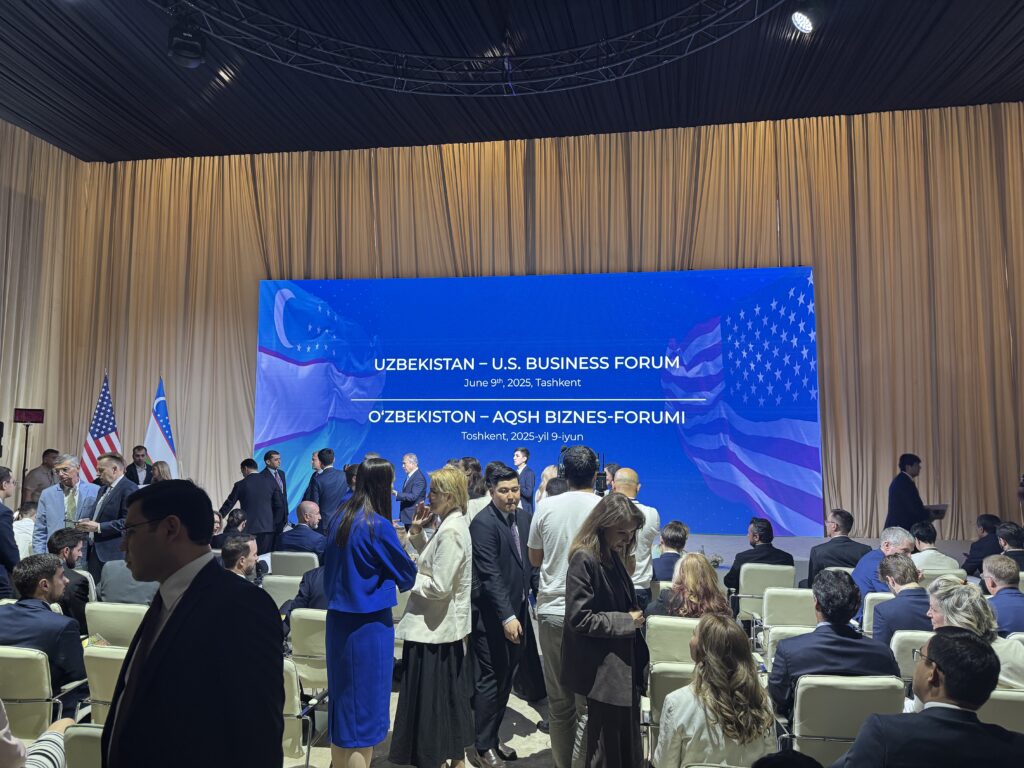
Uzbek President Welcomes U.S. Officials and Business Leaders Ahead of Tashkent International Investment Forum

On June 9, ahead of the Tashkent International Investment Forum, President Shavkat Mirziyoyev welcomed a senior delegation of U.S. business leaders and government officials, underscoring deepening economic ties between Uzbekistan and the United States. Among the participants were U.S. Assistant Secretary of State Eric Meyer, U.S. International Development Finance Corporation (DFC) Vice President Bethany Brez, American-Uzbek Chamber of Commerce Chair Carolyn Lamm, and executives from Boeing, Visa, NASDAQ, Coca-Cola, Morgan Stanley, Franklin Templeton, FLS, Air Products, and others. Mirziyoyev noted that the meeting reflected growing U.S. interest in Uzbekistan’s reform-driven and investment-oriented economy. In 2024, bilateral trade between Uzbekistan and the U.S. reached $882 million, a 15.2% increase from 2023. Of this, Uzbek exports to the U.S. totaled $314.7 million, while imports stood at $564.3 million. Despite this growth, exports to the U.S. still account for only 1.2% of Uzbekistan’s total export volume, according to economist Mirkomil Kholboyev. During the Uzbekistan-U.S. Business Forum in Tashkent, DFC Vice President Brez led discussions on joint projects in critical minerals. The DFC, with a $60 billion mandate, supports global investment in sectors such as energy, infrastructure, and advanced manufacturing. [caption id="attachment_32862" align="aligncenter" width="2560"] Image: Uzbekistan–U.S. Business Forum[/caption] Digital innovation emerged as a key area of cooperation. According to a recent UNDP study, Uzbekistan plans to implement 100 priority artificial intelligence models by 2030 and establish supercomputing labs at major universities. USAID has previously supported this digital agenda by enabling Uzbek startups to engage with Silicon Valley investors and participate in TechCrunch Disrupt in October 2024, strengthening linkages with the U.S. tech ecosystem. Transport and energy infrastructure modernization also featured prominently in the talks. In January 2025, Uzbekistan Airways signed a memorandum with Boeing to acquire fourteen 787-8 Dreamliners, a multibillion-dollar deal with deliveries expected by 2032. Meanwhile, USAID partnered with Uzbekistan on energy sector reform, including support for drafting the “Law on the Electric Power Industry,” which introduces transparent tariff policies and facilitates private-sector entry. Tourism and small business development were additional focus areas. USAID’s five-year, $17.7 million Business Support Project has targeted key sectors such as ICT, tourism, textiles, and the green economy. Under this initiative, the Association of Private Tourism Agencies of Uzbekistan launched new training modules and classification standards for family-run guesthouses in Bukhara, Samarkand, and Tashkent, promoting sustainable, community-based tourism. Throughout the meeting, U.S. business leaders expressed support for Uzbekistan’s reform agenda and presented specific proposals, ranging from expanding fintech infrastructure to piloting AI-driven logistics platforms. The exchanges reflected a mutual commitment to strengthening the U.S.-Uzbek partnership across a wide range of strategic sectors.

Domestic Violence in Kazakhstan: What Has and Hasn’t Changed for Victims

The issue of domestic violence in Kazakhstan has sparked intensified public debate in recent years, particularly following several high-profile cases involving public officials, businesspeople, and artists. Against this backdrop, analysts at the Ranking.kz portal examined how the situation has evolved and how effectively the state is addressing the issue. Stubborn Statistics According to the Committee on Legal Statistics, Kazakhstan has seen a significant decline in overall murder rates, from 1,400 cases in 2010 to 449 in 2024. Similar downward trends are observed for other serious crimes, including rape, sexual assault, and manslaughter. However, the share of murders classified as domestic crimes has increased from 17% in 2018 to 23% in 2024. This means that nearly one in four murders now occurs within families, and the decline in domestic homicide rates has been far slower than the national average. Significantly, during the period when domestic violence was criminalized (2015-2017), the number of murders dropped markedly. After its partial decriminalization, the trend reversed, with rates beginning to rise again. A noticeable change came in 2024, when certain domestic violence offenses, such as assault and minor bodily harm, were reclassified from administrative to criminal offences. This shift led to a sharp increase in related criminal cases, reflecting a new legal approach rather than a sudden spike in incidents. Currently, family conflicts that do not involve serious physical harm are handled under Article 73 of Kazakhstan’s Administrative Code, which covers insults, humiliation, and property damage. In 2024, 74,300 cases were registered under this article, up from 60,500 in 2010, although the earlier figure included assault as well. Punishing the Victims A report by the Human Rights Commissioner sharply criticized the previous administrative model for punishing domestic violence, which typically relied on warnings or brief detentions. In many cases, fines were paid out of the family budget, effectively penalizing the victims themselves. “The effectiveness of measures to prevent and stop violence was 35% in 2023 and just 20% in 2020. In the remaining cases, the violence was repeated,” noted experts from the National Center for Human Rights. Alarmingly, 40-45% of domestic violence victims are men, according to the same report. It also points out that when women resort to killing abusive partners after years of suffering, it highlights the failure of state policies to provide adequate protection. “Violence continues, and current protective measures fall short,” the report concludes. According to the Kazakhstan Institute for Public Development, 6% of respondents nationwide reported experiencing domestic violence in 2024. The regional disparities are stark: in Mangistau, 38% of respondents said they had faced domestic violence, compared to 14% in Karaganda. Equally troubling is the limited awareness and use of support services. Nearly half of respondents had never heard of crisis centers. Of the 67,500 administrative and criminal domestic violence cases in 2023, only 4,400 victims, just 6.5%, sought help at such centers. In some regions, the rate was under 2%. Public Skepticism Remains High Surveys reflect widespread pessimism about progress on the issue. When asked how the domestic...

Back to the Old System for Kyrgyzstan’s Future Parliamentary Elections

On June 9, Kyrgyz President Sadyr Japarov signed the law on amendments to the procedures on electing members of parliament. There are some positive and some controversial changes, one of the most significant of which is the diminished role for political parties. Structurally, the new legislation creates 30 electoral districts in Kyrgyzstan. Each district will elect three parliamentary deputies, with the three candidates receiving the most votes becoming the deputies from their district. Currently, there are 90 seats in Kyrgyzstan’s parliament. That number will remain. According to the new law, one of the three candidates from each territorial constituency must be a woman. Kyrgyzstan has had a gender quota rule in place since 2007 whereby at least 30% of the members of parliament should be women. However, in reality that percentage has never been reached. Currently, only 20 of the 90 of the deputies in Kyrgyzstan’s parliament are women. Under the new legislation, a minimum 33% quota for women is guaranteed. Another change dispenses with by-elections in the event an elected deputy steps down from their post. If a seat is vacated, the candidate from that district who received the fourth most votes in elections will receive the empty seat. If the deputy vacating their seat is a woman, the female candidate who received the next highest number of votes in that electoral district will fill the seat. MP Ulan Primov, one of the authors of the amendments, said Kyrgyzstan has spent nearly 200 million som (about $2.29 million) on by-elections since the 2021 parliamentary elections. One of the most controversial changes is the decision to revert entirely to a single-mandate selection of candidates. Kyrgyzstan elected all its deputies via the single-mandate system in the 1995, 2000, and 2005 parliamentary elections. Parties also ran candidates, but in the 1995 elections, 67 of the 105 seats went to independents, in 2000, 73 of the 105 seats were won by independents, and in 2005, after changes to parliament’s structure, 47 of the 75 places in parliament went to independents. In 2007, the system changed, and deputies were elected by party lists. This led to the first-ever ruling party in Kyrgyzstan’s history, the Ak Jol party of then-President Kurmanbek Bakiyev which took 71 of the 90 seats in parliament in the 2007 elections. Parliament’s structure was changed to 120 seats in 2010. The parliamentary elections that year, and in 2015 and 2020 were conducted using party lists. In the last parliamentary elections in November 2021, Kyrgyzstan had introduced a split system whereby 36 deputies were elected in single-mandate districts and the remaining 54 deputies by party lists. In an interview with state media outlet Kabar in February 2025, President Japarov spoke about the coming changes to election legislation, saying, “Perhaps in 40-50 years, if our people and politicians are ready, we will move to a party system of government.” It is a curious comment considering the other Central Asian countries, Kazakhstan, Tajikistan, Turkmenistan, and Uzbekistan, all use party lists to elect deputies in...

Mirziyoyev Proposes Regional Investment Concept as Trade Hits $13 Billion

President Shavkat Mirziyoyev opened the Fourth Tashkent International Investment Forum on June 10 with a wide-ranging address emphasizing deeper global cooperation, peaceful conflict resolution, and renewed investment in green energy, digital transformation, and regional integration. His remarks underscored Uzbekistan’s economic ambitions and its aspiration to be a constructive global actor, according to the presidential press service. “We welcome more than 7,500 delegates today, including nearly 3,000 foreign guests from around 100 countries,” Mirziyoyev said. “This is a true expression of respect for our country and a sign of mutual trust.” Dignitaries included presidents and prime ministers from Bulgaria, Slovakia, Kazakhstan, Kyrgyzstan, Tajikistan, Azerbaijan, and senior officials from Russia and Turkmenistan. Also in attendance were leaders of major financial institutions such as the European Bank for Reconstruction and Development and the New Development Bank. Addressing Global Challenges Mirziyoyev painted a sobering picture of current global instability. “The global arms race is intensifying,” he noted, citing a 50% increase in military spending since 2010, now totaling $2.5 trillion. He criticized the erosion of international law and diplomacy, citing food insecurity, poverty, and climate change as growing threats. He also condemned the humanitarian crisis in Gaza: “In the 21st century, the death of so many innocent people before our eyes cannot be justified,” he said, urging a fair resolution in line with international law. On Ukraine, he reiterated Uzbekistan’s position that the conflict must be resolved through diplomacy. Mirziyoyev also advocated for continued engagement with Afghanistan, stressing that “stability and economic development in Afghanistan are key factors for long-term progress in the entire region.” Economic Vision and Sustainability Turning to economic progress, Mirziyoyev highlighted that Uzbekistan’s GDP has doubled over the past eight years and is on track to reach $200 billion by 2030. In 2023 alone, Uzbekistan attracted $35 billion in investment and exported goods worth $27 billion. He pointed to major improvements in global rankings: a 48-place rise in the Index of Economic Freedom, a 28-spot climb in Harvard’s Economic Complexity Index, and a recent S&P credit rating upgrade from “stable” to “positive.” He outlined four strategic priorities for sustainable growth: 1. Green Energy Transition Uzbekistan has attracted $6 billion in foreign direct investment in renewable energy, with electricity production rising from 59 to 82 billion kilowatt-hours and projected to exceed 120 billion by 2030. Green energy will make up 54% of the total by then. New measures include privatizing power grids, issuing green certificates and carbon credits, and joining international carbon markets. A new climate investment platform, “Green Uzbekistan”, will be launched this year. 2. Digital Transformation and Artificial Intelligence Mirziyoyev said IT exports are expected to reach $1 billion in 2025, with plans to increase fivefold by 2030. Uzbekistan has climbed 17 spots in the International AI Readiness Index and is developing a national AI model reflecting its cultural identity. Infrastructure plans include 20 new data centers and a national cloud platform, alongside the “One Million AI Leaders” initiative to build future digital skills. 3. Financial Sector Modernization Uzbekistan...

Opinion: Xi Jinping Heads to Astana – What’s at Stake in the Central Asia-China Summit?

On June 16-17, President Xi Jinping of the People’s Republic of China will visit Kazakhstan. The second Central Asia-China summit is scheduled for June 17 in Astana. Leading up to the event, a series of forums, meetings, and conferences have been unfolding across Central Asia and China, drawing experts, journalists, diplomats, and energy-sector representatives. These activities suggest that the upcoming summit is poised to overshadow its predecessor. While U.S. analysts continue debating the viability of their own C5+1 framework for engaging with Central Asia, and the European Union advanced its outreach with the inaugural EU-Central Asia summit, China has relied on a well-worn path. The thousand-year legacy of the Middle Kingdom is filled with moments when it had to engage with the complex mosaic of Central Asia, once a turbulent region of khanates, emirates, and nomadic tribes. Despite the chaos, China succeeded in carving out a secure overland corridor, the Great Silk Road, which threaded through what are now the independent Central Asian republics, linking them like beads in a continental necklace. Then, as now, China is seeking stability in the region, not just for political influence but to safeguard its global supply chains. Beijing’s modern initiatives, including the Belt and Road Initiative and its broader “community of shared future” concept, aim to establish global “islands of comfort” conducive to Chinese interests.  At the heart of this strategy lies a deeply embedded worldview: that China represents civilization itself. The Chinese learned long ago to deal with their neighbors not with violence, but through economic incentives, a method which is proving just as effective today. This layer of understanding is notably absent in many Western and post-Soviet analyses of China’s actions in Central Asia, the Middle East, Africa, and beyond. The reasons for this are twofold. First, Chinese officials are careful never to state views about cultural hierarchies explicitly; doing so would risk alienating partners. This reticence is a feature of traditional Eastern diplomacy. Second, Beijing has cultivated its own expert ecosystem within the post-Soviet sphere. In response to a wave of Sinophobia that swept through Central Asia a decade ago, China now primarily engages with favorable media outlets and Sinologists, many of whom are nurtured through carefully managed media tours. One such tour, organized by People’s Daily, is currently underway ahead of the Astana summit. As a result, the discourse surrounding the summit is shaped less by hard policy proposals than by diplomatic pageantry, with everything presented in the best possible light. At the recent 5th Forum of Think Tanks, “Central Asia-China: New Horizons for Regional Partnership,” Kazakhstan's State Councilor Yerlan Karin likened China and Central Asia to “the two lungs of Asia,” emphasizing the symbolic depth of their growing relationship. The 6th Central Asia-China Foreign Ministers’ Meeting, chaired by Chinese Foreign Minister Wang Yi and held in Almaty in April, likewise offered little in terms of concrete summit outcomes. According to a general statement from Kazakhstan’s Foreign Ministry, topics included political dialogue, trade, connectivity, sustainable development, and security cooperation,...