• KGS/USD = 0.01144 0%
  • KZT/USD = 0.00215 0%
  • TJS/USD = 0.10680 0%
  • UZS/USD = 0.00008 0%
  • TMT/USD = 0.28530 0%
  • KGS/USD = 0.01144 0%
  • KZT/USD = 0.00215 0%
  • TJS/USD = 0.10680 0%
  • UZS/USD = 0.00008 0%
  • TMT/USD = 0.28530 0%
  • KGS/USD = 0.01144 0%
  • KZT/USD = 0.00215 0%
  • TJS/USD = 0.10680 0%
  • UZS/USD = 0.00008 0%
  • TMT/USD = 0.28530 0%
  • KGS/USD = 0.01144 0%
  • KZT/USD = 0.00215 0%
  • TJS/USD = 0.10680 0%
  • UZS/USD = 0.00008 0%
  • TMT/USD = 0.28530 0%
  • KGS/USD = 0.01144 0%
  • KZT/USD = 0.00215 0%
  • TJS/USD = 0.10680 0%
  • UZS/USD = 0.00008 0%
  • TMT/USD = 0.28530 0%
  • KGS/USD = 0.01144 0%
  • KZT/USD = 0.00215 0%
  • TJS/USD = 0.10680 0%
  • UZS/USD = 0.00008 0%
  • TMT/USD = 0.28530 0%
  • KGS/USD = 0.01144 0%
  • KZT/USD = 0.00215 0%
  • TJS/USD = 0.10680 0%
  • UZS/USD = 0.00008 0%
  • TMT/USD = 0.28530 0%
  • KGS/USD = 0.01144 0%
  • KZT/USD = 0.00215 0%
  • TJS/USD = 0.10680 0%
  • UZS/USD = 0.00008 0%
  • TMT/USD = 0.28530 0%

Viewing results 205 - 210 of 949

Kazakhstan Considers “Green” Tax on Plastic Packaging

Azhar Sagandykova, a deputy in Kazakhstan’s Mazhilis, has proposed introducing a “green” tax on non-environmentally friendly packaging. She announced the initiative during the IX Eurasian Business Forum Green Energy & Waste Recycling Forum (GEWR-2025). The proposed tax would apply to packaging materials that are difficult to recycle or non-biodegradable, such as polyethylene terephthalate (PET) bottles, plastic bags, and other polyethylene-based containers. “It is time to seriously consider introducing a green tax on non-environmentally friendly packaging and directing the funds collected towards the development of waste recycling,” Sagandykova stated. According to the United Nations Development Programme (UNDP), Kazakhstan produces approximately 4.5 million tons of waste annually. Of this, 80% is generated by the municipal sector, while 20% comes from industry, healthcare, and other sectors. Only about 26% of the total waste is recycled. These figures were confirmed by Zhomart Aliyev, Kazakhstan's Deputy Minister of Ecology and Natural Resources, who also addressed the forum. Speaking on the sidelines of the event, Aliyev commented on the complexities of implementing such a tax. “It is very difficult to say at this stage what a green tax on a particular product should look like. It could affect virtually all sectors of the economy. We have begun preparatory work, but it is still at an early stage. We need to calculate the figures for the whole country in detail,” he said. In addition to the tax proposal, Sagandykova advocated for a dedicated law on waste management to clarify responsibilities, define infrastructure needs, and introduce government incentives. “The existing Environmental Code contains a number of vulnerabilities and does not cover all aspects of waste management. Therefore, within the framework of a working group in the Mazhilis, we intend to review the systemic approach to solving this problem,” she explained. During the summer, deputies plan to collect proposals from businesses, environmentalists, and civil society stakeholders. These suggestions will inform a draft bill to be discussed in the fall. Aliyev added that the government is already working on a comprehensive waste management concept, excluding radioactive waste, which remains under the jurisdiction of the Atomic Energy Agency. The concept, commissioned by the prime minister, is expected to be finalized by September, when a decision will be made on whether a standalone waste management law is necessary. As previously reported by The Times of Central Asia, Kazakhstan had aimed to phase out plastic packaging and tableware by 2025. However, due to a lack of sufficient alternatives in domestic production, the government was forced to abandon the timeline.

Almaty Grapples with Year-Round Nitrogen Dioxide Crisis, Study Warns

A new study has revealed persistently dangerous levels of nitrogen dioxide (NO₂) pollution in Almaty, Kazakhstan’s largest city, with motor vehicles identified as the primary source. Conducted by the Almaty Air Initiative over 2023-2024, the research highlights aging vehicles, inadequate emissions oversight, and coal-based heating as key contributors to chronically high NO₂ levels throughout the year. With more than 600,000 vehicles on the roads daily, Almaty’s outdated and poorly regulated transport fleet is having a significant environmental impact. According to the Ministry of Internal Affairs, nearly one-third of the city’s vehicles are over 20 years old, many lacking catalytic converters that are standard in other countries. NO₂ Levels Far Exceed Global Health Standards Data from over 50 monitoring stations, installed as part of an Asian Development Bank-supported program, show that annual NO₂ concentrations in Almaty were 4.6 times higher than the World Health Organization’s recommended limits in 2023, and 4.2 times higher in 2024. Only 16 days in 2024 met the WHO’s daily NO₂ threshold of 25 µg/m³. On 143 days, concentrations exceeded 40 µg/m³, posing health risks to vulnerable groups such as children, the elderly, and people with respiratory issues. On seven days, levels surpassed 100 µg/m³, considered extremely hazardous for the general population. Kazhydromet, Kazakhstan’s national weather agency, documented over 11,000 violations of the country’s maximum permissible concentration (MPC) for NO₂ in 2024, an average of nearly 30 per day. Pollution Persists Across All Seasons Unlike particulate matter (PM2.5), which typically spikes during the heating season, NO₂ pollution remains elevated year-round. Peak monthly averages reached nearly 100 µg/m³ in January 2023 and 80 µg/m³ in December 2024. Even in summer, concentrations hovered around 30-35 µg/m³, well above WHO guidelines. In 2024, Almaty recorded 164 “clean” days based on PM2.5 levels (below the WHO’s 15 µg/m³ threshold), but just 16 days met the corresponding standard for NO₂, underscoring the pollutant’s persistent presence and underrecognized health risks. Additional Contributors: Coal and Industry Beyond traffic emissions, NO₂ levels are exacerbated by emissions from two coal-fired thermal power plants, as well as numerous private heating systems and small-scale boiler houses. The study also criticized Kazakhstan’s vehicle inspection system, which it says fails to identify or enforce emissions violations. Study Urges Comprehensive Action To tackle the NO₂ crisis, researchers recommend a suite of policy measures, including: Transitioning public transport to gas and electric power Phasing out coal-based heating in favor of gas Installing emissions filters at thermal power plants and residential heating units Establishing low-emission zones across Almaty Encouraging walking and cycling for short trips Strengthening vehicle inspection and emissions monitoring systems With NO₂ now considered one of the most serious and persistent air quality threats in Central Asia, Almaty’s situation serves as a stark warning for other rapidly urbanizing cities in the region.

Kyrgyz Government Urges Farmers and Migrants to Cultivate Underused Farmland

Kyrgyzstan’s Ministry of Water Resources, Agriculture, and Processing Industry is encouraging both domestic farmers and citizens working abroad to return and develop the country’s underutilized, low-productivity farmland. According to the ministry, Kyrgyzstan currently has 614,000 hectares of such land. The initiative invites citizens to convert these idle plots into productive agricultural zones, helping to green the country and generate income. Those interested will receive comprehensive support from both the ministry and local authorities. Assistance includes the installation of drip irrigation systems, access to preferential loans, supply of high-quality seedlings, and expert consultations. The ministry recommends planting fruit trees and berry shrubs that thrive in low-fertility, arid soil conditions. Suggested crops include apple, apricot, cherry, mulberry, currant, rosehip, sea buckthorn, hawthorn, as well as walnut and pistachio trees. This initiative is part of a broader strategy to stimulate agricultural production and exports in Kyrgyzstan, where more than half the population lives in rural areas.

AIIB and Uzbekistan Finalize $71.1 Million Loan for Climate-Resilient Rural Roads

Uzbekistan and the Asian Infrastructure Investment Bank (AIIB) have concluded a $71.1 million loan agreement to upgrade rural roads in the Khorezm and Karakalpakstan regions. The deal was finalized during the AIIB’s 10th Annual Meeting in Beijing. The loan will finance the first phase of the Karakalpakstan and Khorezm Local Roads Network Reconstruction Project, which aims to modernize rural road infrastructure to improve climate resilience and community accessibility. The project is expected to facilitate better access to markets and essential public services for rural populations. The total cost of the project is projected at $173.4 million, with a second loan tranche planned to cover the remaining amount. The initial phase will prioritize road improvements in Khorezm, while the second tranche will address road upgrades in the Republic of Karakalpakstan. According to the AIIB, a phased approach will allow Uzbekistan to better manage its fiscal resources and enhance project planning and execution. This method also enables the bank to provide tailored technical assistance and integrate lessons learned from earlier phases into subsequent work. This initiative builds on a broader partnership between Uzbekistan and the AIIB. In 2024, the bank approved a $250 million program to support the country's transition to a greener economy. That package includes measures to reduce greenhouse gas emissions, reform climate-related policies, and promote sustainable land and water management, as well as low-carbon transportation and energy solutions. The AIIB also backs Uzbekistan’s efforts to boost energy efficiency, expand renewable energy capacity, promote e-mobility, and encourage state-owned enterprises to adopt climate risk reporting practices. The rural roads project aligns with Uzbekistan’s wider development agenda, which includes modernizing infrastructure, revitalizing underserved regions, and fostering long-term sustainability.

Tajikistan and Central Asia Face Escalating Water Crisis

Central Asia is emerging as one of the regions most vulnerable to drought, according to the latest Global Drought Outlook published by the United Nations. A Region Under Climate Pressure The report highlights a persistent rise in average annual temperatures, diminishing snow cover, and accelerated glacier retreat, particularly in the mountainous regions of Tajikistan and Kyrgyzstan, as key drivers of water insecurity. “Climate change is accelerating glacier retreat... This poses a long-term threat to the region's water security,” the report states. Tajikistan, which holds over 60% of Central Asia’s glaciers, plays a critical role in the region’s hydrology. Agriculture on the Brink The first sector to suffer from prolonged drought is agriculture, which underpins food security across Tajikistan, Uzbekistan, and Turkmenistan. Most agriculture in these countries relies on outdated irrigation systems ill-equipped to handle evolving climate conditions. According to the Food and Agriculture Organization (FAO), the global incidence of droughts rose by 29% between 2000 and 2023. In Central Asia, this trend has resulted in declining crop yields, income losses, and forced livestock sales. In Tajikistan’s Khatlon and Sogd regions, farmers experience income drops of 15-30% during dry years. Despite generating more than 60% of the region's freshwater through glaciers and high-altitude rivers, Tajikistan struggles with its own water shortages. Nearly 60% of water is lost due to leakage in dilapidated canals, compounded by inefficient water management. Rural communities are particularly affected, with thousands of families lacking regular access to clean water. Hydropower and Economic Risks Tajikistan relies on hydropower for over 90% of its electricity. However, inconsistent snowfall and prolonged summer droughts have drastically lowered reservoir levels, threatening national energy stability. More than half of the country’s 14,000 kilometers of irrigation canals require modernization. From 2000 to 2016, drought-related economic losses in Central Asia exceeded $2 billion. In 2023 alone, Tajikistan incurred $5.4 million in damages due to power shortages. Droughts are also impacting public health, employment, and migration. Natural disasters annually affect around 1.4 million people in Uzbekistan and 500,000 in Kazakhstan and Tajikistan. By 2050, drought-related losses are expected to reach 1.3% of regional GDP annually, with up to five million climate migrants projected. Regional and Global Responses Tajikistan, a signatory to the UN Convention to Combat Desertification, is pursuing land restoration and sustainable water management projects. Under the ISCAUZR-2 initiative (Central Asian Initiative on Sustainable Land Management), the country secured nearly $1.5 million to support sustainable agricultural practices. Efforts include the development of fruit tree nurseries, installation of drip irrigation systems, construction of freshwater reservoirs, and deployment of monitoring sensors at water sources. Agroforestry techniques and drought-resistant crop varieties are also being introduced. Despite these initiatives, the region continues to face rising temperatures, Asia has already surpassed a +1.04°C increase and Tajikistan has lost more than 1,000 glaciers. An estimated 10 million people across Central Asia lack sustainable access to safe drinking water. Natural phenomena increasingly compound one another: droughts cause dust storms, which in turn accelerate glacier melt. The UN report warns that without systemic...

Bishkek Launches “Living Wall” Project to Tackle Heat and Pollution

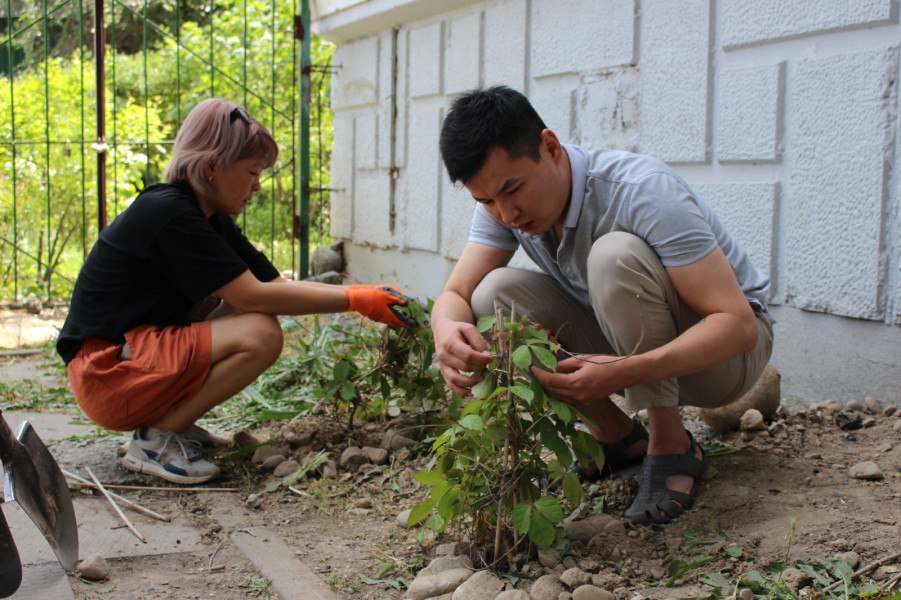
Bishkek has launched a pilot project to green the facades of buildings as part of a broader effort to adapt to climate change and mitigate growing heat and air pollution in Kyrgyzstan’s capital. In June, vertical greenery was installed on the facades of three schools and one apartment building under the “1000 Green Walls” program. The initiative is jointly implemented by the environmental organization MoveGreen and the Bishkek municipality, with support from the United Nations Environment Programme (UNEP) and the development agency Bread for the World. More Than Just Aesthetic Green facades, also known as living walls, offer both visual and environmental benefits. They reduce building surface temperatures, absorb carbon dioxide, release oxygen, and filter dust and pollutants from the air. These vertical gardens also improve sound insulation, protect buildings from temperature extremes, and support urban biodiversity, providing habitat for birds, insects, and butterflies. Two species were selected for the pilot phase: maiden grapes and ivy. Maiden grapes are fast-growing, frost- and drought-resistant vines that create dense green coverage. In addition to insulating buildings, they absorb dust and exhaust emissions, improving local air quality. Their vibrant red foliage in autumn also enhances the city’s visual appeal. Ivy, an evergreen perennial, retains its foliage year-round and provides consistent thermal and acoustic insulation. It is effective in trapping airborne pollutants and helps create a more temperate and pleasant microclimate around buildings. A Scalable Urban Solution The Bishkek municipality views this as a sustainable and scalable urban solution. “These green facades contribute to a more comfortable, ecological, and aesthetically pleasing urban environment,” officials said. The city plans to expand the 1000 Green Walls program to include more schools, kindergartens, and residential buildings in the coming months.