• KGS/USD = 0.01143 -0%
  • KZT/USD = 0.00192 -0%
  • TJS/USD = 0.10820 0.19%
  • UZS/USD = 0.00008 0%
  • TMT/USD = 0.28575 0%
  • KGS/USD = 0.01143 -0%
  • KZT/USD = 0.00192 -0%
  • TJS/USD = 0.10820 0.19%
  • UZS/USD = 0.00008 0%
  • TMT/USD = 0.28575 0%
  • KGS/USD = 0.01143 -0%
  • KZT/USD = 0.00192 -0%
  • TJS/USD = 0.10820 0.19%
  • UZS/USD = 0.00008 0%
  • TMT/USD = 0.28575 0%
  • KGS/USD = 0.01143 -0%
  • KZT/USD = 0.00192 -0%
  • TJS/USD = 0.10820 0.19%
  • UZS/USD = 0.00008 0%
  • TMT/USD = 0.28575 0%
  • KGS/USD = 0.01143 -0%
  • KZT/USD = 0.00192 -0%
  • TJS/USD = 0.10820 0.19%
  • UZS/USD = 0.00008 0%
  • TMT/USD = 0.28575 0%
  • KGS/USD = 0.01143 -0%
  • KZT/USD = 0.00192 -0%
  • TJS/USD = 0.10820 0.19%
  • UZS/USD = 0.00008 0%
  • TMT/USD = 0.28575 0%
  • KGS/USD = 0.01143 -0%
  • KZT/USD = 0.00192 -0%
  • TJS/USD = 0.10820 0.19%
  • UZS/USD = 0.00008 0%
  • TMT/USD = 0.28575 0%
  • KGS/USD = 0.01143 -0%
  • KZT/USD = 0.00192 -0%
  • TJS/USD = 0.10820 0.19%
  • UZS/USD = 0.00008 0%
  • TMT/USD = 0.28575 0%
14 December 2025

Viewing results 1231 - 1236 of 1766

Kazakhstan and Uzbekistan: A Partnership Born From Rivalry

Kazakhstan and Uzbekistan are the largest countries in Central Asia in terms of their economy, population, and vital infrastructure. In the first decades after the collapse of the USSR, the two republics visibly competed for regional supremacy, but this situation has changed dramatically. A Test of Sovereignty Uzbeks and Kazakhs are related Turkic peoples who have lived side by side for centuries, and, therefore, have experienced many mutual offenses from each other in their shared history. Perhaps this is the semi-official explanation for the rivalry between Tashkent and Astana during the reigns of the first presidents of these republics - Islam Karimov and Nursultan Nazarbayev. Another explanation for the struggle for leadership in Central Asia between Nazarbayev and Karimov lies in an old Kazakh proverb: "Two heads (of sheep) cannot fit in one pot." The implication is that there cannot be two leaders in one region at this level of multiple countries and personalities. Nazarbayev and Karimov, out of rivalry between the Soviet party nomenklatura, to which they both belonged, could not allow either of the other to rise. In the end, Moscow chose closer relations with Astana, which led to Tashkent withdrawing from the Collective Security Treaty Organization. Kazakh political scientist Maxim Kaznacheev has stated that this happened because Kazakhstan participated in various alliances, whilst Uzbekistan refused to do so, an indication that Tashkent had passed the sovereignty test, to the chagrin of Russia. "The ability of the government to pursue a sovereign policy should be put at the top of the list when determining a real regional leader. Uzbekistan has done better on this exam. Over the past decades, officially Tashkent has relied mainly on bilateral arrangements, avoiding active participation in multilateral integration formations," the political scientist stated. The Devil in the Details Despite these characteristics, Tashkent does not appear to have gained any advantages from this strategy, whether forced or chosen, due to a weak diplomatic corps. However, perhaps an Uzbek renaissance is yet to come. In late 2022, the Eurasian Development Bank published a report, "Central Asia's Economy: A New Look," which analyzed the prospects for interaction between Central Asian countries and the potential for the region to become a significant player in the world's economic map. According to this document, Kazakhstan remains the leading Central Asian economy, with its nominal 2021 GDP of $197.1 billion, 1.3 times the combined volume of the other four countries in the region. The report noted that by the end of 2022, Kazakhstan accounted for almost 60% of the total GDP of Central Asia. At the same time, GDP growth at the end of 2022 amounted to 3.2% compared to an average annual growth rate of 3.9% from 2010-2021. Uzbekistan is the next-largest economy in Central Asia after Kazakhstan, with a GDP of $69.2 billion in 2021, and $80.4 billion by the end of 2022. Although its nominal GDP is far smaller than Kazakhstan's, and its annual growth rate ($11 billion vs. $27 billion) does not seem to threaten Kazakhstan's...
Kyrgyzstan to Take Chinese Loan to Build Railroad

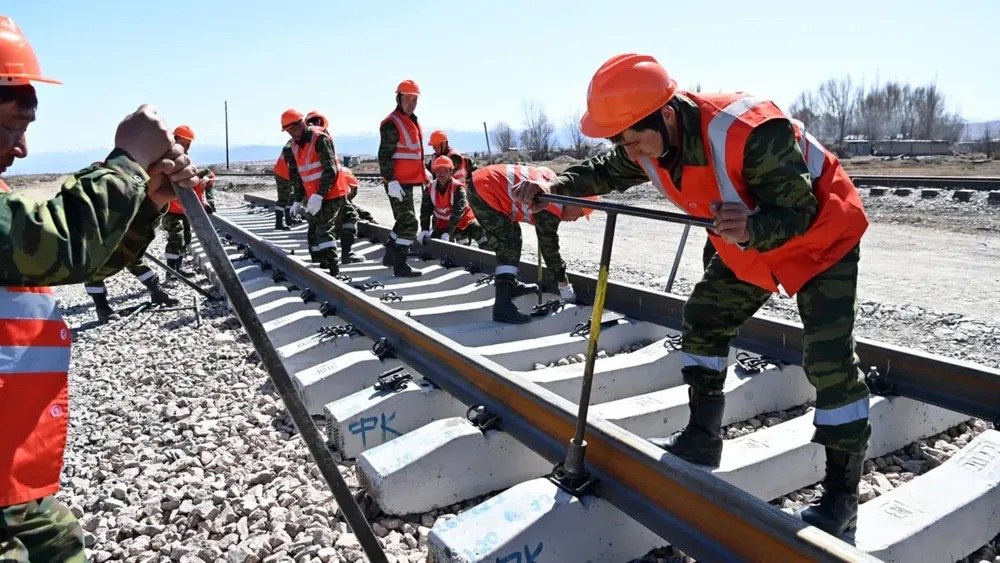
Kyrgyzstan intends to take a loan from China to construct the China-Kyrgyzstan-Uzbekistan railroad. Azamat Sakiyev, the General Director of Kyrgyz Temir Jolu NC, stated at the Parliamentary Committee on Transport, Communications, Architecture, and Construction meeting, 24.kg has reported. The Speaker noted that the feasibility study for the project has already been developed, and the agreement amounts to $4 billion 700 million. "According to the agreement, 51% of the costs will be covered by the People's Republic of China, and the Kyrgyz and Uzbek sides will assume 24.5% each," Sakiyev said. "Where will we find $1 billion?" MP Baktybek Sydykov asked, to which Sakiev replied that the Kyrgyz Republic intends to borrow money from Chinese banks. Sakiyev specified that the Chinese side would lend the joint venture half of the total project cost—$2 billion 350 million—and the parties would cover the other $2 billion 350 million at their own expense. As a result, Kyrgyzstan's share will amount to $783 million. The China-Kyrgyzstan-Uzbekistan railroad is a projected 454-kilometer railroad designed to connect the railroads of China and Uzbekistan through the territory of Kyrgyzstan and further through Turkmenistan, Iran, and Turkey, to connect with the European railroad network within the framework of the New Silk Road transport system. Previously, Kyrgyz President Sadyr Japarov had said the construction would cost between $3 and $5 billion.

Sogd-2024 International Trade Fair Marks First Decade

The international trade fair, Sogd-2024 officially opened at the sports palace in Khojand, Tajikistan, on June 18th. This year marks a decade of the Sogd—Valley of Opportunities fair, which will run from June 18th-19th. More than 500 guests from Tajikistan and abroad have gathered, Andar Rahmani, the head of the press service of the Sogd regional administration informed Sputnik Tajikistan, adding that regional ambassadors are also participating in this important economic event. “Ambassadors and representatives of the diplomatic corps of Russia, Turkey, Uzbekistan, Saudi Arabia, Azerbaijan, Japan, Iran, Belarus, Turkmenistan, Slovakia, Poland, Pakistan, Kyrgyzstan and Kazakhstan visited the region,” Rahmani said. Representatives from the Tashkent, Namangan, Ferghana, Samarkand, Bukhara, and Syr Darya regions of Uzbekistan, and business- people from China’s Shaanxi province and representatives of international financial organizations also participated.

World Bank: Uzbekistan Must Tackle Gender Inequality

The World Bank Uzbekistan has published a new “Country Gender Assessment Report: Uzbekistan” on gender assessment in the country. This report (CGA) was produced with financial support from Great Britain. This report examines gender equality in Uzbekistan in various areas such as education, health, economic activity, protection from gender-based violence, marriage, divorce, and participation in public life. CGA examines social norms, assessing cultural attitudes and practices that affect women’s rights and understandings in Uzbek society. The report makes recommendations to close the gender gap and promote inclusive prosperity. CGA notes that since 2017, significant progress has been made in terms of gender equality in Uzbekistan. Notable achievements include the 2022 Labor Code, which provides for equal pay for women and removes job restrictions. In addition, 2023 amendments to the Criminal Code criminalize domestic violence. Consequently, the “Women, business and Rights” index released annually by the World Bank recognized Uzbekistan as one of the top five countries in terms of gender equality in 2024. Women’s access to education and health services has improved significantly. For example, during the period 2017-2022, the number of admissions to higher education institutions increased significantly, the number of men increased by three times to 29%, and the number of women increased by four times – to 27.4%. Young women face higher unemployment rates than males (15.5% vs 10%), and the share of young women who were not in employment, education, or training (NEET) has reached 42%, compared to 8.8% for males. In addition, the gender pay gap is significant, with women earning 34% less than men, which is more than the global average of 20%. Women’s low wages and employment rates directly hinder economic growth and exacerbate poverty in Uzbekistan. If women participated in the country’s economy on an equal basis with men, the national income in Uzbekistan would increase by 29%. Simply equalizing men’s and women's wages would lift more than 700,000 people out of poverty. However, gender norms, which place women primarily in charge of caregiving and household tasks, hinder progress towards gender equality and inclusive economic growth. The report states that the authorities must address gender inequality to realize Uzbekistan’s full economic potential. These include entrenched social norms that limit women’s economic participation, disparities in access to higher education in STEM fields, health care limitations, deteriorating family planning options, incomplete protection from gender-based violence, and the disparity of women in leadership roles.

UN Approves Uzbekistan’s Initiative to Develop Global Safe Tourism Code

The initiative to create an intergovernmental commission on the development of the Global Safe Tourism Code within the framework of the participation of the delegation led by the Ambassador of Uzbekistan to Spain, Farrukh Tursunov, in the 121st session of the UN Tourism Executive Council was unanimously approved, as reported by the Dunyo news agency. The initiative was initially announced by the President Mirziyoyev at the 25th session of the UN General Assembly on tourism held in Samarkand in October 2023. As stated in the report, conflicts and instability observed in different parts of the world today hurt the development of tourism. In this regard, there is a need to develop a unified approach to ensure the safety of tourists, and the development of the proposed code is a step towards creating a safer, more sustainable, and fairer tourism ecosystem. It is expected that the code will become one of the tools for the sustainable development of tourism and include measures for environmental protection and the preservation of cultural heritage. In his speech at the session, UN Secretary General of Tourism, Zurab Pololikashvili thanked the government of Uzbekistan for its contribution to the organization’s activities and noted that Uzbekistan is the most active participant of this structure, contributing not only to the development of the global tourism industry, but also to the enhancement of the image of the UN.

Germany Negotiating Afghan Deportation Deal with Uzbekistan

The government of the Republic of Uzbekistan may agree with the leadership of Germany on sending its labor migrants to Europe in return for the deportation of Afghan refugees. This was reported by the Bloomberg agency. According to sources, Germany is negotiating with Uzbekistan on the conclusion of a migration pact, which may include the deportation of Afghan asylum seekers, so that Berlin does not have to make direct deals with the Taliban. Chancellor Olaf Scholz has promised a tougher stance on migration, including the deportation of asylum seekers from Afghanistan and Syria. The decision follows a recent series of violent attacks and growing sympathy for the populist far-right in Germany. Interior Minister Nancy Feather, a senior member of Scholz's center-left Social Democrats party, sent officials to the Uzbek capital, Tashkent in late May to negotiate a pact on migration and deportation. Any prospective deal is yet to be finalized. Under the proposed plan, the Uzbek government would accept a limited number of rejected Afghan asylum seekers deported from Germany, and then send them to neighboring Afghanistan using private flights to Kabul. The Uzbek government is considering the idea, but wants any migration pact to also include bilateral rules allowing for the legal migration of skilled workers from Uzbekistan to Germany. According to sources, the German government's special representative for migration agreements, Joachim Stamp, will soon travel to Uzbekistan for further negotiations on such an agreement. An interior ministry spokeswoman declined to comment on the plan, which was also reported by Der Spiegel magazine and the DPA news agency. Following a fatal knife attack by an Afghan refugee on a German policeman, Chancellor Scholz, delivering a speech on law and order in parliament on June 6, said his government would allow criminals to be deported to Taliban-ruled Afghanistan and war-torn Syria. "Serious criminals and terrorist threats have no place here," Scholz said, adding that the interior ministry was working on practical implementation and was already in talks with countries bordering Afghanistan. Germany previously completely halted deportations to Afghanistan shortly before the Taliban returned to power in the summer of 2021.