
• KGS/USD = 0.01144 0%
  • KZT/USD = 0.00212 0%
  • TJS/USD = 0.10432 -0.29%
  • UZS/USD = 0.00008 0%
  • TMT/USD = 0.28571 0.28%
  • KGS/USD = 0.01144 0%
  • KZT/USD = 0.00212 0%
  • TJS/USD = 0.10432 -0.29%
  • UZS/USD = 0.00008 0%
  • TMT/USD = 0.28571 0.28%
  • KGS/USD = 0.01144 0%
  • KZT/USD = 0.00212 0%
  • TJS/USD = 0.10432 -0.29%
  • UZS/USD = 0.00008 0%
  • TMT/USD = 0.28571 0.28%
  • KGS/USD = 0.01144 0%
  • KZT/USD = 0.00212 0%
  • TJS/USD = 0.10432 -0.29%
  • UZS/USD = 0.00008 0%
  • TMT/USD = 0.28571 0.28%
  • KGS/USD = 0.01144 0%
  • KZT/USD = 0.00212 0%
  • TJS/USD = 0.10432 -0.29%
  • UZS/USD = 0.00008 0%
  • TMT/USD = 0.28571 0.28%
  • KGS/USD = 0.01144 0%
  • KZT/USD = 0.00212 0%
  • TJS/USD = 0.10432 -0.29%
  • UZS/USD = 0.00008 0%
  • TMT/USD = 0.28571 0.28%
  • KGS/USD = 0.01144 0%
  • KZT/USD = 0.00212 0%
  • TJS/USD = 0.10432 -0.29%
  • UZS/USD = 0.00008 0%
  • TMT/USD = 0.28571 0.28%
  • KGS/USD = 0.01144 0%
  • KZT/USD = 0.00212 0%
  • TJS/USD = 0.10432 -0.29%
  • UZS/USD = 0.00008 0%
  • TMT/USD = 0.28571 0.28%

Viewing results 283 - 288 of 1543

Bishkek to Host Kyrgyzstan’s First-Ever Full Marathon as Part of Snow Leopard Run 2025

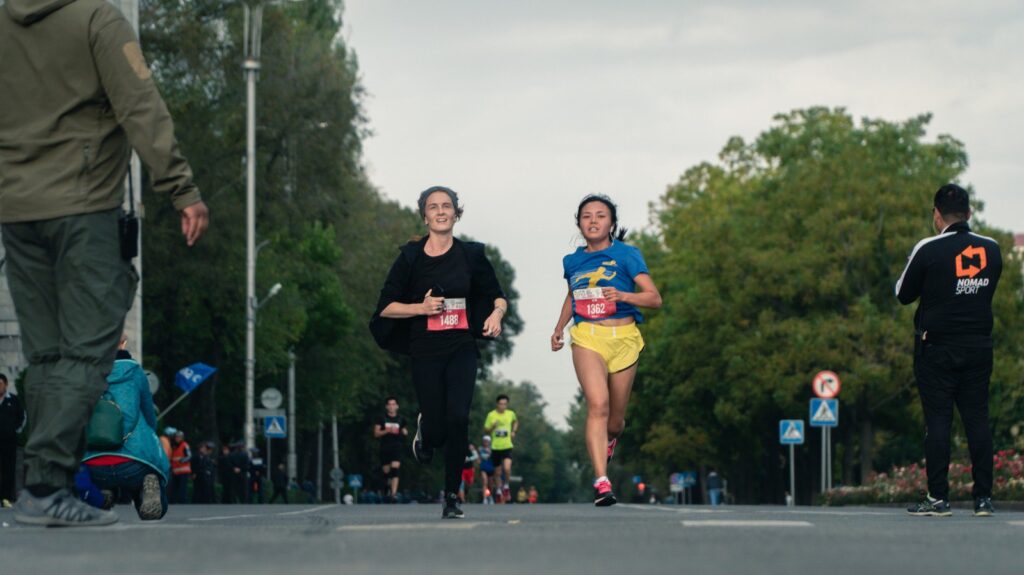
The Bishkek Snow Leopard Run 2025 will take place in the Kyrgyz capital on September 21, combining long-distance running with wildlife conservation. This year’s event will mark a milestone for the country, featuring Kyrgyzstan’s first-ever 42.2 km marathon. Organized by the Public Association Nomad Sport, the race is part of the Association of International Marathons and Distance Races (AIMS) calendar and has also joined the Turkic Alliance of Long Runs (TAN), the first such alliance in Central Asia and the Caucasus. In addition to the full marathon, runners will compete in 5 km, 14 km, and 21.1 km races. All routes will begin at Bishkek’s central Ala-Too Square and pass through the city's main thoroughfares. Nomad Sport General Director Arslan Maldybaev said more than 5,000 runners are expected this year, including participants from Kazakhstan, Uzbekistan, Azerbaijan, Russia, Belarus, and Ukraine. “It is important to us that people learn about Kyrgyzstan and our symbol, the snow leopard, through sport. This is an opportunity to make a name for ourselves and become a magnet for sports tourism,” he told local media. A portion of the entry fees will support snow leopard conservation. Proceeds from this year’s race will fund the purchase of telescopes for wildlife monitoring. First held in 2019, the Bishkek Snow Leopard Run drew 3,600 runners from 20 countries in its inaugural year. The event highlights the growing symbolic role of the snow leopard in Kyrgyzstan. In December 2023, The Times of Central Asia reported that President Sadyr Japarov had signed a decree officially designating the snow leopard as a national emblem.
Book Launch at the U.S. Capitol: New Uzbekistan: The Path of Shavkat Mirziyoyev

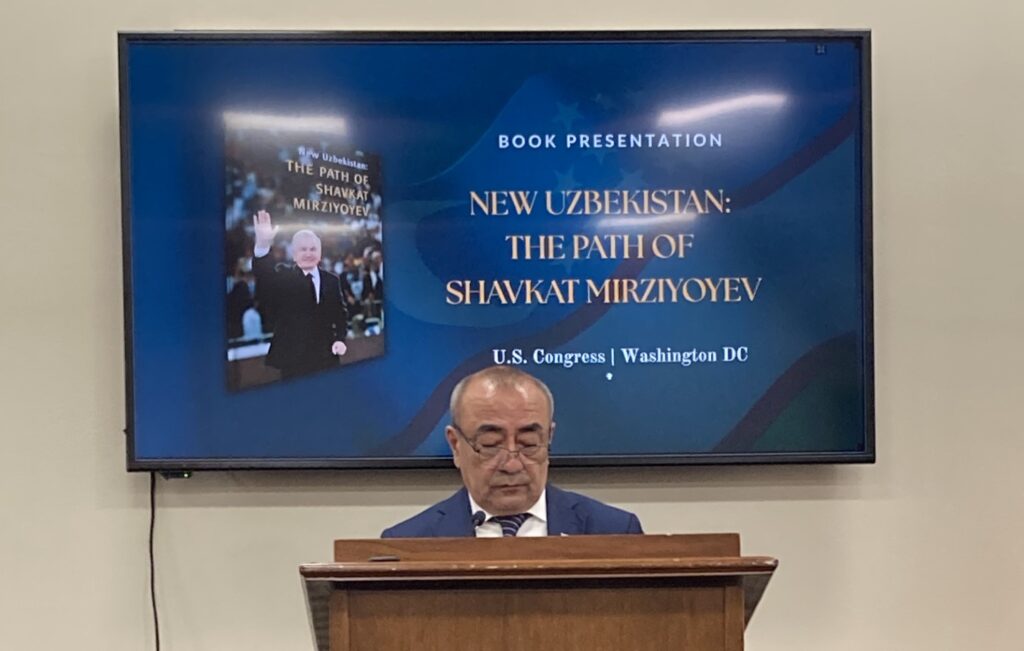
On September 16, the Embassy of Uzbekistan in Washington, D.C., hosted a book launch at the Rayburn Building on Capitol Hill for New Uzbekistan: The Path of Shavkat Mirziyoyev. The event drew diplomats, congressional staff, and representatives from companies such as General Motors and Boeing. The keynote address was delivered by Sodyq Safayev, First Deputy Chairperson of Uzbekistan’s Senate. Other speakers included Husan Ermatov, the book’s Uzbek-language editor and advisor to Uzbekistan’s Ishonch newspaper; Eldor Aripov, Director of the Institute for Strategic and Regional Studies under the President of Uzbekistan; Lisa Choate, President and CEO of American Councils; and Elena Son, Executive Director of the American-Uzbekistan Chamber of Commerce. Speakers highlighted Uzbekistan’s recent trajectory, noting shifts from a state-controlled economy and limited international engagement (1993–2016) to more market-oriented policies and broader foreign relations (2017–present). They also framed today’s Uzbekistan as shaped by historical experiences and cultural development, which some described as an “Uzbek Renaissance.” According to the speakers, President Mirziyoyev has promoted reforms in areas including governance, socio-economic development, and international outreach. Safayev remarked: “this [book signing] is not just about diplomacy but about shared values, mutual understanding, and a common vision of the future. The book before you, authored by Qudratilla Rafiqov, Uzbek scholar and political scientist, is a chronicle of change, resilience, and hope. The most difficult part of this book is a [description of the] transformation of hearts and minds. Its central message is simple and powerful: the history of Uzbekistan is written by people through their interactions and aspirations. And justice lies at the heart of reform.” By justice, he clarified, he meant fairness—ensuring that citizens have opportunities for family stability, safety, and employment. While the book presents Uzbekistan’s current government agenda in a favorable light, it also introduces new readers to the President’s stated priorities: attracting investment, promoting rule of law and fairness, liberalizing the economy, restructuring social policies, contributing to global peace efforts, and maintaining pragmatic security and foreign policy strategies. Aripov emphasized that the book is “not really about reforms, or about a leader who has been able to initiate and implement large-scale transformation in a very short period of time. It is a testimony to a new era into which Uzbekistan is entering. Today, hopes are rising in Uzbekistan, a sense of national pride is strengthened, and ambitions are being achieved that only recently seemed unattainable. These changes are being felt by ordinary citizens. They see how their lives are improving, how opportunities are expanding, and how confidence in the future is becoming a reality. That is why this book is not only a chronicle of, but also a symbol of faith that Uzbekistan can become one of the centers of sustainable development, openness and cooperation in Eurasia and the wider world. Why do I believe this to be the case? Because, under my President, the country has moved from ‘guarded isolation’ to ‘post-purposeful openness,’ from managing risks to exporting stability, and from ad hoc transactions to rules-based cooperation.” The Uzbek Embassy,...

Kazakhstan’s Cultural Reawakening: Almaty Opens Its New Museum of Arts

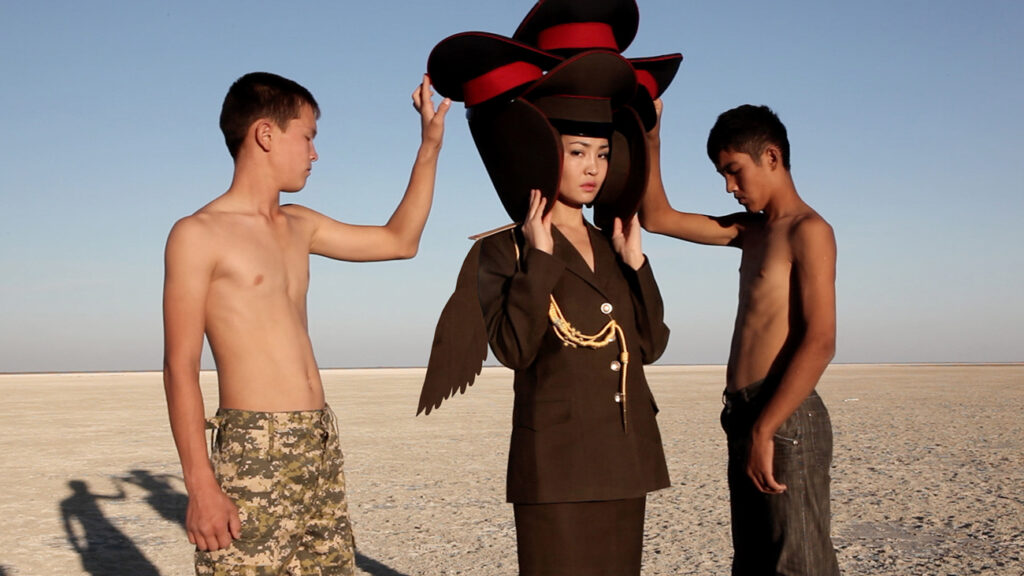
First, a young Kazakh schoolgirl in a black dress with a starched collar, her hair tousled by the wind of the Aral Sea, clutches a large Russian book tightly to her chest as she stands before a lonely school building in the middle of nowhere. Then, a camel speaks: “Give me back the sea!” “No!” cries a woman, her face hidden beneath a military hat. She stands before an abandoned edifice, her head wrapped in fur, her body strangely adorned with eggs. [caption id="attachment_36257" align="aligncenter" width="900"] Image: Almagul Menlibayeva[/caption] This series of surreal images is from the video Transoxiana Dream, by one of Central Asia’s pioneering contemporary artists, Almagul Menlibayeva. The Times of Central Asia attended her major solo show, I Understand Everything, curated by Thai curator Gritiya Gaweewong, a powerful exploration of memory, trauma, and identity, which provides the “treble clef” for the opening of the Almaty Museum of Arts. The show brings together works spanning decades, from Menlibayeva’s early paintings and collages in the 1980s, to her recent internationally recognized video and photography works. Through a variety of mediums, she charts the collapse of the Soviet Union, the ecological devastation of Kazakhstan, and suppressed cultural memory. [caption id="attachment_36258" align="aligncenter" width="2560"] Almagul Menlibayeva, People Talking against a Blue Background, 1988; image: Almaty Museum of Arts[/caption] As always in her practice, the feminine and feminist narratives are at the forefront. Menlibayeva’s women are at times bound with nature or with military rule, alternately merciful or merciless. Her works tackle ecological concerns, tying them directly to the destruction of patriarchy. “For us, opening our program with Menlibayeva’s show was highly significant,” says Meruyert Kaliyeva, the museum’s artistic director. “She is a pioneering Central Asian artist who is known internationally but at the same time has always dealt with topics and themes that are important locally.” A New Museum in Almaty The inauguration of the Almaty Museum of Arts represents a decisive step in shaping Kazakhstan’s creative future. As the country’s first large-scale contemporary art museum, it houses over 700 works collected across three decades, offering a panoramic view of modern Kazakh art while opening pathways to Central Asian and international dialogues. [caption id="attachment_36265" align="aligncenter" width="2560"] Almaty Museum of Arts; image: Alexey Poptsov[/caption] Its mission extends beyond exhibitions: the institution positions itself as a center for education, research, and collaboration, aiming to nurture local artists and connect them to global networks. For Kazakhstan, long without a dedicated contemporary art museum, this moment signals a new era, one in which cultural identity is asserted with confidence, and the arts are recognized as a vital force for national memory as well as international visibility. Kaliyeva emphasizes how essential it is that Kazakh artists now have a platform where voices once peripheral to national culture can take center stage. She also stresses the urgency of the moment: in a world reshaped by geopolitical fractures, climate crises, and cultural decolonization, this opening is necessary: “It’s a moment for Kazakhstan to assert its own narratives, to host...

UN Action Plan to Protect Religious Sites Presented in Astana

As part of the Congress of Leaders of World and Traditional Religions in Astana, a special session convened under the auspices of the United Nations presented an updated Action Plan to Protect Religious Sites around the world. The Congress, held every three years in Kazakhstan’s capital since its inception in 2003, has become a significant platform for interfaith dialogue and global cooperation. For the first time, this year’s forum included a dedicated session on safeguarding religious heritage. The revised plan was introduced by UN Deputy Secretary-General and High Representative for the Alliance of Civilizations Miguel Angel Moratinos, who praised Kazakhstan's longstanding commitment to promoting global peace and interreligious dialogue. He affirmed the UN’s readiness to support collaborative initiatives arising from the Congress. Kazakhstan Senate Chairman Maulen Ashimbayev emphasized the country's backing of the 2023 UN General Assembly resolution on interfaith dialogue and combating hate speech, along with the new UN Action Plan. “Throughout our history, temples and spiritual sites of different religions have coexisted peacefully and remain an integral part of our cultural heritage. Located at the crossroads of East and West, Kazakhstan has always played the role of a bridge connecting peoples, cultures, and religions. We attach great importance to the preservation and protection of these sacred places,” Ashimbayev said. Participants voiced concern over increasing threats to religious heritage in various parts of the world. Director of the UN Alliance of Civilizations Nihal Saad reminded attendees that the original plan was adopted in 2019 in response to a series of attacks on religious institutions. “Despite global efforts, we have witnessed numerous attacks on religious sites. The Alliance is convinced that all places of worship should be sanctuaries, not targets for terror and bloodshed. People should be able to practice their faith peacefully and without fear,” she stated. The session concluded with calls to establish sustainable legal and institutional frameworks to ensure the protection of sacred sites worldwide. As previously reported by The Times of Central Asia, spiritual leaders from across the globe are set to gather in Astana on September 17-18.

Central Asia’s First Rowing Canal Opens in Kazakhstan

Kazakhstan has inaugurated Central Asia’s first-ever rowing canal in the southern city of Turkestan. Opened on September 15, the facility is the only one of its kind in the region and meets the standards of both the International Canoe Federation (ICF) and the International Rowing Federation (FISA). Spanning 100 hectares, the canal stretches 2.5 kilometers and is equipped to host international competitions, including World Cup and Asian Cup events in rowing and canoeing. It will also serve as a dedicated training base for athletes. The complex includes spectator grandstands, a one-kilometer city beach, and an on-site hotel. In addition to its sporting function, the canal will contribute to environmental sustainability by supplying water for irrigating Turkestan’s green belt. According to the Ministry of Tourism and Sports, more than 6,000 people in Kazakhstan regularly participate in rowing and canoeing. Officials highlight rowing as one of the most “medal-rich” sports, with 14 medal sets awarded at the Olympic Games and more than 20 at the World Rowing Championships, offering strong opportunities for national athletic achievement. Authorities expect the new facility to significantly advance the development of rowing in Kazakhstan and to strengthen Turkestan’s profile as a regional hub for both culture and sports.

Kyrgyzstan Announces Dates For World Nomad Games 2026

Kyrgyzstan, host of the 2026 edition of the World Nomad Games, says the opening ceremony will be held in Bishkek on August 31 and the games will end on the shores of the scenic Lake Issyk-Kul on September 6. The dates of the games were announced on Tuesday by the organizing committee, which expects participants and guests from more than 89 countries. Aside from the opener in the Kyrgyz capital, the main schedule of the games will be held at Issyk-Kul, a northeastern resort area near the border with Kazakhstan. [caption id="attachment_36223" align="aligncenter" width="1600"] Image: TCA, Stephen M. Bland[/caption] Kyrgyzstan hosted the first three World Nomad Games in the same area in 2014, 2016, and 2018. The 2022 games were held in Turkey, and the last edition in 2024 occurred in Kazakhstan. The games have expanded over the years, providing a showcase for the cultural heritage of Central Asian and regional societies through sports involving birds of prey, dogs, horses, wrestling, archery, as well as displays of agility and other physical feats. [video width="1920" height="1080" mp4="https://timesca.com/wp-content/uploads/2024/09/Nomad_2-day.mp4"][/video] The games will demonstrate Kyrgyzstan’s role as “an international platform for cultural dialogue,” organizers said. Earlier this month, Kyrgyz President Sadyr Japarov invited cultural and sports delegations from member countries of the Shanghai Cooperation Organization to participate in the games next year. He spoke during a meeting of SCO leaders in Tianjin, China. The Eurasian group’s members include Belarus, India, Iran, Kazakhstan, China, Kyrgyzstan, Pakistan, Russia, Tajikistan, and Uzbekistan. .
