• KGS/USD = 0.01143 0%
  • KZT/USD = 0.00216 0%
  • TJS/USD = 0.10633 -0.28%
  • UZS/USD = 0.00008 0%
  • TMT/USD = 0.28571 0%
  • KGS/USD = 0.01143 0%
  • KZT/USD = 0.00216 0%
  • TJS/USD = 0.10633 -0.28%
  • UZS/USD = 0.00008 0%
  • TMT/USD = 0.28571 0%
  • KGS/USD = 0.01143 0%
  • KZT/USD = 0.00216 0%
  • TJS/USD = 0.10633 -0.28%
  • UZS/USD = 0.00008 0%
  • TMT/USD = 0.28571 0%
  • KGS/USD = 0.01143 0%
  • KZT/USD = 0.00216 0%
  • TJS/USD = 0.10633 -0.28%
  • UZS/USD = 0.00008 0%
  • TMT/USD = 0.28571 0%
  • KGS/USD = 0.01143 0%
  • KZT/USD = 0.00216 0%
  • TJS/USD = 0.10633 -0.28%
  • UZS/USD = 0.00008 0%
  • TMT/USD = 0.28571 0%
  • KGS/USD = 0.01143 0%
  • KZT/USD = 0.00216 0%
  • TJS/USD = 0.10633 -0.28%
  • UZS/USD = 0.00008 0%
  • TMT/USD = 0.28571 0%
  • KGS/USD = 0.01143 0%
  • KZT/USD = 0.00216 0%
  • TJS/USD = 0.10633 -0.28%
  • UZS/USD = 0.00008 0%
  • TMT/USD = 0.28571 0%
  • KGS/USD = 0.01143 0%
  • KZT/USD = 0.00216 0%
  • TJS/USD = 0.10633 -0.28%
  • UZS/USD = 0.00008 0%
  • TMT/USD = 0.28571 0%

Viewing results 535 - 540 of 2065

UAE Firm Plans to Build Sugar Factory in Kazakhstan

Al Khaleej Sugar, one of the world's leading sugar producers, intends to build a sugar factory near the city of Konaev, in Kazakhstan’s Almaty Region. The initiative was discussed during a meeting between Almaty Region Akim Marat Sultangaziev and the company’s managing director, Sheikh Jamal Al Gurair.  Key topics on the agenda included the selection of a suitable land plot, the organization of sugar beet cultivation, access to water for raw material production, and power supply infrastructure for the future facility. A site near Konaev, just 56 kilometers from Almaty, is currently considered the most promising due to its logistical advantages. “We want to create a completely self-sufficient enterprise using renewable energy sources. This will minimize the impact on the environment,” said Sheikh Jamal Al Gurair. Al Khaleej Sugar currently accounts for up to 3% of global refined sugar output. If the project proceeds, it would mark the UAE-based company’s first sugar production venture in Kazakhstan. Sugar Sector in Kazakhstan Kazakhstan currently has four operational sugar factories: AksuKant in the Taldykorgan district, Koksu Sugar Factory in Almaty region, and the Merken and Taraz factories in Zhambyl region. Of these, three are configured to process sugar beets, while the Taraz facility processes raw cane sugar. The primary beet-growing regions in Kazakhstan are Almaty and Zhambyl. In 2024, Kazakhstan harvested 1.2 million tons of sugar beets, yet only 700,000 tons were processed due to limited production capacity.  Last year, Kazakhstan produced 243,000 tons of sugar, less than half of its domestic consumption needs. Despite the local shortfall, a significant share of sugar output is exported, primarily to neighboring Russia. This imbalance has led to recurring supply challenges. In summer 2022, a Russian export ban on sugar triggered a sharp price increase in Kazakhstan. In response, Kazakhstan began imposing its own seasonal ban on sugar exports from June to August to stabilize domestic prices. As previously reported by The Times of Central Asia, the restriction remained in place last year.  The prospective Konaev plant, if realized, could significantly enhance Kazakhstan’s processing capacity and reduce its reliance on imported refined sugar, contributing to greater food security and industrial diversification.
Kazakhstan and Kyrgyzstan Seek to Increase Agricultural Trade

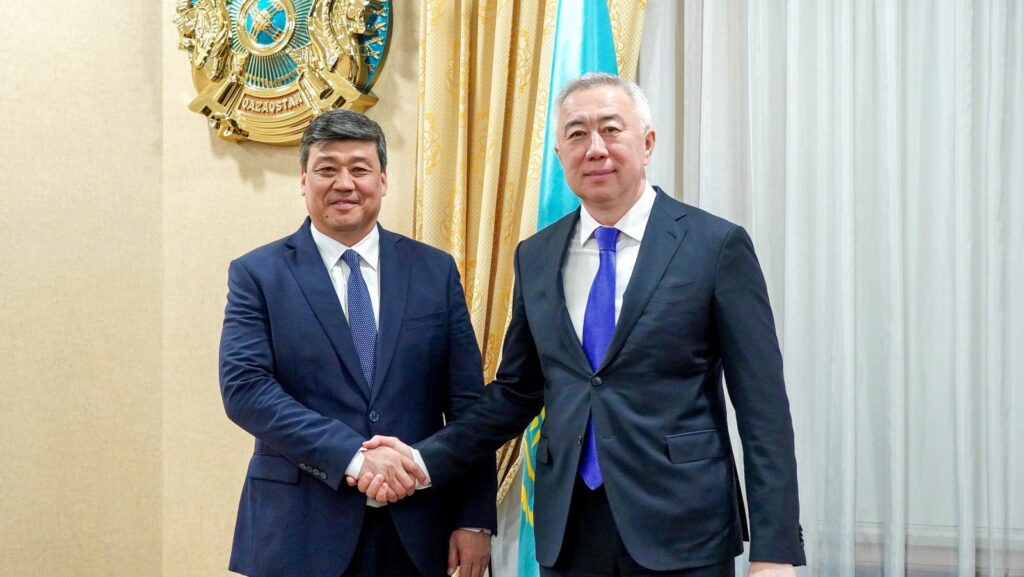
Kazakhstan and Kyrgyzstan have agreed to establish a "green-light corridor" for the export of Kyrgyz agricultural products to Kazakhstan, as well as for the supply of early spring fruits and vegetables from Kyrgyzstan.  The agreement was discussed during an April 25 meeting in Astana between Kyrgyzstan’s Deputy Chairman of the Cabinet of Ministers and Minister of Water Resources, Agriculture and Processing Industry, Bakyt Torobayev, and Kazakhstan’s Deputy Prime Minister and Minister of National Economy, Serik Zhumangarin. Kazakh and Kyrgyz officials agreed to jointly determine the list and volumes of agricultural products required by Kazakhstan. Zhumangarin and Torobayev also discussed introducing tariff discounts on rail transportation for Kyrgyz food and agricultural products intended for export and transit through Kazakhstan. The officials noted the steady growth of Kazakh-Kyrgyz trade, which reached $1.7 billion last year. Zhumangarin proposed expanding the range of Kazakh goods exported to Kyrgyzstan.  "We are ready to increase the export of Kazakhstani products across 195 commodity items by more than $260 million," Zhumangarin stated. He also suggested increasing the export of Kazakh grain and oilseeds to Kyrgyzstan.

Kazakhstan to Increase Taxes for High Earners

The Kazakh Ministry of National Economy has submitted a second package of amendments to the tax legislation to parliament, proposing an increase in the individual income tax rate for high earners. The second package was submitted to the Mazhilis (the lower house of the Kazakh parliament) on April 25. One of the key provisions is the introduction of differentiated individual income tax rates based on employees' earnings. "Citizens with lower incomes will pay personal income tax at a lower rate than high-paid workers," the Ministry of National Economy stated.  The ministry has not specified the exact income levels that will be subject to the higher rate. However, in early April, Minister Serik Zhumangarin indicated to parliamentarians that an increased rate of 15% was being proposed for employees whose annual income exceeds 8,500 monthly calculation indices (MCI). Currently, one MCI in Kazakhstan is valued at 3,932 KZT ($7.64). By 2026, when the new Tax Code is expected to come into force, it is planned to rise to 4,129 KZT ($8). Based on these figures, the threshold for the increased personal income tax rate would start at 35 million KZT per year (approximately $68,000) or 2.9 million KZT per month ($5,600) in 2026. Not all of a high earner's salary would be taxed at the increased 15% rate. Instead, only the portion exceeding the 2.9 million KZT threshold would be taxed at the higher rate; income up to that threshold would continue to be taxed at the standard 10% rate. Currently, Kazakhstan levies a flat personal income tax rate of 10%. The Ministry of National Economy projects that the introduction of a progressive scale could increase tax revenues by 70 billion KZT per year (approximately $13.5 million). Additional Tax Code Reforms The ministry also proposed optimizing deductions for medical, education, and social contributions. A single basic deduction of 30 MCI per month would be introduced, replacing the current deduction of 14 MCI. All additional deductions would be eliminated, aiming to simplify accounting procedures and reduce the administrative burden for individuals and employers. At present, employees can exempt from taxation a portion of their salary equivalent to 14 MCI, or about 55,000 KZT ($106), upon request. This exemption is available to all working citizens but can be used at only one place of employment. Under the proposed changes, starting in 2026, Kazakhstani citizens would be able to exempt 123,800 KZT ($239) per month from taxation. The ministry also proposed strengthening liability for violations related to compulsory social and health insurance and the use of special tax regimes. These measures are part of a broader strategy to reinforce tax compliance across the country. In total, the government has proposed 71 amendments to the draft new Tax Code and related legislation, along with 67 amendments to the current Tax Code. As previously reported by The Times of Central Asia, the Mazhilis approved the draft of the new Tax Code in its first reading in early April. However, the proposed reforms continue to provoke debate and...

Kazakhstan Weighs OPEC+ Exit, Raising Fears of Global Oil Price War

Kazakhstan is reportedly considering a reassessment of its participation in the OPEC+ alliance, raising concerns among major global oil market players, according to Reuters. Reuters columnist Ron Bousso Thomson noted that recent statements from Kazakhstan’s new Minister of Energy, Yerlan Akkenzhenov, emphasized prioritizing national interests over adhering to the cartel's production quotas. In an interview with Reuters, Akkenzhenov said, "Kazakhstan will proceed from its own interests in determining production volumes". Such rhetoric may signal Kazakhstan's de facto refusal to comply with OPEC+ quotas and could mark the first step toward a formal withdrawal from the alliance, which is led by Saudi Arabia. Since 2022, OPEC+ members had agreed to cut output by 5.85 million barrels per day to stabilize prices within a $70-90 per barrel range. Production Growth Despite Restrictions Kazakhstan has consistently exceeded its production limits. In March 2025, the country produced 1.85 million barrels of oil per day, 26% above its established quota of 1.468 million barrels. This surge is attributed to the expanded development of the Tengiz field. Such non-compliance has reportedly irritated Saudi Arabia, which, according to IMF estimates, needs oil prices above $90 per barrel to balance its national budget. In early April, Riyadh responded by slashing oil prices for the Asian market and accelerating production increases, signaling its displeasure toward undisciplined alliance members. Analysts warn that if tensions escalate further, Saudi Arabia could resort to drastic measures, potentially triggering a global price war. The Danger of a Price War The specter of a repeat of 2014, when Saudi Arabia flooded the market to push out U.S. shale producers, looms large. Should OPEC+ collapse, a supply glut could cause oil prices to plummet. Countries with higher production costs, such as Kazakhstan, would be particularly vulnerable to such a scenario. Risks for Kazakhstan's Budget and the Tenge According to analysts, Kazakhstan faces significant fiscal risks. Economist Arman Beisembayev explained that citizens would not immediately feel the impact of a sharp decline in oil prices due to existing contracts, which typically take three to six months to fulfill. However, he cautioned that economic repercussions could begin to surface by the fall. Financial analyst Andrei Chebotarev predicted that falling oil revenues would necessitate a budget revision. The current state budget is based on an oil price of $75 per barrel and an exchange rate of 470 tenge per U.S. dollar. In reality, oil prices are trending toward $65, and the tenge has depreciated to 518 per dollar. “Most likely, the government will increase withdrawals from the National Fund and revise budget expenditures. Devaluation may also become inevitable to balance the budget under new realities,” Beisembayev added. Global Turbulence and Geopolitical Factors Experts highlight that the policies of U.S. President Donald Trump's administration, particularly the escalation of trade conflicts, have played a significant role in destabilizing global markets. Newly imposed U.S. tariffs have already dampened global oil demand. “For developed countries, cheap oil is a boon. But for Kazakhstan, it poses risks and a threat of recession,” Beisembayev added....

Kazakhstan Begins Mineral Exploration in Afghanistan’s Nuristan Province

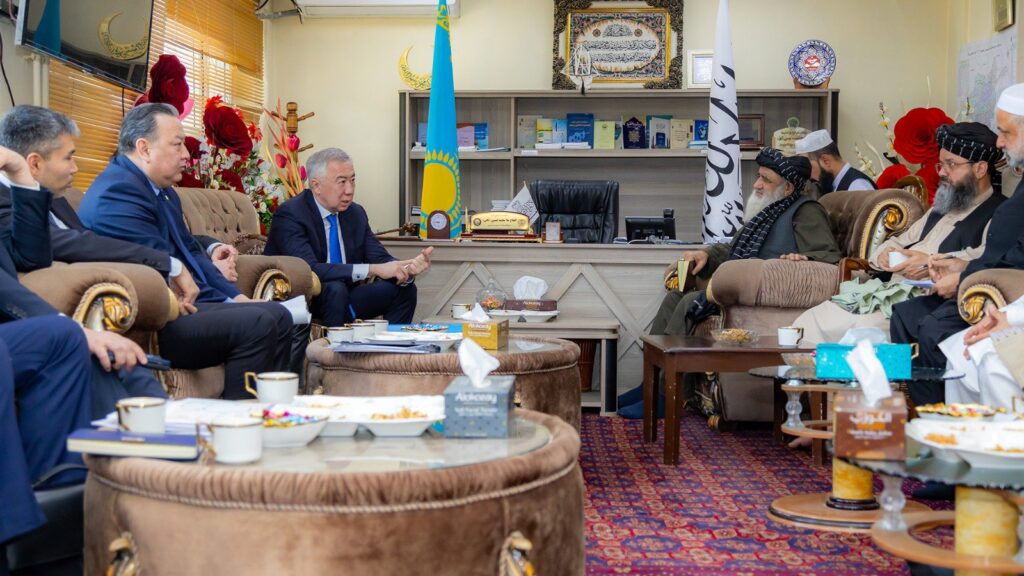
Kazakhstani geologists have begun prospecting potential mining sites in Afghanistan, starting with the resource-rich Nuristan Province. The initiative reflects Kazakhstan’s broader efforts to expand its mining interests and strengthen economic ties with Afghanistan. In mid-April, a group of geologists and engineers from Kazakhstan traveled to Afghanistan, according to the Ministry of National Economy. During their visit, specialists collected 130 kilograms of ore samples from prospective deposits in Nuristan Province, targeting beryllium, lead, and zinc resources. The samples will now be sent to Kazakhstan for laboratory analysis. Depending on the results, Kazakhstan may move to a more in-depth phase of negotiations regarding the development of these deposits. Nuristan Province is located along the border between Afghanistan and Pakistan, south of the Hindu Kush mountain range, with its administrative center in the city of Parun. Mining activity in the province has historically focused on artisanal extraction of precious and semi-precious stones, including varieties of beryl. At least 55 gemstone deposits are known to exist in the region, featuring lazurite, cordierite, ruby, kunzite, emerald, and danburite. However, industrial-scale mining of lead and zinc has not previously been developed in the area. Kazakhstan’s geological exploration in Afghanistan will not be limited to Nuristan. During a meeting in Kabul between Kazakhstan’s Deputy Prime Minister Serik Zhumangarin and Afghanistan’s Minister of Mines and Petroleum Hedayatullah Badri, it was agreed that another team of Kazakhstani specialists would travel to Afghanistan at the end of May. The Afghan side also expressed readiness to share information about confirmed mineral reserves that could be of interest to Kazakh companies. “Today Kazakhstan has formed a professional pool of extractive companies experienced in geological exploration, mining, and processing of solid minerals. These companies are keen to find and invest in promising deposits,” Zhumangarin noted. Representatives from major firms such as ERG Exploration, Kazakhmys Barlau, and Kazatomprom accompanied the Kazakh delegation. The meeting participants agreed to establish a joint technical commission to facilitate timely discussions on emerging issues. Zhumangarin also attended the Kazakhstan-Afghanistan Business Forum, which saw participation from 50 Kazakhstani companies. During the forum, he highlighted the potential for Afghanistan to serve as a key logistics hub between Central and South Asia, while Kazakhstan could become a reliable supplier of food products, technologies, engineering services, chemicals, and IT solutions. "An ambitious but achievable goal has been set, to increase the volume of trade to $3 billion in the short term. Achieving this requires building sustainable supply chains, expanding the range of traded goods, and creating favorable conditions for investment and entrepreneurship," Zhumangarin stated. He also proposed to Afghan Deputy Prime Minister Abdul Ghani Baradar the opening of a Kazakh trade house in Kabul. Additionally, the Kazakh side suggested considering the export of buses manufactured by QazTehna LLP to Afghanistan. As previously reported by The Times of Central Asia, Kazakhstan is also exploring the possibility of exporting cars produced in Kostanay and Almaty to Afghanistan, with first deliveries potentially taking place this year.

Kazakhstan’s Central Bank Governor: Navigating the “New Global Map”

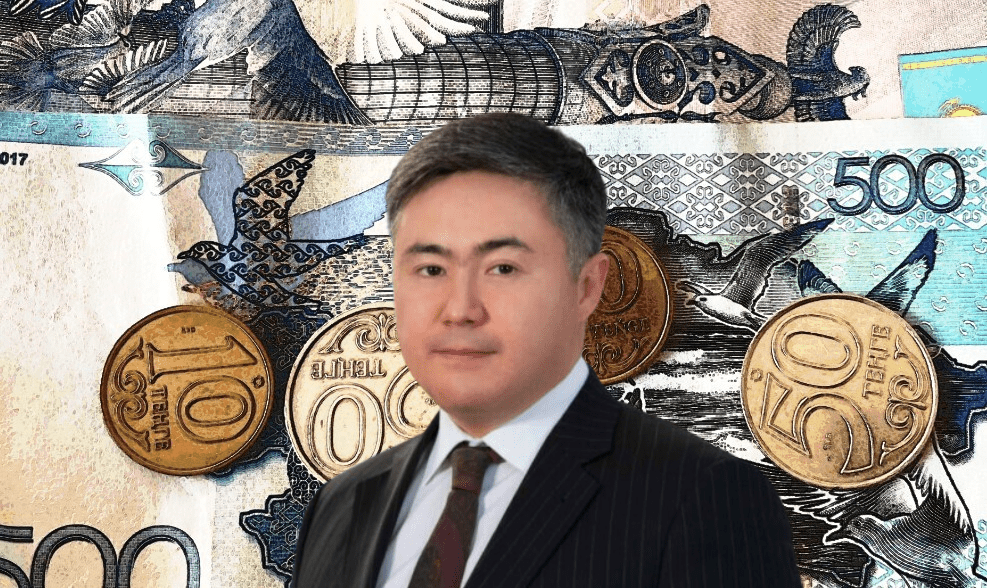
Gov. Timur Suleimenov of the National Bank of Kazakhstan spoke about U.S. tariffs, financial uncertainty, reforms and declining oil prices on Wednesday at the spring meetings in Washington of the World Bank Group and the International Monetary Fund. Here are some of Suleimenov’s key comments in a conversation with Jihad Azour, director of the IMF’s Middle East and Central Asia department: Consumer lending and regulation in Kazakhstan: Due to advances in digitizing financial services, Suleimenov said, “consumer lending became easy for the banks because they're all interlinked to the government databases, they have developed their own databases. So checking a consumer, a potential consumer, and deciding whether or not to go ahead with the loan takes minutes. And therefore everyone can go online and in a couple of weeks get, I don't know, $1,000 microcredit or something like that. That led to proliferation of consumer lending. It grew in last five years, it grew at about 30%. Well, nominal wages grew at about 10-12%. So it's not sustainable and that's why we decided that we're doing something. Our part as macroprudential regulator and our colleagues at the Agency for Oversight, they're doing their part in terms of prudential regulation as well.” U.S. Tariffs: “Now, of course, we're in a completely different setup with tariffs, reshaping global economy, supply chains, investment flows. And I think everyone is yet to find their place on this new global map. In terms of trade with the United States, we have $4.2 billion in trade and most of it is in strategic goods when it comes to U.S. imports from Kazakhstan, therefore it is exempted. But the key element is of course oil prices, global economic turmoil, of course the decrease in oil prices for oil-producing countries. Very important, 50% of our exports is oil, 35-33% of our fiscal revenues is oil. So anything that relates to oil production or oil price affects public finances and overall economic performance of the country. But we are ready, we of course as the situation was unfolding, we have our plan B and plan C. I believe many countries do have the same plan and I think we all should. It's very difficult to predict how this thing plays out.” Navigating Uncertainty “Sometimes times of crisis call for very difficult reforms. But all the stakeholders should be on the same page. Sometimes, you know, things like stability are better than development. They prevail. And therefore, it is for the governments and central banks to sit down together and see what the priorities are, the common national interests, national economic interests, whether it's difficult reforms, whether it's just maintaining stability. Well, in Kazakhstan, I think we're ready for more radical reforms that we're currently implementing. But again, let's be honest, being a petroleum state, oil producing state, makes it much, much more difficult. Because when you have 30% of your GDP in coffers in the national fund… it is very difficult to sell the reforms to the public, to the parliaments, because they're saying, guys, you're sitting on cash. The cash is invested normally, elsewhere, not into the local economy, which is the right way,...