• KGS/USD = 0.01144 0%
  • KZT/USD = 0.00202 0%
  • TJS/USD = 0.10399 -0.29%
  • UZS/USD = 0.00008 0%
  • TMT/USD = 0.28490 0%
  • KGS/USD = 0.01144 0%
  • KZT/USD = 0.00202 0%
  • TJS/USD = 0.10399 -0.29%
  • UZS/USD = 0.00008 0%
  • TMT/USD = 0.28490 0%
  • KGS/USD = 0.01144 0%
  • KZT/USD = 0.00202 0%
  • TJS/USD = 0.10399 -0.29%
  • UZS/USD = 0.00008 0%
  • TMT/USD = 0.28490 0%
  • KGS/USD = 0.01144 0%
  • KZT/USD = 0.00202 0%
  • TJS/USD = 0.10399 -0.29%
  • UZS/USD = 0.00008 0%
  • TMT/USD = 0.28490 0%
  • KGS/USD = 0.01144 0%
  • KZT/USD = 0.00202 0%
  • TJS/USD = 0.10399 -0.29%
  • UZS/USD = 0.00008 0%
  • TMT/USD = 0.28490 0%
  • KGS/USD = 0.01144 0%
  • KZT/USD = 0.00202 0%
  • TJS/USD = 0.10399 -0.29%
  • UZS/USD = 0.00008 0%
  • TMT/USD = 0.28490 0%
  • KGS/USD = 0.01144 0%
  • KZT/USD = 0.00202 0%
  • TJS/USD = 0.10399 -0.29%
  • UZS/USD = 0.00008 0%
  • TMT/USD = 0.28490 0%
  • KGS/USD = 0.01144 0%
  • KZT/USD = 0.00202 0%
  • TJS/USD = 0.10399 -0.29%
  • UZS/USD = 0.00008 0%
  • TMT/USD = 0.28490 0%

Viewing results 1051 - 1056 of 1866

Kazakhstan Reports Another Big Jump in Saiga Antelope Numbers

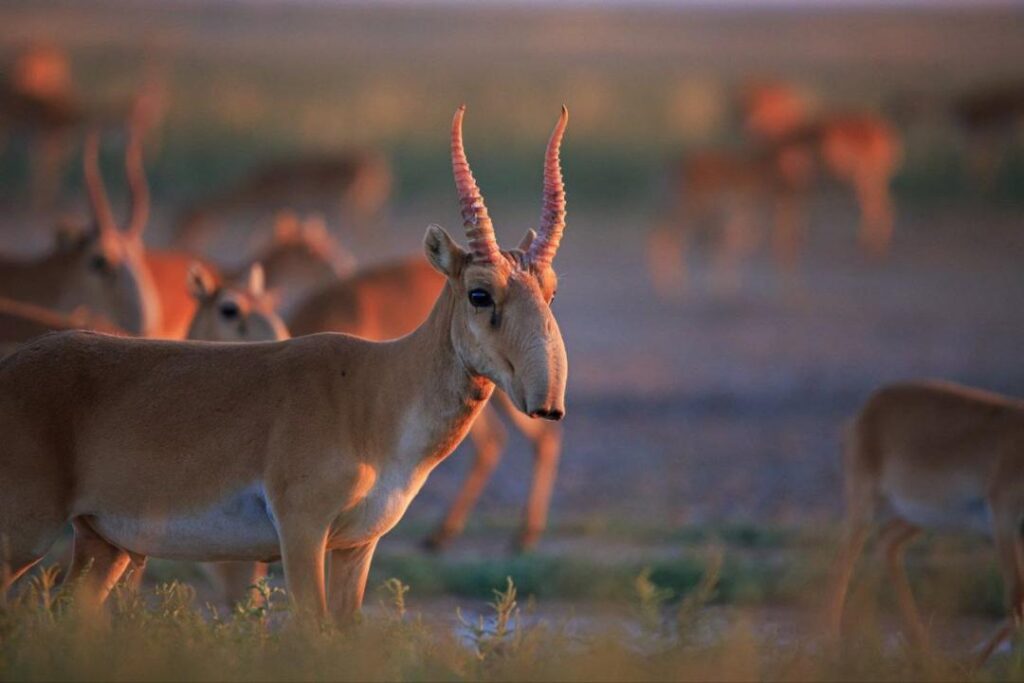
The number of saiga antelopes in Kazakhstan has surged to an estimated 2,833,600, an increase of well over 40% since last year, according to an aerial survey conducted between mid-April and May 1. The total number is likely to be much higher because the study was done before the calving season in May The new data represents another step in the extraordinary comeback of a species whose numbers were estimated at 20,000 in 2003 and then, after a period of growth, suffered another big population crash because of a bacterial disease outbreak in 2015. A reduction in poaching and the expansion of land earmarked for conservation helped the species recover in Kazakhstan, though saigas are vulnerable to several diseases and extreme weather. Some farmers say ballooning saiga numbers threaten their crops and the government has explored mass kills and other ways to regulate the population. Helicopters were used to count the antelopes over an area of about 150,000 square kilometers this year, logging 215 flight hours as they flew at a steady altitude of 120 meters, according to the Altyn Dala Conservation Initiative, which aims to restore the Kazakh steppe ecosystem. It said state agencies were involved and the science - survey route plans, data collection and result processing – was carried out by the Association for the Conservation of Biodiversity of Kazakhstan. “These annual figures are made using the same methodology which is well established,” the conservation initiative said on June 3. “They are derived by extrapolation and primarily reflect the trend in the species’ numbers, i.e. an increase of over 40%, and the approximate number. These data were obtained in April 2024, before calving, which took place in May, so now, by the beginning of June, considering the successful breeding season, the number of the species will have almost doubled.” The surveys were carried out in the regions of West Kazakhstan, Mangistau, Akmola, Aktobe, Kostanay, Karaganda, Ulytau, Pavlodar and Abay. The dry steppe grasslands and semi-arid deserts of Central Asia are the saiga’s natural habitat. The vast majority of saigas are in Kazakhstan; Russia and Mongolia have small populations. Saigas from Kazakhstan have migrated in and out of Uzbekistan, sometimes reaching Turkmenistan. But such cross-border movements have dropped. The number reaching Uzbekistan has declined, partly because a border fence was built, and saigas haven’t been seen in Turkmenistan for several years, according to the IUCN Red List of Threatened Species. IUCN stands for International Union for Conservation of Nature, a group based in Switzerland. Last year, the saiga’s conservation status on the red list was upgraded from “critically endangered” to “near threatened” because of its population gains. Saiga females start to breed when they are only eight months old and they often give birth to twins.
Endangered Wild Horses Return to Kazakhstan’s Golden Steppe

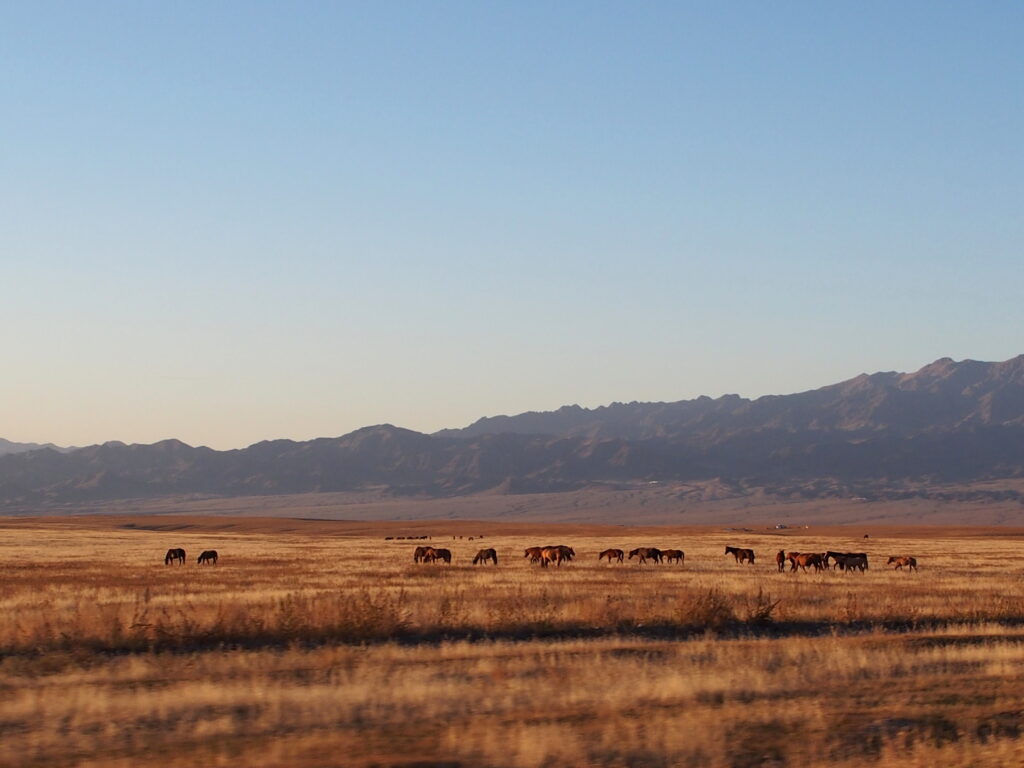
Three wild horses have been transported from the Prague Zoo to the vast grasslands of Kazakhstan, restoring the endangered species to one of its natural habitats after an absence of a century.  A Czech military plane helped to deliver the Przewalski's horses to the “Golden Steppe," or Altyn Dala, in central Kazakhstan, where they will stay for a while in enclosures to get used to conditions in their new environment. The Czech Ministry of Foreign Affairs said it co-funded repairs to the enclosures after damage caused by recent flooding in the Central Asian country.   “Congratulations to all those involved in these huge efforts to return these wild horses to the steppes of Kazakhstan,” said the Altyn Dala Conservation Initiative, a multinational partnership that is working to restore the Kazakh steppe ecosystem. It said on Tuesday that another group of the wild horses, which are named after the Russian geographer who identified the species in 1881, are on their way from Tierpark Berlin, a German zoo. Przewalski’s horse is “the last genetically wild horse on Earth” and its Russian namesake first came across the species in Mongolia, according to the multinational conservation group. The species vanished from the wild in the 1960s. But several European zoos kept some of the horses, saving the species from extinction, and reintroductions into the wild began in the 1990s, first in China and then in Mongolia.  The Prague Zoo is leading the relocation project in Kazakhstan, which aims to introduce a total of eight Przewalski’s horses to the steppe in the first year and several dozen horses over the next five years. Some of the wild horses will also come from Hungary’s Hortobagy National Park, which has the largest group of Przewalski’s horses outside Mongolia, as well as Nuremberg Zoo in Germany.  The reintroduction center for the horses is located in the Torgai steppe, which lies within a network of linked nature reserves that total 40,000 square kilometers, according to the Frankfurt Zoological Society, a partner in the Altyn Dala Conservation Initiative. The initiative, in turn, is led by the Association for the Conservation of Biodiversity of Kazakhstan. The conservation initiative has overseen a surge in the number of saiga antelope to more than 1.9 million, a 10-fold increase since a devastating disease outbreak in 2015.  “Unlike the Saiga, the Przewalski’s horse prefers a much broader selection of grasses, and in turn distributes the seeds of additional plant species across their shared steppe environment, playing a complimentary role.  In addition to this, their dung piles provide nutrients to other plants and decomposers, such as insects,” the initiative said.  A key part of the project is raising awareness about the wild horses among local communities. Conservationists are planning work with children and schools, providing educational materials and coloring books that outline the differences between wild and domestic horses. 

Kazakhstan’s Bolashak Program: More Trouble Than It’s Worth?

In 1993, Nursultan Nazarbayev, the first president of Kazakhstan, established the Bolashak ('Future' in Kazakh) International Scholarship. Its goal was to help gifted Kazakhstani youth obtain a high-quality foreign education. However, the program is currently mired in scandals with alarming regularity. Of course, most of these clickbait stories are minor — such as a 2022 incident with the famous singer Dimash Qudaibergen. He was selected for the Bolashak Program and went abroad before changing his mind. He tried to transfer the scholarship to someone else but was forced to return the money to the state. Still, several cases indicate that behind the scenes at the Center for International Programs, which administers the scholarship, something is not right. So far, no one has intervened – the program is still running – but the latest scandal could attract the attention of Kazakhstan's president Kassym-Jomart Tokayev. And he has already expressed dissatisfaction with some of the conditions of the scholarship. Getting the president’s attention Let’s unpack the current scandal, which has to be extinguished by a senior official such as the minister of education and science. Kazakhstani Natalya Vorobyova recorded a video message to Tokayev, saying that in 2016, she and her colleague Makpal Daribaeva acted as debt guarantors for her former colleague Valeria Gavrilenko, who had completed the Bolashak Program. According to Vorobyova, Gavrilenko “in 2019, conspiring with the center’s employees… illegally withdrew two apartments [that had been pledged to the center] as collateral and went off to live in the UK.” Now, her debt – graduates of the program are required to work in Kazakhstani government agencies for 3-5 years (depending on the region) – has to be repaid by the guarantors, i.e., by Vorobyova and Daribaeva. They owe about KZT30 million ($60,000). The press service of the Center for International Programs explained that since Gavrilenko evaded paying off the debt, the agreement transferred it to the guarantors. Just days later, on May 30, Sayasat Nurbek, who heads Kazakhstan’s Ministry of Education and Science, intervened, saying that an agreement had been reached with Gavrilenko whereby she would pay off her debt, with a corresponding agreement already signed by her. “Since Gavrilenko took it upon herself to fully return the money, an agreement was signed with her, and she has begun to pay back the money. Accordingly, the claims against the guarantors are withdrawn. Nevertheless, we were forced to initiate a case against all three obligation-bearers. We were forced to do this because they are jointly liable under the law. If Gavrilenko pays the full amount, the claims against the guarantors will be dropped. Unfortunately, they seem to have been advised incorrectly. They felt threatened that they would be forced to pay full damages. Today, we are concentrating all claims on Gavrilenko,” Nurbek said in the Senate as he was answering questions from journalists. As for the third party in this scandal – which, according to the minister, is also responsible – it is the former president of the Center for International...

Nazarbayev In-Law, Askar Kulibayev’s Oil Terminal Seized

Representatives of the General Prosecutor's Office of Kazakhstan have reported that an oil terminal in the port of Aktau belonging to Askar Kulibayev has been returned to the state. The 134-hectare property is valued at $66 million. “It was established that in 2011, the oil terminal was alienated into the ownership of Kulibayev's company. On February 26th, 2024, by the decision of the Specialized Inter-district Economic Court of Mangistau region, the claim of the Almaty city prosecutor was satisfied, and the oil terminal was returned to the state's ownership," said the supervisory body. The Almaty prosecutor's office stated that the claim was filed to compensate for the damage caused by the unlawful seizure of a foreign investor's property. However, the official message does not name the affected company. Now 87-years-old, Askar Kulibayev served as First Secretary of the Guryev (now Atyrau) Regional Committee of the Communist Party of Kazakhstan and as the Minister of Construction in independent Kazakhstan. He is the matchmaker of former President Nursultan Nazarbayev's daughter, and the father of Kazakhstan's richest man, Timur Kulibayev. In 2024, Timur Kulibayev and his wife Dinara Kulibayeva, still sit atop the list of the richest Kazakhs. The combined fortune of the Nazarbayev family is estimated at almost $10 billion.

Kazakhstan Works with Armenia and Azerbaijan for South Caucasus Peace

By Robert M. Cutler On May 10–11, Kazakhstan's President Kassym-Jomart Tokayev hosted peace talks between the Azerbaijani and Armenian foreign ministers. These constructive negotiations were strictly bilateral, with Kazakhstan absent from the room and only providing the venue for the meeting. The event illustrates the dedication by Tokayev and his foreign policy to regional stability and mediation. Kazakhstan has done this sort of thing in the past; it hosted Russia–Turkey–Iran talks over Syria until last year. It was also mentioned as a place for bilateral Russia–Ukraine negotiations, although that idea never materialized.   Armenia's Future is in the South Caucasus and Asia Tokayev had offered to provide the venue during his first official visit to Armenia, which took place on April 15 this year. His trip to Armenia may in retrospect be seen as a turning point. Former President Nursultan Nazarbayev had been forced to cancel a visit in 2016, following protests in Yerevan against Astana's support of Baku in the Karabakh conflict. Armenia’s participation in the new peace efforts, now under way for a couple of years, marks a significant shift after decades of rejecting such cooperation. It offers the prospect of renewed regional relations. Under Prime Minister Nikol Pashinyan, Armenia has lately been trying to shift its foreign policy, reaching out to Western countries such as France and the U.S. in order to decrease its long-standing dependence on (some would say, vassalage to) Russia. But Armenia is a state in the South Caucasus, not in Europe or America. For this reason, the state’s objective interests (as opposed to those of the far-flung diaspora) are geopolitically compatible with those of Azerbaijan and Turkey, and also of Kazakhstan more distantly. Astana’s ties with Baku and Ankara, and Azerbaijan’s strengthening of its own ties with Central Asia, reflect strategic manoeuvring in the region. These partnerships enhance Kazakhstan's and Turkey's roles in promoting stability and development in the South Caucasus. They consequently offer Armenia a new path to prosperity. Peace with Azerbaijan would lead to the lifting of the Turkish embargo on Armenia and open the possibility of Armenia's integration into the Trans-Caspian International Trade Route (TITR, "Middle Corridor"). Such an opening would further widen Armenia's diplomatic vistas and decrease its dependence on Russia. Turning to Europe and the U.S. can offer some advantages, but Armenia must be cautious of the influence of a bellicosely irredentist Armenian diaspora, whose interests are not first and foremost the well-being of Armenians living in Armenia. Prioritizing regional integration and cooperation with its South Caucasus neighbours and other TITR participants will enable Armenia proper to build a more stable and prosperous future.   Infrastructure and Connectivity Initiatives With the assistance of the international financial institutions, the European Union and Central Asia are developing the TITR as a critical trade corridor that will also contribute significantly to the prosperity and stability of the countries lying along its route. Azerbaijan and Kazakhstan have long been key players in the promotion and realization of this plan. The Middle Corridor,...

Justice Prevails in Kazakhstan Murder Trial Exposing Rift Between Government and Old Regime

The trial of Kuandyk Bishimbayev, a former Minister of the Economy of Kazakhstan, was a watershed event representing the growing role of civil society in the country, as well as the new political leadership’s success in breaking a decades-old cycle sustained by corrupt elites. In spearheading reforms to align his country with international best practices, President Kassym-Jomart Tokayev has also answered people’s demands. But public worries that Bishimbayev, sentenced to 24 years in prison for killing his wife, may be pardoned as soon as Tokayev leaves office shows how fragile the country’s institutional development remains and how its progress may still be on a ticking clock. Kazakh politician Kuandyk Bishimbayev was convicted of murdering his common-law wife, Saltanat Nukenova, during an altercation between the couple in November 2023 at an Astana restaurant. Throughout the course of his trial, which started in March 2024, it became apparent that the violence caught on a CCTV camera was not a one-off incident, but the latest in a string of abuse. The video, also seen by the jury, includes scenes of a man grabbing a woman by the hair, kicking her, and hitting her in the face. Nukenova is said to have subsequently died from brain trauma. Several factors drew international attention to the case, including the high-profile names involved, broadcasted court proceedings, wide social media engagement, and the commentaries from human rights figures and opinion leaders. The ultimate verdict handed down to Bishimbayev, 24 years imprisonment in a maximum-security institution, is in many ways unprecedented in post-Soviet states, and became a harbinger of changes in both Kazakhstan’s justice system and society. Bishimbayev’s cousin and the director of the restaurant where Nukenova was killed, Bakhytzhan Baizhanov, was also sentenced to four years in prison.   How a tragedy precipitated positive change Saltanat Nukenova’s death, and the events following it, helped bring about new laws and perhaps even opened the way for further reforms. Just as importantly, they also increased legal literacy among Kazakhstan’s civil society. The government’s response, for its part, has garnered international praise. Critically, the public tragedy expedited the implementation of positive steps that President Tokayev had previously wanted to take. Contrary to popular belief, Nukenova’s murder was not the basis of the initiative to re-criminalize domestic violence. This change had already been proposed by Tokayev in 2019, but was opposed by legislators, some of whom reportedly had themselves been previously associated with cases of domestic violence or abuse. The events surrounding Nukenova’s death provided the government with an opportunity to overcome domestic opposition and take steps to correct the country’s course on violence against women and children. On April 15, 2024, Tokayev signed a landmark law criminalizing violence against women and children, reversing a 2017 decriminalization. The need for full-fledged judicial reforms has been advocated for by several international non-governmental organizations (NGOs) and public associations, as well as institutions in the United States and Europe. This is not surprising given that the country’s existing judicial system was largely formed under its first...