• KGS/USD = 0.01143 0%
  • KZT/USD = 0.00205 0%
  • TJS/USD = 0.10433 0.1%
  • UZS/USD = 0.00008 0%
  • TMT/USD = 0.28577 0%
  • KGS/USD = 0.01143 0%
  • KZT/USD = 0.00205 0%
  • TJS/USD = 0.10433 0.1%
  • UZS/USD = 0.00008 0%
  • TMT/USD = 0.28577 0%
  • KGS/USD = 0.01143 0%
  • KZT/USD = 0.00205 0%
  • TJS/USD = 0.10433 0.1%
  • UZS/USD = 0.00008 0%
  • TMT/USD = 0.28577 0%
  • KGS/USD = 0.01143 0%
  • KZT/USD = 0.00205 0%
  • TJS/USD = 0.10433 0.1%
  • UZS/USD = 0.00008 0%
  • TMT/USD = 0.28577 0%
  • KGS/USD = 0.01143 0%
  • KZT/USD = 0.00205 0%
  • TJS/USD = 0.10433 0.1%
  • UZS/USD = 0.00008 0%
  • TMT/USD = 0.28577 0%
  • KGS/USD = 0.01143 0%
  • KZT/USD = 0.00205 0%
  • TJS/USD = 0.10433 0.1%
  • UZS/USD = 0.00008 0%
  • TMT/USD = 0.28577 0%
  • KGS/USD = 0.01143 0%
  • KZT/USD = 0.00205 0%
  • TJS/USD = 0.10433 0.1%
  • UZS/USD = 0.00008 0%
  • TMT/USD = 0.28577 0%
  • KGS/USD = 0.01143 0%
  • KZT/USD = 0.00205 0%
  • TJS/USD = 0.10433 0.1%
  • UZS/USD = 0.00008 0%
  • TMT/USD = 0.28577 0%

Viewing results 7 - 12 of 126

Two Kyrgyz Citizens Shot Dead by Uzbek Border Guards Near Tripoint Frontier

According to the Kyrgyz Border Service, two Kyrgyz citizens were shot and killed on August 15 near the junction of the Kyrgyz, Uzbek, and Kazakh borders after allegedly failing to comply with Uzbek border guards during an attempted detention. Their bodies were returned to Kyrgyzstan via the Baymak checkpoint, and authorities from both countries are conducting a joint investigation. The two men, residents of Aygyr-Zhal village in Kyrgyzstan’s Chatkal District, were reported missing on August 25. During bilateral consultations held three days later, the Uzbek authorities informed their Kyrgyz counterparts that on August 15, an Uzbek border patrol had encountered two unidentified individuals in the border zone. According to the Uzbek side, the men ignored orders to stop, prompting border guards to open fire. Both men sustained fatal injuries. On August 31, family members of the deceased traveled to Uzbekistan to identify the bodies, which were subsequently returned to Kyrgyzstan for forensic examination. Uzbek officials also expressed their readiness to return the men's belongings, including three horses and a tent. Authorities in both countries have confirmed that the incident will be subject to a formal investigation, with its findings to be made public. The shooting follows the resolution of a decades-long border demarcation process involving Kyrgyzstan, Uzbekistan, and Tajikistan. In March 2025, after nearly twenty years of negotiations, the three countries agreed on the official tripoint demarcation during talks in Dushanbe. While that agreement was hailed as a breakthrough in regional cooperation, the recent incident underscores the lingering sensitivities and security challenges along portions of the border.

Britain Imposes Sanctions on Kyrgyzstan’s Capital Bank, Other Entities

Britain has announced sanctions against Kyrgyzstan-based Capital Bank and its director, Kantemir Chalbayev, as part of a growing crackdown on financial networks allegedly being used by Russia to get around international restrictions and fund the war in Ukraine. The bank has previously denied circumventing such restrictions. “With sanctions continuing to bite, Russia has turned to the Kyrgyz financial sector to channel money through opaque financial networks, including through the use of cryptocurrencies. These networks have created a convoluted scheme to evade sanctions imposed by the UK and its partners,” the Foreign Office said on Wednesday. So-called secondary sanctions also targeted the Grinex and Meer cryptocurrency exchanges, as well as the infrastructure behind the new rouble-backed cryptocurrency token A7A5, which has moved $9.3 billion on a dedicated crypto exchange in just four months, according to the British government. The new round of British sanctions was also applied to the Kyrgyzstani firm Old Vector. The firm collaborated with Garantex, which had created Grinex to evade sanctions, and others in the development of the A7A5 token, according to an Aug. 14 statement by the U.S. Treasury Department that imposed similar measures. In May, state-owned Capital Bank said it was complying with international sanctions regulations. “Since 2023, as part of its risk management policy, Capital Bank has ceased all forms of financial interaction with individuals and legal entities subject to sanctions imposed by the United States, the European Union, and the United Kingdom,” the bank said. “This decision was made to protect the financial system of the Kyrgyz Republic from the potential impact of secondary sanctions and to ensure the security of operations for both resident and non-resident clients.” The Foreign Office statement comes as U.S. President Trump tries to end the war in Ukraine through dialogue, meeting last week with Russian President Vladimir Putin and this week with Ukrainian President Volodymyr Zelenskyy and European leaders.

Kyrgyzstan Parliament’s Secret Polygamy Law Repeal Blocked by President Japarov

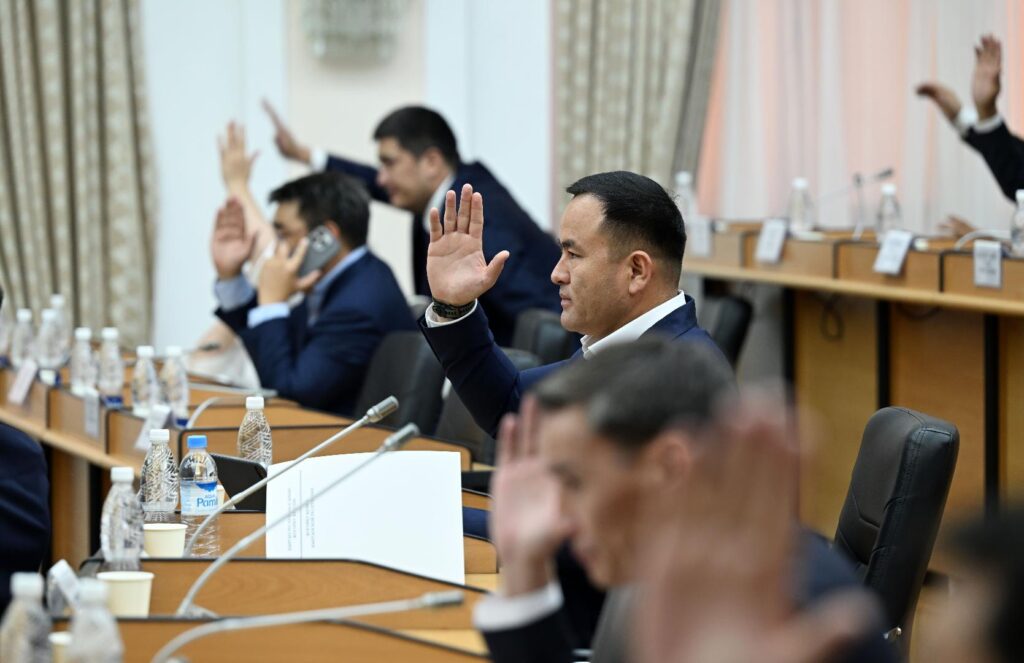
On June 25, 2025, Kyrgyzstan’s parliament, the Jogorku Kenesh, voted to repeal Article 176 of the Criminal Code, which criminalizes polygamy. The initiative was debated behind closed doors, without public hearings, and only came to light after the bill was submitted to President Sadyr Japarov for approval. According to the presidential administration, Japarov returned the bill for further revision. Before doing so, he sought official assessments from several key state bodies, including the Ombudsman’s Office, the Prosecutor General’s Office, the National Agency for Religious Affairs, the National Academy of Sciences, the Ministry of Justice, and the Constitutional Court. These institutions concluded that the proposal was incompatible with Kyrgyzstan’s Constitution and its international commitments, including the Convention on the Elimination of All Forms of Discrimination against Women (CEDAW) and the Convention on the Rights of the Child (CRC). In an explanatory note, the president stated that retaining criminal liability for polygamy "demonstrates a commitment to the principles of gender equality and the rule of law, protects women and children from legal and social inequality, and contributes to strengthening the institution of the family.” Under the current law, polygamy in Kyrgyzstan is classified as a minor offense. It is punishable by a fine ranging from 50,000 to 100,000 KGS (approximately $570 - $1,140), and criminal proceedings can only be initiated at the request of the victim. The Family Code permits only one officially registered marriage, and the civil registry office is not authorized to record second or subsequent unions.

Attacks on Doctors Surge in Kyrgyzstan Amid Systemic Failures

A recent spate of violent assaults on doctors in Kyrgyzstan has sparked growing concern within the healthcare sector. Over the past week alone, multiple incidents of medical staff being physically attacked have been reported at the National Hospital in Bishkek, with relatives of patients identified as the primary perpetrators. The first major incident involved a young resident doctor who was providing emergency treatment to a patient suffering from a severe nosebleed. According to local media reports, the patient's relatives attempted to interfere during the treatment and later assaulted the doctor as he accompanied the patient to a hospital ward. The doctor sustained a concussion, and his uniform was torn during the altercation. In a controversial move, police officers responding to the scene did not detain the attackers. Instead, they arrested the injured doctor, citing his use of obscene language. A court later sentenced him to three days of administrative detention. Human rights advocates say the doctor was denied legal counsel. Despite mobile phone video footage recorded by the doctor and corroborating statements from hospital staff, law enforcement agencies reportedly ignored this evidence. “The patient is much better, he received the necessary treatment and has been stable since. His relatives, however, acted with arrogance and cruelty toward medical personnel, seemingly convinced of their own impunity,” said Barmet Baryktabasova, chair of the Medical Trade Union. Just days later, a second assault occurred at the same hospital, this time targeting an emergency department physician. Although the attack was captured on CCTV, police again refrained from detaining the perpetrators, issuing only vague statements. The Medical Trade Union has announced plans to file formal appeals to the President’s Office, the Ministry of Health, the Prosecutor General, and the State Committee for National Security. The union argues that violence against medical professionals is becoming systemic and poses a threat to the integrity of Kyrgyzstan’s already strained healthcare infrastructure. Health Minister Erkin Checheibaev condemned the assaults in a public Facebook post: “There is lawlessness against doctors! The man who attacked the doctor must be punished. This sets a dangerous precedent when attackers face no consequences.” He emphasized the urgent need to protect the dignity and physical safety of medical personnel, warning that failure to act could lead to a severe staffing crisis in the coming years. This is not the first wave of violence against healthcare workers in Kyrgyzstan. In 2023, following several incidents, the National Hospital briefly enhanced security by installing panic buttons, surveillance cameras, and hiring private guards. However, these measures were later rolled back due to budget constraints. Currently, the average salary for public sector healthcare workers in Kyrgyzstan ranges from $300 to $400 per month. Combined with long hours and frequent high-stress situations, poor compensation is prompting many experienced professionals to exit the system. The government has pledged to implement healthcare funding reforms over the next three to four years, but many in the medical community fear those changes will come too late.

“Be a Man”: Bishkek Vice Mayor Detained in Public Showdown

The Vice Mayor of Bishkek, Zhamalbek Yrsaliev, has been detained during a public meeting in the Tunguch neighborhood, presided over by Kamchybek Tashiyev, the controversial Chairman of Kyrgyzstan’s State Committee for National Security (GKNB). Residents at the July 16 meeting accused Yrsaliev of illegally occupying a 1,500 m² municipal land plot where unauthorized commercial kiosks and children's attractions had been operating for six years without any lease payments. According to Economist.kg, this misuse cost the city budget over 2.9 million Kyrgyz som ($33,160), and stalled the planned development of a public square and playground. During the meeting, Tashiyev confronted Yrsaliev directly. In a moment caught on video, he told the vice mayor to take responsibility for his actions and “Be a man,” ordering the security services to detain him immediately. Officers escorted Yrsaliev from the event to the GKNB headquarters. According to Sputnik Kyrgyzstan, Yrsaliev admitted responsibility and apologized, but Tashiyev continued to reprimand him, telling Yrsaliev, “You will not deceive the people.” The investigation is ongoing. The charges against Yrsaliev include abuse of office and corruption. Alongside him, officials from the Lenin and Oktyabr district administrations were also detained during the same operation, according to preliminary reports. Appointed as vice mayor in May 2024, Yrsaliev previously served as vice-mayor of Bishkek for housing and communal services, and akim of the Pervomaisky district. The arrest marks another chapter in Kyrgyzstan’s sweeping anti-corruption campaign under President Sadyr Japarov. In January 2023, former Deputy Prime Minister Zhenish Razakov was detained on suspicion of a $1 million fraud and abuse of office, and in December 2024, the authorities arrested the head of the state tax service and his deputy. While Yrsaliev’s detention has been officially framed as part of an anti-corruption effort, it unfolds within a broader political climate in Kyrgyzstan marked by increasing executive consolidation and the expanded role of the GKNB in domestic affairs. Independent watchdogs, including Freedom House, have noted a rise in politically motivated prosecutions and diminished judicial independence in recent years, raising concerns that cases such as this may serve not only legal but also political purposes. Further updates are expected as the investigation continues.

Kyrgyzstan Shutters April TV as President Signs New Media Law

A district court in Bishkek has ordered the liquidation of April TV, one of Kyrgyzstan’s few remaining independent broadcasters, intensifying what some observers are calling an ongoing campaign to silence dissenting voices in the country’s media landscape. The decision, handed down by the Oktyabr District Court on July 9, followed a lawsuit brought by state prosecutors who alleged that the broadcaster's content was “biased, one-sided, destructive and manipulative,” and posed a threat to the constitutional order. In a related development, on July 11, President Sadyr Japarov signed a new law clamping down on media freedom into force. In the district court, prosecutors argued that April TV’s content risked inciting mass unrest and undermining the authority of the state. The court’s ruling cited assessments conducted by the State Committee for National Security (GKNB), which claimed that the broadcaster’s video reports negatively influenced public opinion, insulted government officials, and could provoke calls for the seizure of power. Over the past two years, President Japarov's administration claims to have successfully thwarted several attempted coups and assassination plots targeting high-ranking officials. These incidents, according to the government, highlight ongoing challenges to political stability in Kyrgyzstan, which has framed its efforts as critical to ensuring the country’s continued progress amidst a complex regional and domestic landscape. In addition to terminating April TV’s legal status, the court also authorized the blocking of its online platforms and affiliated channels, including the popular YouTube-based partner channel Next TV. Editor-in-chief of April TV, Dmitriy Lozhnikov, rejected the government’s claims, defending the station’s critical tone and stating that “criticizing the government isn’t a crime, but one of the core functions of the press.” In a final message before going offline, the outlet declared it was taking “a vacation from which [we] might never return.” At least ten current and former staff members of April TV were summoned for questioning by the GKNB as part of a broader criminal probe. No specific charges have been disclosed. The closure of April TV mirrors actions taken against other prominent independent outlets in Kyrgyzstan over the past two years. In February 2024, a Bishkek court approved the liquidation of Kloop, a media organization known for its investigative reporting on corruption – a ruling later upheld by the Supreme Court. The authorities claimed that its charter did not permit Kloop to engage in journalism, and objected to what they described as the “negative tone” of its reporting. In late May, the security forces conducted coordinated raids on the homes of eight current and former Kloop employees in Bishkek and Osh — detaining two on charges of “public calls for mass unrest” and compelling the others to sign non-disclosure agreements. Kloop has relocated its operations abroad, maintaining access to its content in Kyrgyzstan through mirror sites and launching a new podcast studio in Georgia. Despite mounting pressure, the outlet’s leadership remains defiant, vowing to continue producing the “most incisive investigations, the most objective news, and the boldest commentary.” In a similar vein, the investigative media outlet Temirov...