
• KGS/USD = 0.01144 0%
  • KZT/USD = 0.00204 0%
  • TJS/USD = 0.10398 0%
  • UZS/USD = 0.00008 0%
  • TMT/USD = 0.28490 0%
  • KGS/USD = 0.01144 0%
  • KZT/USD = 0.00204 0%
  • TJS/USD = 0.10398 0%
  • UZS/USD = 0.00008 0%
  • TMT/USD = 0.28490 0%
  • KGS/USD = 0.01144 0%
  • KZT/USD = 0.00204 0%
  • TJS/USD = 0.10398 0%
  • UZS/USD = 0.00008 0%
  • TMT/USD = 0.28490 0%
  • KGS/USD = 0.01144 0%
  • KZT/USD = 0.00204 0%
  • TJS/USD = 0.10398 0%
  • UZS/USD = 0.00008 0%
  • TMT/USD = 0.28490 0%
  • KGS/USD = 0.01144 0%
  • KZT/USD = 0.00204 0%
  • TJS/USD = 0.10398 0%
  • UZS/USD = 0.00008 0%
  • TMT/USD = 0.28490 0%
  • KGS/USD = 0.01144 0%
  • KZT/USD = 0.00204 0%
  • TJS/USD = 0.10398 0%
  • UZS/USD = 0.00008 0%
  • TMT/USD = 0.28490 0%
  • KGS/USD = 0.01144 0%
  • KZT/USD = 0.00204 0%
  • TJS/USD = 0.10398 0%
  • UZS/USD = 0.00008 0%
  • TMT/USD = 0.28490 0%
  • KGS/USD = 0.01144 0%
  • KZT/USD = 0.00204 0%
  • TJS/USD = 0.10398 0%
  • UZS/USD = 0.00008 0%
  • TMT/USD = 0.28490 0%

Viewing results 25 - 30 of 50

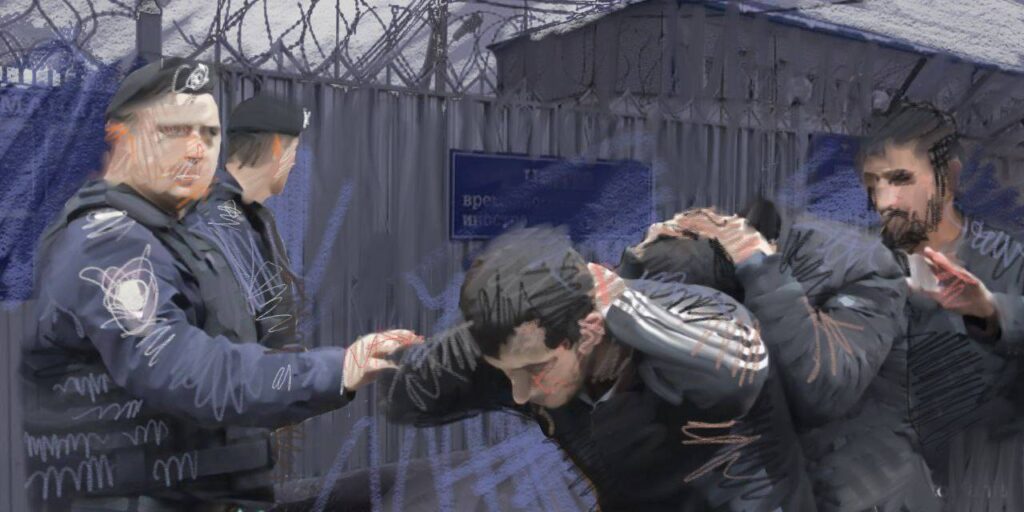
Central Asians Beaten and Deported from Russia

The punishment for many Central Asians in Russia whose work or residency documents are not in order is pain and humiliation, and then possibly deportation. Xenophobia targeting Central Asians in Russia has been on the rise since the March 22 terrorist attack on Moscow’s Crocus City Hall that left more than 140 people dead. Russian authorities apprehended a group of ethnic Tajiks who allegedly carried out the attack and after that the level of prejudice against Central Asians in Russia, which has always existed, dramatically worsened. The treatment of Central Asians at the Sakharovo migration center on the outskirts of Moscow is an example. Moscow courts are likely to send Central Asians caught with document problems to the Sakharovo center. Radio Free Europe’s Kyrgyz Service interviewed several people who passed through the Sakharovo center. Their descriptions shed light on the conditions inside. One man who spent 18 days in the center said, “The day we entered there, they intimidated us, forced us to walk in single file, run fast… then they examined us and beat us with a stun gun.” That jibes with another man’s description. “They call your last name, then you go out into the corridor and run. There they hit you on the back of the head and tell you to ‘run.’” Then, the man continued, “They made me face the wall, forced me to raise my arms up, spread my legs, and started hitting me with a stun gun.” There is an anti-Islamic element to the treatment of detainees at Sakharovo. A different person remembered this about his detention. “They fed us food with pork. Since we were hungry, we removed the meat and ate what was left.” He said there were some people who recited their daily prayers in their rooms. “When one guy was saying namaz, the guards entered. Then one of them (the guards) hit him in the face twice.” When the person continued saying his prayers, the guards said, “Let him go to Kyrgyzstan, Tajikistan, Uzbekistan, and read his prayer there.” Some of the detainees with beards were forcibly shaved. Batygul Moldobayeva is from Kyrgyzstan. She was detained in Moscow this summer with an expired work permit and sent to Sakharovo. Moldobayeva said the guards yelled at women detainees and were rude to them. She added that sometimes the guards “asked them to be their ‘temporary wives.’” Moldobayeva said there were pregnant women in the center, some as far along as six months, and the guards did not pay any attention to their condition. According to Moldobayeva, there were some Kyrgyz citizens at Sakharovo who had been there for three or four months. Askar Uskenbayev is another Kyrgyz citizen who was detained in Moscow in mid-June and sent to Sakharovo. He said he met fellow Kyrgyz citizens who had been there six months. After being deported back to Kyrgyzstan, Moldobayeva posted about her experience on social media and warned Kyrgyz citizens to be sure all their documents were in order if they...


SCO and Afghanistan on the Cusp of a New Relationship

The hype surrounding the recent summit of the Shanghai Cooperation Organization Council of Heads of State in Astana has died down, and the expert community has offered differing takeaways, with some experts optimistic and others cautious. Few, however, have considered what new this summit delivered on Afghanistan. In general, what is the role of the Shanghai Cooperation Organization (SCO) in resolving the political issues around long-suffering Afghanistan and rebuilding its economy? Despite the SCO’s previous hands-off approach to Afghan affairs, the issue of Taliban-ruled Afghanistan was raised for the first time at the highest level of the SCO in Astana, which gives hope that the organization will expand its role. In their remarks, almost every SCO head of state touched on Afghanistan in essentially the same vein, stating the need for peace, stability and security, while underlining the fact that Afghanistan is an integral part of Central Asia. Indeed, Afghanistan was mentioned in the final declaration of the Astana summit, with Member States “reaffirming their commitment to asserting Afghanistan as an independent, neutral and peaceful state free from terrorism, war, and narcotic drugs [and voicing] their readiness to support the international community’s efforts to facilitate peace and development in that country.” At the same time, there was a clear message to the Taliban that “the establishment of an inclusive government involving multiple representatives of all ethnic and political groups of Afghan society is the only way toward attaining lasting peace and stability in that country.” These statements represent a rather big step, considering that previously the SCO failed to find a consensus on Afghanistan and develop its own mechanisms to interact with Kabul. The creation of the SCO-Afghanistan Contact Group back in 2005 was rather a spontaneous reaction to the US-led coalition's Operation Enduring Freedom in the wake of the 9/11 terrorist attack. The SCO itself says the contact group was created because of the "concerns of the SCO countries about the negative development of the situation in Afghanistan and the intention of the SCO to establish a specific consultative dialogue with Kabul." While the contact group included the members’ permanent representatives to the SCO, only a few events were ever held. Indeed, interest in the contact group was only really apparent from the Afghan side, which was looking for SCO assistance in rebuilding the Afghan economy and SCO participation in implementing various energy and transport infrastructure projects and creating favorable conditions for Afghan goods to access the markets of SCO countries. However, none of this was realized. The SCO states preferred, as they still do, to conduct relations with Afghanistan bilaterally, and did not support the efforts of the SCO Secretariat to intensify the work of the contact group. In 2010, Uzbekistan directly indicated its interest in building relations with Afghanistan exclusively on a bilateral basis and stated that it would no longer take part in the contact group. In June 2012, Afghanistan’s application for SCO observer status was granted. Yet this step was more symbolic and failed to...

Saudi Islamic Development Bank Increasing Its Presence in Central Asia

The Saudi-based Islamic Development Bank (IDB) has been particularly active in Central Asia so far in 2024. The growing IDB role is part of Central Asian region’s foreign policy shift toward the Arab world as financial backers to replace Russia, which is devoting huge attention and resources to its war in Ukraine, and China, which is increasingly reluctant to spend large sums of money in Central Asia after pouring in tens of billions of dollars there during the last 25 years. Some of the Central Asian governments owe China substantial amounts of money that they are unlikely to be able to pay for possibly decades. The Central Asian states have been members of the IDB for many years. Kyrgyzstan was first, joining in 1993, followed by Turkmenistan in 1994, Kazakhstan in 1995, Tajikistan in 1996, and Uzbekistan in 2003. One of the IDB’s three regional offices is in Almaty, Kazakhstan (the other two are in Kuala Lumpur, Malaysia and Rabat, Morocco).  The IDB has been dealing individually with the five Central Asian countries on a wide range of projects and programs in recent months. Energy Resources In February, Tajik Minister of Economic Development and Trade Zavqi Zavqizoda announced a deal was reached for the IDB to provide $250 million to Tajikistan. Zavqizoda said $150 million of that would go toward construction of the Rogun hydropower plant (HPP).  The Rogun HPP was a Soviet-era project. Construction started in 1976 but was discontinued shortly after the Soviet Union collapsed. Tajikistan restarted work on the HPP in 2008. Tajik President Emomali Rahmon has repeatedly said that building the HPP with a planned 3600 MW capacity will make the country energy independent and even allow Tajikistan to bring in extra revenue exporting electricity to neighboring countries.  In its 28 years as an IDB member, Tajikistan had received some $620 million from the IDB, so the $250 million announced in February 2024 represents a significant jump in IDB financial help. Not surprisingly, when IDB President Muhammad Al-Jasser visited Kyrgyzstan in June, Kyrgyz President Sadyr Japarov sought IDB investment in the Kambar-Ata-1 HPP, another decades-old project with a multi-billion-dollar price tag that has barely made any progress in being realized during the 33 years Kyrgyzstan has been independent. Al-Jasser did not commit to IDB financing for the Kyrgyz HPP. However, less than a week after Al-Jasser was in Kyrgyzstan, the IDB was one of several international financial organizations that signed on at a conference in Vienna to be a members of a coordination donors’ committee for the Kambar-Ata-1 projects. At a meeting in Istanbul in February, the IDB reaffirmed its support for the Central Asia-South Asia-1000 (CASA-1000) project that aims to export electricity from HPPs in Kyrgyzstan and Tajikistan to Afghanistan and Pakistan. Kyrgyz Energy Minister Taalaybek Ibrayev met with Al-Jasser in June during the latter’s visit to Kyrgyzstan to discuss funding for Kyrgyzstan’s section of CASA-1000. Not Only Energy In June, the IDB pledged up to $2 billion in funding for improvements to water management...

SCO Summit in Astana: Correspondents from China Global Television Network, Times of Central Asia Discuss Upcoming Meeting

National leaders and other dignitaries from over 20 countries will be in the Kazakh capital of Astana this week for the annual summit of the Shanghai Cooperation Organization (SCO). The Times of Central Asia will be covering the SCO Summit live on 3 and 4 July from the city’s Palace of Peace and Reconciliation. The SCO is a political, security and economic alliance in the wider Eurasia region. This year’s Summit host Kazakhstan was a founding member of the Organization in 2001, alongside China and Russia, and its Central Asian neighbors Kyrgyzstan, Tajikistan and Uzbekistan. The last time the Summit was held in Astana, in 2017, India and Pakistan became full members. There are currently nine full member states, four observer states, and 14 dialogue partners, covering half of the world’s population, and almost a third of global GDP. This year's Summit will have significant implications for regional and global affairs. It is likely to produce initiatives aimed at reducing trade barriers, and promoting investments between SCO member states. High on the agenda will be the Belt and Road Initiative (BRI) – a crucial framework for enhancing connectivity and economic ties between China and its Central Asian partners. Other anticipated outcomes include new initiatives on climate change and sustainable development, as well as strengthened cultural and educational exchanges. Upon the initiative of Kazakhstan’s President Kassym-Jomart Tokayev, 2024 has been named the SCO “Year of Ecology”. Ahead of the Astana Summit, The Times of Central Asia’s senior editor Jonathan Campion spoke with an anchor from China Global Television Network, Mr Zhong Shi, about the role of the Shanghai Cooperation Organization plays in the Central Asia region. Their talk can be viewed in full in the videos below. In response to The Times of Central Asia’s question about what makes the SCO different from other alliances that the countries of Central Asia are aligned with, Mr Zhong explained that: “The SCO has been truly effective in combatting what we call the three enemies of all members, namely terrorism, extremism and separatism. There have been joint military drills conducted to enhance the coordination among armed forces”. Listen to Mr Zhong’s full response below: [video width="1920" height="1080" mp4="https://timesca.com/wp-content/uploads/2024/06/fullscreen-Zhong-Shi-answer-2-questions.mp4"][/video]   [video width="1920" height="1080" mp4="https://timesca.com/wp-content/uploads/2024/06/tw0-windows-Zhong-Shi-answer-2-questions.mp4"][/video] In turn, Mr Campion gave The Times of Central Asia’s perspective on the upcoming Summit. Asked about the impact that the Belt and Road Initiative has had on Central Asia, he replied: "Central Asia is evolving as a land bridge component to the Belt and Road Initiative linking China to the Caspian Sea. We’re seeing that investments in transport infrastructure are unlocking the region’s vast natural resources. With the world making a green transition, Kazakhstan stands out, as it has an abundance of critical materials – or green metals as they are known – that are used in the components of green technologies.” Listen to Mr Campion’s full response below: [video width="1920" height="1080" mp4="https://timesca.com/wp-content/uploads/2024/06/Jonathon-answer-Q2.mp4"][/video]   [video width="1920" height="1080" mp4="https://timesca.com/wp-content/uploads/2024/06/Jonathon-answer-Q3.mp4"][/video]  

Men in Black Blamed for Series of Murders in Northern Tajikistan

People in the Konibodom area of northern Tajikistan are locking themselves in their homes when darkness falls. Some are arming themselves. Others have left altogether out of fear. There appears to be a serial killer or killers on the loose. At least 13 people have been murdered in their homes in or near Konibodom since late March, and local police seem baffled as to who is doing this or why. It started with the killing of five members of the Sharipov family in late March. Initially investigators believed the 65-year-old head of the house had killed his wife, daughter-in-law, and two grandchildren, then hanged himself, but they later determined someone broke into the home and the killer hanged the man to make it look like a domestic dispute and suicide. On the night of April 16-17, someone broke into a home in the Gafurjon Ortikov neighborhood of Konibodom and killed the husband and wife who lived there. Police said the bodies of the victims, whom police did not identify, bore the signs of a violent death. The most recent killings happened on the night of May 28-29 in the village of Sanjidzor, outside Konibodom. Mahbuba Ahmedova and her two children were killed in their home and that same night, at a different house, the deputy director of a local school, Zulho Ibragimova, her brother and brother’s wife were killed. Local law enforcement said preliminary evidence showed all six people were strangled. Locals speak about men in black who break into people’s homes at night and kill them. A video was posted, purportedly from a surveillance camera in Konibodom, that shows a person with black clothing and a black hood or mask trying to break into a home. Konibodom resident Mahsuda Kodirova said she and her daughter were sitting in the courtyard of their home a little after 10 in the evening on June 11, when a man in black clothing with a black mask suddenly appeared and approached them. Kadirova said she and her daughter screamed and ran out into the street. When the police arrived, they told Kadirova they had received many similar calls from terrified residents during the previous 48 hours. Understandably, there is panic in Konibodom. Many of the men, especially the young men of Konibodom, are currently migrant laborers in Russia who are supporting their elderly parents, wives, and children back home. The bodies of Mahbuba Ahmendova and her two children were found by neighbors after Ahmedova’s husband had been calling her from Russia and finally called a neighbor to go and check on his family. Konibodom is near the border with Kyrgyzstan and the population of the city is mixed, mostly Tajiks, but many Kyrgyz as well. Most of the victims have been ethnic Tajiks, but Ibragimova, her brother, and her brother’s wife were Kyrgyz. The seeming randomness of the victims puts everyone on edge, at least everyone still there. The Tajik news outlet Asia-Plus sent its reporters to Sanjidzor after the killings in late...

Eurasian Connectivity Comes One Step Closer at the 2024 CAMCA Forum in Bishkek

The wider Eurasia region took another step towards cooperation and connectivity last week, as the 10th annual CAMCA Regional Forum was held in Bishkek. CAMCA – standing for Central Asia, Mongolia, the Caucasus and Afghanistan – is an initiative to accelerate dialogue between governments, private enterprises and media figures from these ten nations. Organized by the Washington, D.C.-based Central Asia-Caucasus Institute and the Rumsfeld Foundation, this year’s Forum – the first such event to take place in Kyrgyzstan – featured over 300 delegates across its two days, and presented insights from over 70 speakers. Attendees came from 25 countries in total. Professor Frederick Starr, the Central Asia-Caucasus Institute’s chairman, used his opening address to call on the countries of the region to start preparing for a future within a cohesive international bloc. Dr Starr reasoned that Russia and China, imperial powers that have traditionally had a controlling presence in Central Asia, may see their global influence wane in the coming decade. This would give the countries of Central Asia, and their neighbors, more space to create projects that serve their economies directly. A leading CAMCA regional project is the ‘Middle Corridor’ trade route, which bypasses Russia to transport goods more efficiently between Europe and China. Discussions are also taking place concerning the creation of single business and tourist visas for the whole Central Asia region. The importance of collaboration between countries in the Caucasus and Central Asia to mitigate the impact of climate change has never been so great. Addresses by senior members of the Kyrgyz government highlighted the progress that Kyrgyzstan has made since the administration of president Sadyr Japarov began its work in 2021. The country’s deputy prime minister Edil Baisalov reported that Kyrgyzstan is on track to double its GDP to $30 billion by 2030, while the minister for digital development, Nuria Kutnaeva, spoke about the rapid digitalization of the country’s government services.  In a noticeably warm and collaborative atmosphere, the event nonetheless highlighted the barriers that prevent the ten countries from forming a tangible ‘CAMCA’ space in the present. A key goal is the harmonization of their legislation and policy directions; however, no delegates from Tajikistan could travel to Bishkek for the Forum, as otherwise solid relations between Tajikistan and Kyrgyzstan are still strained by a dispute over their common border. Likewise, Armenian voices were also absent this time, in light of several of the sessions featuring Azerbaijani speakers and talking points. The event featured only one guest from Turkmenistan.  Even in these conflicts, however, Central Asian diplomacy is at work. The conflict on the Kyrgyz-Tajik border, mainly in Tajikistan’s Vorukh district, is being resolved through negotiations between the two countries’ governments, which would have been unthinkable even five years ago. Meanwhile, Kazakhstan is acting as a mediator between Baku and Yerevan in the aftermath of the war in Nagorno-Karabakh. Other topics on the agenda included security priorities for Central Asia, digital innovation in business, cooperation with Afghanistan, transitions in global energy markets, and infrastructure projects...