
• KGS/USD = 0.01144 0%
  • KZT/USD = 0.00210 0%
  • TJS/USD = 0.10438 0%
  • UZS/USD = 0.00008 0%
  • TMT/USD = 0.28490 0%
  • KGS/USD = 0.01144 0%
  • KZT/USD = 0.00210 0%
  • TJS/USD = 0.10438 0%
  • UZS/USD = 0.00008 0%
  • TMT/USD = 0.28490 0%
  • KGS/USD = 0.01144 0%
  • KZT/USD = 0.00210 0%
  • TJS/USD = 0.10438 0%
  • UZS/USD = 0.00008 0%
  • TMT/USD = 0.28490 0%
  • KGS/USD = 0.01144 0%
  • KZT/USD = 0.00210 0%
  • TJS/USD = 0.10438 0%
  • UZS/USD = 0.00008 0%
  • TMT/USD = 0.28490 0%
  • KGS/USD = 0.01144 0%
  • KZT/USD = 0.00210 0%
  • TJS/USD = 0.10438 0%
  • UZS/USD = 0.00008 0%
  • TMT/USD = 0.28490 0%
  • KGS/USD = 0.01144 0%
  • KZT/USD = 0.00210 0%
  • TJS/USD = 0.10438 0%
  • UZS/USD = 0.00008 0%
  • TMT/USD = 0.28490 0%
  • KGS/USD = 0.01144 0%
  • KZT/USD = 0.00210 0%
  • TJS/USD = 0.10438 0%
  • UZS/USD = 0.00008 0%
  • TMT/USD = 0.28490 0%
  • KGS/USD = 0.01144 0%
  • KZT/USD = 0.00210 0%
  • TJS/USD = 0.10438 0%
  • UZS/USD = 0.00008 0%
  • TMT/USD = 0.28490 0%

Viewing results 583 - 588 of 2832

Timur’s Birthplace Languishes on UNESCO List of Endangered Sites

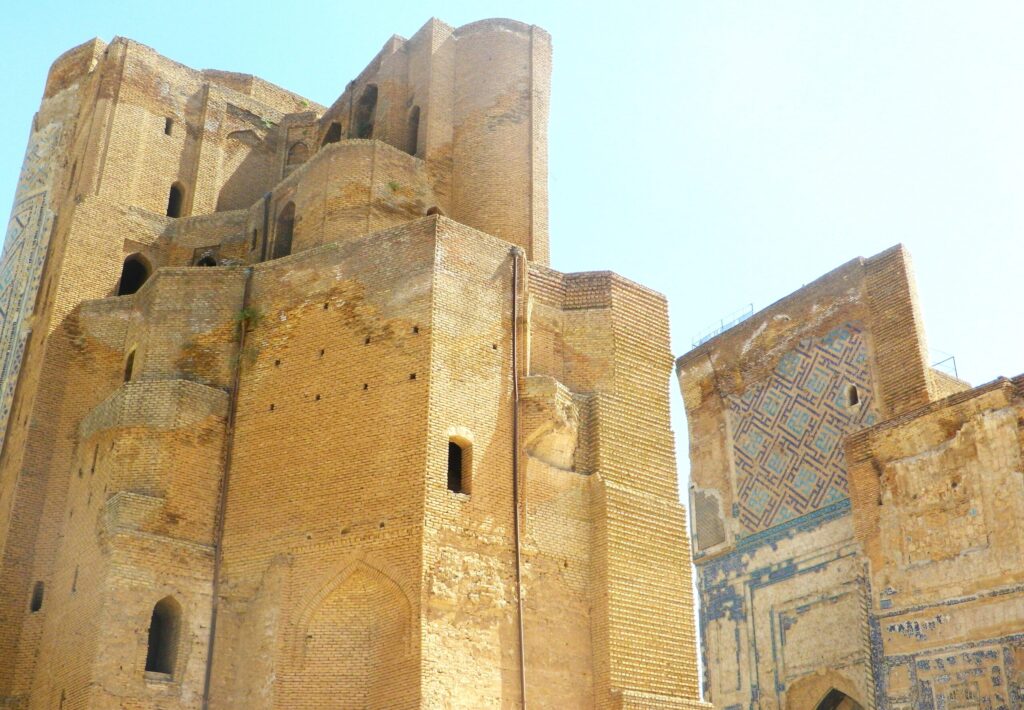
Bukhara, Samarkand, Khiva. Uzbekistan’s cultural heritage draws visitors from around the world, but the troubled modern history of another ancient site, Shakhrisabz, is a reminder that development and mass tourism sometimes overshadow preservation. Shakhrisabz, or Green City, is less known than some other tourist destinations in Uzbekistan that were part of the Silk Road network linking cultures across Asia, Europe, and Africa many centuries ago. Yet the old urban core is more than 2,000 years old and contains spectacular monuments and other structures, some dating from the heyday of the city during the rule of the Turco-Mongol conqueror Timur, also known as Tamerlane, and the Timurids in medieval times. [caption id="attachment_34196" align="aligncenter" width="2560"] Timur Statue; image: TCA, Stephen M. Bland[/caption] UNESCO declared it a world heritage site in 2000. But the historical center of Shakhrisabz, previously called Kesh, was placed on the U.N. cultural agency´s list of world heritage sites in danger in 2016 after large sections were razed to make way for a park and tourist facilities. It has stayed on the danger list ever since as officials in Uzbekistan, assisted by international advisers, try to figure out a way to prevent it from losing its United Nations status altogether. A total of 53 locations around the world are on UNESCO’s danger list. [caption id="attachment_34197" align="aligncenter" width="2560"] The Fayzullah Ravnakhi Museum B&B, one of many buildings demolished to make way for tourist facilities; image: TCA, Stephen M. Bland[/caption] A solution in Uzbekistan’s case appears to be in the works. At a meeting in Paris this month, the UNESCO World Heritage Committee tentatively approved an Uzbek proposal that would restore Shakhrisabz in southern Uzbekistan to the regular heritage list but in reduced form – only four key Timurid monuments would be included, while the rest of the historical center would be labeled as a buffer zone. “The main focus is expected to shift from the concept of a ´complete historic city´ to the conservation of the ensemble of monuments, including the Ak-Saray Palace, while preserving their urban context,” reported Gazeta.uz, a media organization in Uzbekistan. [caption id="attachment_34198" align="aligncenter" width="2560"] Ak-Saray Palace; image: TCA, Stephen M. Bland[/caption] Uzbekistan must conduct archaeological studies, prepare a restoration plan, and take other measures in order for the proposal to succeed, according to Gazeta.uz. Uzbekistan must update UNESCO on its progress in February 2026, and the process could still take several years. Construction of the Ak-Saray Palace began in 1380 after a military victory by Timur, who was born in the city, according to UNESCO. The agency said that not one of the many Timurid monuments in Samarkand, north of Shakhrisabz, can rival the Ak-Saray Palace. “The foundations of its immense gate have been preserved: this architectural masterpiece is outstanding in its dimensions and bold design,” UNESCO said. While Shakhrisabz has less tourist infrastructure than nearby Samarkand, there are efforts to raise its profile. Last year, the Economic Cooperation Organization, whose ten members include Central Asian countries, declared it the tourism capital for 2024. Uzbekistan’s other cultural sites have also faced...

Azerbaijan’s Aliyev: Uzbekistan’s First Gift Helped Rebuild Karabakh

At a major media forum held in Khankendi, Azerbaijani President Ilham Aliyev expressed gratitude to Uzbekistan for its contribution to the reconstruction of Nagorno-Karabakh. Speaking at the event, Professor Sherzodhon Kudratkhodja, Rector of Uzbekistan’s University of Journalism and Mass Communications, congratulated Aliyev on successfully hosting the 17th Summit of the Economic Cooperation Organization (ECO) in Khankendi. He noted that while Uzbek journalists had visited Karabakh over the past three years, this was their first visit to Khankendi, marking a symbolic step toward reconciliation and renewal. Kudratkhodja praised the recent meeting between Aliyev and Armenian Prime Minister Nikol Pashinyan in Abu Dhabi, calling it “historic” and “a beacon of friendship” amid global uncertainty. He also asked about the strategic importance of the Zangezur corridor, not just for Azerbaijan and Armenia, but for the wider Turkic world. “The corridor will serve as a bridge, reconnecting once-separated lands,” he said. Commending the reconstruction of roads, buildings, mosques, and churches in Karabakh, he added: “This shows the world your tolerance and noble spirit.” Uzbekistan’s First Contribution In response, Aliyev highlighted Uzbekistan’s role in the early phases of Karabakh’s reconstruction following the 2020 Second Karabakh War. He cited the construction of a school for 960 students in Fizuli, initiated by Uzbek President Shavkat Mirziyoyev and named after the renowned Uzbek scholar Mirzo Ulugbek. “Uzbekistan made the first gift in restoring Karabakh,” Aliyev said. “A few days ago, I visited the school again. Over 500 children are already studying there, even though refugees are only just beginning to return to Fizuli. We deeply appreciate this brotherly gesture by the President of Uzbekistan.” Rebuilding Efforts in Karabakh The Second Karabakh War, also known as the 44-day war, ended in November 2020 with a ceasefire agreement restoring Azerbaijani control over formerly occupied territories. By mid-2024, Azerbaijan had spent more than USD $7 billion on reconstruction, including demining, infrastructure development, industrial revitalization, and tourism initiatives. Aliyev emphasized the symbolism of hosting the ECO Summit at Khankendi’s new congress center, built on the site of the former separatist parliament. Leaders from eight ECO member states attended the event, underscoring normalization in the region. Nearby, reconstruction continues at a Soviet-era hotel and Victory Square, the former site of the communist party headquarters, which is being transformed with the construction of a new Victory Museum. Zangezur Corridor and Regional Connectivity Aliyev also underlined the strategic significance of the Zangezur corridor, which is intended to link mainland Azerbaijan with its exclave of Nakhchivan and further to Turkey. He cited billions of dollars in national infrastructure investment, including the Caspian Sea’s largest port, expanded roadways, and the Baku-Tbilisi-Kars railway-now capable of handling 25 million tonnes of freight annually. “During President Mirziyoyev’s visit, we discussed increasing freight traffic through this corridor,” Aliyev said. He also referenced the development of the China-Kyrgyzstan-Uzbekistan-Turkmenistan railway, which will provide an additional route across the Caspian Sea and enhance regional connectivity. “These links are proof that our region can grow stronger together,” Aliyev stated. A Shared Legacy Both speakers highlighted...

Uzbekistan, Pakistan, and Afghanistan Sign Deal to Study TransAfghan Railway

Uzbekistan, Pakistan, and Afghanistan have taken a significant step toward realizing the long-planned TransAfghan railway. According to Uzbekistan Railways, the three countries signed an intergovernmental agreement on July 17 in Kabul to launch a technical and economic feasibility study for the proposed “Termez-Naibabad-Maidan Shar-Logar-Kharlachi” route. The deal was finalized at a trilateral summit attended by Uzbekistan’s Transport Minister Ilkhom Makhkamov, Pakistan’s Railways Minister Muhammad Hanif Abbasi, and Afghanistan’s acting Public Works Minister Mohammad Esa Thani. The route itself was agreed upon in July 2023 in Islamabad by representatives of all three nations. A project office established under the International Transport Corridors Development Strategy, launched in May 2023 in Tashkent with branches in Kabul and Islamabad, will oversee the study. Originally proposed in 2018, the TransAfghan railway is envisioned to link Termez in Uzbekistan with Mazar-i-Sharif and Kabul in Afghanistan, before extending to Peshawar in Pakistan. The line would run over 700 kilometers through Afghanistan, creating a direct land corridor between Central Asia and the Arabian Sea. Uzbekistan’s Foreign Minister Bakhtiyor Saidov reiterated the project’s importance during a July 17 meeting with Afghanistan’s acting Interior Minister Sirajuddin Haqqani. Saidov noted that trade between Uzbekistan and Afghanistan has nearly tripled over the past year, emphasizing that deeper ties among Afghanistan, Uzbekistan, and Pakistan could benefit the broader region. Haqqani, in turn, praised Uzbekistan’s “goodwill, constructive cooperation, and spirit of brotherhood,” describing the railway as a strategically vital project that could spur economic growth across Central Asia. The initiative has drawn support from Russia, Iran, and several international financial institutions. The railway is expected to reduce transit times for Central Asian exports to Pakistani ports from several weeks to just a few days. While the project's initial cost was estimated at $4.8 billion, later projections have placed it at $7 billion, according to Tolo News. The forthcoming feasibility study is a critical next step. It will evaluate engineering challenges, projected costs, trade flow potential, and security conditions along the proposed route. If the study confirms the project's viability, the three governments can proceed with securing funding and establishing a construction timeline. Regional analysts say the railway could transform trade and logistics across Central Asia. It would offer landlocked countries, including Uzbekistan, Kazakhstan, and Tajikistan, direct access to seaports in Karachi and Gwadar, opening new markets in South Asia and beyond. For now, officials in Tashkent, Islamabad, and Kabul are concentrating on completing the study. With strong political backing and expanding trade links, they believe the TransAfghan railway stands a strong chance of becoming a central artery in the region’s future transport infrastructure.

Opinion: Off the Grid in Uzbekistan – A Journey to Sarchashma’s Living Heritage

The Uzbek government’s tourism campaign is aiming to attract visitors to the ancient cities of Samarkand, Bukhara, and Khiva. These places, embodying Central Asia’s rich shared Persian and Turkic heritage, have been given extensive infrastructural and hospitality investments. Today, a stroll through Samarkand features a display of its luxury hotels and brick-paved shopping alleys boasting assortments of vintage ware and mass-produced souvenirs. Bukhara, also transformed by upgrades and restorations, is now host to the trendy Biennial, marketing the city as a new hub for ‘creatives, thinkers and visitors from all over the world’, in line with its legacy as the historical intellectual center of Central Asia. Finally, Khiva’s clay walls have been leveraged to turn the Itchan Kala into an attraction-cum-shopping-town where its distinct floral ornamentation is eclipsed by the fluorescent parade of cheap goods along and around historic monuments. While tourists who limit themselves to this triad will no doubt find heritage between the cracks of the consumerist-package wrapping, they risk missing out on the stuff that makes Central Asia so lovable – its people, nature, and quiet reverence for culture. That is why, for the more adventurous travelers, I recommend going off-piste, deep into the Gilon Valley two hours east of Shahrisabz: to the green little Tajik village of Sarchashma. [caption id="attachment_34153" align="aligncenter" width="2560"] Image: Madina Gazieva[/caption] The picturesque way leading to Sarchashma starts at the Hisorak hydroelectric dam, 30km east of Shakhrisabz, itself a site of historic importance as the birthplace of the famous conqueror Amir Temur. Lasting approximately an hour and a half, the drive from Hisorak to Sarchashma feels like something out of a Kiarostami film: a winding earthen road, towered by the foothills of the Hissor mountain range, bordered by the azure Aksu River that culminates in the Hisorak reserve downstream. One can pause on top of the dam, or at any point, to appreciate the dramatic landscape created by the serpentine Aksu, interrupted by mountains rising from the valley floor. Closer to Sarchashma, two prominent, rounded, equilateral mountains emerge upstream of the river; this is where Sarchashma is cozily nestled amid a sprawling green patch of poplar and walnut trees. As the village’s elders explain, the settlement used to be called ‘Kizilimchak’, denoting ‘red-chested girl’ – the locals’ way of honoring the eminence of their topography. [caption id="attachment_34154" align="aligncenter" width="2560"] Sarchashma Museum; image: Madina Gazieva[/caption] A cultural legacy, unadulterated nature, and welcoming people are what make Sarchashma worth visiting. The village is host to a small but packed museum, comprising three rooms in an old mosque, founded by Kundal artist and schoolteacher Aki Furqat. Furqat, who speaks Russian, spent years collecting scattered archaeological items such as pottery, sewing and farming tools found near what the inhabitants say was an ancient settlement called ‘Ochtepa’, now farmland, a few kilometers from Sarchashma. While formal excavations have yet to be carried out, the temporal range of artefacts points to a rich legacy: more recent items include Persian philosophical texts, Soviet-era photographs, and contemporary books written by local...

Kazakhstan to Build Strategic Railway Bridge Across Syr Darya River

Kazakhstan will construct a 500-meter railway bridge over the Syr Darya River as part of a strategic infrastructure initiative to bolster transport links with Uzbekistan, Kazakhstan Temir Zholy (KTZ), the national railway company, has announced. Preparatory works are already underway, with construction progressing on a 152-kilometer segment of the new Darbaza-Maktaaral railway line, stretching from Erdaut station to the Syr Darya floodplain. The full project will include 35 bridges in total. The Darbaza-Maktaaral line is seen as vital for strengthening Kazakhstan’s transport and transit infrastructure. It is expected to ease pressure on the congested Saryagash-Tashkent rail corridor and the heavily utilized Saryagash border station, enabling a significant increase in freight traffic to Uzbekistan and beyond-to Tajikistan, Afghanistan, and Iran. Once operational, the railway is projected to carry over 20 million tons of cargo annually. In addition to its international significance, the project is poised to stimulate economic development in southern Kazakhstan. By directly linking the Maktaaral and Zhetysai districts to the national rail network, it will eliminate the need to transit through Uzbek territory, streamlining domestic logistics and enhancing regional accessibility. Completion of the Darbaza-Maktaaral railway is scheduled for 2026.

Mother Gives Birth on Uzbekistan Airways Flight to Tashkent

A baby boy has been born on board an Uzbekistan Airways flight from Istanbul to Tashkent. According to the airline, the mother went into premature labor during the flight. “There were two doctors on board who, together with the crew, quickly provided all the necessary medical assistance,” the company said in a statement. “The flight attendants acted professionally, calmly, and clearly. Their confidence, composure, and care were vital at this important moment.” The plane made an emergency landing at the airport in the Uzbek city of Urgench, where medics were waiting for the woman and her newborn boy and took them to the hospital. Uzbekistan Airways congratulated the family on the new addition and expressed its gratitude to the pilots and flight attendants, singling out the two doctors who were on the same flight and organized assistance for the woman in labor. After landing in Urgench, the plane flew on to Tashkent. In January this year, the crew of a Uzbekistan Airways plane delivered a baby to a passenger during a flight from Tashkent to New York. The aircraft was forced to land in Keflavik (Iceland), where the mother and child were taken to hospital. In April 2024, a boy was born on a flight operated by the same airline from Tashkent to Istanbul.
