• KGS/USD = 0.01144 0%
  • KZT/USD = 0.00205 0%
  • TJS/USD = 0.10429 0.29%
  • UZS/USD = 0.00008 0%
  • TMT/USD = 0.28490 0%
  • KGS/USD = 0.01144 0%
  • KZT/USD = 0.00205 0%
  • TJS/USD = 0.10429 0.29%
  • UZS/USD = 0.00008 0%
  • TMT/USD = 0.28490 0%
  • KGS/USD = 0.01144 0%
  • KZT/USD = 0.00205 0%
  • TJS/USD = 0.10429 0.29%
  • UZS/USD = 0.00008 0%
  • TMT/USD = 0.28490 0%
  • KGS/USD = 0.01144 0%
  • KZT/USD = 0.00205 0%
  • TJS/USD = 0.10429 0.29%
  • UZS/USD = 0.00008 0%
  • TMT/USD = 0.28490 0%
  • KGS/USD = 0.01144 0%
  • KZT/USD = 0.00205 0%
  • TJS/USD = 0.10429 0.29%
  • UZS/USD = 0.00008 0%
  • TMT/USD = 0.28490 0%
  • KGS/USD = 0.01144 0%
  • KZT/USD = 0.00205 0%
  • TJS/USD = 0.10429 0.29%
  • UZS/USD = 0.00008 0%
  • TMT/USD = 0.28490 0%
  • KGS/USD = 0.01144 0%
  • KZT/USD = 0.00205 0%
  • TJS/USD = 0.10429 0.29%
  • UZS/USD = 0.00008 0%
  • TMT/USD = 0.28490 0%
  • KGS/USD = 0.01144 0%
  • KZT/USD = 0.00205 0%
  • TJS/USD = 0.10429 0.29%
  • UZS/USD = 0.00008 0%
  • TMT/USD = 0.28490 0%

Viewing results 37 - 42 of 935

Japan and Central Asia Enter a New Era of Strategic Partnership

On December 20, the first summit of Central Asian and Japanese leaders (CA+JAD) was held in Tokyo. The Tokyo Declaration, an ambitious roadmap for future cooperation, was adopted during the summit. It aims to transform relations between Japan and the five Central Asian countries into a deep and multifaceted strategic partnership.  New Paths for the Region Japan intends to invest about $20 billion in business projects across Central Asia over the next five years. Priority areas for cooperation include environmental initiatives, and the transition to carbon neutrality in the energy sector. Additional areas include developing supply chains for key minerals, disaster risk reduction, and earthquake preparedness. Projects in agriculture and logistics, particularly improvements along the Trans-Caspian International Transport Route, were also discussed. Other topics covered included launching direct flights between Japan and Central Asia, advancing cooperation in digital technologies and artificial intelligence, and expanding scholarships and training programs.  Attendees included Japanese Prime Minister Sanae Takaichi; Kazakh President Kassym-Jomart Tokayev; Kyrgyz President Sadyr Japarov; Tajik President Emomali Rahmon; Turkmen President Serdar Berdimuhamedov; and Uzbek President Shavkat Mirziyoyev. The second Central Asia-Japan summit is scheduled to take place in Kazakhstan, in line with the agreed English alphabetical rotation. Turkmenistan: Petrochemical Cooperation President Serdar Berdymuhamedov met with representatives of major Japanese corporations, including Sumitomo, Toyo Engineering, Muroosystems, Itochu, Argonavt, Mitsubishi, Kawasaki Heavy Industries, and Tokyo Boeki Eurasia.  He cited several successful Japanese-led projects in Turkmenistan, such as waste processing plants, a wastewater treatment initiative for industrial reuse, PET plastic recycling, and e-waste processing to reduce hazardous materials. New memorandums were signed between Turkmen and Japanese entities. Key among them: an agreement involving the state-owned concern Turkmenhimiya, Mitsubishi Heavy Industries, Mitsubishi Corporation, and Gap Inşaat on building a urea plant in the Balkan region with a capacity of 1.155 million tons per year. Turkmenhimiya also signed an agreement with Kawasaki Heavy Industries to extend maintenance for the Akhal gas-to-gasoline plant. In addition, a cooperation deal was reached with Toyo Engineering and Turkey’s Rönesans Endüstri for the second phase of the Kiyanly polymer plant. Other memoranda included partnerships between the Ministry of Automobile Transport of Turkmenistan and Sumitomo Corporation, TurkmenGas and Sumitomo Europe, and the Ministry of Communications and Mitsubishi Corporation Machinery, focusing on artificial intelligence and digital technologies. Agreements were also signed with media outlets, banks, and universities. Diplomatic ties between Japan and Turkmenistan were established in 1992. The Japanese Embassy opened in Ashgabat in 2005, and the Turkmen Embassy in Tokyo followed in 2013. Japan also plays a vital role in Turkmenistan’s export of polypropylene. Japanese firms Kawasaki and Sojits helped construct a fertilizer complex in the town of Mary, while Itochu and Day Nippon were involved in modernizing the national railway’s IT systems. Kyrgyzstan: Energy and Education Ties President Sadyr Japarov oversaw the signing of bilateral agreements spanning exports, energy, healthcare, education, tourism, agribusiness, and digital development.  Agreements included a roadmap between Kyrgyzstan’s Ministry of Energy and MurooSystems for a small hydropower plant on the Chon-Kemin River and various education-related memorandums with...


Uzbekistan Unveils New Capital Market Reforms to Attract $1 Billion in Investment

Uzbekistan has approved a presidential decree aimed at enhancing the investment climate in the country’s capital markets. According to the Ministry of Justice, the reform package is designed to attract $1 billion in new investments by 2030 through the introduction of modern financial instruments. As part of this strategy, authorities plan to issue corporate bonds worth five trillion Uzbekistani som (approximately $415 million) to expand funding opportunities for local businesses. The ministry noted that the decree also focuses on improving investor protection by introducing mechanisms expected to eliminate over 85 percent of current violations in the capital market. A key component of the reform is the indefinite extension of the “Regulatory Sandbox”, a special legal regime that allows financial institutions to test innovative products under simplified regulatory conditions. Within the sandbox framework, Uzbek legal entities can apply for participant status, while foreign organizations and local investment funds may offer financial services related to the safe custody and accounting of securities they issue or hold. The decree also permits issuers, in specific cases outlined by law, to release unsecured corporate bonds exceeding the size of their own capital, broadening fundraising options for businesses. Separately, Uzbekistan has taken a major step toward digital finance. As previously reported, the Wallet service on the Telegram messaging platform officially launched in Uzbekistan on December 9, giving over 27 million local users access to cryptocurrency transactions. The service supports major digital assets such as Bitcoin, Toncoin, and USDT, enabling users to buy, store, and transfer crypto using local payment systems. The launch reflects Uzbekistan’s broader ambition to position itself as a regional hub for regulated digital financial services.

No Disneyland Planned as Uzbekistan and Disney Hold Exploratory Talks

Uzbekistan has held early-stage discussions with The Walt Disney Company on possible cooperation in children’s media and creative industries, but no agreement has been announced to build a Disneyland or theme park in the country. The talks took place during a meeting between Saida Mirziyoyeva, the Uzbek president’s daughter and head of the Presidential Administration, and a Disney vice president responsible for international partnerships. According to an account cited by Uzbek media, the sides discussed potential cooperation in producing Uzbek-language children’s content, training specialists in animation and filmmaking, and developing a creative hub focused on film and media production. [caption id="attachment_41248" align="aligncenter" width="1200"] Image: Saida Mirziyoyeva, Telegram[/caption] Public attention intensified after Zamin.uz published an English-language article titled “Disneyland Park Planned for Construction in Uzbekistan.” The article itself, however, stated that the idea was under discussion rather than approved, and did not cite any signed agreements, confirmed investment figures, or construction timelines. Subsequent reporting by other Uzbek outlets aligned more closely with the official summaries, with Gazeta.uz reporting that the meeting focused on content production, professional training, and the possible opening of a Disney regional office serving Central Asia, without reference to a theme park project. UzDaily similarly reported discussions centered on children’s television programming and creative education initiatives, noting that the talks were exploratory in nature. Neither Disney nor the Uzbek authorities have released statements confirming plans to build a theme park. No land allocation, development partner, regulatory approval, or financing structure has been announced. Disney has not included Uzbekistan in its list of active or planned theme park developments. Disney theme park projects are typically announced only after extended negotiations and formal agreements. When the company confirmed a new theme park resort project in Abu Dhabi in 2025, it disclosed the local development partner, project framework, and governance structure at the time of announcement. Uzbekistan has made the creative industries and tourism development policy priorities in recent years, seeking partnerships with major international companies to expand film production, animation, and cultural exports. Officials say discussions with global media firms are part of that broader strategy. For now, the talks with Disney remain preliminary. Until formal agreements are announced by both sides, officials have indicated that references to a Disneyland under construction in Uzbekistan do not reflect the current status of discussions.

EDB Forecasts Strong Economic Growth in 2026 for Kazakhstan, Kyrgyzstan, Tajikistan, and Uzbekistan

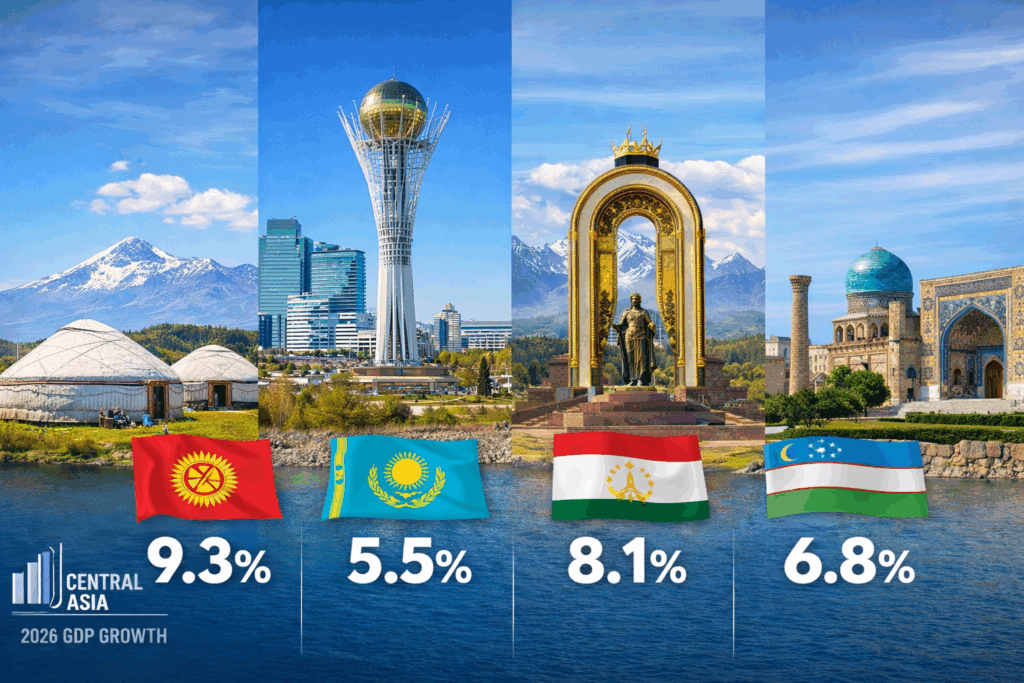
On December 18, the Eurasian Development Bank (EDB) published its Macroeconomic Outlook for 2026-2028, reviewing recent economic developments and offering projections for its seven member states: Armenia, Belarus, Kazakhstan, Kyrgyzstan, Russia, Tajikistan, and Uzbekistan. According to the report, aggregate GDP growth across the EDB region is forecast to reach 2.3% in 2026. Kyrgyzstan (9.3%), Tajikistan (8.1%), Uzbekistan (6.8%), and Kazakhstan (5.5%) are expected to remain the region’s fastest-growing economies. After two years of rapid expansion, the region’s GDP growth is set to moderate to 1.9% in 2025, down from 4.5% in 2024, mainly due to a slowdown in Russia’s economy. Although lower oil prices are expected to reduce export revenues for energy exporters such as Kazakhstan and Russia, the impact on overall growth will be limited. Meanwhile, net oil importers, including Armenia, Belarus, Kyrgyzstan, Tajikistan, and Uzbekistan, will benefit from improved terms of trade and reduced inflationary pressure. High global gold prices will support foreign exchange earnings for key regional exporters, including Kyrgyzstan, Tajikistan, and Uzbekistan. The report also notes a gradual decline in the U.S. dollar’s share in central bank reserves across the region, though its role in international settlements remains stable. Kazakhstan Kazakhstan’s economy is projected to grow by 5.5% in 2026, supported by the implementation of the National Infrastructure Plan and the state program “Order for Investment,” which are expected to cushion the effects of lower oil prices. Growth in non-commodity exports will also play a stabilizing role. Inflation is forecast to decline to 9.7% by the end of 2026, after peaking early in the year due to a value-added tax (VAT) increase. The average tenge exchange rate is expected to be KZT 535 per U.S. dollar, underpinned by a high base interest rate and rising export revenues. Kyrgyzstan Kyrgyzstan is forecast to lead the region in GDP growth at 9.3% in 2026, driven by higher investment in transport, energy, water infrastructure, and housing construction. Inflation is expected to ease to 8.3%, although further declines will be constrained by higher tariffs and excise taxes. The average exchange rate is projected at KGS 89.2 per U.S. dollar, supported by robust remittance inflows and high global gold prices, gold being the country’s main export commodity. Tajikistan Tajikistan is projected to maintain high GDP growth of 8.1% in 2026, fueled by capacity expansion in the energy and manufacturing sectors, along with rising prices for gold and non-ferrous metals. Inflation is expected to reach 4.5% by year-end. The somoni is expected to remain stable, with an average exchange rate of TJS 9.8 per U.S. dollar, supported by growth in exports and remittances. Uzbekistan Uzbekistan’s economy is forecast to expand by 6.8% in 2026, sustained by strong investment activity and favorable gold prices. Inflation is projected to decline to 6.7%, helped by tight monetary policy and a stable exchange rate. The average soum exchange rate is expected to be UZS 12,800 per U.S. dollar, supported by high remittances and increased metal exports.

Uzbekneftegaz Signs $5 Million Consulting Deal With U.S. Firm Ballard Partners

Uzbekneftegaz has signed a $5 million lobbying and strategic consulting contract with the U.S.-based firm Ballard Partners, according to documents published by the Uzbek Telegram channel Revizor on December 12. The agreement outlines services for “strategic consulting and advocacy before the U.S. government.” The reported monthly fee is $83,334, implying a contract duration of approximately five years. Ballard Partners is often described by U.S. media outlets as having close ties to President Donald Trump. Reuters recently reported that several major companies, including cryptocurrency exchanges Kraken and Blockchain.com, retained Ballard Partners after the November elections for lobbying on digital asset regulation. The firm is led by Brian Ballard, a longtime Trump fundraiser, and has seen a notable uptick in clients in recent months. Politico reported earlier this year that Ballard Partners’ revenue has sharply increased, with many organizations under pressure from the current administration turning to the firm for representation. According to the report, Ballard signed around 40 new clients following the elections, exceeding its client intake from the previous ten months. The Uzbekneftegaz deal follows recent comments by Uzbekistan’s Minister of Energy, Jurabek Mirzamakhmudov, confirming that the government has been in discussions with the U.S. Treasury’s Office of Foreign Assets Control (OFAC) regarding sanctions on Russian energy giant Lukoil. However, there is no publicly available evidence linking the Uzbekneftegaz agreement with Ballard Partners to the Lukoil sanctions issue. At this stage, the specific scope of Ballard Partners’ work on behalf of Uzbekneftegaz remains undisclosed. The available documentation does not specify the precise interests the firm will advocate for in Washington, leaving open questions about the contract’s strategic goals and expected outcomes.

Financing Agreement for China-Kyrgyzstan-Uzbekistan Railway Project Signed in Bishkek

On December 16, a loan agreement was signed in Bishkek to finance the construction of the China-Kyrgyzstan-Uzbekistan (CKU) railway, an ambitious regional transport project intended to bolster connectivity across Central and South Asia. According to the Kyrgyz government, the agreement was concluded between China-Kyrgyzstan-Uzbekistan Railway Company LLC, a joint venture formed by the three participating countries and a syndicate of Chinese banks, including the China Development Bank and Eximbank. The CKU railway has been discussed for more than two decades, but repeatedly stalled over financing, route selection, and technical concerns. Momentum increased after 2022 as China sought alternative westbound transport corridors and Central Asian states looked to diversify trade routes and reduce reliance on existing transit pathways. The total cost of the railway project is estimated at $4.7 billion. Half of that amount, approximately $2.3 billion, will be provided as a 35-year loan from China to the joint project company, which will be responsible for repayment. The remaining $2.3 billion will be contributed to the company’s authorized capital: China will cover 51%, while Kyrgyzstan and Uzbekistan will each provide 24.5%. The CKU railway is a strategically significant infrastructure initiative spanning 523 kilometers. Construction officially began on December 27, 2024, in Kyrgyzstan’s Jalal-Abad region. Once completed, the railway will link Kashgar in China with Torugart, Makmal, and Jalal-Abad in Kyrgyzstan, and continue on to Andijan in Uzbekistan. A cargo transshipment station and logistics hub are planned in Makmal. The railway is expected to handle up to 15 million tons of cargo annually. Despite its strategic appeal, the project has raised concerns about debt exposure, particularly for Kyrgyzstan, which already relies heavily on Chinese financing. Officials say the joint-venture structure and long loan maturity will limit fiscal risks, though critics argue projected cargo volumes will need to be met for the railway to be financially sustainable. Currently, neither Kyrgyzstan nor Uzbekistan has a direct rail link with China; the only such connection in Central Asia runs through Kazakhstan. For Uzbekistan, the railway is expected to shorten transit times to Chinese markets and expand export capacity for industrial and agricultural goods. Officials in Tashkent have argued that the CKU route could reduce delivery times by several days compared with existing rail corridors. The CKU railway is among the most technically complex projects in the region. It includes the construction of 50 bridges and 29 tunnels, totaling 120 kilometers in length, meaning roughly 40% of the route will consist of bridges and tunnels. The Kyrgyz section alone will cover 304 kilometers. On December 5, Chairman of the Kyrgyz Cabinet of Ministers Adylbek Kasymaliev visited the construction site of one of the tunnels in the Jalal-Abad region to inspect progress. According to government sources, work has begun on 18 of the 29 planned tunnels and 17 of the 50 bridges. The project currently involves 5,695 pieces of machinery and over 5,000 workers. For Kyrgyzstan, the CKU railway represents the largest infrastructure project in the country’s history. Authorities view the project as a chance to transform...