• KZT/USD = 0.00210
  • TJS/USD = 0.10810
  • UZS/USD = 0.00008
  • TMT/USD = 0.29850
  • KZT/USD = 0.00210
  • TJS/USD = 0.10810
  • UZS/USD = 0.00008
  • TMT/USD = 0.29850
  • KZT/USD = 0.00210
  • TJS/USD = 0.10810
  • UZS/USD = 0.00008
  • TMT/USD = 0.29850
  • KZT/USD = 0.00210
  • TJS/USD = 0.10810
  • UZS/USD = 0.00008
  • TMT/USD = 0.29850
  • KZT/USD = 0.00210
  • TJS/USD = 0.10810
  • UZS/USD = 0.00008
  • TMT/USD = 0.29850
  • KZT/USD = 0.00210
  • TJS/USD = 0.10810
  • UZS/USD = 0.00008
  • TMT/USD = 0.29850
  • KZT/USD = 0.00210
  • TJS/USD = 0.10810
  • UZS/USD = 0.00008
  • TMT/USD = 0.29850
  • KZT/USD = 0.00210
  • TJS/USD = 0.10810
  • UZS/USD = 0.00008
  • TMT/USD = 0.29850

Viewing results 43 - 48 of 825

Uzbekistan to Host Inaugural Silk Road Finance & Technology Forum in August

Uzbekistan is set to host the inaugural Silk Road Finance and Technology Forum in August, a new international event aimed at advancing the country’s role as a regional hub for financial technology and innovation. According to a joint announcement by the Central Bank of Uzbekistan and the Global Finance & Technology Network (GFTN), the forum will take place in Tashkent from August 24 to 26, 2026. The event will be held at Central Asian Expo Uzbekistan and the Islamic Civilization Centre. It is expected to bring together policymakers, regulators, investors, entrepreneurs, and technology leaders from Central Asia and beyond. The organizers describe the forum as Uzbekistan’s flagship platform for discussions on finance, innovation, and public policy. It is being launched as the country pursues an ambitious strategy to become a leading fintech center in the region. Uzbekistan’s financial technology sector has expanded rapidly in recent years, driven by growing digital adoption and a young population of more than 37 million people. According to the organizers, nearly 70% of the population now uses digital services, creating favorable conditions for the development of financial technologies. The forum comes as Uzbekistan implements a presidential strategy for the sector through 2030. The plan includes attracting $1 billion in foreign investment, training more than 5,000 specialists, licensing more than 200 market participants, supporting more than 100 startup graduates from incubation programs, and testing digital currencies and stable tokens. The Central Bank has also announced plans to expand the country’s financial innovation infrastructure. These initiatives include the creation of a globally accessible Regulatory Sandbox 2.0, the Q-FINEX Quantum Finance Testbed, and a dedicated $50 million venture fund for fintech development. Authorities are also working on regulatory frameworks covering open banking, digital payments, buy now, pay later services, and cybersecurity resilience. The three-day forum will be organized around five main themes: open banking, digital assets and stablecoins, cross-border payments, Islamic finance, and innovation and investment. The event’s theme, “Al-Jabr,” references the Arabic concept of “bringing parts together,” which gave rise to algebra, and honors the legacy of the ninth-century scholar Al-Khwarizmi, who was born in Khwarezm, in present-day Uzbekistan. Organizers say the theme points to the forum’s goal of linking finance with technology policy. The forum is being co-hosted with Ant International and joins GFTN’s global network of events, which includes the Singapore FinTech Festival, the Point Zero Forum in Zurich, GFTN Forum Japan, and the Black Swan Summits. “Innovation flourishes when trust, talent and capital converge,” said Sopnendu Mohanty, group CEO of GFTN. He said the forum would help connect global expertise with regional ambitions and support Central Asia’s emergence as a center for financial innovation. GFTN is a Singapore-based not-for-profit organization established by the Monetary Authority of Singapore in 2024. It promotes financial innovation and inclusion through partnerships with public- and private-sector institutions.

Opinion: Central Asia’s Shift from Silk Road Romance to Infrastructure Finance – What the June Forums Are Building

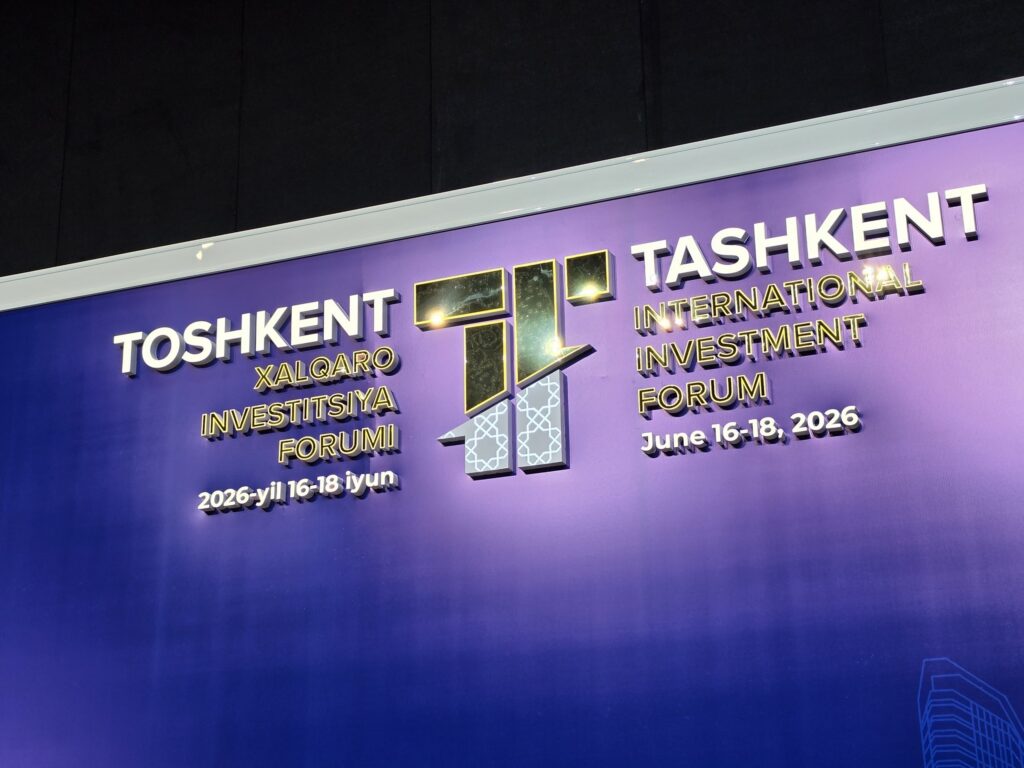
In mid-June, Tashkent and Baku will host two major international finance gatherings within the same regional window: the fifth Tashkent International Investment Forum in Uzbekistan, and the Islamic Development Bank Group’s 2026 Annual Meetings in Azerbaijan. The overlap in timing is useful less as a calendar coincidence than as a signal of how infrastructure, finance, and regional integration are now being discussed together. In Tashkent, the fifth Tashkent International Investment Forum opens under the theme “Investment Resilience: New Frontiers, New Partnerships.” In Baku, the Islamic Development Bank Group will convene delegates from its 57 member countries under the theme “Regional Integration for Sustainable Prosperity.” Add the Astana International Financial Centre’s increasingly active forum calendar, a new cross-border Islamic finance alliance signed in May among regional industry associations, and a stream of connectivity and green investment pledges from recent regional summits, and the wider region looks increasingly focused on turning connectivity talk into investment structures. The more important question is not how much money is being discussed, but what kinds of projects are becoming investable. One answer keeps surfacing: a multi-thousand-kilometer trade route that carries goods from China across Kazakhstan, over the Caspian Sea to Azerbaijan, and onward through Georgia and Türkiye to Europe. The Middle Corridor, formally known as the Trans-Caspian International Transport Route, runs through many of the investment pitches now being made across the region. The forums show how infrastructure, finance, and regional connectivity are increasingly being discussed together. The corridor is one of the clearest tests of whether that agenda can move from conference language into bankable projects. For most of the past century, the world categorized this region under two headings. One is heritage: the caravanserais and blue domes of the old Silk Road. The other is hydrocarbons: the oil and gas beneath the Caspian basin. Both cast the region as a place value came out of or once passed through. The corridor proposes something more ambitious: that value should pass through again, but this time on terms shaped by the region itself. The shift is from selling what lies underground to earning from where the region sits on the map. Freight volumes on the Middle Corridor have risen roughly fivefold over recent years, while transit times have been cut from about a month to roughly two weeks as border procedures and port operations improved. The World Bank’s benchmark study sets out the goal of tripling freight volumes and halving travel time by 2030, and regional projections now point to annual throughput of around ten million tons or more by the end of the decade. For landlocked economies long dependent on a single route to world markets, a second viable artery is less a convenience than a form of strategic insurance. But turning a route on a map into a working corridor requires serious capital. It requires expanded port capacity on the Caspian, additional vessels and ferries, rail upgrades, terminal infrastructure, and the less visible digital and customs systems that allow cargo to clear multiple borders...

Central Asia’s Renewable Energy Boom Faces Growing Grid Challenges

Central Asia is rapidly expanding its renewable energy sector, with solar power emerging as one of the key drivers of the region’s energy transition. However, a new report by the Eurasian Development Bank (EDB) warns that accelerated deployment of renewable energy, without matching investment in grid infrastructure, reserve capacity, storage systems, and market reforms, could increase systemic risks and raise overall electricity costs. The warning comes as electricity demand across Central Asia continues to grow steadily. The region’s population now exceeds 80 million, and power consumption is rising by 3% to 6% annually. According to the EDB, electricity demand could increase by nearly 40% by 2030, reaching 370 billion kilowatt-hours annually, up from approximately 270 billion kilowatt-hours today. Governments across the region have announced ambitious renewable energy targets for the coming decade. Uzbekistan plans to install more than 25 gigawatts of renewable energy capacity by 2030, including solar and wind generation. Kazakhstan aims to commission 8.4 gigawatts of renewable energy by 2035, while Kyrgyzstan plans to add 3.65 gigawatts of solar capacity and 400 megawatts of wind power over the same period. Tajikistan is targeting 2 gigawatts of solar and wind generation by 2030, while Turkmenistan has announced plans for 300 megawatts of solar power capacity. Yet the region’s transition toward cleaner energy sources presents a growing challenge: electricity demand is increasing faster than power systems are adapting to accommodate large volumes of variable renewable generation. Solar energy production peaks during daylight hours, creating fluctuations that conventional power systems must manage. In the morning, before solar panels begin generating at full capacity, electricity demand is largely met by hydropower plants and thermal generation fueled by coal or natural gas. As solar output rises during the day, conventional plants must reduce generation or temporarily shut down. After sunset, when electricity consumption remains high but solar production falls to zero, conventional generators must rapidly increase output to stabilize the system. These abrupt shifts create operational challenges and increase costs for grid operators. According to the EDB’s report, Power Sector of Central Asia: Modernization and Energy Transition, the main obstacles to integrating renewable energy are technical and institutional, not simply financial. If sudden drops in solar or wind generation caused by weather changes are not immediately offset, power systems risk instability and, in extreme cases, blackouts. As renewable capacity expands, grids require more flexible generation, larger reserve margins, energy storage systems, and more sophisticated operational management tools. The report notes that renewable generation is being introduced faster than supporting infrastructure can be developed. In many countries, transmission networks were not designed to accommodate a high share of variable energy sources. Weather forecasting systems also remain insufficiently accurate to support reliable real-time balancing of renewable output. Market reforms have lagged as well. Capacity markets, reserve markets, and tariff systems in several Central Asian countries have yet to evolve in ways that encourage investment in flexible backup generation and storage technologies. As a result, the report argues, the real system-wide cost of renewable energy may...

Uzbekistan and Hong Kong Agree to Launch Business Council

Uzbekistan and Hong Kong have taken a step toward expanding economic ties after the Chamber of Commerce and Industry of Uzbekistan and the Hong Kong General Chamber of Commerce (HKGCC) signed a memorandum of understanding on business cooperation. According to Uzbekistan’s Chamber of Commerce and Industry, the agreement was signed during a business mission to Central Asia led by Hong Kong Chief Executive John Lee Ka-chiu. The memorandum is intended to deepen trade and economic relations and create new opportunities for businesses in Uzbekistan and Hong Kong. The document follows several months of discussions. Negotiations began in March during a visit by Uzbekistan’s Ambassador to China, Farhod Arziev, to the HKGCC. The talks continued through meetings and consultations, including a visit by a delegation from Uzbekistan’s Chamber of Commerce and Industry to Hong Kong in May. A key outcome of the agreement is the planned establishment of the Uzbekistan-Hong Kong Business Council. The platform is expected to support regular dialogue between entrepreneurs, help build commercial partnerships, and advance joint projects in trade and investment. The two sides also plan to organize business forums, B2B meetings, and trade missions to increase direct contacts between companies and investors. The agreement comes as Hong Kong increases its economic engagement with Central Asia. Earlier this month, a Hong Kong delegation visited Kazakhstan, where agreements were signed in areas including finance, logistics, technology, energy, and trade. As previously reported by The Times of Central Asia, Kazakhstan secured more than 40 commercial agreements during the visit and began discussions on new investment and tax cooperation frameworks with Hong Kong. The Chamber of Commerce and Industry of Uzbekistan said the memorandum is expected to open new opportunities for businesses in both jurisdictions while supporting increased trade and investment cooperation.

Uzbekistan Plans $30 Billion Mining Investment Drive Backed by AI and Digital Geology

Uzbekistan is planning a major digital transformation of its mining and geology sector, with artificial intelligence set to play a central role in mineral exploration, resource management, and industrial production. According to the presidential press service, President Shavkat Mirziyoyev reviewed a presentation on June 9 on plans to expand the use of digital technologies and AI across the industry, one of the country’s key economic sectors. Officials said mining and geology enterprises accounted for 20% of Uzbekistan’s industrial output in 2025 and generated 118.5 trillion soums in budget revenues. The government sees technological modernization as a priority for improving efficiency, attracting investment, and expanding the country’s long-term resource base. The presentation pointed to progress already made in digitalization. Major mining enterprises cut operating expenses by 7.3 trillion soums in 2025, while production costs fell by 9.1%. Authorities have also launched the Geomonitoring information system and digitized data on more than 2,000 mineral deposits. Over the next five years, Uzbekistan aims to increase its proven reserves by 879 tons of gold, 510 tons of silver, and 676,000 tons of copper. Officials said AI technologies will be introduced throughout the geological exploration process to speed up the analysis of geological data, improve reserve assessments, forecast promising mineral deposits, and make drilling more efficient. Mirziyoyev instructed officials to take the sector’s technological transformation to a new stage by creating systems capable of managing and analyzing production processes with AI. The industry generates large volumes of information, from geological surveys and drilling results to maps, laboratory analyses, and production data. Integrating these resources into a unified electronic database and applying 3D modeling tools could improve exploration outcomes. According to the presentation, the proposed measures could reduce production costs by 10%, cut the time needed to identify new deposits by half, and increase the number of investment proposals several times over. A key element of the strategy is the creation of a National Geological Database. Authorities plan to digitize more than 36,000 geological reports and primary data records and establish a Center for Technological Transformation. Officials estimate that this will double the speed and quality of geological data processing and accelerate reserve estimation and deposit modeling. The presentation also outlined plans to attract $30 billion in investment to the geology and mining sector by 2030. To support that target, the government plans to implement 32 digital and AI-focused projects from 2026 to 2030 at six major enterprises: Navoi Mining and Metallurgical Company, Almalyk Mining and Metallurgical Complex, Navoiyuran, Uzmetkombinat, Uzbekcoal, and the Uzbekistan Technological Metals Complex. The projects will cover production automation, corporate governance, AI, labor and industrial safety, and geological exploration. Officials said the measures could increase operational efficiency by 7%, improve the reliability of machinery and equipment by 20%, raise energy efficiency by 8%, and reduce human-factor-related errors and risks by 15%. As previously reported by The Times of Central Asia, Uzbekistan and the United States signed agreements earlier this year aimed at securing supply chains for critical minerals and rare earth elements,...

Germany Pledges to Review Visa Obstacles Facing Skilled Workers From Uzbekistan

Germany has pledged to examine visa-related difficulties faced by Uzbekistani specialists and consider measures to address them, according to Uzbekistan’s Dunyo news agency. The commitment was announced during a meeting at the Frankfurt Chamber of Commerce and Industry focused on organized and safe recruitment of workers from Uzbekistan for the German labor market. The event was chaired by Dr. Jürgen Ratzinger, the chamber’s managing director for international business, and brought together representatives of German institutions and executives from WISAG, one of Germany’s largest service companies. Uzbekistan's delegation included Gulnara Salimova, honorary representative of Uzbekistan’s Migration Agency in Germany, and Vice Consul Bekzod Abdullayev. During the talks, Uzbek officials outlined efforts to prepare workers for employment in Germany. These measures include vocational training programs tailored to the needs of the German labor market, language instruction, and initiatives designed to support legal and organized labor migration. Participants also discussed challenges faced by Uzbekistani specialists during the visa application process. According to Dunyo, German representatives acknowledged that visa processing for qualified Uzbekistani workers often takes considerable time and said they would study systemic issues and consider possible solutions. The discussions come as Germany continues to face labor shortages in several sectors and seeks qualified foreign workers. Uzbekistan, meanwhile, has increased efforts to create legal pathways for employment abroad through government-supported migration programs. The meeting also follows a recent investigation by German authorities into an alleged visa fraud and migrant smuggling network involving citizens of Uzbekistan. Earlier this month, Germany’s Federal Police carried out searches at seven locations in the states of Hesse and Lower Saxony as part of an investigation led by prosecutors in Bavaria. The case concerns suspected commercial smuggling of foreign nationals, unauthorized residence, visa fraud, and document forgery. The investigation began after federal police inspected a citizen of Uzbekistan traveling on a long-distance bus shortly after he entered Germany through a Bavarian border crossing. Officials at the Frankfurt meeting highlighted the importance of ensuring that labor migration takes place through transparent, legal, and secure channels while improving opportunities for qualified professionals from Uzbekistan seeking work in Germany.