• KGS/USD = 0.01144 0%
  • KZT/USD = 0.00205 0%
  • TJS/USD = 0.10782 0%
  • UZS/USD = 0.00008 0%
  • TMT/USD = 0.28490 0%
  • KGS/USD = 0.01144 0%
  • KZT/USD = 0.00205 0%
  • TJS/USD = 0.10782 0%
  • UZS/USD = 0.00008 0%
  • TMT/USD = 0.28490 0%
  • KGS/USD = 0.01144 0%
  • KZT/USD = 0.00205 0%
  • TJS/USD = 0.10782 0%
  • UZS/USD = 0.00008 0%
  • TMT/USD = 0.28490 0%
  • KGS/USD = 0.01144 0%
  • KZT/USD = 0.00205 0%
  • TJS/USD = 0.10782 0%
  • UZS/USD = 0.00008 0%
  • TMT/USD = 0.28490 0%
  • KGS/USD = 0.01144 0%
  • KZT/USD = 0.00205 0%
  • TJS/USD = 0.10782 0%
  • UZS/USD = 0.00008 0%
  • TMT/USD = 0.28490 0%
  • KGS/USD = 0.01144 0%
  • KZT/USD = 0.00205 0%
  • TJS/USD = 0.10782 0%
  • UZS/USD = 0.00008 0%
  • TMT/USD = 0.28490 0%
  • KGS/USD = 0.01144 0%
  • KZT/USD = 0.00205 0%
  • TJS/USD = 0.10782 0%
  • UZS/USD = 0.00008 0%
  • TMT/USD = 0.28490 0%
  • KGS/USD = 0.01144 0%
  • KZT/USD = 0.00205 0%
  • TJS/USD = 0.10782 0%
  • UZS/USD = 0.00008 0%
  • TMT/USD = 0.28490 0%

Viewing results 43 - 48 of 239

Uzbekistan Ratchets Up Drive Against “Evil” of Corruption

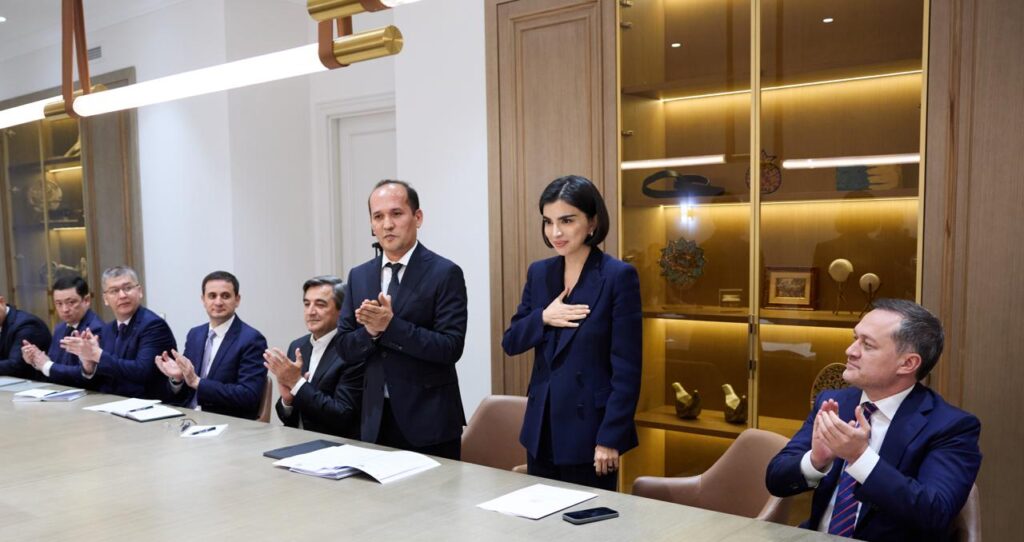
Uzbek President Shavkat Mirziyoyev announced a major shakeup of Uzbekistan’s campaign against corruption on Wednesday, ordering the dismissal of the heads of anti-corruption bodies in 117 ministries and departments and saying many officials had fostered mistrust by failing to deliver clean government as promised. Mirziyoyev, who took office in 2016, described corruption as an obstacle to Uzbekistan’s efforts to reform its economy. He said that, while there had been progress toward transparency, virtually every sector in the nation, including the media, schoolteachers, non-governmental groups and neighborhood authorities, should mobilize alongside the state to fight the scourge.  “Corruption is such an evil that it undermines people's trust in the state, the Constitution and laws, and becomes a serious threat to sustainable development and security,” Mirziyoyev said at a meeting of the National Anti-Corruption Council, which was established in 2020 to lead efforts to curb graft.  International groups that study corruption have long said that autocratic tendencies, opaque bureaucracy and weak justice systems in Central Asia make it hard for those countries to get a comprehensive grip on the problem and hold the powerful – regardless of their political allegiances - to account for any wrongdoing.  Even so, Kazakhstan has taken some notable steps, expanding its outreach to other countries in an effort to recover stolen assets and considering the establishment of a public register of officials convicted of corruption-related offenses.  Uzbekistan has similarly made advances, while falling short on enforcement and other pledges. A 2024 report by the Organisation for Economic Co-operation and Development noted that prosecution of corruption offenses in Uzbekistan “is generally ensured, but more efforts should be directed at countering high-level corruption;” that there is no specialized legislation related to the protection of whistleblowers; and that while Uzbekistan has a business ombudsman institution, “companies do not report cases of corruption for fear of negative repercussions from the state.” Mirziyoyev’s remarks, which included scathing criticism of the alleged passivity of some officials, appeared designed to give new momentum to the kind of openness that his government deems essential to a successful, diversified economy.   “The Prime Minister was instructed to dismiss the heads of the "internal anti-corruption control" structures in 117 ministries and departments and replace them with honest, dedicated and professional personnel, and to set clear tasks for them,” Sherzod Asadov, the presidential press secretary, said in an account of the meeting that he posted on Facebook. Ministers will directly employ regional compliance officers and “take political responsibility and personally answer for corruption in the entire system,” according to the account.  Uzbekistan’s Minister of Emergency Situations, Abdulla Kuldashev, was recently fired because of fire safety bureaucracy and legal violations, the president said. He also expressed frustration that he had to personally instruct measures against wasteful spending in investment and healthcare programs last year, resulting in the saving of several hundred million dollars.   "But why should these works begin after the president gives an order?" he said.   One measure that Uzbekistan previously introduced is an index that rates the openness of...

Powering the Future: Kazakhstan and Uzbekistan Race to Tackle Energy Crises with Nuclear Plans

Kazakhstan has officially designated the site for its first nuclear power plant (NPP), while Uzbekistan has also identified a location and announced plans to establish an international consortium. Despite severe power shortages in densely populated regions, concrete timelines for construction remain unclear. Kazakhstan Finalizes NPP Site Selection On February 25, Kazakhstan formally approved the construction site for its first NPP. A decree signed by Prime Minister Olzhas Bektenov designated the Zhambyl district in the Almaty region as the site for the facility. President Kassym-Jomart Tokayev reiterated in January 2025 that Kazakhstan would likely require multiple nuclear power plants, and urged the government to accelerate the construction process. International Consortium Considered for Construction Kazakhstan has yet to finalize its choice of technology and contractor. In 2024, Tokayev stated that multiple foreign companies should collaborate on the project through an international consortium. Tokayev emphasized the need for cutting-edge technology from global players. Several companies and technologies are currently under consideration, including: CNNC (China) - HPR-1000 reactor Rosatom (Russia) - VVER-1200 reactor KHNP (South Korea) - APR-1000, APR-1400 reactors EDF (France) - EPR1200 reactor. Political analyst Gaziz Abishev noted that the selection of locations and contractors reflects Kazakhstan’s multi-vector foreign policy. Abishev suggested that Kazakhstan could ultimately build three NPPs, potentially awarding contracts to Rosatom, a Chinese-French consortium, and a South Korean firm. While Rosatom remains the frontrunner, only preliminary agreements with Russia have been reported so far. Urgency Amidst a Growing Energy Deficit Kazakhstan faces an urgent need to begin NPP construction due to its increasing electricity shortfall. In 2024, electricity consumption reached 120.6 billion kWh, while production stood at 118.3 billion kWh, resulting in a 2.4 billion kWh deficit. By 2025, the deficit is projected to rise to 3.3 billion kWh. The situation is particularly dire in southern Kazakhstan, where demand far exceeds supply. The region consumes 27.7 billion kWh but produces only 15.3 billion kWh, creating a 12.4 billion kWh deficit. As a result, Kazakhstan is heavily reliant on Russian electricity imports. Aging infrastructure exacerbates the crisis. In the winters of 2023-2024, power plant failures left residents in the towns of Ridder and Ekibastuz without heat during extreme subzero temperatures. The government reports that 66% of CHPP equipment is worn out, with five major plants, in Uralsk, Stepnogorsk, Taraz, Kyzylorda, and Kentau, operating with over 80% wear and tear. The average age of CHPPs in Kazakhstan is 61 years, with 76% of plants exceeding 50 years of operation. Experts argue that Kazakhstan cannot achieve energy independence without nuclear power. The energy deficit will continue to grow, particularly in Almaty, the country’s largest city, which is at risk of blackouts and rolling outages. Uzbekistan Moves Forward with Its First NPP Uzbekistan is also advancing its nuclear energy plans. The first NPP will be built in the Jizzakh region, approximately 1,000 km from Kazakhstan’s planned plant. In May 2024, Uzatom signed a contract with Atomstroyexport, a division of Rosatom, for the construction of a 330 MW low-capacity nuclear plant consisting of six...

Karimova and Nazarbayeva: Power, Prison, and Privilege – The Diverging Fates of Central Asia’s First Daughters

The lives of the eldest daughters of Kazakhstan’s first president, Nursultan Nazarbayev, and Uzbekistan’s first president, Islam Karimov, share striking similarities. Both once wielded immense influence in their respective countries, yet their destinies took drastically different turns. Amid a flurry of media reports after Uzbekistan and Switzerland signed an agreement to return funds appropriated by Karimova, some recent articles have compared the trajectories of the two women. While Nazarbayev allowed his daughter, Dariga, to maintain her wealth and political standing, Karimov took decisive action against his daughter, Gulnara, stripping her of power and ensuring she faced legal consequences. The Rise and Fall of Gulnara Karimova Once a high-profile public figure, Gulnara Karimova built a vast business empire, pursued a career in fashion career, and even dabbled in pop music under the name ‘Googoosha.’ A former UN envoy and self-styled 'Princess of Uzbekistan,' - "From her desire for self-expression came her poems. From her poems came the music. Meet Googoosha.....poet, mezzo soprano, designer and exotic Uzbekistan beauty," read Karimova's X account and since removed official website. "A robber baron… a greedy, power-hungry individual who uses her father to crush business people or anyone else who stands in her way… She remains the single most hated person in the country," asserted a leaked U.S. diplomatic cable. With her political ambitions becoming increasingly apparent, alarming Uzbekistan’s leadership, however, the authorities closely monitored her activities and reported them to her father. By 2014, Karimova had fallen from grace. Placed under house arrest, images of her detention were leaked to the media. After Islam Karimov’s death in 2016, legal proceedings against her intensified. In 2017, she was sentenced to nine years in prison on corruption charges. The Uzbek Supreme Court later extended her sentence to 13 years and four months, with the term officially calculated from August 21, 2015. Karimova's financial empire also crumbled. In 2020, the Swiss authorities froze her assets, valued at 800 million Swiss francs (approximately $880 million at the time). Uzbekistan recovered $131 million from these funds, and in February 2024, Uzbekistan and Switzerland signed an agreement to repatriate an additional $182 million. The funds, originally seized by the Swiss authorities in 2012 as part of a corruption case against Karimova, will be transferred to Uzbekistan through the UN Uzbekistan Vision 2030 Fund. Dariga Nazarbayeva: From Power to Uncertainty Unlike Karimova, Dariga Nazarbayeva remained a central political figure in Kazakhstan for years. Nazarbayeva held several high-ranking positions, including deputy prime minister and chair of the Senate. In 2019, when Nazarbayev stepped down, she was just one step away from the presidency. Following the political turmoil in Kazakhstan in January 2022, Nazarbayeva disappeared from public life. While her current whereabouts remain unclear, she is frequently linked to luxurious properties in London and the UAE. A British court recently reviewed a case involving her London properties, which were initially seized as “unjustified wealth.” However, she and her family successfully proved that the assets were acquired legally. The protests that erupted on January 2,...

Uzbekistan Strengthens Intellectual Property Protection

Uzbekistan is taking significant steps to enhance intellectual property (IP) protection with a new draft law, which was approved in its first reading by the Legislative Chamber of the Oliy Majlis on February 18. The proposed legislation introduces amendments to multiple legal codes, strengthening penalties for copyright violations and industrial property rights infringements. Key changes include: Increased fines for copyright infringement Administrative penalties for violating rights to selection achievements Confiscation of items used in patent-related offenses Expanded judicial powers to inspect and seize counterfeit goods Stricter criminal liability for intellectual property violations Criminal penalties for unauthorized use of trademarks, software, and inventions Mandatory destruction of counterfeit goods at the offender’s expense The law aims to curb counterfeit production, attract foreign investment, and support Uzbekistan’s efforts to join the World Trade Organization. Under Uzbekistan’s Copyright Law, intellectual property rights apply to works by Uzbek citizens, residents, and those first published in the country. Currently, fines for copyright violations range from UZS 375,000 (USD 28.95) to UZS 1.87 million (USD 144.36) for individuals and up to UZS 3.75 million (USD 289.48) for officials. Additionally, the Code of Administrative Responsibility imposes various fines for violations of personal non-property rights related to intellectual property. In neighboring Kazakhstan, copyright or related rights violations under the Criminal Code carry a minimum fine of KZT 295,360 (USD 588.17) as of 2024. More severe offenses can result in imprisonment for three to six years.

Uzbekistan Doubles Sports Budget to $230 Million, Launches Presidential Olympics

Uzbekistan has announced the launch of the Presidential Olympics, a new national sports competition, following a recent video conference meeting chaired by President Shavkat Mirziyoyev. Competitions in Olympic sports, titled "Olympic Peaks of New Uzbekistan," will be held twice a year across the country. Winners at the district and regional levels will receive awards from local authorities, while regional champions will advance to the Presidential Olympics, which will take place annually at the Olympic Village from December 10-20. Top athletes will be awarded valuable prizes, including houses and cars. Additionally, first and second-place winners will gain admission to the Republican Olympic and Paralympic Center, where they will receive scholarships for their first two years of study. The initiative aims to enhance Uzbekistan’s international sports standing and help the country secure a top-ten finish at the Los Angeles 2028 Olympic Games. During the meeting, it was noted that Uzbekistan’s sports budget has doubled over the past four years, rising from UZS 1.5 trillion ($115.38 million) to UZS 3 trillion ($230.77 million). Additionally, coaches’ salaries have doubled; significant investments have been made in sports infrastructure; 101 new sports facilities have been built; and 67 existing facilities have been reconstructed. To further support athletes preparing for international competitions, including the Olympics, an additional UZS 300 billion ($23 million) will be allocated. President Mirziyoyev commented, “Sport is, first of all, an ambassador of peace, a source of national pride for every country.”

Uzbekistan Advances Draft Law on Religious Policy

Uzbekistan’s Legislative Chamber has approved the draft law On State Policy in the Religious Sphere and sent it to the Senate for further consideration. The law, formally titled On Ensuring Freedom of Conscience of Citizens in the Republic of Uzbekistan and Approving the Concept of State Policy in the Religious Sphere, was first discussed in the lower chamber on January 31 and was open for public consultation until February 10. The draft law consists of seven chapters and 41 articles, outlining the goals of state policy in religious affairs and detailing 10 key tasks to support these objectives. The proposed legislation focuses on: Ensuring freedom and equality for all citizens, regardless of gender, nationality, language, or religion, while preventing discrimination Strengthening national unity and respecting traditions while ensuring equal opportunities for all communities Establishing equal legal conditions for citizens’ participation in social life Protecting the right to freedom of conscience without forced religious indoctrination Maintaining secularism in state policies and governance Ensuring public institutions and law enforcement operate based on secular principles Promoting religious tolerance and civic engagement Preventing civil servants from favoring or discriminating against any religion in their professional duties Advancing science, culture, and the arts while benefiting from global achievements Combating radicalization, extremism, and terrorism to protect public safety and social order During the public consultation period, citizens submitted more than 480 comments, suggestions, and recommendations. Lawmakers also held meetings with religious representatives and journalists to gather feedback. On February 6, officials met with representatives from 16 religious groups, all of whom expressed support for the proposed law, emphasizing that it would help maintain religious harmony and stability in Uzbekistan. Authorities stated that most citizens backed the initiative, recognizing its timely development and potential benefits for the country. A working group and the responsible committee reviewed all proposals and incorporated necessary adjustments before finalizing the draft.