
• KGS/USD = 0.01144 0%
  • KZT/USD = 0.00216 0%
  • TJS/USD = 0.10659 0%
  • UZS/USD = 0.00008 0%
  • TMT/USD = 0.28530 0%
  • KGS/USD = 0.01144 0%
  • KZT/USD = 0.00216 0%
  • TJS/USD = 0.10659 0%
  • UZS/USD = 0.00008 0%
  • TMT/USD = 0.28530 0%
  • KGS/USD = 0.01144 0%
  • KZT/USD = 0.00216 0%
  • TJS/USD = 0.10659 0%
  • UZS/USD = 0.00008 0%
  • TMT/USD = 0.28530 0%
  • KGS/USD = 0.01144 0%
  • KZT/USD = 0.00216 0%
  • TJS/USD = 0.10659 0%
  • UZS/USD = 0.00008 0%
  • TMT/USD = 0.28530 0%
  • KGS/USD = 0.01144 0%
  • KZT/USD = 0.00216 0%
  • TJS/USD = 0.10659 0%
  • UZS/USD = 0.00008 0%
  • TMT/USD = 0.28530 0%
  • KGS/USD = 0.01144 0%
  • KZT/USD = 0.00216 0%
  • TJS/USD = 0.10659 0%
  • UZS/USD = 0.00008 0%
  • TMT/USD = 0.28530 0%
  • KGS/USD = 0.01144 0%
  • KZT/USD = 0.00216 0%
  • TJS/USD = 0.10659 0%
  • UZS/USD = 0.00008 0%
  • TMT/USD = 0.28530 0%
  • KGS/USD = 0.01144 0%
  • KZT/USD = 0.00216 0%
  • TJS/USD = 0.10659 0%
  • UZS/USD = 0.00008 0%
  • TMT/USD = 0.28530 0%

Our People > Bruce Pannier

Bruce Pannier's Avatar

Bruce Pannier

Bruce Pannier is a Central Asia Fellow in the Eurasia Program at the Foreign Policy Research Institute, the advisory board at the Caspian Policy Center, and a longtime journalist and correspondent covering Central Asia. For a decade, he appeared regularly on the Majlis podcast for RFE/RL, and now broadcasts his Spotlight on Central Asia podcast in partnership with The Times of Central Asia.

Articles

Did Kyrgyzstan’s Security Chief Order an Assassination?

The head of Kyrgyzstan’s State Committee for National Security (GKNB), Kamchybek Tashiyev, has been waging a campaign against organized criminal groups in his country for the last few years and it seems he believes in fighting fire with fire. Speaking to representatives of Kyrgyzstan’s education sector on January 16, Tashiyev referred to the fight against organized crime, specifically mentioning the slain reputed crime boss Kamchybek Kolbayev. “I had to take the decision to liquidate the thief in law,” Tashiyev said, “for the sake of the state. And I made this decision, and we eliminated him.” He quickly regretted such candor after his comments received wide coverage and has revised his version of events leading up to Kolbayev’s killing. The Gangster Kamchybek Kolbayev, aka Kolya Kyrgyz, was allegedly the kingpin of Kyrgyzstan’s criminal world. The term “thief in law” originated in Soviet prisons among inmates who were high-ranking figures in organized criminal groups. This tradition continued after the fall of the USSR and the “Brothers’ Circle” of top thieves in law connects criminal organizations in former Soviet republics. Kolbayev seemed indeed to be a thief in law and according to the U.S. State Department, he was part of the Brothers’ Circle, and back in 2007 it was said that Kolbayev was the “leader of the most influential criminal group” in Kyrgyzstan. Kolbayev had been imprisoned more than once, though his prison conditions were not harsh. While in prison in late 2020, a video was posted of Kolbayev and other prisoners enjoying a small feast and singing. He seemed untouchable. The Raid On October 4, 2023, the GKNB’s special Alfa unit raided the Blonder Pub in Bishkek, looking for Kolbayev. Reports from that day said the GKNB intended to detain Kolbayev as a suspect in murder of another criminal figure in July 2022. According to the GKNB, Kolbayev offered armed resistance and was shot dead when the GKNB commandos returned fire. Given the lenient treatment Kolbayev had so often received from Kyrgyz authorities, it seemed strange he chose to open fire on law enforcement officers rather than submit to being gently detained, as he had been before, and possibly incarcerated in luxury prison conditions. However, Kolbayev was an odious figure in Kyrgyzstan, greatly feared by many and the circumstances of his death did not seem to matter to most people, so long as he was gone. A ‘Hit’? On January 16, Tashiyev explained to deputy education and science ministers, university rectors, and other directors of institutions of higher learning that the organized crime structure in Kyrgyzstan had grown strong and had extended across the country. Tashiyev said the criminal network was preying upon businesses and individuals. “We were forced to take necessary measures,” Tashiyev declared, and then stated he had given the order for Kolbayev to be eliminated. He added that the GKNB’s campaign against organized crime was a success. Kyrgyzstan had become “the only country in Central Asia… and probably in the post-Soviet countries, that does not have organized crime.” It...

1 year ago

KazMunayGaz Looking to Buy Another European Oil Refinery

Kazakhstan’s KazMunayGaz (KMG) is seeking to acquire an oil refinery in Bulgaria from Russia’s LUKoil at a bargain price. The purchase of Lukoil Neftohim Burgas, the largest oil refinery in the Balkans, would, according to some media sources, more than double [KMG’s] European refining capacity.” KMG reported a bid of $1 billion for the refinery, which one outlet stated “seems small.”   Pressured Out The Burgas refinery was built in the early 1960s and “joined the LUKoil Group” in 1999. The European Union decision to impose a ban on Russian oil imports after the Kremlin launched its full-scale war on Ukraine deprived Lukoil Nefthohim Burgas of its major source of crude oil. According to a Financial Times report from November 2024, the Bulgarian government pressured LUKoil to sell the refinery, hitting the Russian company “with a 60% tax on profits in an effort to force out its owners” and prohibiting the “export of Russian crude-based products from Lukoil Neftohim Burgas.” In turn, LUKoil complained about “discriminatory laws and other unfair, biased political decisions toward the refinery.” KMG reportedly lost interest in the refinery in late 2024, but BNN Bloomberg reported on January 7 that the Kazakh company was still among the bidders for the Bulgarian refinery.   Advantage KMG When the EU banned Russian oil imports, Lukoil Nefthohim Burgas compensated by purchasing oil from Kazakhstan and the Middle East. If KMG buys the Bulgarian refinery, presumably most or all of the crude processed there will come from Kazakhstan. Kazakhstan exported some 70.5 million tons of oil in 2023, and expects figures will be slightly less in 2024, some 68.8 million tons, due to maintenance at the Tengiz and Kashagan fields. Some 80% of those oil exports are shipped from Kazakhstan through the Caspian Pipeline Consortium (CPC) pipeline to Russia’s Black Sea port at Novorossiysk. Prior to Russia’s full-scale invasion of Ukraine, the EU purchased about 50% of the Kazakh oil shipped through the CPC pipeline, but that amount has risen to 80% since the ban on Russian oil imports was imposed. Kazakhstan is also increasing the amount of oil it exports through Azerbaijan to Georgia’s Black Sea port at Batumi, where KMG subsidiary KazTransOil owns the oil terminal. Kazakhstan has a deal to ship 1.5 million tons of oil annually through Azerbaijan, but Kazakh Energy Minister Abdusalam Satkaliyev said in November 2024 that his country was looking to boost that to 20 million tons. Kazakhstan currently has two Aframax-class oil tankers (deadweight 80,000 tons each) operating in the Black Sea, but plans to bring this number to 12 during the coming years. The Lukoil Nefthohim Burgas refinery has a capacity to process some seven tons of oil annually. KMG International already owns two oil refineries in Romania. The Petromidia refinery, with an annual capacity of some five million tons, is located 20 kilometers from the Black Sea port city of Constanta, and the much smaller and older Vega refinery, north of Bucharest, with an annual capacity of some 350,000 tons....

1 year ago

Heads of Kyrgyz, Tajik, and Uzbek Governments Meet… Finally

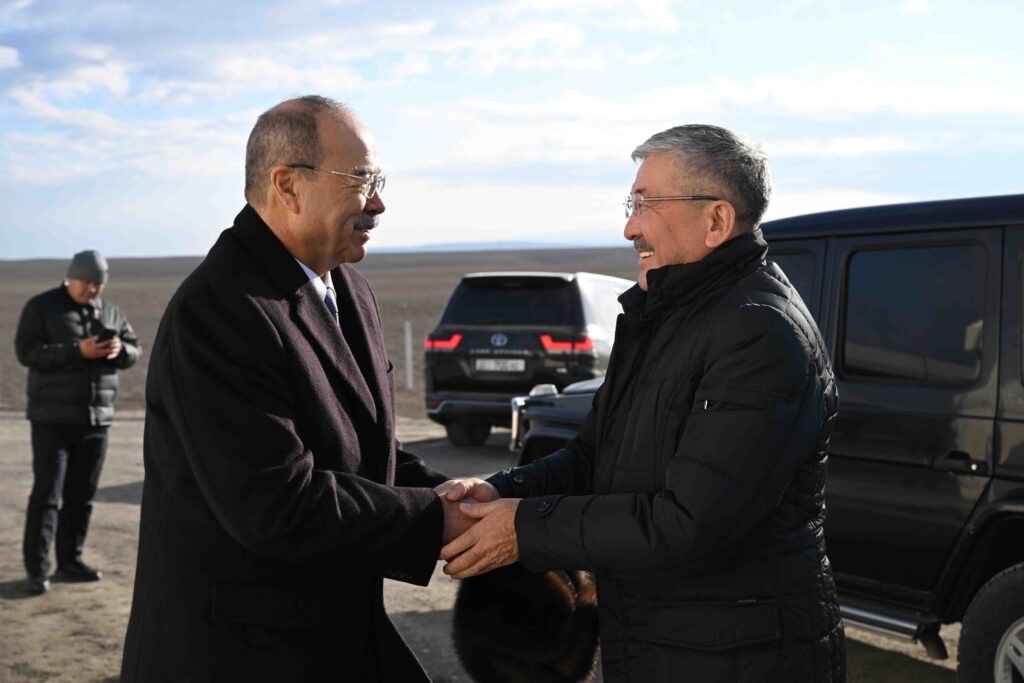
It took more than 30 years, but the prime ministers of the three Central Asian countries that share the Ferghana Valley finally met to discuss a range of important issues that concern all three states. Tajik Prime Minister Kohir Rasulzoda, Uzbek Prime Minister Abdulla Aripov, and Chairman of Kyrgyzstan’s Cabinet of Ministers (Kyrgyzstan does not have a post of prime minister) Adylbek Kasymaliyev met on January 8 at a desolate area where the borders of the three countries meet. [caption id="attachment_27412" align="aligncenter" width="8256"] Image: gov.kg[/caption] The group touted agreements on the completion of the delimitation process along the Uzbek-Kyrgyz border and the early December 2024 agreement on the Kyrgyz-Tajik border. Since 1991, unmarked areas of the borders in the Ferghana Valley were often the scenes of conflicts between communities on either side of the frontier. Border guards sometimes fired on trespassers and dozens of people were killed or wounded, sometimes simply because they inadvertently strayed over unmarked territory into the neighboring country. The Ferghana Valley is the most densely populated region in Central Asia. This is due to the rich agricultural land which makes the region to this day the breadbasket of Central Asia. Soviet mapmakers drew lines to create Soviet republics in the region, though these borders mattered little since they were internal administrative boundaries inside one country. [caption id="attachment_27413" align="aligncenter" width="8256"] Image: gov.kg[/caption] After the USSR collapsed, these often-arbitrary, zigzagging borders took on meaning, and disputes quickly broke out about what land historically belonged to which nation and who had rights to water use. These issues were greatly complicated by the existence of enclaves created during the Soviet period such as Uzbekistan’s Soh and Shahimardon and Tajikistan’s Vorukh, all three of which are surrounded by Kyrgyzstan.   Looking Ahead The three prime ministers discussed hydropower plants (HPP), an important topic for all three countries, especially as key HPPs are located in the mountains ringing the Ferghana Valley and more are currently under construction. Central Asia is one the regions most affected by climate change, so HPPs and water use in general are crucial issues, especially given that agriculture in the Ferghana Valley is vital to all three countries. All three countries face electricity shortages and hydropower is seen as a means of alleviating or even totally resolving this dilemma, but at the same time waters flowing from the mountains of Kyrgyzstan are important for agriculture in every Central Asian state. Uzbek media noted Uzbek Energy Minister Jurabek Mirzamahmudov was part of the delegation attending the January 8 talks. Reports did not mention if energy ministers from Kyrgyzstan and Tajikistan were also present. [caption id="attachment_27414" align="aligncenter" width="8256"] Image: gov.kg[/caption] Central Asia is also taking on a new importance as a trade corridor between Europe and China, and from Europe and China into Afghanistan and on further to Pakistan. Reports noted logistics were high on the agenda at the meeting of the three prime ministers. Trade between the three countries, specifically in the Ferghana Valley, was also discussed not only...

1 year ago

Old Projects Now Part of Kyrgyzstan’s Near Future

Two projects that successive governments in Kyrgyzstan over the course of more than three decades have promoted as key to the country’s long-term success appear to finally be making progress. The idea for the China-Kyrgyzstan-Uzbekistan (CKU) railway dates back to the early days of Kyrgyzstan’s independence, and plans for construction of the massive Kambar-Ata-1 hydropower plant (HPP) go back even further, to the Soviet-era. After all these years, these aspirations that have almost faded into dreams are set to be realized.   All Aboard On December 27, Kyrgyz President Sadyr Japarov took part in a ceremony near the southern city of Jalal-Abad to launch construction of Kyrgyzstan’s section of the CKU railway. The idea of a trans-Asian railway that would run from China into Kyrgyzstan and on to points further west goes back to the first meeting on Central Asian presidents in December 1991 in Ashgabat, Turkmenistan. It was a lofty ambition from five leaders whose countries had been independent for barely three months, but then-Kyrgyz President Askar Akayev followed up on the proposal, discussing the railway project with Chinese leaders when he visited Beijing in May 1992. That was more than one year before the first road border crossing opened between the two countries. By the end of the 1990s, the scope of the project had narrowed to a railway connecting China, Kyrgyzstan, and Uzbekistan, though it was often vaguely mentioned the line could be part of a longer railway connecting China to Europe through Central Asia. The topic of the CKU railway was always part of the agenda for every Kyrgyz president whenever they met with Chinese leaders. In June 2001, then-Kyrgyz transport and communications minister Kubanychbek Jumaliyev announced his country would sign an inter-governmental agreement with China and Uzbekistan on construction of the railway. At that time, Jumaliyev said some 250 kilometers of the line would pass through Kyrgyzstan and the cost of construction of the whole line would be about $2.3 billion. According to the latest plans for the route, CKU railway will be 486 kilometers, from Kashgar in China’s western Xinjiang Uyghur Autonomous Region to Torugart on the Kyrgyz-China border, then through the Kyrgyz cities of Makmal and Jalal-Abad to Andijon in Uzbekistan. The distance is not great, but the mountainous landscape of Kyrgyzstan through which the route will pass presents some formidable challenges. The 312 kilometers that will run through Kyrgyzstan requires construction of 81 bridges and 41 tunnels that will account for some 120 kilometers of the 312-kilometer Kyrgyz section of the railway. According to some sources, including Akylbek Japarov, who until December 16 was chairman of Kyrgyzstan’s Cabinet of Ministers, the estimated cost of building the entire railway is now put at some $8 billion. Cash-strapped Kyrgyzstan is expected to pay some $4.7 billion of that, and has already agreed to accept a Chinese loan of some $2.35 billion. The advantages for Kyrgyzstan will not come quickly, but they should come eventually. Simply being better connected to markets in Europe and China...

1 year ago

Fear Returns to Tajikistan’s Konibodom Area

A series of murders in spring had residents in the area around Tajikistan’s northern city of Konibodom on edge for weeks. Thirteen people were killed between late March and late May, apparently by someone who broke into their homes at night. The victims ages ranged from young children to elderly people; they were ethnic Tajiks and Kyrgyz (Konibodom is located near the border with Kyrgyzstan), and the crimes happened in different areas around the city. The murders stopped, and later the Tajik authorities said they had captured the suspects, but on December 9, the nightmare started again with six people being killed, and on December 16, four more people were found dead in their homes.   The Killing Starts Again On December 9, the bodies of six people were found in the Shurkurgon neighborhood of Konibodom. All six were members of the Nematov family. Thirty-seven-year-old Naimjon was found hanged on a tree in the courtyard of the family’s home. His body showed signs of a struggle. His 33-year-old wife and four children, the youngest only two years old, were all strangled inside the family’s home. Local authorities and police have not commented on the killings. On December 16, reports said the bodies of 35-year-old Gaibullo Majidov and his 28-year-old wife Zarnigor were found in their home in Konibodom’s Hisorak neighborhood. Their three children were reportedly unharmed. On the same day in the same neighborhood, the bodies of 70-year-old Oyisha Shokirova and her 44-year-old son Javlon were found. Reports said all appeared to have died violent deaths, but the exact cause was not given. Police have also not commented on these murders. Prior to these latest killings, it appeared the police had caught at least some of the people responsible for a wave of murders in the spring that had local residents talking about “men in black” who prowled the streets in the middle of the night.   The Authorities’ Version On July 31, Konibodom Mayor Abdusalom Tukhtasunzoda said a suspect had been caught for the May 28-29 killings of six people in the village of Sanjidzor, on the outskirts of Konibodom. Tukhtasunzoda did not give any details about the suspect or the motive, except to say the person had been detained the week before. The Konibodom mayor said the murders in May were not connected to the earlier killings of five members of the Sharipov family in March, or to Muzaffar Urmonov and his wife Inoyat Urmanova in April. Tukhtasunzoda also dismissed the tales being told of men dressed in black clothing and masks being responsible for any of the murders. “There were no people ‘in black’ in the city of Konibodom,” Tukhtasunzoda said, “The video, which is distributed on social networks, was not filmed in Konibodom. Such footage is being circulated to frighten people.” On August 8, First Deputy Interior Minister Abdurahmon Alamshozoda told a press conference the was “nothing sensational” about the murders in Konibodom the previous spring. Alamshozoda said the incidents in March and April were the...

1 year ago