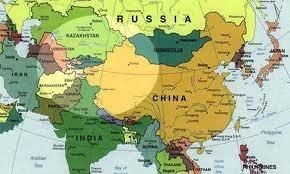
BISHKEK (TCA) — The Publisher’s note: Throughout the 19th and 20th centuries, Central Asia was the scene of intense geopolitical struggle and the Great Game between the British and Russian Empires, and later between the Soviet Union and the West, over Afghanistan and neighboring territories. Into the 21st century, Central Asia has become the area of a renewed geopolitical interest, dubbed the New Great Game, largely based on the region’s hydrocarbon and mineral wealth. On top of that, the region now is perhaps the most important node in the implementation of China’s One Belt, One Road initiative through which Beijing aims to get direct access to Western markets. Every week thousands of news appears in the world’s printed and online media and many of them may escape the attention of busy readers. At The Times of Central Asia, we strongly believe that more information can better contribute to peaceful development and better knowledge of this unique region. So we are presenting this Weekly Digest which compiles what other media have reported on Central Asia over the past week.
KAZAKHSTAN
Want to Explore Central Asia? Kazakhstan Should be the First Place on Your List
A glance at some places foreign tourists must see in Kazakhstan
Aug 28 — “Getting tourist visa for Kazakhstan is easy as you can have it for just Rs 4400 from the embassy, that too within 5 days of application. Last year, the Kazakhstan embassy issued more than 25,000 visas for Indians. To simplify the process, the embassy has also introduced the E-Visa. For transit visa you need to have return flight ticket usable within 72 Hours. If you want to travel only Kazakhstan then you must have the tourist visa.” READ MORE: https://www.news18.com/news/lifestyle/want-to-explore-central-asia-kazakhstan-should-be-the-first-place-on-your-list-2287431.html
A Windswept Plain, a Sea of Oil and a Mountain of Money
A Chevron-led joint venture among several energy companies is spending billions of dollars in Kazakhstan to expand an oil field remarkable for its longevity, promise and risk
Aug 29 — “In a windswept land of salt flats and wild horses, investors are pouring money into one of the largest and most lucrative oil fields outside the Middle East. Oil has been pumped from this remote plain since the early 1990s at a pace that would have depleted other fields by now. Yet it is still gushing, and there is much more to come.” READ MORE: https://www.nytimes.com/2019/08/29/business/kazakhstan-oil-tengiz-chevron.html
‘Ground Zero’: Report from the former Semipalatinsk Test Site in Kazakhstan
Every year on August 29, at the initiative of Kazakhstan, the UN and its Member States mark the International Day against Nuclear Tests. This year, the Day coincides with the 70th anniversary of the first atomic bomb test at the Semipalatinsk test site in Kazakhstan
Aug 29 — “Moscow-400, Semipalatinsk-21, End of the Line, Kurchatov City. All these are the names for a top-secret city built on the banks of the Irtysh River in the north-east of Kazakhstan after the Second World War. Living there were Soviet scientists and members of the military whose job it was to conduct nuclear tests. To get inside Kurchatov City, which in the late 1940’s was surrounded by checkpoints, friends and family members of the city’s inhabitants would wait for months for permission. Getting outside the city, named after Soviet nuclear physicist Igor Kurchatov, wasn’t so easy either.” READ MORE: https://news.un.org/en/story/2019/08/1045221
The reforms Kazakhstan needs
The Kazakh currency, the tenge, lost nearly half its value against the US dollar, real incomes dropped to pre-oil-boom levels, and unemployment skyrocketed, especially among the young
Aug 30 — “Kazakhstan’s former president, Nursultan Nazarbayev, who resigned in March after nearly 30 years in power, was a great admirer of the Singaporean leader Lee Kuan Yew. For Nazarbayev, Lee’s leadership showed the importance of strengthening the economy before liberalising politics. But the flaws in that approach are now on stark display.” READ MORE: https://www.aspistrategist.org.au/the-reforms-kazakhstan-needs/
KYRGYZSTAN
Kyrgyzstan Attempts to Isolate Local Islam
Kyrgyz authorities profess a separation of state and religion while also paradoxically preferring one version of Islam
Aug 28 — “After Kyrgyzstan obtained independence, the country experienced a religious revival which included the entry of many religious denominations into the country. Among them were various Christian as well as Islamic sects. The new Islamic groups in many ways differed from the practices of local or so-called “traditional Islam.” As a result, a new religious diversity emerged in the landlocked mountainous country alongside an ethnic diversity which remained from the Soviet era.” READ MORE: https://thediplomat.com/2019/08/kyrgyzstan-attempts-to-isolate-local-islam/
Kyrgyzstan: Risk of a third revolution?
The feud between Atambayev and Jeenbekov has shown that Kyrgyzstan is far from becoming a “democratic island” in Central Asia
Aug 29 — “Notwithstanding the recent violent unrest in Kyrgyzstan, Atambayev’s saga is unlikely to lead to a violent overthrow of the government, which occurred in the country in 2005 and 2010. A political turmoil has shaken Kyrgyzstan. After hours of tense confrontations between protesters and police, former President Almazbek Atambayev was detained on 8 August. The arrest of Atambayev is the latest development of a six-week standoff, which started when current President Sooronbay Jeenbekov lifted his immunity from prosecution last June.” READ MORE: https://globalriskinsights.com/2019/08/kyrgyzstan-struggle-of-power-between-presidents/
Kyrgyzstan’s revolving doors of justice and politics
In the changing political landscape in Kyrgyzstan, and with the future parliamentary election in sight, the role of the parliament is likely to remain weak as that of the president is likely to grow
Aug 30 — “One quarter-turn of the kaleidoscope that is Kyrgyzstan’s political scene and everything changes. Some politicians are coming out of prison. Others are going in. And then there are elections looming on the horizon. On August 29, the Pervomaisk district court in Bishkek approved a petition to release Omurbek Tekebayev and Duishonkul Chotonov from prison pending a review of their case.” READ MORE: https://eurasianet.org/kyrgyzstans-revolving-doors-of-justice-and-politics
TAJIKISTAN
China increases its presence in Russia’s former Central Asian backyard
A recent joint exercise in Tajikistan is the latest example of Beijing’s growing security and economic interests in the former Soviet republic
Aug 25 — “China is increasing its military and economic presence in parts of central Asia that Russia has traditionally considered its sphere of influence – a development some analysts believe could cause concern in Moscow. While Russia’s influence remains strong in many former Soviet republics, China is steadily building up its military and economic influence in Tajikistan, particularly in the remote, mountainous areas on its western borders where central government authority is weak.” READ MORE: https://www.scmp.com/news/china/diplomacy/article/3024261/china-steps-its-presence-russias-former-central-asian-backyard
Tajikistan Inaugurates its First Radiotherapy Centre in its Northern Province with IAEA Support
The provision of the new radiotherapy equipment for the Sughd Centre is the latest in a series of advances made by the Government of Tajikistan with the support of the IAEA
Aug 27 — “Each year, approximately 3000 cancer patients in Tajikistan require radiotherapy as part of their treatment. Until last week, patients living in the Sughd region, Tajikistan’s northernmost province, would have to travel across 300 kilometres of mountainous roads to reach the country’s only operational radiotherapy clinic, located in the national capital, Dushanbe. On 18 August, this gap separating cancer patients from the care they require was finally closed when a new radiotherapy facility was officially inaugurated in Khujand, the capital of Sughd province.” READ MORE: https://www.iaea.org/newscenter/news/tajikistan-inaugurates-its-first-radiotherapy-centre-in-its-northern-province-with-iaea-support
Tajikistan: Presidential awards show preferences among ruling family
The president’s son-in-law mainly known for ruthless business practices has been given a high state award
Aug 30 — “The president of Tajikistan bestowed one of the nation’s highest honors on one of his sons-in-law, but the authorities seem eager for the fact not to be publicized too widely. As RFE/RL’s Tajik service, Radio Ozodi reported, President Emomali Rahmon on August 29 handed out awards to people found to have made a special contribution to the fields of science and culture, as well as to distinguished law enforcement officers.” READ MORE: https://eurasianet.org/tajikistan-presidential-awards-show-preferences-among-ruling-family
TURKMENISTAN
Turkmenistan: Tiger, tiger, burning dimly
In its ‘Akhal-Teke: A Turkmenistan Bulletin’, Eurasianet reviews the main news and events in the Central Asian country for the previous week
Aug 27 — “The practice of requiring parents enrolling first-graders and aspiring college students to provide a detailed tabulation of family members going back three generations dates to the days of Turkmenistan’s late president Saparmurat Niyazov. As the Chronicles of Turkmenistan has reported this week, ever more people are being made to provide this potted familial history.” READ MORE: https://eurasianet.org/turkmenistan-tiger-tiger-burning-dimly
The Hajj for a bribe
A bribe of about $556 needs to be paid to those who make the list of pilgrims in order to secure a place on the list for those travelling at government expense
Aug 28 — “On 25 August the pilgrims who had performed Hajj to Mecca and Medina as part of the government quota returned to Turkmenistan. Correspondents of “Chronicles of Turkmenistan” found out that those making the pilgrimage have their expenses covered. Moreover, a significant part of the money allocated by the government is left after the trip.” READ MORE: https://en.hronikatm.com/2019/08/the-hajj-for-a-bribe/
Turkmenistan Turns To Singapore For Economic Development
Before his trip to Singapore, President Berdimuhamedov approved an agreement signed with Singapore’s GP Global Equipment Pte. Ltd to design and construct a gas compressor station in Turkmenistan
Aug 29 — “In a region where hydrocarbon exports dominate national economies, the central government of Turkmenistan is making a concerted effort to develop the Caspian country’s non-oil sector and partnering with Singapore to make it happen. “Singapore could be a stepping stone for Turkmenistan on its way to the Southeast Asian market, which offers great opportunities for business communities,” Koh Poh Koon, Singapore’s senior minister of state at the Ministry of Trade and Industry said during a meeting in Singapore on Monday with Turkmenistan’s President Gurbanguly Berdimuhamedov, according to reports by state-run Turkmenistan Today.” READ MORE: https://caspiannews.com/news-detail/turkmenistan-turns-to-singapore-for-economic-development-2019-8-28-11/
UZBEKISTAN
Uzbekistan Experiences The Pitfalls Of Peacemaking In Afghanistan
Kabul might view the recent visit by the Taliban delegation to Uzbekistan as the Uzbek government’s attempt to bolster its own security by warming ties with the Taliban
Aug 24 — “Fostering peace is a complicated process, and Uzbekistan just received a strong hint that best intentions can be interpreted as unwanted actions. Tashkent is trying to help promote peace in Afghanistan. Other parties are too, but the outcome of events in Afghanistan has a direct bearing on Uzbekistan, which shares an approximately 160-kilometer border with Afghanistan. Uzbekistan hosted a regional security and development conference in November 2017 that focused heavily on Afghanistan, and a conference specifically on Afghanistan in March 2018.” READ MORE: https://www.rferl.org/a/uzbekistan-afghanistan-taliban-peacemaking-pitfalls/30126897.html
Can Uzbekistan’s new leader reform the country?
If the Uzbek president wants genuine reform of religious freedoms in the country, he faces a steep uphill battle
Aug 27 — “In recent years, Uzbek President Shevkat Mirziyoyev has made headlines for shifting the country’s foreign policy and introducing several social and economic reforms, ending 27 years of closed rule by Islam Karimov. Branding himself a “reformer”, Mirziyoyev visited every Central Asian capital in the first year of his presidency, settled a decades-old border dispute with neighbouring Kyrgyzstan and continued his multi-pronged policy, in which Tashkent adopted a non-committal adaptive foreign policy and tried to balance relations with the US, Russia and China.” READ MORE: https://www.trtworld.com/opinion/can-uzbekistan-s-new-leader-reform-the-country-29297
Shuttering Notorious Jaslyk Prison A Victory for Human Rights in Uzbekistan
Human Rights Watch helped to keep international attention on Uzbekistan’s ‘house of torture’
Aug 27 — “In early August, Uzbekistan President Shavkat Mirziyoyev announced that the notorious Jaslyk prison would be closed. Jaslyk’s planned closure offers hope that Uzbekistan is on the path to making serious improvements in its terrible record on human rights. Since it opened in 1999, Jaslyk stood as a symbol of Uzbekistan’s terrible human rights record, a “house of torture” for thousands of religious prisoners, government critics, and others. Some inmates never made it out alive.” READ MORE: https://www.hrw.org/news/2019/08/27/shuttering-notorious-jaslyk-prison-victory-human-rights-uzbekistan
AFGHANISTAN
Inside Afghanistan: Record Numbers Struggle to Afford Basics
57% of Afghans report having struggled to afford food in the past year
Aug 26 — “Afghans not only are facing challenges in regard to their safety and security as the country’s presidential election nears, but they also are struggling more than ever to afford the basics such as food and shelter. Gallup surveys in Afghanistan over the past decade highlight the great need for action from incoming leadership.” READ MORE: https://news.gallup.com/poll/265832/inside-afghanistan-record-numbers-struggle-afford-basics.aspx
In Afghanistan and Kashmir, It’s the 1980s All Over Again
Decades of violence and terrorism were set in motion back then. Here’s how to avoid that from happening this time around
Aug 29 — “While a superpower negotiates an exit from Afghanistan, India stirs up a hornet’s nest in Kashmir. It is the 1980s, and the world is at an inflection point that led to a major insurgency in Kashmir, the Afghan civil war, the rise of the Taliban, and the attacks of 9/11. Again today, the world is facing no less an important transition period as the United States is set to conclude a preliminary peace agreement with the Taliban and India’s Hindu nationalist government continues its communications and media blackout in Kashmir after having revoked the region’s nominal autonomy this month.” READ MORE: https://foreignpolicy.com/2019/08/29/in-afghanistan-and-kashmir-its-the-1980s-all-over-again/
I Served 10 Tours in Afghanistan. It’s Time for Us to Leave
To win, we would need a comprehensive new strategic approach, and I do not see that as likely to happen. The only alternative left is to leave, says Brig. Gen. Donald C. Bolduc (Ret), a former commander of U.S. Special Operations Command Africa and a fellow at the American College of National Security Leaders
Aug 30 — “On the evening of July 15, 1979, a solemn and weary President Jimmy Carter sat in the Oval Office and addressed the nation about what he termed a “fundamental threat to American democracy.” Known historically as the “crisis of confidence” speech, President Carter used his prime-time slot to empathize about a general malaise hovering over the country. It was a particularly perilous period for America, whose economy was trapped by high Inflation and energy shortages and whose political elite was distrusted by the very citizens they were supposed to represent.” READ MORE: https://time.com/5664533/afghanistan-troops-leave/
WORLD
‘Central Asia has always been important for Europe’
The influence of political heavyweights China and Russia in Central Asia grows. Peter Burian, the EU Special Representative for Central Asia, on Europe’s role in the region
Aug 27 — “Our new Strategy will aim to focus future EU action in the region on two key priorities. Firstly, we want to be partners for resilience. We want to strengthen the capacity of Central Asian states and societies to overcome internal and external shocks and enhance their ability to embrace reform. This should translate into closer cooperation on human rights and the rule of law. This will also imply closer cooperation in security, including counter-radicalisation and counterterrorism, but also new areas such as hybrid threats and cyber-security. We also want to cooperate with the countries of the region to turn environmental challenges into opportunities.” READ MORE: https://www.ips-journal.eu/topics/international-relations/article/show/central-asia-has-always-been-important-for-europe-3676/
Central Asia’s Koreans in Korea: There and (Mostly) Back Again
Central Asia’s Korean population is looking to South Korea for fast money, but not for long-term living
Aug 28 — “Fearing Japanese espionage in the Soviet Far East, in 1937 Stalin deported some 170,000 Koreans from these border areas to uninhabited regions in northern Uzbekistan and southern Kazakhstan. These Koreans had originally settled in Primorye after fleeing famine on the Korea peninsula in the 1860s. Today, the number of Koreans living outside the peninsula counts up to seven million people, and more than 300,000 live in Central Asia as a result of this massive deportation.” READ MORE: https://www.opendemocracy.net/en/odr/central-asias-koreans-in-korea-there-and-mostly-back-again/




 TCA
TCA