• KGS/USD = 0.01144 0%
  • KZT/USD = 0.00194 -0%
  • TJS/USD = 0.10866 -0.18%
  • UZS/USD = 0.00008 -0%
  • TMT/USD = 0.28490 0%
  • KGS/USD = 0.01144 0%
  • KZT/USD = 0.00194 -0%
  • TJS/USD = 0.10866 -0.18%
  • UZS/USD = 0.00008 -0%
  • TMT/USD = 0.28490 0%
  • KGS/USD = 0.01144 0%
  • KZT/USD = 0.00194 -0%
  • TJS/USD = 0.10866 -0.18%
  • UZS/USD = 0.00008 -0%
  • TMT/USD = 0.28490 0%
  • KGS/USD = 0.01144 0%
  • KZT/USD = 0.00194 -0%
  • TJS/USD = 0.10866 -0.18%
  • UZS/USD = 0.00008 -0%
  • TMT/USD = 0.28490 0%
  • KGS/USD = 0.01144 0%
  • KZT/USD = 0.00194 -0%
  • TJS/USD = 0.10866 -0.18%
  • UZS/USD = 0.00008 -0%
  • TMT/USD = 0.28490 0%
  • KGS/USD = 0.01144 0%
  • KZT/USD = 0.00194 -0%
  • TJS/USD = 0.10866 -0.18%
  • UZS/USD = 0.00008 -0%
  • TMT/USD = 0.28490 0%
  • KGS/USD = 0.01144 0%
  • KZT/USD = 0.00194 -0%
  • TJS/USD = 0.10866 -0.18%
  • UZS/USD = 0.00008 -0%
  • TMT/USD = 0.28490 0%
  • KGS/USD = 0.01144 0%
  • KZT/USD = 0.00194 -0%
  • TJS/USD = 0.10866 -0.18%
  • UZS/USD = 0.00008 -0%
  • TMT/USD = 0.28490 0%
17 December 2025

Kyrgyzstan’s ex-president paying the price for years of abrasive rule

BISHKEK (TCA) — It is now clear that “operation successor” designed by former President of Kyrgyzstan Almazbek Atambayev has failed, and that he may end up like some of his currently disgraced loyalists. We are republishing this article on the issue, originally published by Eurasianet:

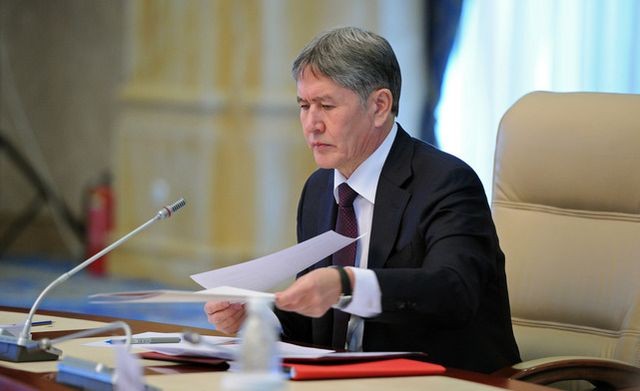
Over the six years in which he ran Kyrgyzstan, former President Almazbek Atambayev made enemies left and right, paying little heed for the consequences. Now that he is out of power, his often abrasive and arbitrary style of rule is returning to haunt him.

Atambayev, 61, has had a torrid few months. Many allies installed by him in powerful government posts have been fired in a systematic purge waged by his successor-turned-foe. Some have been arrested. And now another scandal is looming.

Since last week, lawmakers have begun demanding a renewed probe into the nebulous circumstances under which Kyrgyzstan planned in 2014 to rent out four military helicopters to Uganda’s armed forces. The person fanning the flames of the scandal was once fired by Atambayev and was later investigated on corruption charges.

What is known so far is that Kyrgyzstan proposed to lease two MI-24Bs and two MI-8MTBs donated to it by Russia to Uganda for use in peacekeeping operations in Somalia. Deputies in parliament want to understand how the deal was hatched.

The contract was reportedly signed by representatives of the Ugandan defense ministry and the state-owned Kyrgyzkural weapons enterprise in December 2014, but the public only learned about it many months afterward. Even then, the affair only came to light by virtue of a petition from then-Defense Minister Abdilla Kudaiberdiyev for prosecutors to investigate whether the deal was even legal.

Under the terms of the agreement, lease payments were to be made to the Dubai-based bank accounts of a company called Sky Tech Trading Services FZE. It is unclear whether the Kyrgyz state would have been the ultimate beneficiary of the transaction.

After Kudaiberdiyev made a stink, a government-appointed interdepartmental working group in September 2015 decreed that the helicopter lease indeed did “not correspond to the requirements of Kyrgyzstan’s existing legislation.” In other words, whoever pushed through the contract may have broken the law.

And as chance would have it, a copy of the government decree on the lease, dated October 8, 2014, and bearing Atambayev’s signature has suddenly come to light, courtesy of RFE/RL’s Kyrgyz service, Radio Azattyk.

Kudaiberdiyev clearly has an axe to grind. In October 2015, the helicopter affair having died down, he was fired by Atambayev. His dismissal came on the heels of prosecutor filing charges against him on suspicion of corrupt schemes within the ministry.

He is now relishing the opportunity to get back.

“To sign [a contract] between two states it was a requirement to get permission from the government of Kyrgyzstan. But that didn’t happen. [Atambayev] unilaterally broke the law and signed the agreement,” Kudaiberdiyev told Radio Azattyk last week.

A particularly piquant aspect of this story is the notion that Atambayev might be seen as having betrayed the confidence of his fastest allies in Moscow.

“They are trying to discredit Atambayev in the eyes of the Russian authorities,” Denis Berdakov, political analyst, told Eurasianet. “They are trying to show that he damaged Russian interests with this two-faced behavior. And this will harm his image far worse than any 10 criminal cases on internal national matters.”

Atambayev’s only remnant source of formal political influence is his Social Democratic Party of Kyrgyzstan, or SPDK, which holds the largest bloc of seats in parliament.

It has been left to the SDPK to deny the Uganda helicopter story as “another case of fake news.”

It is not easy to understand quite why Atambayev’s successor, Sooronbai Jeenbekov, is proving so ferocious in hounding his one-time ally. The most prevalent and convincing explanation is that Jeenbekov, who was elected to power in October and inaugurated as head of state in November, has bristled at the prospect of having Atambayev hanging around as a back-seat president.

Atambayev signaled his intentions on that front at the end of March when he retook the helm of the SDPK, a party he was originally instrumental in founding.

But he may have overlooked the fact that the power of that party was contingent on negotiated settlements with local powerbrokers. And while in the top seat, Atambayev may have forgotten the value of teamwork.

Indeed, the SDPK’s representatives in parliament have proven a fickle source of support of late. The vote of no-confidence that culminated the ouster of Sapar Isakov, an arch Atambayev-ite, as prime minister in April was put forward by opposition deputies but was eventually supported in parliament by many SDPK members.

The explanation for this counterintuitive dynamic was provided, albeit in highly cryptic terms, by Atambayev himself in an incensed June 6 statement about criminal charges being filed against Isakov and another ally, former Bishkek mayor and head of the customs service Kubanychbek Kulmatov. (Both men are currently in detention.)

“Yesterday’s decision to arrest civil servants who clearly documented the extent of theft in the customs system is in fact revenge being meted out by the friends and patrons of the famous Rayim Million, whose dismissal led to positive changes and sharp increase in customs revenues,” Atambayev said.

The fleeting allusion was clear to observers of Kyrgyz politics. In late November, Rayimbek Matraimov, the real name of the man known popularly as Rayim Million, was fired from his immensely influential post as deputy chairman of the Customs Service. A government statement announcing his dismissal accused him of failing to show “compliance with government policies.”

That was an impossibly bland way to describe the sudden fall from grace for such a powerful individual. Matraimov is a consummate operator and a highly recognizable power-broker in his native south. His nickname, which local media uses liberally, is an allusion to the kinds of riches that high-ranking customs officials in Kyrgyzstan are said to acquire.

Atambayev does not spell it out, but Matraimov’s ability to wreak revenge against the former president’s entourage is contingent in part on the political support he is said to have lent the SDPK over the years. Crossing Matraimov was never going to go well.

Atambayev is still protected by the privilege of immunity as a former head of state, but the emboldened parliament has been talking of scrapping that legal protection.

As Medet Tiulegenov, a professor of international and comparative politics at Bishkek’s American University of Central Asia, told Eurasianet, Jeenbekov has many people in his entourage bearing grudges against Atambayev.

And with his legacy of six years in power, there may be a surfeit of suspect transactions implicating Atambayev like the one of the helicopters to Uganda.

“Considered against the background of general trends, this is one of those stark cases that could have not just internal implication but also international ones,” said Tiulegenov.

Kazakhstan: Almaty builds a high-tech Japanese plant

ALMATY (TCA) — A technical opening of a new plant for the production of engineering protection systems of the transnational corporation Tokyo Rope Manufacturing has taken place within the framework of the initiative “50 Projects-Drivers of Almaty’s Development”, in the industrial zone of Kazakhstan’s largest city. The enterprise has no analogue in the CIS and was introduced by Japanese investments, the Kazakh Invest National Company for Investment Support and Promotion said.

The governor of the city Bauyrzhan Baibek noted that the launch of a high-tech plant is the realization of the instruction of the President of the country Nursultan Nazarbayev to attract foreign investments and create innovative production facilities in Kazakhstan.

The new enterprise has unique equipment for the production of drill anchors, high-strength metal cables, steel zinc-coated grids for mining and quarrying. The plant’s capacity is more than 17 thousand tons of steel products per year.

Chairman of the Board of Directors of Tokyo Rope Manufacturing Shigeto Tanaka said that Almaty was the starting point for the spread of advanced Japanese technologies throughout the region.

“After the launch of the first phase of the project in 2016, the products of the Tokyo Rope Almaty plant are already being used in the CIS and the Persian Gulf, including the implementation of a major project in Saudi Arabia. The products of the plant localized in Almaty were also used to strengthen the riverbed of the Esentai River, the highway to the Big Almaty Lake, the Medeu-Shymbulak cable car and the Mun Zhylky Platinum. I am sure that the joint work carried out today will give impetus to the influx of new Japanese investments into Kazakhstan,” Shigeto Tanaka said.

The Japanese company was founded over 130 years ago. It is the world leader in the production of steel ropes. In Tokyo Rope they also specialize in the design, manufacture and installation of protective structures against mudflows, avalanches, landslides, rock falls. The ropes of the Japanese company are used in the construction of 12 of the world’s 20 largest bridges. Each fourth tire produced in Japan uses Tokyo Rope products. Along with this, the company is known for high-quality ropes for high-speed elevators and products for engineering protection.

“In general, more than 40 large domestic and foreign projects in the spheres of construction, pharmaceutical, chemical, food and light industry are being realized in the industrial zone of Almaty today. In the current year, it is planned to introduce 9 new projects, including the plant for the production of cable and wire products of the Russian company KMK Investment, the Kazakh-Chinese enterprise Asia Steel Pipe Corporation for the production of large diameter welded pipes for the transportation of oil, gas, water and oil products,” Almaty’s executive committee’s press service added.

Uzbekistan taking an active approach to WTO accession

TASHKENT (TCA) — Membership in the World Trade Organization would open up new prospects for Uzbekistan, and the country is intent on moving toward that goal. At a two-day seminar that started in Tashkent on June 21, national officials, agricultural producers and many others study the implications of WTO accession for Uzbekistan, with special attention to possible reforms in the area of trade and domestic support policy.

Continue reading

Kazakhstan: Senate speaker signals Nazarbayev won’t run in 2020

ASTANA (TCA) — The state power succession is a relevant issue in Kazakhstan, and the most recent developments show that the authorities have crafted a transition scheme. We are republishing this article on the issue, originally published by Eurasianet:

The speaker of Kazakhstan’s parliament has dropped a political bombshell by stating in an interview that President Nursultan Nazarbayev may not run for re-election in 2020.

“He is a very wise man, he is absolutely reasonable. And I think that in 2020 we shall have presidential elections with other candidates,” Tokayev told BBC’s Hard Talk program in an interview aired on June 20.

Tokayev said he was expressing his own personal views in making the forecast, although it is unlikely such a senior official in Kazakhstan would issue the remarks without sanction from higher up. As speaker of the Senate, Tokayev is in formal terms only second in the hierarchy to Nazarbayev.

The date of Nazarbayev’s departure from the top of Kazakhstan’s political pyramid has for years been object of sustained speculation and this may be the clearest indication to date that a definitive exit strategy has been crafted.

There have been tentative signs in the recent past that a transition of sorts is in the offing.

Early in 2017, Nazarbayev, who turns 78 on July 6, issued a televised declaration nebulously outlining his desire to formally dilute the powers of the president and shift toward a more parliamentary form of government.

“The basic essence is that the president will give some of his powers to parliament and the government,” he said in a January 25, 2017, address televised on all national channels. “The proposed reform is a serious redistribution of power and a democratization of the political system as a whole.”

As outlined by Nazarbayev, those reforms will give the executive more powers over running the economy, while the head of state retains control over defense and foreign policy. The head of the Constitutional Council, Kairat Mami, met with Nazarbayev earlier this week to debrief him on the progress being made toward overhauling the constitution, but few details were provided by the president’s office on the substance of the conversation.

In the broader picture, the planned transition toward a highly consensual model of parliamentarianism indicates that Nazarbayev intends to be Kazakhstan’s first and last all-powerful head of state.

Parliament is at present overwhelmingly dominated by Nazarbayev’s Nur Otan party. A pair of officially sanctioned ersatz opposition parties have been allowed to occupy 14 out of the legislature’s 107 seats in the directly elected lower house of parliament.

Genuinely confrontational political parties have been either sidelined into irrelevance through harassment and by being ignored by media almost entirely under the thumb of the government or banned altogether. Sensing the prospect of change at the top, some opposition activists are seeking to mobilize in order to seize the initiative in a post-Nazarbayev era, although it is unclear they possess the organizational nous or the public appeal to capitalize on the moment.

Strong legal guarantees have also been put in place for Nazarbayev in anticipation of his departure from office.

In 2010, he was proclaimed Leader of the Nation, a bespoke status endowing him with lifetime powers and immunity from prosecution. Meanwhile, it was made a criminal offense punishable by up to a year in prison to make remarks insulting Nazarbayev. And journalists publishing insulting remarks about Nazarbayev could face a maximum penalty of three years in prison.

To begin with, he made a show of disdaining the Leader of the Nation honorific, which was supposedly the autonomous initiative of lawmakers, and demanded in a performance of modesty that people stop delivering eulogies to him. But when it came time to vetoing the proposal, he disdained the opportunity.

This is all to say that even if Nazarbayev does decide to step down, he will still retain immense influence over running the country.