• KGS/USD = 0.01144 0%
  • KZT/USD = 0.00216 0%
  • TJS/USD = 0.10456 0%
  • UZS/USD = 0.00008 0%
  • TMT/USD = 0.28490 0%
  • KGS/USD = 0.01144 0%
  • KZT/USD = 0.00216 0%
  • TJS/USD = 0.10456 0%
  • UZS/USD = 0.00008 0%
  • TMT/USD = 0.28490 0%
  • KGS/USD = 0.01144 0%
  • KZT/USD = 0.00216 0%
  • TJS/USD = 0.10456 0%
  • UZS/USD = 0.00008 0%
  • TMT/USD = 0.28490 0%
  • KGS/USD = 0.01144 0%
  • KZT/USD = 0.00216 0%
  • TJS/USD = 0.10456 0%
  • UZS/USD = 0.00008 0%
  • TMT/USD = 0.28490 0%
  • KGS/USD = 0.01144 0%
  • KZT/USD = 0.00216 0%
  • TJS/USD = 0.10456 0%
  • UZS/USD = 0.00008 0%
  • TMT/USD = 0.28490 0%
  • KGS/USD = 0.01144 0%
  • KZT/USD = 0.00216 0%
  • TJS/USD = 0.10456 0%
  • UZS/USD = 0.00008 0%
  • TMT/USD = 0.28490 0%
  • KGS/USD = 0.01144 0%
  • KZT/USD = 0.00216 0%
  • TJS/USD = 0.10456 0%
  • UZS/USD = 0.00008 0%
  • TMT/USD = 0.28490 0%
  • KGS/USD = 0.01144 0%
  • KZT/USD = 0.00216 0%
  • TJS/USD = 0.10456 0%
  • UZS/USD = 0.00008 0%
  • TMT/USD = 0.28490 0%

Kyrgyzstan-Kazakhstan border crisis remains unresolved

BISHKEK (TCA) — “The Kyrgyz Republic has deliberately chosen the path of Eurasian integration, as it best meets the strategic economic interests of the country. This decision was dictated by long-term national priorities of the Kyrgyz Republic,” Sapar Isakov, Prime Minister of Kyrgyzstan, said at the Eurasian Intergovernmental Council meeting on October 25 in Yerevan, Armenia.

The Council’s meeting gathered prime ministers of Eurasian Economic Union (EEU) member states — Armenia, Belarus, Kazakhstan, Kyrgyzstan, and Russia.

The EEU Customs Code is among the most harmonized legislations, consisting of the best international practices and giving significant advantages to business, Isakov added.

The head of Kyrgyzstan’s Government spoke about the situation at the Kyrgyz-Kazakh border.

“We are negotiating with our partners at the level of prime ministers. You are all witnessing that there were certain problems, and some of them have been settled. But there is a question — should there be these problems, and do they correspond to the spirit of our partnership?” Isakov addressed the meeting participants.

On October 10, Kazakhstan strengthened border control at the Kyrgyz-Kazakh border. On October 18, Isakov visited Astana, where an agreement was reached on a priority in checking people with personal baggage, regular buses with passengers, cars and empty trucks.

The problem with crossing the border by trucks loaded with often perishable products remains unresolved, as long lines of trucks continue standing on the Kyrgyz side of the border.

“We would like to hope that our Kazakh friends will solve these issues, because our legal framework gives us every reason to say that vehicles loaded with our goods should not stand but should pass the border, as it is written in our contracts,” Isakov said. The EEU basic principles provide for the free movement of goods, capital, services and labor.

In the framework of Kyrgyzstan’s presidency in the EEU, 2017 was declared the year of improvement of business conditions. Decisions made under Kyrgyzstan’s chairmanship will contribute to improving the business competitiveness of the EEU countries in the long term, Isakov said.

Kazakhstan’s position

The work carried out by Kazakhstan on the border “is not directed specifically towards the Kyrgyz side,” Prime Minister of Kazakhstan Bakytzhan Sagintayev said at the meeting. Kazakhstan does not pursue anything but reducing tax losses and smuggling, and “this also applies to our other friends in the Union,” he added.

The two states have to develop and adopt a roadmap, consisting of 48 points, to outline the ways of implementing the agreement. “We have full understanding on 43 points and in the future, our services will work on their implementation,” Sagintayev said.
He presented a brief overview of the situation regarding the supply of goods from China to the EEU member countries.

The statistics of imports of goods from China to the EEU states shows its decline in all countries except Kyrgyzstan. In 2016, almost 50% less goods were imported from China to Kazakhstan than two years earlier. Russia imports 25% less goods from China, and a slight decrease is in Belarus. The increase in customs duties from China imports is only in Armenia – by twice, and in Kyrgyzstan — more than sixfold.

Comparison of the data on trade between China and Kyrgyzstan revealed significant discrepancies. According to China’s foreign trade statistics, exports to Kyrgyzstan amounted to $4.3 billion in 2015. According to Kyrgyzstan, imports amounted to $1 billion. The deviation is $3.3 billion. In 2016, the discrepancy exceeded $4 billion. For this year, according to preliminary estimates, the deviation will be $2.5 billion, Sagintayev said.

As a result, the amount of customs duty losses in the EEU budget will be about $828.6 million for three years, Sagintayev said. Therefore, the increase of control at Kazakhstan’s border is aimed at identifying violations by cargo carriers, he concluded.

Kyrgyzstan’s view

Not only Kyrgyzstan but all the EEU member countries are facing the problems of unaccounted imports, and it is not correct to say that only Kyrgyzstan has such problem, Economy Minister of Kyrgyzstan Artem Novikov told journalists in Yerevan.

If to compare statistics in Kazakhstan, the situation is the same, he said. For example, China showed $8.5 billion exports to Kazakhstan at the end of 2015, while Kazakhstan showed $5 billion in imports, Novikov said.

Kyrgyzstan’s Government intends to analyze the statement of the Prime Minister of Kazakhstan, and to submit a separate statement.

Despite the agreement concluded by PM Isakov in Astana, and even if the roadmap is signed, the border will not open, and there will be no free movement of goods from Kyrgyzstan, according to the Kazakh side.

“Therefore, the road map has not been signed. Further work on this issue will be carried out taking into account the EEU mechanisms and our bilateral consultations with Kazakhstan,” Novikov concluded. Last week, the Economy Ministry of Kyrgyzstan appealed to the WTO and the Eurasian Economic Commission regarding this issue.

Minister Novikov said that the strengthened border control mechanism that is currently being applied by Kazakhstan violates the EEU rules on the free movement of goods, services, capital and labor.

Conclusion

The relations between the two countries have deteriorated after harsh statements of outgoing President of Kyrgyzstan Almazbek Atambayev regarding the Kazakh president, made on the eve of the October 15 presidential elections in Kyrgyzstan. Shortly thereafter, enhanced border control was introduced by the Kazakh side.

Some experts believe the situation on the Kyrgyz-Kazakh border may be resolved after the inauguration of the new Kyrgyz president, which will take place before December 1, 2017.

Other experts believe the main role in resolving the border situation belongs to Kyrgyzstan’s Government, after its powers will intensify after December 1, according to the amended Constitution. Much will then depend on the actions to be taken by the cabinet of Sapar Isakov.
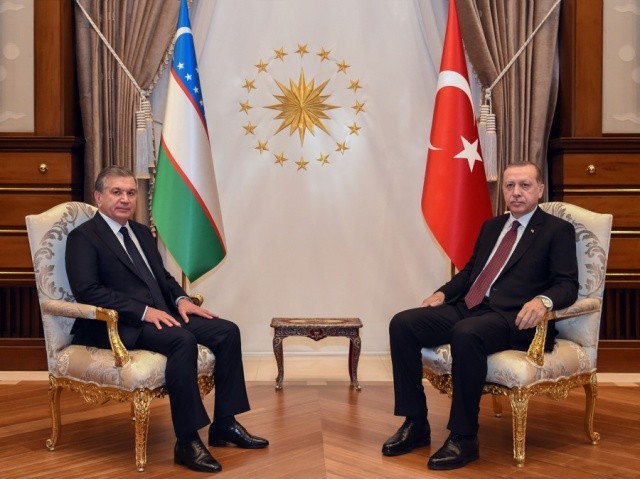

Uzbekistan president visits Turkey to expand cooperation

TASHKENT (TCA) — On October 25, President of Uzbekistan Shavkat Mirziyoyev arrived in Turkey with a two-day state visit at the invitation of Turkish President Recep Tayyip Erdogan. It is the first official visit to Turkey by Uzbekistan’s president since 1999.

Mirziyoyev and Erdogan held a meeting in a narrow format. During the negotiations, cooperation between Uzbekistan and Turkey in political, trade, economic, investment, transport and communication spheres were discussed, the press service of the Uzbek president said.

The visit of President Erdogan to Uzbekistan in November 2016 demonstrated Turkey’s interest in strengthening cooperation with Uzbekistan. The two heads of state also held negotiations within the framework of One Belt, One Road forum on May 14 this year and the summit on science and technology of the Organization of Islamic Cooperation held on September 10 in Astana.

Turkey is an important trade partner of Uzbekistan. In 2016, bilateral trade amounted to 1.2 billion US dollars. For 9 months of this year, the mutual trade increased by 29 percent. There are about 500 Turkish companies in Uzbekistan.

During the negotiations, Mirziyoyev and Erdogan noted that there are still unused opportunities for mutually beneficial cooperation, and that this visit will give a new impetus to the development of contacts between ministries and departments, businessmen of the two countries.

It was said that Uzbekistan can export to Turkey a wide range of industrial products, transformers, cables and other electrical goods, polymers, copper and copper products, mineral fertilizers, yarn, fruit and vegetables, and processed food.

In Uzbekistan, Turkish companies take part in the organization of production, in free economic and small industrial zones, of products with high added value on the basis of deep processing of mineral resources and raw materials.

The negotiations paid special attention to the issues of transport and logistics. It was decided to optimize transit tariffs and provide preferences in order to increase the competitiveness and attractiveness of international transport corridors passing through the territory of Uzbekistan and Turkey.

Uzbekistan seeks agricultural cooperation with US

TASHKENT (TCA) — A delegation of the Ministry of Agriculture and Water Resources of Uzbekistan is paying an official visit to the United States these days, the Jahon information agency reported on October 25. The delegation is comprised of rectors of the Tashkent State Agrarian University and Andijan Agricultural Institute, as well as the management of the Tashkent Institute of Irrigation and Mechanization of Agriculture and Samarkand Agricultural Institute.

Continue reading

OSCE helps enhance security of energy infrastructure in Kyrgyzstan

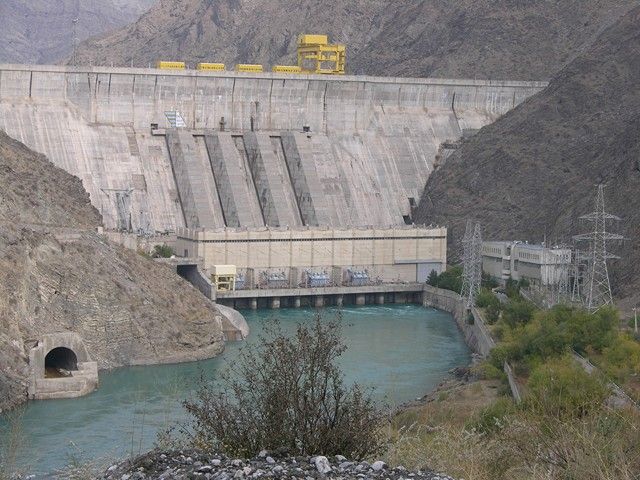
BISHKEK (TCA) — The OSCE Programme Office in Bishkek has handed over video surveillance equipment to the National Guard of the Armed Forces of Kyrgyzstan to enhance the security of the country’s strategic energy facilities — the Tash-Kumyr and Kurpsai hydroelectric power stations. The stations are part of Kyrgyzstan’s largest Naryn hydropower plant cascade.

Continue reading

Trade possibilities spurring rapprochement between Tajikistan and Uzbekistan

TASHKENT (TCA) — With the new leadership in Tashkent, the warming political relations between Tajikistan and Uzbekistan have allowed boosting trade between the two neighbors. We are republishing this article on the issue, originally published by EurasiaNet.org:

As visitors arrived at the UzExpoCenter exhibition hall in Tashkent last week, they were greeted by sight of a carpet woven with the image of the presidents of Uzbekistan and Tajikistan shaking hands. Some took photos of themselves cheerfully standing in front of the carpet.

For three days, ending October 13, Tajik entrepreneurs representing around 120 companies showed off their wares at the trade fair in the Uzbek capital. The event was a response to an analogous event in April organized for Uzbek exporters looking to expand their market in Tajikistan.

Prior to this year, Uzbekistan and Tajikistan for the best part of two decades had engaged in a low-level cold war. Thus, the sense of novelty about the goodwill exchange is strong.

A member of the Tajik delegation, Dushanbe-based entrepreneur Abdumavlon Abulloyev, told EurasiaNet.org that he last visited Uzbekistan in 1985, when he was 33 years old. When asked to comment on the fair, he seemed more interested in talking about the excitement of being back. “When I crossed the border, it felt as though we had never left. … I am so happy with the positive developments taking place between our countries,” said Abulloyev.

Abulloyev’s company processes cotton and produces a wide range of clothes, from overalls for manual laborers to school uniforms. For him, as for many Tajik manufacturers, the prospect of gaining a foothold in Uzbekistan’s populous and geographically convenient market is appealing.

His Uzbek partner, Jamallidin Yakubov, however, was slightly more circumspect and said that although the countries may be growing closer on a diplomatic level, lots of details need to be addressed to boost imports and exports. “When importing goods from Tajikistan into Uzbekistan, we have to pay a 100 percent import tariff. That means it is easier to export Tajik sewed goods and clothes made from cotton to Kazakhstan,” Yakubov said.

Slapping punishing tariffs on imports was the late President Islam Karimov’s notion of how to keep external competition at bay. His successor, Shavkat Mirziyoyev, has embarked on a radically different approach to trade and is seeking to simplify life for exporters and importers alike.

Although the focus at the UzExpoCenter was on selling the Tajikistan brand, the deals went both ways.

Mastura Tagayeva, manager for exports and marketing at Uzbek personal hygiene products supplier SofFresh, said she went to the Dushanbe fair in April and was struck by the level of excitement the event generated. And during her visit to the Tashkent exhibition, Tagayeva managed to bag another sale.

“We have reached an agreement for a Tajik company to buy from us paper cones [used for winding yarn], diapers and feminine hygiene products,” Tagayeva said.

There was particular excitement at the stand for Italian denim company Carrera, which has a factory in Tajikistan. Visitors were especially struck by the low prices for men’s jeans — at $12 apiece, they would compete well in the Uzbek market.

Uzbek model Viviana Nurmetova, the company representative at the Carrera stand, explained that all their denim goods are manufactured with Tajik cotton. Around 90 percent of their Tajik output, which ranges from jeans to shirts and jackets, is at the moment sent to Italy and then exported onward to markets in Western Europe.

As long as Karimov was in power, it would have been inconceivable to stage any such fairs. Fazliddin Abdiyev, a 23-year-old shoe manufacturer, told EurasiaNet.org that not only was he visiting Uzbekistan for the first time, but that the idea of traveling to Tashkent had never even crossed his mind before. Abdiyev said he is dipping his toe into the Uzbek market to see what the competition is like.

“We produce quality wares with Turkish equipment. Our military-style boots should find demand among Uzbek businesses. They are really in with young people right now,” Abdiyev said.

Economist Yuliy Yusupov noted that even though the barrier for bilateral trade is coming down, administrative obstacles, including the visa regime and import tariffs, remain in place. Earlier this month, Uzbekistan lifted visa requirements for Tajik citizens visiting the country for a single day, but longer stays still require completing onerous paperwork and an $18 visa fee.

“One key problem of the Tajik economy is the excessively high rate of the Tajik currency, on account of all the remittances from migrants. The somoni is depreciating more slowly than inflation is increasing, and that means the real exchange rate is increasing. In real terms, Tajik goods are getting more expensive, and imports getting cheaper,” Yusupov said.

Tajik journalist Muzaffar Yunusov said that the high tariff wall has fueled a robust trade in contraband goods. Black marketeers take meat, potatoes and cigarettes from Tajikistan across the border. Flowers, tomatoes and fuel go the other way.

Recent data suggests that either trade is on the rise or that some of it is emerging out of the shadow economy. Bilateral trade between Uzbekistan and Tajikistan rose by 17.8 percent year-on-year in 2016 to $197 million, according to Uzbek government figures. The figure for the first nine months of this year is already $178.2 million, indicating that this year will be significantly better than last.

In April, when Tajikistan hosted a fair of Uzbek goods, about 160 companies touted hundreds of varieties of goods from tractors to cotton harvesters, cars to trucks and buses, and pharmaceutical materials to food and textiles. Deals worth a total of $50 million were signed for export of Uzbek goods to Tajikistan.

On the first day of the Tajik fair, 19 contracts worth a total of $27 million were signed. No figures are yet available for the entire three-day event.

On the final day of the Tajik fair, Uzbek officials announced that the national air carrier, Uzbekistan Airways, would imminently be lowering its fares for return flights between the two capitals — from $350 to $190.