• KGS/USD = 0.01144 0%
  • KZT/USD = 0.00215 0%
  • TJS/USD = 0.10599 -0.28%
  • UZS/USD = 0.00008 0%
  • TMT/USD = 0.28571 0%
  • KGS/USD = 0.01144 0%
  • KZT/USD = 0.00215 0%
  • TJS/USD = 0.10599 -0.28%
  • UZS/USD = 0.00008 0%
  • TMT/USD = 0.28571 0%
  • KGS/USD = 0.01144 0%
  • KZT/USD = 0.00215 0%
  • TJS/USD = 0.10599 -0.28%
  • UZS/USD = 0.00008 0%
  • TMT/USD = 0.28571 0%
  • KGS/USD = 0.01144 0%
  • KZT/USD = 0.00215 0%
  • TJS/USD = 0.10599 -0.28%
  • UZS/USD = 0.00008 0%
  • TMT/USD = 0.28571 0%
  • KGS/USD = 0.01144 0%
  • KZT/USD = 0.00215 0%
  • TJS/USD = 0.10599 -0.28%
  • UZS/USD = 0.00008 0%
  • TMT/USD = 0.28571 0%
  • KGS/USD = 0.01144 0%
  • KZT/USD = 0.00215 0%
  • TJS/USD = 0.10599 -0.28%
  • UZS/USD = 0.00008 0%
  • TMT/USD = 0.28571 0%
  • KGS/USD = 0.01144 0%
  • KZT/USD = 0.00215 0%
  • TJS/USD = 0.10599 -0.28%
  • UZS/USD = 0.00008 0%
  • TMT/USD = 0.28571 0%
  • KGS/USD = 0.01144 0%
  • KZT/USD = 0.00215 0%
  • TJS/USD = 0.10599 -0.28%
  • UZS/USD = 0.00008 0%
  • TMT/USD = 0.28571 0%

Viewing results 1 - 6 of 43

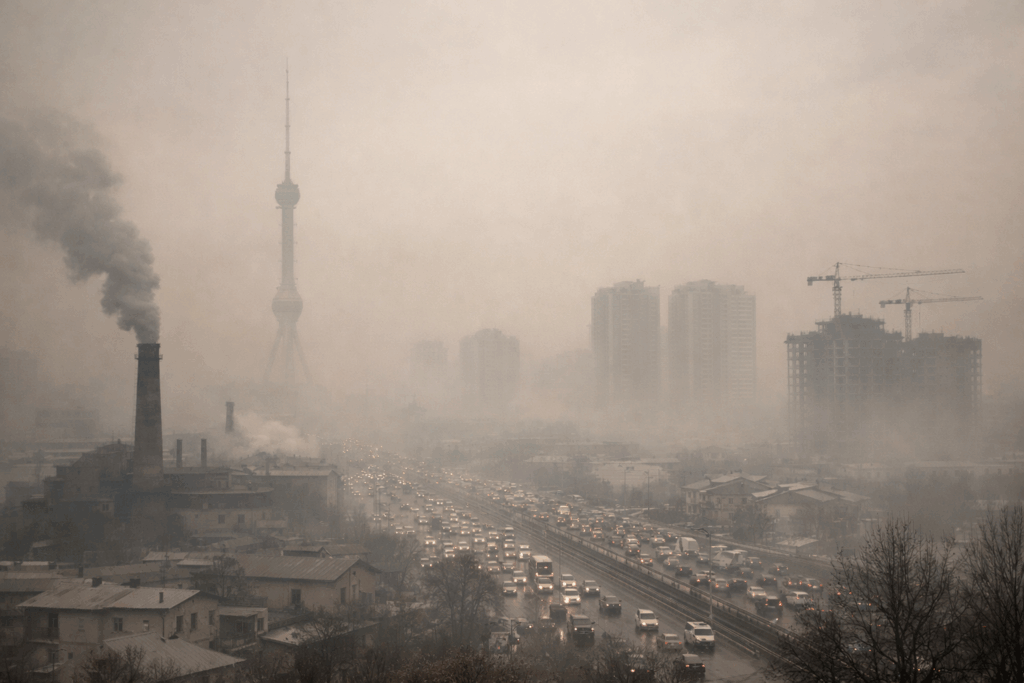
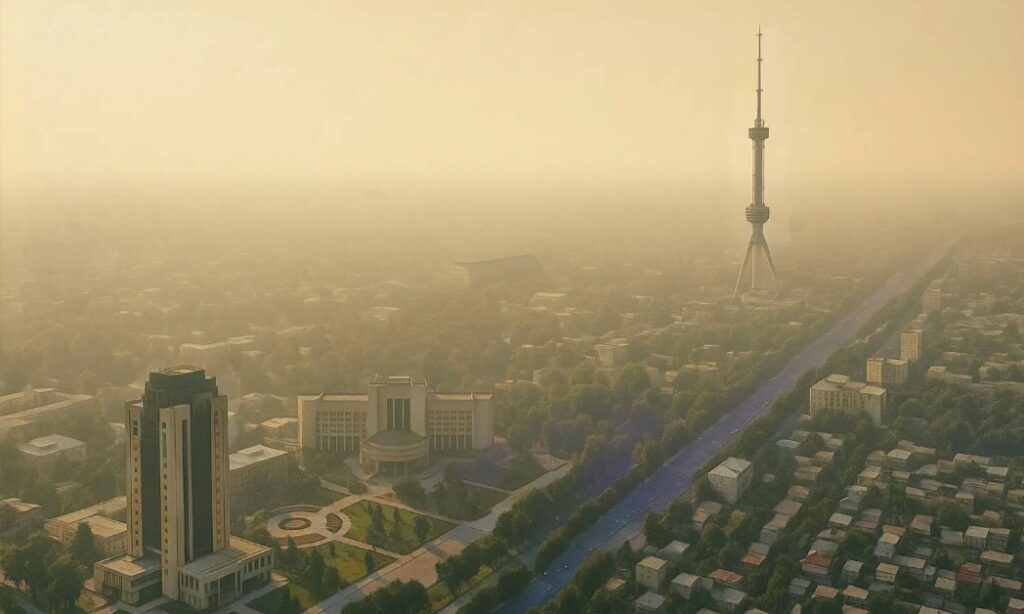
Tashkent Launches Emergency Measures as Air Pollution Worsens

Tashkent is experiencing a significant decline in air quality, prompting President Shavkat Mirziyoyev to sign a decree on November 25 implementing urgent environmental measures. According to the presidential press service, the decree establishes a special commission to take immediate steps to stabilize the situation. The decision follows a high-level meeting on November 24 chaired by Saida Mirziyoyeva, head of the Presidential Administration, to discuss “urgent measures to improve the ecological situation in Tashkent.” Experts at the meeting presented a series of short, medium, and long-term proposals, ranging from immediate restrictions to structural reforms aimed at preventing future pollution spikes. The new plan includes enhanced environmental monitoring, stricter controls on major polluters, tighter regulations for construction sites, and citywide greening initiatives. Authorities also intend to develop a modern air quality assessment system supported by new scientific infrastructure. A key component of the initiative is the establishment of a specialized laboratory under the State Committee for Ecology to analyze sources of PM2.5 pollution, one of the primary contributors to the current smog. To expedite the process, the decree exempts a broad range of imported equipment from customs duties. These exemptions apply to automated monitoring stations, dust-gas filtration systems, localized water-treatment devices, and thousands of quartz filters required for sampling. The measure also extends to household air purifiers brought into the country by individuals and businesses, as demand for such devices has surged. In response to the prolonged dry conditions, the Muslim Board of Uzbekistan announced the performance of istisqo, a traditional Islamic prayer for rain, to be held on November 28 following Friday prayers in mosques nationwide. “In Islamic history, istisqo has been performed during periods of drought, and its benefits have been noted in hadith literature,” the Board stated. Teachers and students from Islamic institutions will also recite the entire Sahih of Imam al-Bukhari before the prayer. This call for collective prayer comes as climate change continues to intensify environmental stress in Uzbekistan. According to a newly released Atlas of Environmental Change by the UN Environment Programme (UNEP), Uzbekistan’s average annual temperature has risen by 1.6°C over the past 60 years, nearly three times the global average of 0.6°C. In the Aral Sea region, warming has reached 1.8 to 2.5°C, contributing to more frequent droughts, particularly in summer and autumn, and placing further strain on already limited water resources. UNEP describes Uzbekistan’s water resources as “among the country’s most valuable and vulnerable,” noting that they depend almost entirely on sources located outside its borders. The atlas highlights the increasing importance of integrated water-resource management and cross-border cooperation, which officials say have already helped address local water-security issues. The agency also points to the adoption of water-saving technologies such as drip irrigation, which are critical to sustaining the country’s irrigated agricultural sector, the backbone of many rural economies. Despite demographic and environmental pressures, the report finds that Uzbekistan has achieved near self-sufficiency in food production. Reforestation is also a national priority. UNEP praises the Yashil Makon (Green Space) initiative, launched in 2021...

Air Pollution Research Center Opens at Osh State University with Japanese Support

A new Inter-Institutional Research Center for Air Pollution Studies (IRCAPS) has been inaugurated at Osh State University in southern Kyrgyzstan. The center is part of a five-year joint project between Osh State University and the Tokyo University of Science. Funded by the Japan International Cooperation Agency (JICA) and the Japan Science and Technology Agency (JST), the $5 million initiative includes full provision of technical equipment for the facility. The opening ceremony, held on November 18, was attended by Professor Nobutoshi Nawa, a leading scientist from the Tokyo University of Science, and Nishigato Kotaro, JICA’s representative in Kyrgyzstan. Osh State University Rector Kudaiberdi Kojobekov stated that the center's establishment represents a new phase in scientific and educational collaboration between Kyrgyzstan and Japan. The center will focus on studying the health impacts of air pollution. Monitoring equipment will be installed both indoors and outdoors in residential areas to assess air quality in Osh, Bishkek, and other regions. Japanese scientists will collaborate directly with Kyrgyz researchers, and the resulting data will be used to formulate policy recommendations for relevant institutions and stakeholders. The project is being carried out in coordination with the Ministry of Health, the Ministry of Natural Resources, Ecology, and Technical Supervision, the Hydrometeorological Service, the International Higher Medical School, the Osh City Administration, and various international partners. Air pollution remains a critical issue in Kyrgyzstan, particularly in its largest urban centers, Bishkek and Osh. Key sources include the widespread use of coal for heating and vehicle exhaust emissions.

Tashkent’s Air Pollution Crisis Sparks Public Concern and Expert Warnings

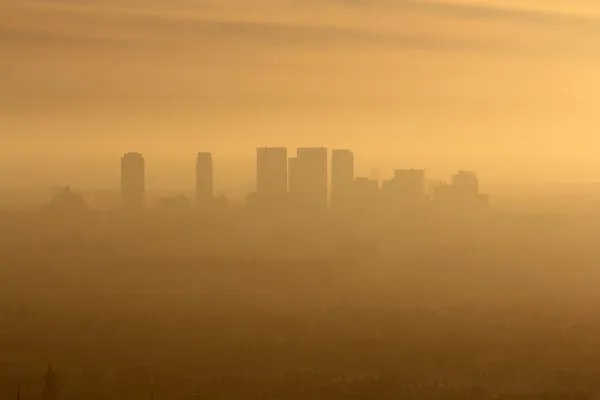
On November 20, local media reported that Tashkent briefly topped the global air pollution rankings compiled by IQAir, drawing urgent public attention to the capital’s worsening environmental conditions. According to IQAir, the city’s PM2.5 concentration reached 229 at 10:51 a.m. on November 21, placing Tashkent behind only Delhi and Lahore for hazardous air quality. Experts Warn of Long-Term Mismanagement Behind Toxic Air Environmental specialists attribute the crisis to deep-rooted structural mismanagement. Environmental advocate Mutabar Khushvaktova cited IQAir’s breakdown of primary pollution sources: summer dust storms (36%), heating systems running on coal and fuel oil in autumn and winter (28%), vehicle emissions (16%), and industrial activity (13%). Khushvaktova argued that ineffective oversight across construction, industry, transportation, and urban development has contributed to the current crisis. “Even after the Ministry of Ecology was established, conditions did not improve. Initially, the ministry reacted defensively to criticism but then stopped responding altogether. If this continues, public frustration will intensify and the economy will suffer. Illness will increase, productivity will fall, hospitals will be overwhelmed, and skilled professionals may leave the country,” she warned. She outlined several urgent steps: increased government transparency, expert-led planning, strict protection of green zones, enhanced oversight of construction sites, mandatory filtration at industrial plants, and boosted funding for water and glacier research. She also emphasized safeguarding forests, reservoirs, and nature reserves from tourism-related development and called for full reform of Tashkent’s landscaping department. “We need stable urban ecosystems, modern irrigation systems, restored canals, and composting initiatives. This work must be done in close cooperation with the Ecology Committee,” she said. Families in Tashkent Voice Growing Health Concerns Madina Mo‘minova, a writer and filmmaker known for her work on environmental themes in children’s literature, expressed grave concern for families in the capital. “Air quality in Uzbekistan, especially in Tashkent, has reached an unbearable level,” she said. “I fear for my children and grandchildren. People are afraid to open their windows or even go outside. Many are already thinking about leaving.” Mo‘minova noted that while the government has taken preliminary steps, the response needs to be more comprehensive and sustainable. “Greenhouses shouldn’t just be shut down, they need access to clean energy sources like natural gas to prevent recurring pollution after every inspection. We want to live in a safe, healthy country, not one teetering on ecological collapse,” she said. Urban Planners Call for Infrastructure Restoration and Stricter Oversight Temur Akhmedov, an expert on green urban development, stressed the importance of rehabilitating traditional infrastructure. “Restoring canals should be the top priority in Tashkent and other cities,” he said. “In many areas, the damage is extensive, but we must recover what we can.” He also advocated for halting new construction until a comprehensive environmental strategy is in place, along with enforcing dust-control measures at existing sites. These environmental concerns coincide with accelerated urban development plans. On November 20, President Shavkat Mirziyoyev signed a decree aimed at stabilizing the housing and mortgage markets. The initiative includes plans to double annual housing construction by 2040, reaching 421,000...

Metro Expansion Key to Almaty Infrastructure Plans

Next year, Almaty plans another incremental step in the development of its public transport infrastructure with the opening of a new station at Kalkaman. This should see the tentacles of the transport system shift towards the west of the city. In the future, there are also plans to extend the metro north to Alatau, where the government’s “smart city” is being developed. Investment in public transport is welcome, particularly with vocal complaints from residents about ever-increasing traffic problems and their contribution to the city’s winter smog. “The expansion of the metro is considered one of the key tools for improving the environmental situation in Almaty,” a spokesperson for the Almaty mayor’s office (or Akimat), told The Times of Central Asia. “Increasing the share of passenger transportation via the subway reduces the use of cars, decreases traffic congestion, lowers emissions, and contributes to improved air quality.” The ambitious new metro project is in addition to over 600 new buses expected to be added to the Almaty Bus fleet this year. But despite these schemes, the traffic problem shows little sign of abating. It begs the question: has the city got public transport priorities right? [caption id="attachment_39565" align="aligncenter" width="1600"] New-look trolleybuses and electro-buses can be seen as part of Almaty’s modern fleet; image: TCA, Joe Luc Barnes[/caption] The rise of the automobile “Traffic jams in Almaty began in the early 2000s, when the economic situation improved and people started buying cars,” Dauren Alimbekov, a high-profile blogger on Almaty transport, told The Times of Central Asia. He adds that the privatisation of other forms of public transport exacerbated this problem. The tram network was suspended in 2015 after two high-profile accidents, with the tracks being dismantled in 2017. Its disappearance coincided almost exactly with the arrival of ride-hailing services such as Yandex Go! in July 2016. By 2023, over 200,000 residents were moonlighting as Yandex Go! drivers to earn extra money. “In recent decades, the city has been planned with cars in mind, with major thoroughfares such as Al-Farabi almost totally lacking in convenient pedestrian crossings,” said Alimbekov. This influx of drivers has created problems. Private cars are a major contributor to air pollution in the city. On some days earlier this year, Almaty recorded the worst pollution in the world. [caption id="attachment_39564" align="aligncenter" width="1600"] A lack of dedicated bus lanes slows journey times and prevents more people from using public transport; image: TCA, Joe Luc Barnes[/caption] Public transport That is not to say that there is no public transport in the city. Indeed, the Almaty Metro is the only metro system in Central Asia to have opened since the collapse of communism. Trains began running in 2011, but they only travelled between an initial five stations. Two more opened in 2015, which saw a spike in passenger numbers. Today, there are eleven stations, although most of these remain along Abay Avenue, giving it little practical value to most residents. The metro system does not connect to either of the city’s main train...

Kyrgyzstan Confronts Transport-Driven Air Pollution

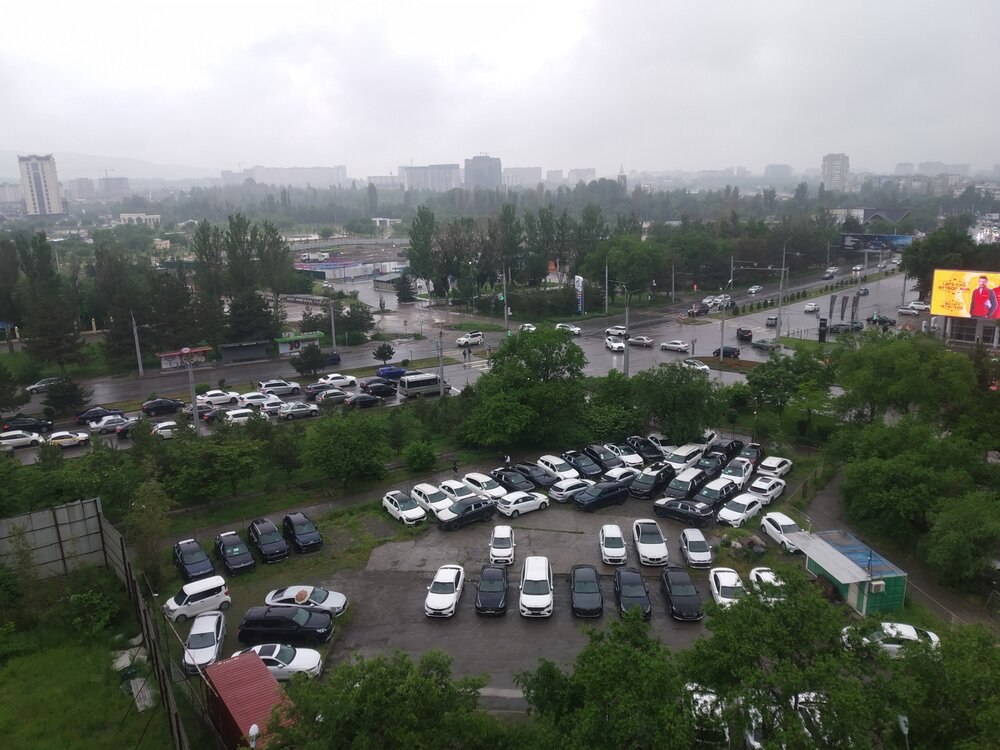
On October 21, Bishkek hosted the National Multi-Stakeholder Dialogue “Tackling Transport Air Pollution in Kyrgyzstan: Towards Clean Air in Cities All Year Round.” The event gathered representatives from government bodies, international organizations, environmental NGOs, academia, and civil society. Participants discussed coordinated actions and practical solutions to reduce air pollution and improve environmental conditions in Kyrgyz cities. Key proposals included transitioning to cleaner fuels, expanding public transport, improving energy efficiency, and implementing stricter emission standards. A systemic approach was emphasized, involving the promotion of electric vehicles, public environmental education, and robust air quality monitoring. Experts warned that transport-related pollution is a leading contributor to chronic diseases and premature death, particularly among vulnerable populations. Kyrgyz Minister of Natural Resources, Ecology and Technical Supervision, Meder Mashiev, highlighted that while previous efforts had focused on pollution during the heating season, new World Bank analysis shows that vehicle emissions significantly impact air quality year-round in Bishkek. According to the Ministry, vehicle emissions account for roughly 30% of air pollution in the capital. In 2024, 1,674,085 vehicles were registered in Kyrgyzstan, with 83% or 1,392,737, over 15 years old. In Bishkek, 426,946 vehicles were registered, including 333,801 older than 15 years, most of which do not meet modern environmental standards. The city administration reported that more than 750,000 vehicles operate on Bishkek’s roads daily, more than double the road network’s intended capacity of 350,000. This, combined with poor fuel quality and widespread reliance on private cars, has led to a systemic environmental challenge. Mashiev outlined several initiatives to address the issue. First, the city is transitioning to environmentally friendly public transport. Over 1,300 eco-friendly buses and 120 electric buses have been delivered to Bishkek. Each new bus replaces approximately four diesel buses, cutting diesel fuel consumption by around 100 tons per day. By the end of 2024, 3,535 electric vehicles were registered in the capital, and 44 charging stations had been installed. Second, modern air quality monitoring systems are being deployed to enable more accurate and responsive pollution tracking. Third, updates to the regulatory framework are being implemented to improve emission controls and compliance mechanisms. “We have already taken concrete steps to improve air quality in Bishkek, the use of low-quality coal has been banned, large-scale greening projects are underway, and an active transition to alternative energy sources is in progress,” said Mashiev. He concluded that similar measures would be introduced in other major cities across Kyrgyzstan, including Osh and Jalal-Abad.

Greening Campaign in Bishkek Targets Air Quality Improvement

A citywide greening campaign was launched in Bishkek on October 15, with plans to plant more than 10,000 tree and shrub saplings across the capital. The initiative is part of a broader effort to combat environmental degradation and improve air quality in one of Central Asia’s most polluted cities. According to the Bishkek City Administration, priority will be given to areas surrounding educational institutions. The plan includes the creation of green zones around every school in the city. The tree-planting campaign is designed to help reverse decades of urban deforestation, a consequence of rapid development that has significantly reduced Bishkek’s tree cover. Once regarded as one of the greenest cities in the former Soviet Union, Bishkek has lost much of its vegetation due to unchecked construction and infrastructure expansion. Environmental experts have urged city planners to prioritize the planting of tall, broadleaf deciduous trees, valued for their shade and noise-reducing qualities, over coniferous species, which currently dominate urban landscaping. The campaign aligns with Kyrgyzstan’s nationwide “Jashyl Muras” (“Green Heritage”) initiative, launched by President Sadyr Japarov in March 2022. The program aims to plant between five and six million saplings each year. In 2024, the Ministry of Natural Resources, Ecology and Technical Supervision reported that more than 8.1 million saplings were planted across the country. Additional Measures to Reduce Pollution On the same day, during a meeting of the Interdepartmental Commission for Improving Air Quality, Bishkek Mayor Aibek Junushaliev detailed other municipal efforts to reduce pollution. He noted that more than 1,500 diesel-powered minibuses have been removed from central city streets. The municipal transport fleet now consists of 1,449 environmentally friendly buses, 1,329 running on liquefied natural gas and 120 electric buses purchased in 2025. According to the Ministry of Natural Resources, Ecology and Technical Supervision, motor vehicle emissions contribute approximately 30% of Bishkek’s air pollution. Further efforts include the installation of a desulfurization system at the Bishkek Thermal Power Plant (TPP), which supplies heat and hot water to most of the capital. The plant’s emissions are estimated to account for around 15% of the city’s air pollution. The new system captures up to 96.6% of sulfur dioxide (SO₂) generated during coal combustion, marking a major step toward improving air quality in the city.