• KGS/USD = 0.01144 0%
  • KZT/USD = 0.00206 0%
  • TJS/USD = 0.10736 -0.19%
  • UZS/USD = 0.00008 0%
  • TMT/USD = 0.28490 -0.28%
  • KGS/USD = 0.01144 0%
  • KZT/USD = 0.00206 0%
  • TJS/USD = 0.10736 -0.19%
  • UZS/USD = 0.00008 0%
  • TMT/USD = 0.28490 -0.28%
  • KGS/USD = 0.01144 0%
  • KZT/USD = 0.00206 0%
  • TJS/USD = 0.10736 -0.19%
  • UZS/USD = 0.00008 0%
  • TMT/USD = 0.28490 -0.28%
  • KGS/USD = 0.01144 0%
  • KZT/USD = 0.00206 0%
  • TJS/USD = 0.10736 -0.19%
  • UZS/USD = 0.00008 0%
  • TMT/USD = 0.28490 -0.28%
  • KGS/USD = 0.01144 0%
  • KZT/USD = 0.00206 0%
  • TJS/USD = 0.10736 -0.19%
  • UZS/USD = 0.00008 0%
  • TMT/USD = 0.28490 -0.28%
  • KGS/USD = 0.01144 0%
  • KZT/USD = 0.00206 0%
  • TJS/USD = 0.10736 -0.19%
  • UZS/USD = 0.00008 0%
  • TMT/USD = 0.28490 -0.28%
  • KGS/USD = 0.01144 0%
  • KZT/USD = 0.00206 0%
  • TJS/USD = 0.10736 -0.19%
  • UZS/USD = 0.00008 0%
  • TMT/USD = 0.28490 -0.28%
  • KGS/USD = 0.01144 0%
  • KZT/USD = 0.00206 0%
  • TJS/USD = 0.10736 -0.19%
  • UZS/USD = 0.00008 0%
  • TMT/USD = 0.28490 -0.28%

Viewing results 1 - 6 of 124

Kazakhstan Modernizes Civil Aviation Infrastructure to Boost Tourism and Investment

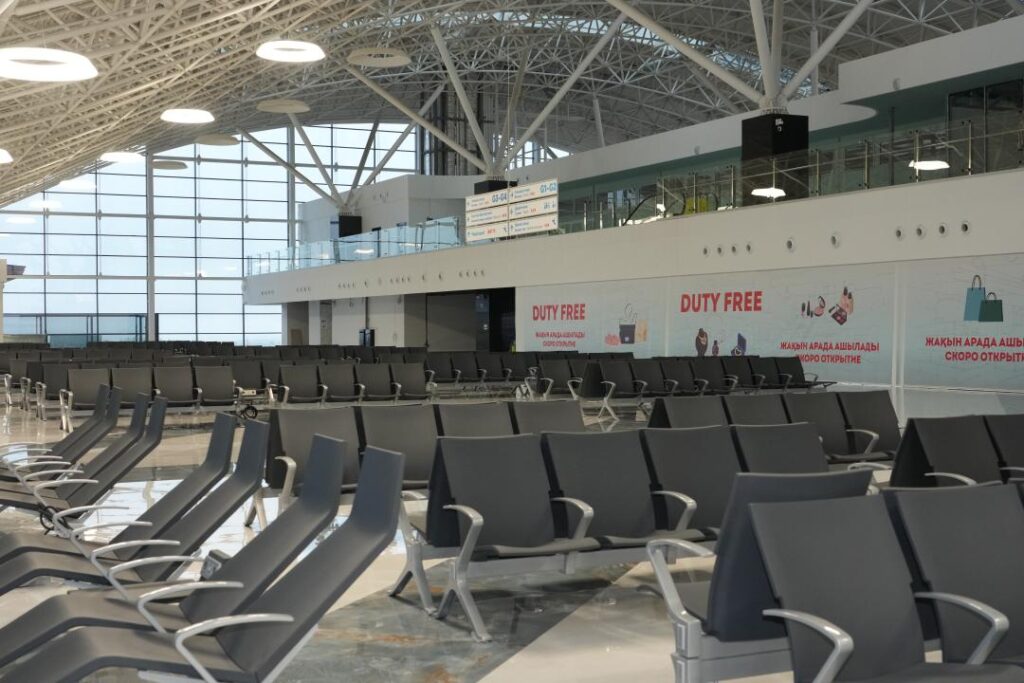
In 2024, Kazakhstan made significant strides in modernizing its air transport infrastructure, opening three new passenger terminals at the airports of Almaty, Shymkent, and Kyzylorda. The upgrades are expected to expand the capacity of these airports, increase the number of air routes, and stimulate growth in passenger traffic. According to the Ministry of Transport, these developments will enhance domestic and international tourism while boosting the investment appeal of Kazakhstan’s regions. The Role of Air Transport As the world’s 9th-largest country, Kazakhstan relies heavily on air transport to complement its extensive railway network. Fast and efficient air travel is crucial for connecting the nation’s vast territories and integrating its economy into global markets. New Terminals and Capacity Expansion: Almaty International Airport The new terminal at Almaty International Airport, which opened on June 1, has increased the airport’s capacity from 2.5 million to 14 million passengers annually. Almaty Airport serves as a hub for domestic airlines such as Air Astana, SCAT, Qazaq Air, and Fly Arystan. It operates regular flights to 19 cities across Kazakhstan and offers international connections on 50 routes to 26 countries through 30 foreign airlines. Shymkent Airport In southern Kazakhstan, the new terminal at Shymkent Airport expanded the facility’s capacity from 800,000 to 6 million passengers per year. The airport now offers international flights to 10 destinations, including Jeddah and Medina (Saudi Arabia), Doha (Qatar), Phu Quoc (Vietnam), and Phuket (Thailand). The frequency of flights has also increased to 24 per week. Kyzylorda International Airport The new terminal at Kyzylorda International Airport in south-central Kazakhstan has raised its capacity from 300,000 to 2 million passengers per year. The airport now operates 25 domestic flights, significantly enhancing connectivity for the region. Strategic Projects: Khorgos-Eastern Gate Beyond passenger terminals, a $500 million project to construct a cargo-passenger airport at the Khorgos-Eastern Gate Special Economic Zone (SEZ) is underway. The project, led by the Kazakh-German consortium SKYHANSA, will position Kazakhstan as a critical link on the Western Europe–Western China highway and the Trans-Caspian International Transport Route (TITR), which connects China and Europe. The new airport will include: A passenger terminal capable of handling up to 500 passengers per hour. A cargo terminal with an annual capacity of 250,000 tons. A fuel storage facility with a capacity of 550,000 tons. A technical center for aircraft servicing. Tourism, shopping, and entertainment facilities. This project underscores Kazakhstan’s commitment to expanding its role as a logistics and trade hub in Central Asia. Growth in Air Transportation The air transport sector in Kazakhstan continues to grow at a rate of 10-15% annually. In 2024, Kazakh airlines transported approximately 15 million passengers, while the nation’s airports served 30 million passengers. Cargo transportation also saw significant growth, with 28,000 tons transported in the same period. Kazakhstan’s domestic airlines add 10-15 aircraft to their fleets each year, bringing the total fleet to 102 aircraft as of 2024. Expanding International Connectivity Kazakhstan operates 582 flights per week to 31 countries, including Russia, Kyrgyzstan, Uzbekistan, Tajikistan, Georgia, Belarus, Azerbaijan, the UAE,...

Uzbekistan to Launch VIP Air Taxi Service in Partnership with UAE’s JETEX

During President Shavkat Mirziyoyev’s official visit to the United Arab Emirates on January 13, Uzbekistan’s Ministry of Transport signed a memorandum of cooperation with JETEX, a leading UAE-based aviation services company. The agreement, signed by Uzbekistan’s Minister of Transport Ilkhom Makhkamov and JETEX founder Adel Mardini, sets the stage for ambitious projects in Uzbekistan’s civil aviation sector. One of the cornerstone initiatives involves JETEX providing Fixed Base Operator (FBO) services for VIP and CIP (Commercially Important Passenger) customers at Tashkent-East Airport through a public-private partnership. This project will also include the repair, sale, and maintenance of small aircraft, along with the launch of VIP air taxi services. These efforts aim to strengthen Uzbekistan’s tourism industry and elevate the travel experience for high-end customers. According to officials, the project is expected to improve the quality of passenger services and enhance Tashkent’s reputation as an attractive and prestigious destination. Moreover, it is anticipated to generate over 200 jobs in Uzbekistan’s business aviation sector, contributing to the nation’s economic growth. Founded in 2005, JETEX has become a global leader in business aviation services, with operations in over 50 locations across the Middle East, Europe, Asia-Pacific, Africa, and the Americas. The company’s expertise in Fixed Base Operator services ensures reliable and sustainable growth in the business aviation sector. Fixed Base Operators (FBOs) provide essential airport services such as aircraft refueling, parking, hangar maintenance, repair, charter sales, and other aviation-related services. These facilities cater to private and business aviation, ensuring high-quality services for operators and passengers. The partnership with JETEX marks a significant step forward in modernizing Uzbekistan’s aviation infrastructure and expanding its footprint in the global business aviation market.

Aliyev Takes Aim at Russia in Azerbaijan Airlines Crash

Azerbaijani President Ilham Aliyev has intensified his criticism of Russia, accusing it of a “cover-up” over the Azerbaijan Airlines plane which crashed near the Kazakh city of Aktau on December 25. During a televised address, Aliyev expressed Azerbaijan’s “surprise, regret, and righteous indignation” over what he described as “absurd” explanations for the crash. Departing from protocol, Aliyev delivered his address in Russian, a poignant choice that heightened the gravity of his message. “I can confidently say that the guilt for the deaths of Azerbaijani citizens in this accident lies with the representatives of the Russian Federation,” Aliyev stated. “We demand justice, we demand punishment of the guilty, we demand complete transparency and humane treatment… If the city of Grozny had taken timely measures to close Russian airspace over its territory, if all the rules of ground services had been observed, and if there had been coordination between the armed forces and civil services of the Russian Federation, then this tragedy would not have happened.” On Monday, Aliyev met with the two surviving flight attendants and the families of other crew members who perished, describing them as “heroes”. The Flight Recorders In a related development, Brazil has concluded its analysis of the black boxes from Azerbaijan Airlines Flight 8243. The Aeronautical Accidents Investigation and Prevention Center (CENIPA) confirmed that the findings were handed over to Kazakhstan’s Aviation Accident Investigation Department in line with international protocols for aircraft accident investigations. These results will contribute to the final report on the incident. As previously reported by The Times of Central Asia (TCA), the incident led the Commission on Aviation Incident Investigation, headed by Kazakhstan’s Minister of Transport, Marat Karabayev, to decide to send the flight recorders to Brazil’s CENIPA. The investigation was conducted by three Brazilian specialists in collaboration with Azerbaijani and Russian experts. Chronology of the Crash The incident occurred on December 25, when an Embraer 190 aircraft operated by Azerbaijan Airlines crashed near Aktau on Kazakhstan’s Caspian Sea coast. The plane was flying between Baku, Azerbaijan, and Grozny, Russia. Of the 67 people on board, 38 were killed, and 29 were injured. The passengers included 37 Azerbaijani citizens, 6 Kazakhs, 3 Kyrgyz, and 16 Russians. On December 26, video footage showing small holes in the fuselage wreckage sparked speculation about possible external damage. Aviation and military analysts suggested the holes might have been caused by air defense systems, given reports from the Chechen authorities about the shooting down of Ukrainian drones in the area. This raised concerns about the potential for misidentification. [caption id="attachment_27352" align="aligncenter" width="1280"] Chechen Pantsir Missile Launcher; image: Vitaly V. Kuzmin[/caption] When asked about the possibility of external fire, Kazakh Minister Marat Bozumbayev emphasized that conclusions would only be drawn after all available evidence had been examined. International Collaboration The Azerbaijani government rejected the idea of a Russian-led investigation, opting instead for an international team of experts, including representatives from Embraer. The black boxes were sent to CENIPA on December 29. The crash also prompted a temporary suspension...

Questions Mount After Azeri Plane Crash with Focus on Russian Air Defenses

On December 25, an Azerbaijani Embraer 190 aircraft operating a Baku-Grozny flight made a hard emergency landing near the city of Aktau, Kazakhstan. The aircraft, carrying five crew members and 62 passengers, suffered devastating consequences. Both pilots were killed, along with 36 passengers. Additionally, 29 people, including three children, were hospitalized. The aircraft disintegrated on impact, and a fire engulfed its midsection. Initial reports suggested a bird strike, but alternative theories have since emerged. Kazakhstan’s Ministry of Emergency Situations detailed the timeline: at 11:02 Astana time, the crew issued a distress signal while flying over the Caspian Sea. By 11:37, the plane made a hard landing in the steppe near Aktau. Before official rescue teams arrived, employees of a local energy company working nearby provided critical first aid and captured the first videos of the crash. They managed to pull 15 passengers from the wreckage of the tail section. Specialized rescue teams and medics, stationed at Aktau airport in anticipation of the emergency landing, arrived promptly thereafter. According to Nurdaulet Kilybay, Akim of Mangystau Region, "22 ambulance teams and six units from the Center for Disaster Medicine worked at the crash site." The regional multidisciplinary hospital had prepared “30 surgical and trauma beds, along with 10 intensive care beds” for victims. Speculations and Investigations Journalists questioned Bozumbayev during the briefing about theories which are currently circulating, including those suggesting air defense involvement. The official avoided drawing conclusions, stating: "It is impossible to establish even a preliminary cause because there are specialists for this. They will carry out work. Then it will be clear. I can't speak now. I watched what people are posting... While [the plane] fell to the ground, and turned over, a lot of things could have happened. So, I am far from reaching conclusions." Speculation on Russian Telegram channels has posited that perforations in the aircraft’s tail section resemble shelling damage. One theory links the crash to Ukrainian drone (UAV) raids over Grozny, suggesting that air defense systems mistakenly targeted the plane. The Telegram channel VChK-OGPU claimed that "Initially, the aircraft appears to have fallen victim to UAV jammers that were operating at the time because of a drone attack. As soon as the airliner started to descend for landing, its GPS stopped working and the dispatcher lost 'radar contact.' The pilot could not land the plane in such conditions and decided to fly to Baku. When he began to turn around to do so, there was an explosion nearby — all indications are that the plane was hit by air defense equipment." The report further alleges that the strike occurred over Chechnya’s Naursky District, home to military units equipped with air defense systems. Kazakh officials stressed the need for patience, as forensic and aviation experts work to analyze the wreckage and flight data, with Bozumbayev emphasizing that “An interdepartmental investigative and operational group has been set up. Both forensic experts and experts from our Aviation Administration, who investigate such air incidents, came with me. As part...

What Happened Over Russia? Probe Into Fatal AZAL Crash in Kazakhstan Begins

Investigators into the crash of an Azerbaijan Airlines plane in Kazakhstan that killed 38 people are trying to determine what caused the aircraft to divert from its planned landing in Grozny, the capital of Russia-controlled Chechnya. The Embraer 190 passenger plane, which was carrying 62 passengers and five crewmembers, crashed on Wednesday three kilometers from the airport at Aktau, a city on the Caspian Sea in southwestern Kazakhstan. The plane had been heading from the Azerbaijani capital of Baku to Grozny, but eventually declared an emergency and headed to Aktau, about 440 kilometers to the east and across the Caspian, for reasons that have yet to be clarified. “Even a preliminary cause cannot be established because there are specialists for that. They will carry out their work. Only after that it will be clear. I can't say anything at this point,” said Kazakh Deputy Prime Minister Kanat Bozumbayev, according to the state Kazinform news agency. “I saw what people posted... While it was falling to the ground, it was flipping over, many things could have happened. Therefore, I am far from making any conclusions.” Russia’s state-run news agency Tass initially reported that fog in Grozny caused Flight J28243 to divert to Makhachkala, the capital of the Russian territory of Dagestan, and then to Aktau. RIA Novosti, another Russian state-owned media outlet, cited Russian aviation authorities as saying the plane diverted because of a collision with birds. However, some aviation and military analysts have paid particular attention to a video showing numerous small holes on part of the fuselage wreckage, and there is speculation that air defense systems may have fired on the plane; Chechen officials have reported shooting down drones from Ukraine, which is at war with Russia. Bozumbayev, the Kazakh minister, was asked about the possibility that the aircraft was fired on, and said that final results of the investigation will be announced after all evidence is examined, reported the Azeri Press Agency, or APA. The prosecutor general’s office in Kazakhstan has opened a criminal case and the country’s chief transport prosecutor visited the scene as a member of a government commission. Kazakh media reported that the flight recorder had been found. Video and images released by Kazakhstan’s Ministry of Emergency Situations showed rescue teams converging in vehicles and on foot on the flaming plane wreckage in a flat expanse of land near Aktau. One vehicle trained a water hose on the flames. Debris from the plane was scattered in the area. Emergency responders were able to pull survivors from the crumpled, partly intact fuselage. Some video appearing on social media showed a survivor limping out of the wreckage while another passenger who had been rescued was unable to walk because of apparent leg injuries. Another unverified video also shows a passenger purportedly praying on the plane in the minutes before the crash. News of the crash came as Russian President Vladimir Putin hosted a meeting in St. Petersburg for leaders of the Commonwealth of Independent States, a regional...

Kyrgyzstan Opens Airport in Karakol – More New Routes Coming Soon

On December 11, Kyrgyzstan’s President Sadyr Japarov inaugurated the reconstructed international airport in Karakol, the main city of the Issyk-Kul region. Situated southeast of Lake Issyk-Kul, Karakol is Kyrgyzstan’s winter tourism hub and home to the nation’s largest and most popular mountain ski resort. President Japarov highlighted the reopening of the Karakol International Airport as a pivotal move toward strengthening regional connectivity, boosting tourism, and enhancing Kyrgyzstan’s international profile. “This is just the beginning,” Japarov remarked, announcing plans for a major new development: a “Kyrgyz Courchevel,” envisioned as Central Asia’s largest and most modern ski resort. Located 70 kilometers from the airport, the year-round facility is planned to accommodate up to a million tourists per season. Kyrgyzstan’s government is also prioritizing the modernization of regional airports to improve domestic air connectivity. Renovation projects are underway in Naryn, Kazarman, Kerben, and Batken, while construction of a new airport in the southern city of Jalal-Abad is set to begin soon. Starting in May, the government plans to launch domestic flights on routes including Kazarman-Bishkek, Naryn-Bishkek, Kerben-Bishkek, Karakol-Osh, and Talas-Osh. These flights will be operated by the state-owned Asman Airlines. This follows the reopening of the Talas airport in May, as previously reported by The Times of Central Asia, marking its return to operation after decades of inactivity since the Soviet-era. Originally built in 1979 to accommodate planes and helicopters, the airport had long been out of service until its recent renovation. To support the enhanced domestic air network, Kyrgyzstan’s Manas International Airport Open Joint Stock Company has procured two Bombardier Dash 8 Q400 aircraft for Asman Airlines. Manufactured in Canada, the Dash 8 Q400 is a short-haul plane capable of carrying up to 80 passengers over distances of up to 2,000 kilometers.