Viewing results 1 - 6 of 4
German authorities have deported a 21-year-old citizen of Tajikistan who was detained on suspicion of planning attacks in crowded areas. Although no criminal case was formally opened, law enforcement officials cited concerns for public safety as sufficient grounds for deportation. The individual was detained in December 2025 in the city of Magdeburg. According to Die Zeit, the arrest was prompted by concerns that the young man posed a potential threat to public safety. Authorities claimed that although there was insufficient evidence to prosecute him under criminal law, his behavior suggested the possibility of radical intentions. Following several weeks of investigation, a decision was made to deport him. Police linked their concerns to signs of religious radicalization. Reports suggest the individual exhibited ideological extremism and a growing interest in firearms. While enrolled in a vocational school, he allegedly clashed repeatedly with classmates over religious issues. Mario Schwan, head of the Saxony-Anhalt state police, stated that the case was considered an “immediate threat” based on the police’s assessment. The man had entered Germany legally in June 2024 under a visa granted for participation in the Au Pair program. In his application, he expressed interest in German language and culture. He later enrolled in medical studies at the University Hospital of Magdeburg.
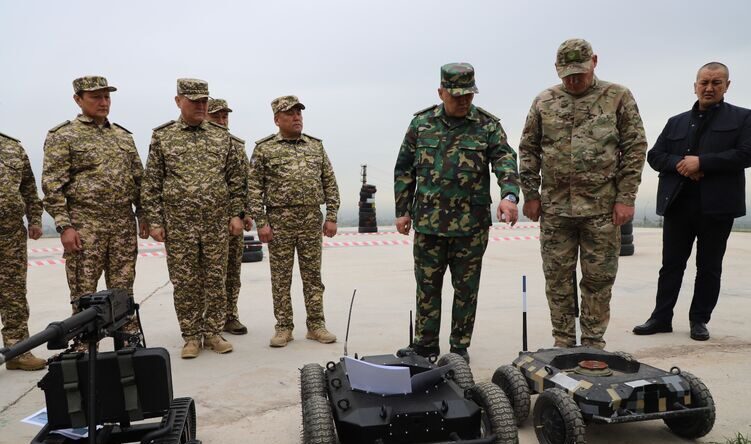
Kyrgyzstan’s elite State Committee for National Security (GKNB) special forces unit, Alpha, demonstrated advanced combat capabilities during the Asman Kozomolu 2025 anti-terrorist exercises, held to enhance operational readiness in modern warfare scenarios. According to the GKNB, the drills featured the use of cutting-edge weaponry, including unmanned aerial vehicles (UAVs), first-person view (FPV) drones, and robotic ground systems. The exercises aimed to sharpen the operational skills of personnel in deploying modern combat technologies under conditions simulating real combat. “In conditions close to combat, critical capabilities of modern combat robotics and UAVs were demonstrated, along with the process of manufacturing FPV drones,” the committee stated. A key component of the drill involved storming a simulated administrative building using a ground-based combat robot, followed by a coordinated assault by special forces. The unit also rehearsed neutralizing enemy vehicles using kamikaze ground drones and attack drones equipped with shaped-charge munitions. Additionally, operators practiced deploying FPV drones with varying payload-release mechanisms. GKNB Chairman Kamchybek Tashiev attended the exercise and participated in sniper shooting drills. Addressing the forces, he emphasized the government’s commitment to equipping military and security units with state-of-the-art logistics and weaponry to counter emerging threats. Kyrgyzstan initiated its drone program in late 2021, acquiring Turkish-made Bayraktar drones during heightened tensions along the Tajik border. Since then, the country has expanded its drone arsenal to include Russian Orlan-10 UAVs. In 2022, Kyrgyzstan inaugurated its first drone base, and by 2024, it had unveiled its first domestically produced drone at an industrial exhibition attended by President Sadyr Japarov.