• KGS/USD = 0.01144 0%
  • KZT/USD = 0.00191 -0%
  • TJS/USD = 0.10840 0.37%
  • UZS/USD = 0.00008 0%
  • TMT/USD = 0.28571 0%
  • KGS/USD = 0.01144 0%
  • KZT/USD = 0.00191 -0%
  • TJS/USD = 0.10840 0.37%
  • UZS/USD = 0.00008 0%
  • TMT/USD = 0.28571 0%
  • KGS/USD = 0.01144 0%
  • KZT/USD = 0.00191 -0%
  • TJS/USD = 0.10840 0.37%
  • UZS/USD = 0.00008 0%
  • TMT/USD = 0.28571 0%
  • KGS/USD = 0.01144 0%
  • KZT/USD = 0.00191 -0%
  • TJS/USD = 0.10840 0.37%
  • UZS/USD = 0.00008 0%
  • TMT/USD = 0.28571 0%
  • KGS/USD = 0.01144 0%
  • KZT/USD = 0.00191 -0%
  • TJS/USD = 0.10840 0.37%
  • UZS/USD = 0.00008 0%
  • TMT/USD = 0.28571 0%
  • KGS/USD = 0.01144 0%
  • KZT/USD = 0.00191 -0%
  • TJS/USD = 0.10840 0.37%
  • UZS/USD = 0.00008 0%
  • TMT/USD = 0.28571 0%
  • KGS/USD = 0.01144 0%
  • KZT/USD = 0.00191 -0%
  • TJS/USD = 0.10840 0.37%
  • UZS/USD = 0.00008 0%
  • TMT/USD = 0.28571 0%
  • KGS/USD = 0.01144 0%
  • KZT/USD = 0.00191 -0%
  • TJS/USD = 0.10840 0.37%
  • UZS/USD = 0.00008 0%
  • TMT/USD = 0.28571 0%
14 November 2025

Viewing results 1 - 6 of 9

Survey Reveals What Kazakhstanis Think About the Army and Defense

In September 2025, the research platform Demos.kz conducted a nationwide survey on public perceptions of Kazakhstan’s Armed Forces. When asked about the likelihood of Kazakhstan becoming involved in a military conflict over the next five years, 29.7% of respondents considered the risk very low, 28% rated it as average, 13.2% as rather low, 7.1% as very high, and 6.9% as rather high. Public confidence in the military's capabilities was divided. Some 31.9% of respondents believe the Kazakh army is strong enough to defend the country against external threats, while 35% said it will “more likely be able” to do so. Meanwhile, 15.8% said the army will “most likely not” be able to protect the country, and 10.4% expressed the view that “No, it won't be able to protect it at all”. On the issue of defense partnerships, 29.3% favored strengthening ties with Russia through the Collective Security Treaty Organization (CSTO). A further 27.5% supported closer cooperation with NATO members such as the United States or Turkey. Another 22.6% favored working with China via the Shanghai Cooperation Organization (SCO), 20% preferred collaboration with neighboring Central Asian countries, and 18.4% advocated for neutrality and minimizing military alliances. Opinion was also split on the preferred army recruitment model. A total of 36.6% supported transitioning to a fully professional, contract-based military. Another 36.5% favored returning to universal compulsory service, while 17.7% supported retaining the current mixed system. According to Kazakhstan’s 2025-2027 state budget, the country plans to allocate 2.7 trillion KZT ($5.2 billion) to defense and law enforcement in 2025. The Finance Ministry reported that military spending from January to July 2025 amounted to 544.4 billion KZT, down 8.8% from the same period in 2024. Last year, Kazakhstan’s defense budget totaled approximately 1.3 trillion KZT. Over the past three years, Kazakhstan has steadily increased defense spending. According to media reports, the defense budget stood at $1.2 billion in 2023 and $1.1 billion in 2022.

Uzbekistan Leads in Central Asia’s Military Strength Rankings

U.S. News recently published its list of the world’s strongest militaries, with Russia, the U.S., and Israel in the top three. The Times of Central Asia reviewed this rating in the Central Asian countries section. Uzbekistan ranks 19th globally in military strength, the highest in the region. However, U.S. News ranks the country 74th out of 78 in its “Best Countries” category, citing an economy still largely driven by cotton. Uzbekistan remains a major global player in cotton, as the fifth-largest exporter and seventh-largest producer worldwide. Kazakhstan, Central Asia’s largest economy, ranks 22nd for military strength and is noted for its vast reserves of fossil fuels, uranium, and other minerals. Much of Kazakhstan’s economic growth has been oil-driven, and the country ranks 83rd on the “Best Countries” list. U.S. News ranked countries based on cultural influence, entrepreneurship, heritage, openness to business, quality of life, and social purpose. In a separate ranking, the Global Firepower Military Index for 2024 lists Kazakhstan as Central Asia’s top military power, placing it at 58th worldwide. Uzbekistan has fallen by three places since last year’s rankings — the only country in the region not to show an improvement — and is now in the 65th position. In the bottom half of the table, Turkmenistan lies in 83rd place, while Kyrgyzstan is 100th. Global Firepower puts Tajikistan in 107th place, making it the region’s weakest army.

Death in Peacetime: Navigating Challenges and Responses in Kazakhstan’s Armed Forces

Deputies in the Mazhilis have raised the issue of violent deaths and suicides in the armed forces, whilst sections of the public have also called for the army to be converted to a contract basis and the draft age to be raised.   Alarming statistics In late September, Konstantin Avershin, a member of the Mazhilis Committee on International Affairs, Defense, and Security, spoke about the results of an investigation into suicides in law enforcement and security agencies. Over the past four years, 86 suicides have occurred in across said agencies, Avershin stated, with this data pertaining to the Ministry of Defense, the National Guard of the Interior Ministry, the Border Service of the National Security Committee, the State Protection Service, and the Ministry of Emergency Situations. “In four years, 40 suicides have been registered in the Armed Forces. In 2021 - 10, 2022 - 7, 2023 - 12, and 2024 - 11. By category these were: officers - 7, contract servicemen - 22, cadets - 4, conscript soldiers - 7. Pretrial investigations have been completed in 34 cases, and final procedural decisions have been made. In none of them were signs found of 'leading' to suicide,” according to Avershin. The proceedings in these cases were terminated due to a lack of corpus delicti. Despite this, based on the results of official investigations, disciplinary measures were taken against 180 persons: eleven were relieved of their posts, two were demoted, and 167 service personnel received various disciplinary sanctions in line with their rank. On October 8, Avershin raised another problem: the poor quality of food being provided to service personnel. According to his data, the funds allotted for rations per soldier is 2,250 tenge ($4.6) per day. By comparison, chess players, sport fishermen, ship modelers, and players of togyzumalak (a national board game) and checkers are entitled to 6,276.4 tenge ($12.9) per day, according to the Ministry of Tourism and Sport's regulations for 2024. “A soldier cannot be fed almost three times worse than a checkers player,” Avershin stated. Earlier, MP Nartai Sarsengaliyev asked Defense Minister Ruslan Zhaksylykov about the current situation in Kazakhstan's army. The deputy highlighted numerous high-profile cases, stating that over the past three years, 270 servicemen have died in Kazakhstan. “In August 2023, a commanding officer beat a recruit with a chair in a military unit. The case was closed after the parties reconciled. In June 2024, in one of the military units in the Zhambyl region, a soldier who had been in the army for only one month was admitted to intensive care in an unconscious state. The situation caused shocked society. National Guard soldier Yerbayan Mukhtar has been unconscious for five months after suffering a head injury. Those in charge say that 'Yerbayan 'fell in the bathroom and sustained a head injury.' Who would believe this? As a result of the injury, half of the soldier's skull was removed. Now, he needs constant care. Now his parents are taking Yerbayan abroad for treatment,” Sarsengaliyev stated. In...

MP: Kazakhstan’s Army Not Ready to Switch to a Contractual Basis

Kazakh Mazhilis deputy Konstantin Avershin has explained why the authorities do not support the petition to abolish compulsory military service. Avershin opposed the idea, stating that compulsory service trains citizens to handle firearms and live in barracks conditions. According to him, in Soviet times, this was taught in schools through initial military training, but today, there is no such practice besides military service. Avershin stated that Kazakhstanis must be prepared to defend the country, given its vast territory and resources. He also emphasized that the country's population is small, about 20 million people, so it is crucial that as many citizens as possible have the skills to defend the nation. Avershin also criticized the idea of voluntary service on a contract basis, saying that Kazakhstan's budget would not be able to support an entirely professional army. He said the country focuses on social needs, transitioning to a professional army will take time, and that modernizing the military is one of the key tasks set by President Tokayev. “We are working closely with the Armed Forces," Avershin stated. "Every case of a serviceman's deaths is taken under control. I speak as a representative of the specialized committee.” As previously reported, activists in Kazakhstan have demanded that mandatory military service be ended, publishing a petition in support of this demand. One of the the reasons behind this was recent tragic cases among servicemen, which, according to the authors of the petition, revealed severe problems in the army. The petition emphasizes that the main issues are hazing and non-statutory relations, which exert intense pressure on conscripts, causing psychological trauma and even suicide. The authors also voiced concern about inadequate training, stating that modern challenges and technologies can only be effectively tackled by professional soldiers, not conscripts. In recent years, Kazakhstan has witnessed a disturbing trend in the army, with an increase in suicides among soldiers. In 2022, President Tokayev ordered an investigation to identify the causes of these incidents, as the problem of hazing and psychological pressure remains one of the key causes of tragic incidents in the military. Such incidents have not ceased despite the measures taken, causing increasing concern among both the public and the authorities.

Kyrgyzstan Hosts CSTO Exercises

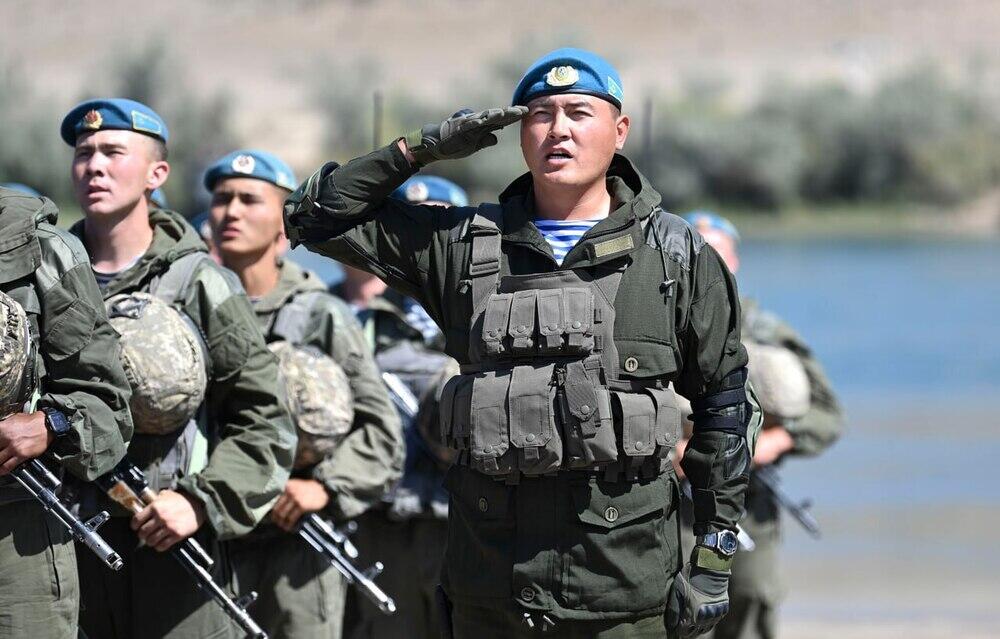
According to a statement from the Collective Security Treaty Organization (CSTO), troops from five of the organization's six member states -- Kyrgyzstan, Russia, Kazakhstan, Belarus, and Tajikistan -- have convened this week at the Edelweiss military training ground in Kyrgyzstan's Issyk-Kul region for training. The joint exercises involve over five thousand people and 900 units of military equipment, with only Armenia not represented. “The tasks of the exercise include improving mechanisms for making and implementing decisions on the use of forces and means, as well as increasing coherence between the armies of the allied countries and the interoperability of military formations in preparing and conducting joint operations,” said Andrei Serdyukov, Chief of the CSTO Joint Staff. The exercises combine various training components. The maneuvers include special exercises with intelligence forces, and logistics exercises. The Interaction-2024 command-staff exercise is aimed at preparing for a joint operation to resolve a potential armed conflict. [caption id="attachment_22933" align="aligncenter" width="300"] @TCA. A.Chipegin[/caption] The CSTO press service said that one of the exercise's priorities this year is to improve the deployment of the collective forces, including managing the transit of military contingents through allied countries. Observers from nine countries are present at the Edelweiss ground: Algeria, China, Egypt, India, Iran, Mongolia, Pakistan, Saudi Arabia, and Uzbekistan. Also observing the exercise are representatives of the UN Secretariat, the SCO Secretariat, the CIS Executive Committee, and the CIS Anti-Terrorism Center. “In our dynamically changing world, security is becoming paramount, and this requires new approaches, effective coordination, and clear solutions... Our countries have become direct participants in the beginning reshuffle of forces in the world,” Lieutenant General Baktybek Bekbolotov, Kyrgyzstan's Minister of Defense, commented at the opening of the exercise. According to Bekbolotov, the main threats to the countries of Central Asia are terrorism, separatism, and extremism, as well as the arrival of radical groups from the Middle East to the region's borders. “With a global threat, the efforts of one country are not enough. There are regional organizations for this purpose; in our case, the main one is the CSTO,” Bekbolotov stressed.

Tajikistan Intends To Expand Production of Armored Vehicles and Special Equipment

Tajikistan's Sipar Group plans to significantly expand the production of armored vehicles and special equipment at its plant in the city of Tursunzade. The project is being implemented with a foreign investment of $15 million, allowing the company to produce 17 types of special vehicles. The plant is already actively developing its production capacity. The enterprise assembles military and civilian vehicles using components from the United Arab Emirates. Tajikistan's Minister of Industry and New Technologies, Sherali Kabir, said that armored vehicles in Tursunzade are manufactured using Canadian technologies; therefore, they are in no way inferior to their counterparts produced in other Central Asian countries. So far, the plant has produced a limited volume of vehicles, but given the demand, it plans to increase its production capacity significantly in the coming years. The project will also create more than a hundred new jobs, which will make an important contribution to the region's economic development. The plant's products are aimed not only at the domestic market, but also with the possibility of exporting to other Central Asian countries in mind, which would allow Tajikistan to strengthen its position in the international arena in the defense industry.