• KGS/USD = 0.01144 0%
  • KZT/USD = 0.00205 0%
  • TJS/USD = 0.10429 0.29%
  • UZS/USD = 0.00008 0%
  • TMT/USD = 0.28571 0.28%
  • KGS/USD = 0.01144 0%
  • KZT/USD = 0.00205 0%
  • TJS/USD = 0.10429 0.29%
  • UZS/USD = 0.00008 0%
  • TMT/USD = 0.28571 0.28%
  • KGS/USD = 0.01144 0%
  • KZT/USD = 0.00205 0%
  • TJS/USD = 0.10429 0.29%
  • UZS/USD = 0.00008 0%
  • TMT/USD = 0.28571 0.28%
  • KGS/USD = 0.01144 0%
  • KZT/USD = 0.00205 0%
  • TJS/USD = 0.10429 0.29%
  • UZS/USD = 0.00008 0%
  • TMT/USD = 0.28571 0.28%
  • KGS/USD = 0.01144 0%
  • KZT/USD = 0.00205 0%
  • TJS/USD = 0.10429 0.29%
  • UZS/USD = 0.00008 0%
  • TMT/USD = 0.28571 0.28%
  • KGS/USD = 0.01144 0%
  • KZT/USD = 0.00205 0%
  • TJS/USD = 0.10429 0.29%
  • UZS/USD = 0.00008 0%
  • TMT/USD = 0.28571 0.28%
  • KGS/USD = 0.01144 0%
  • KZT/USD = 0.00205 0%
  • TJS/USD = 0.10429 0.29%
  • UZS/USD = 0.00008 0%
  • TMT/USD = 0.28571 0.28%
  • KGS/USD = 0.01144 0%
  • KZT/USD = 0.00205 0%
  • TJS/USD = 0.10429 0.29%
  • UZS/USD = 0.00008 0%
  • TMT/USD = 0.28571 0.28%

Viewing results 1 - 6 of 108

Spanish Artist Jaume Plensa Unveils “Nades” Sculpture for Almaty Museum of Arts

A new 12-meter sculpture titled Nades, created by internationally acclaimed Spanish artist Jaume Plensa, has been unveiled in Almaty. Commissioned specifically for the future Almaty Museum of Arts, the piece was presented during a special ceremony attended by the museum’s founder, Kazakhstani entrepreneur and arts patron Nurlan Smagulov. “We dreamed of having a work of art next to the museum that would become an important part of Almaty. Nades is the embodiment of female strength, dignity, and beauty,” Smagulov said. The sculpture portrays the head of a young woman with closed eyes and two long braids, a nod to the traditional image of a Kazakh girl. According to Plensa, the work is based on a real face that was scanned and then abstracted into a universal symbol. “I work with real people, I scan their faces and transform the image until their individuality disappears. I want every viewer to recognize themselves in them. These faces become mirrors,” Plensa explained. Born in Barcelona in 1955, Plensa is known for his monumental public sculptures installed in cities around the world. His notable works include Water’s Soul (2020, Jersey City), Julia (2018, Madrid), Roots (2014, Tokyo), Soul (2011, Singapore), and Alchemist (2010, MIT, Boston). The Almaty Museum of Arts, Kazakhstan’s first private contemporary art museum, is set to open in September 2025. It will showcase a collection of over 700 works from Kazakhstan, Central Asia, and beyond, all curated from Smagulov’s personal collection.

Kyrgyzstan: Film Festival Showcases Central Asian Talent, New and Old

An international film festival in Kyrgyzstan this week is celebrating the past, present, and future of Central Asian cinema. The Bishkek International Film Festival features a retrospective of the work of Kyrgyz director Tolomush Okeev, whose films include The Ferocious One, The Red Apple, and The Descendant of the Snow Leopard; a presentation of ten film projects by emerging directors in Central Asia; and a competition among nine films whose directors are from Kyrgyzstan, Kazakhstan, Uzbekistan, and Tajikistan. The June 11-15 festival also has master classes for those who really want to dig into the craft of making films. Hosts of some of the classes include actor and educator Olesya Gribok, who will talk about working with emotions, self-presentation, and other core actor values; designer Alex Rosno, who will discuss using AI tools to create scenes and build storyboards; and Andrzej Bartkowiak, a cinematographer and director with decades of experience with lighting, movement, and composition. Films from India, Mongolia, Germany and other countries will vie for an international prize. A separate contest involves nine films from Central Asia, seeking to highlight the region’s movie-making talent. There’s also “KyrgyzBox” - a competition just for movies, including box office standouts, from Kyrgyzstan. In another contest, film project contenders are “accepted only from citizens from Central Asian countries – Kyrgyzstan, Kazakhstan, Uzbekistan, Turkmenistan and Tajikistan - with strong potential for international distribution,” according to the film festival. The project must be a feature film that is at least 75 minutes long and filming must be planned in Central Asia or have a “close connection” to the region. The retrospective of Okeev, who died in 2001 at age 66, showcases a screenwriter and director who made films over several decades of the Soviet era and was known for filming in the majestic mountains and deserts of Kyrgyzstan. The Bishkek festival, the third edition of the event, will screen several of Okeev’s films, including The Descendant of the Snow Leopard, a 1984 film that draws inspiration from Kyrgyz tales about hunters who follow ancient laws. “When a young chief, Kojozhash, breaks a sacred ancestral taboo, it leads to tragic consequences for the entire tribe,” the festival says in a description of the film. The snow leopard is a national symbol of Kyrgyzstan, which is taking steps to protect the vulnerable species.

Bridging Continents: Launching the VIMA Art Fair in Cyprus

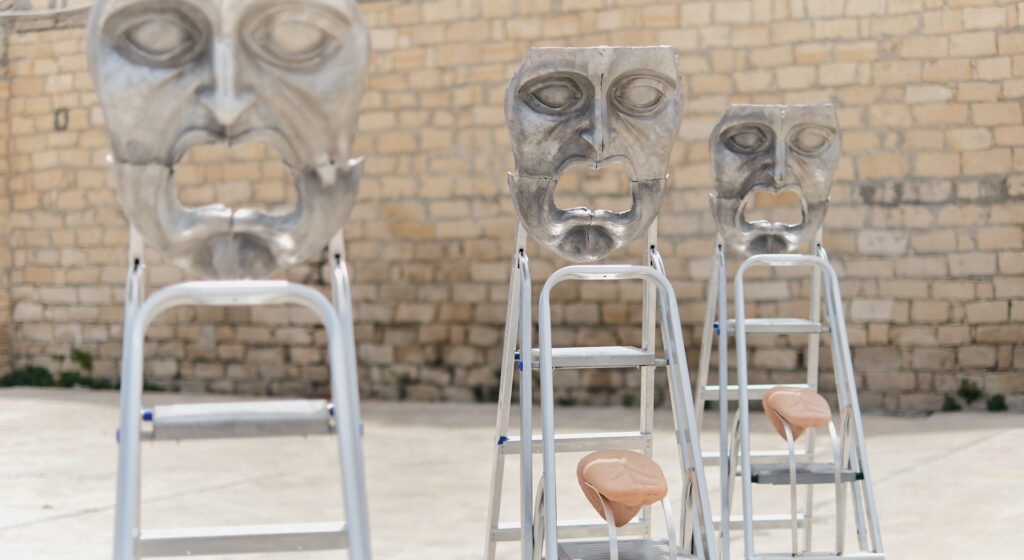
In the art world, fairs often have a meteoric rise and fall in an oversaturated market of competing events. But every so often, one lands with a quiet, deliberate weight, embedding itself in the soil of its context and revitalizing it. VIMA Art Fair in Limassol, Cyprus, is one such project. Unfolding in a transformed wine warehouse near the sea, VIMA resisted the sterile polish of typical fair venues. Here, the Mediterranean wind mingled with the hum of languages, from Russian to Arabic, Greek, and Turkish, to English. The fair was founded by three Russians who have established themselves in Cyprus - Edgar Gadzhiev, Lara Kotreleva, and Nadezhda Zinovskaya - all of whom have brought a deep well of curatorial and institutional experience from Central Asia, Eurasia, and beyond. The trio have diverse backgrounds: Zinovskaya used to manage Ayarkut, an international art foundation operating across Kazakhstan and Mexico, together with Gadzhiev, who specialized in marketing in the cultural sector. Lara Kotreleva, meanwhile, has a museological background in Moscow and founded Sphere Space, an ongoing research initiative dedicated to architectural heritage in Limassol. To set up the fair, they teamed up with an expert committee comprising the Cypriots Alexandros Diogenous and Tasos Stylianou, co-founders of Limassol Art Walks, and Andre Zivanari, director of the Point Center for Contemporary Art in the capital, Nicosia. Of the 27 participants at the fair, there was an emphasis on the ten Cypriot galleries, commercial, not-for-profit, and artist-run spaces, part of Cyprus’s flourishing contemporary art scene, as well as on a number of Middle Eastern and Greek galleries. The Caucasus also made an appearance, with Georgia’s Window Project (Tbilisi) presenting a thoughtful mix of Georgian and international artists. Their mission centers on bridging generational narratives, with a particular emphasis on promoting emerging Georgian talents alongside an often-overlooked older generation of artists. At VIMA, the gallery highlighted the work of female artists, including Tamar Giorgadze, Sigrid Gloerfelt, Natela Grigalashvili, Tamara K.E., and Anie Toidze. Representing Azerbaijan, pop/off/art (Baku) featured a dynamic selection of artists primarily from the post-Soviet sphere as well as Eastern and Central Europe, showcasing works by Despina Flessa, Andrey Krasulin, and Shamil Shaaev. The mood was easygoing and fresh, but did not shy away from important socio-political themes that are unavoidable on the island, from the Greek-Turkish divide, to the arrival of a number of expats fleeing wars. Through a program of talks and a collateral exhibition, the fair leaned into this complexity and spelled out the necessity of communities coexisting, as well as articulating the desire to create new cultural infrastructure through public and private collaboration. The Times of Central Asia spoke with Edgar Gadzhiev, Lara Kotreleva, and Nadezhda Zinovskaya. [caption id="attachment_32435" align="aligncenter" width="1920"] Portrait of the co-founders of the VIMA Art Fair, Edgar Gadzhiev, Nadezhda Zinovskaya, and Lara Kotrelevaimage; image courtesy of the VIMA Art Fair[/caption] TCA: Why did you choose Cyprus as the location to launch this project? Gadzhiev: It wasn’t a random decision. We conducted long-term research, and it became...

Twentieth Century Travelogue Documents British Women’s Experiences in Central Asia

Interpreting English-language sources accurately for Kazakh readers can be quite challenging. It often requires drawing on the richness, expressiveness, and natural rhythm of the Kazakh language. I came to appreciate this during an internship in the United States. Each evening, on the first floor of our home in Arlington, Virginia, I would spend about three hours in the study, poring over old library books containing historical records about Kazakhs. A quote often came to mind during those long nights: “A person with a good book is never truly alone.” It became both a source of inspiration and motivation. One day, I discovered a remarkable book, published in 1927 in both Boston and New York, titled Through the Jade Gate and Central Asia. Written by Mildred Cable and Francesca French, the book recounts their travels as British female missionaries across northwestern China and Central Asia. It offers a vivid portrayal of life in the region a century ago. The authors journeyed through Gansu, Xinjiang, the Gobi Desert, and visited Mongol and Tibetan settlements. In 1923, Cable, French, and their companion, Evangeline French, traveled more than 2,400 kilometers through Central Asia. They set out from Huozhou, spreading Christianity along the way. During their travels, they opened a mission school, distributed religious literature, and tried to learn local languages, such as Uyghur, to better communicate with Muslim women. However, conversions among local women were rare. The group crossed the desert five times, traversed the Tibetan plains, and eventually reached Zaysan via Shauyeshek. In Zaysan they met with Kazakh families and documented their encounters. For example, one Kazakh man asked if they knew how to operate a sewing machine, likely one he had purchased from Russians. They also met a Nogai man with two wives and a son, one wife being Kazakh and the other from another Turkic group. Throughout the book, the authors include photographs and descriptions of the people they met along the way.   Their journey continued along the Irtysh River, where they were moved by a boatman’s song. Upon reaching Semey, they then traveled by train to Novosibirsk and Omsk. On a boat from Omsk, they observed a Kazakh family and were struck by their blend of nomadic tradition and Western education. The family’s Western-style clothing, musical abilities, and refined manners stood out. One Kazakh man even played traditional music on the piano for his child, a moment that so impressed the authors that they included the musical notation in their book. The book also records a striking demographic insight: “We were told the Kazakh population exceeds seven million.” The travelers were clearly impressed by the Kazakhs’ adaptability, modesty, and political awareness, suggesting these qualities would soon position them for greater influence. They were especially taken by the poise and beauty of a Kazakh nurse, who left a lasting impression. In the end, every foreign source that offers insight into our history is an asset. This travelogue stands out as a vivid and respectful portrayal of our ancestors and as...

Kyrgyzstan’s UN Mission Opens Environmental Art Exhibition in New York

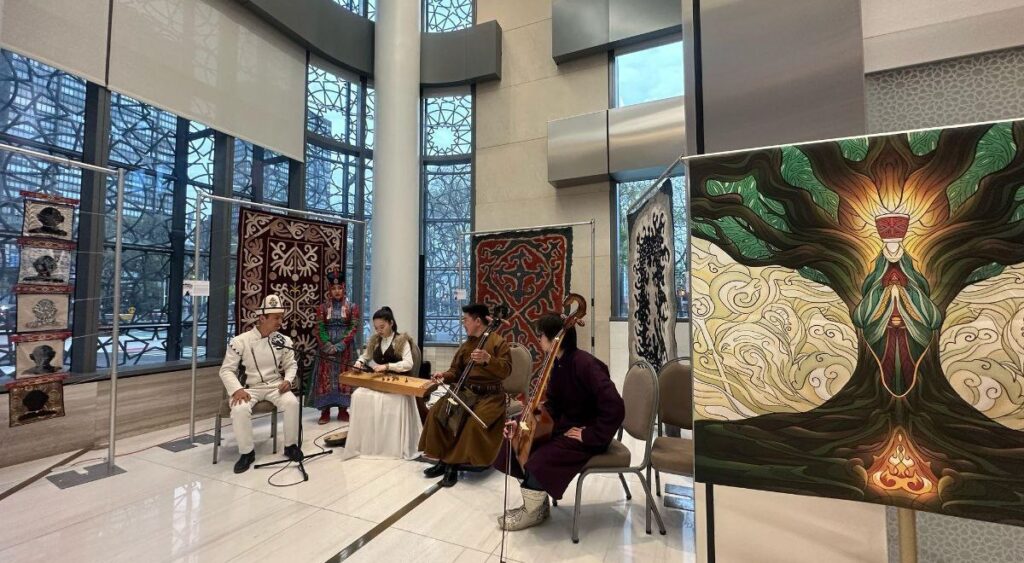
In honor of International Mother Earth Day, the Permanent Mission of the Kyrgyz Republic to the United Nations has opened an art exhibition in New York, highlighting the planet’s environmental challenges. The exhibition features works by young Kyrgyz artists that explore the intricate relationship between climate change, human development, and the natural world. Through a mix of paintings and installations, the artists aim to emphasize the environmental threats affecting global stability. [caption id="attachment_31162" align="aligncenter" width="900"] @mfa.gov.kg[/caption] Speaking at the opening, Aida Kasymalieva, Kyrgyzstan’s Permanent Representative to the UN, underscored the urgent need for intergenerational dialogue and collective responsibility in tackling environmental degradation. “Humanity must realize its shared duty to nature and future generations,” she said, calling for stronger efforts to reduce pollution, curb biodiversity loss, and increase funding for green initiatives. “This exhibition supports the Kyrgyz Republic’s broader commitment to environmental sustainability both nationally and internationally,” the Kyrgyz Foreign Ministry stated in a press release. “Kyrgyzstan is actively implementing programs to preserve mountain ecosystems, protect biodiversity, and transition to a green economy.” [caption id="attachment_31163" align="aligncenter" width="900"] @mfa.gov.kg[/caption] Kyrgyzstan has long sought to draw international attention to the unique vulnerabilities of mountain regions. Since the early 2000s, the country has positioned itself as a global advocate for highland communities, particularly in the context of climate resilience and sustainable development.

Altynai Osmo’s New Show in New York: Restoring Female Narratives

In the heart of Tribeca in New York, the Sapar Contemporary Art Gallery has launched a new exhibition, Beneath the Earth and Above the Clouds, which brings Central Asian narratives to the forefront. This dual show – which runs until May 15, 2025 - features Altynai Osmo and Aya Shalkar, two artists who have been devoted to exploring female narratives in the region, and do this through works that are both steeped into tradition, and modern and vibrant at the same time. The Times of Central Asia spoke with Altynai Osmo, a multimedia artist from Kyrgyzstan whose work weaves the threads of nomadic heritage with contemporary expression. Born in Bishkek and nurtured by the serene shores of Lake Issyk-Kul, Osmo's artistic journey is deeply rooted in the traditions of her homeland. A graduate of Central Saint Martins in London, she seamlessly blends mediums — textiles, metals, video, and installation — to explore themes of identity, matriarchy, and the evolving role of women in Central Asian societies. Her works such as Blessing Yurt, a red fringed costume inspired by the Kyrgyz nomadic traditional dwelling, not only pay homage to ancestral practices but also challenges present-day socio-political narratives. Speaking with TCA, Osmo reflects on the layers of meaning in her new series, her enduring engagement with mythology and matriarchy, and how her practice bridges personal memory and collective history. [caption id="attachment_31131" align="aligncenter" width="2231"] Image courtesy of Altynai Osmo/Sapar Contemporary Art Gallery[/caption] TCA: Can you tell me about how your previous practice led to this new series for the show? My previous work has always involved exploring the intersections of feminine identity, cultural memory, and inherited spirituality in Central Asia, particularly in Kyrgyzstan. This new series evolved naturally from that foundation. It reflects a more layered and intentional engagement with Central Asian history, mythology and matriarchal histories — particularly the symbolic and spiritual dimensions that have often been erased, distorted and forgotten. The materials and narratives I use now draw more explicitly from the Kyrgyz epic, Manas, ancestral craftsmanship, and belief systems like Tengrism, allowing me to express deeper reflections on women's roles across time. TCA: Your Kyrk Kyz series reinterprets the legendary warrior women of Central Asia. How does this mythology resonate with contemporary Kyrgyz identity and gender roles? The Kyrk Kyz legend, with its origin in female strength and collective action, presents a striking contrast to the more patriarchal norms that dominate present-day Kyrgyz/Central Asian society. Revisiting these stories reminds us that women were once seen as the protectors of land, lineage, and cultural continuity. By reimagining these warriors through my art, I want to challenge modern gender expectations and inspire a reconnection to a more empowering view of womanhood that is already rooted in our collective past. [caption id="attachment_31132" align="aligncenter" width="2560"] Image courtesy of Altynai Osmo/Sapar Contemporary Art Gallery[/caption] TCA: The use of felt in your masks ties your work to nomadic traditions. How does the choice of materials reinforce the themes of your work? Felt is not just a...