• KZT/USD = 0.00221
  • TJS/USD = 0.10820
  • UZS/USD = 0.00008
  • TMT/USD = 0.29850
  • KZT/USD = 0.00221
  • TJS/USD = 0.10820
  • UZS/USD = 0.00008
  • TMT/USD = 0.29850
  • KZT/USD = 0.00221
  • TJS/USD = 0.10820
  • UZS/USD = 0.00008
  • TMT/USD = 0.29850
  • KZT/USD = 0.00221
  • TJS/USD = 0.10820
  • UZS/USD = 0.00008
  • TMT/USD = 0.29850
  • KZT/USD = 0.00221
  • TJS/USD = 0.10820
  • UZS/USD = 0.00008
  • TMT/USD = 0.29850
  • KZT/USD = 0.00221
  • TJS/USD = 0.10820
  • UZS/USD = 0.00008
  • TMT/USD = 0.29850
  • KZT/USD = 0.00221
  • TJS/USD = 0.10820
  • UZS/USD = 0.00008
  • TMT/USD = 0.29850
  • KZT/USD = 0.00221
  • TJS/USD = 0.10820
  • UZS/USD = 0.00008
  • TMT/USD = 0.29850
14 October 2026

Viewing results 1 - 6 of 5

Central Asia Wins 186 Asian Games Medals as Uzbekistan Finishes Fifth

Athletes from Central Asia’s five countries won 186 medals at the Asian Games in Japan, where Uzbekistan finished fifth overall and Kazakhstan claimed the region’s largest medal haul. The 20th Summer Asian Games were held from September 19 to October 4 in Aichi-Nagoya, Japan. China once again topped the medal table, followed by Japan and South Korea. Uzbekistan won 70 medals, including 21 golds, matching its fifth-place finish at the previous Games in Hangzhou. The result follows a 13th-place finish in the medal table at the 2024 Paris Olympics. Kazakhstan won 84 medals, including 12 golds, and finished eighth in the standings, up from 11th at the previous Asian Games. Among Kazakhstan’s champions was road cyclist Alexey Lutsenko, whose two victories took his Asian Games career tally to six golds, making him the country’s most successful athlete in the competition by number of gold medals. Boxers Torekhan Sabyrkhan and Aibek Oralbay also won gold. Kazakhstan’s men’s épée fencing team claimed another title, while Vladislav Yakovlev and Ivan Chernukhin took gold in the men’s pair rowing event. Kazakhstan’s Yasmina Toxanbayeva crossed the line first in the women’s marathon race walk, a 26.2-mile event, but was disqualified because her shoes did not comply with World Athletics requirements. The Kazakhstan Athletics Federation challenged the decision. Tajikistan won 16 medals and finished 22nd, surpassing its previous record of seven medals at a single Asian Games. Before the Japan Games, the country had won 35 medals in total across all previous Summer Asian Games appearances. Kyrgyzstan finished 26th with 14 medals, including one gold and three silvers. The country also won 10 bronzes, and all but one of its medals came in combat sports. Turkmenistan’s two silver medals went to karate athlete Davut Nazmyradov and weightlifter Shahzadbek Matyakubov. Matyakubov finished second in the men’s 110-kilogram category behind Uzbekistan’s Akbar Djuraev. The next Summer Asian Games will be held in Doha in 2030.
Kazakhstan’s Yasmina Toxanbayeva Stripped of Asian Games Gold Over Shoes

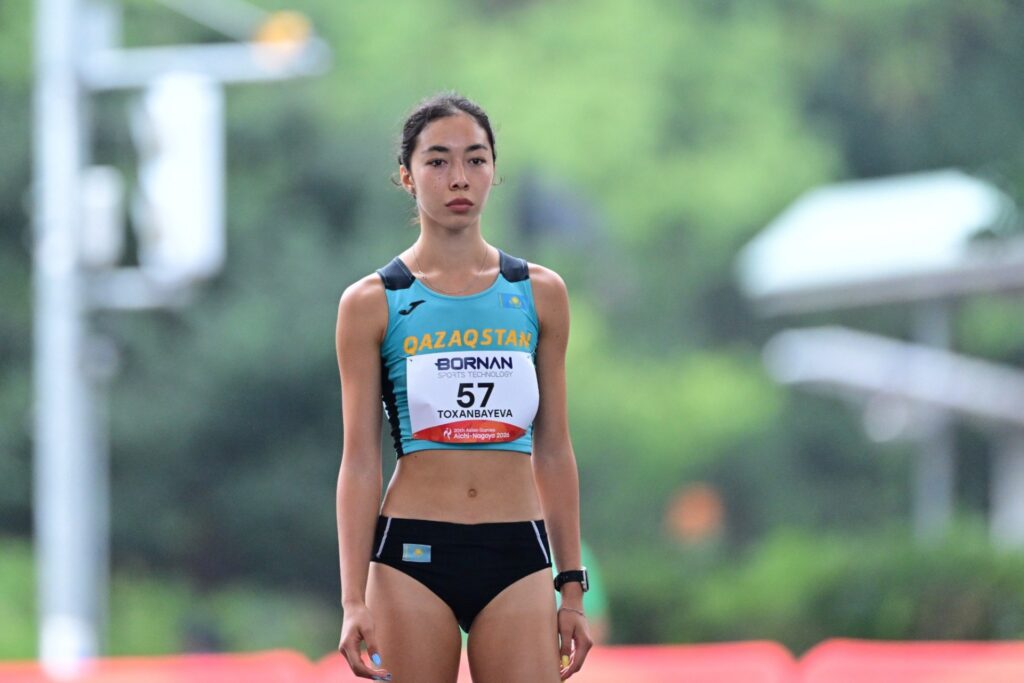
Kazakhstan’s Yasmina Toxanbayeva crossed the line first in the women’s marathon race walk at the Asian Games in Japan but was later disqualified over her footwear. The Kazakhstan Athletics Federation is challenging the decision, which followed a finding that her shoe model was not on World Athletics’ approved list. She completed the 42.195-kilometer race at the 2026 Asian Games in Aichi-Nagoya on September 27 in 3 hours, 22 minutes, and 20 seconds. China’s Danzengquzong finished nearly four minutes behind in 3:26:09, while her compatriot Ma Li recorded 3:32:26. According to Kazakhstan’s National Olympic Committee, officials checked the leading finishers’ shoes for compliance with World Athletics regulations. The model worn by Toxanbayeva was not on the approved list. Photographs and information about the footwear were sent to World Athletics, and the medal ceremony was postponed pending a ruling. World Athletics determined that the shoes did not meet its requirements. The Olympic Council of Asia confirmed her disqualification on September 28. The revised standings awarded Danzengquzong gold, Ma Li silver, and Japan’s Yukiko Umeno, who had initially finished fourth, bronze. The Kazakhstan Athletics Federation challenged the decision. It said Toxanbayeva had competed in ASICS shoes, but acknowledged that the specific model she wore was not on the World Athletics approved list. The federation also said her shoes had been inspected before the race and she had been cleared to start. The federation said it had filed a protest and a complaint against the decision and would continue to defend Toxanbayeva’s interests. It also acknowledged its own responsibility for ensuring compliance with competition regulations and technical requirements. World Athletics, the international governing body for track and field, maintains a database of shoes approved for competition. Athletes must use an approved model for the relevant discipline. Approval of other shoes made by the same manufacturer does not make an unlisted model eligible. The current Athletic Shoe Regulations were approved on March 19, 2026, and took effect on April 20. A similar footwear controversy had already affected the medal standings at the current Asian Games. Iranian heptathlete Fatemeh Mohitizadeh was disqualified after officials ruled that the shoes she used during the long jump did not comply with World Athletics regulations. Her disqualification moved Kazakhstan’s Alina Chistyakova from fourth to third, giving her the bronze medal. The Kazakhstan Athletics Federation said that regardless of the outcome of its challenge, it would pay Toxanbayeva the prize money she would have received for winning the event from its own funds. “For us, Yasmina is the champion. The Federation will continue to support her,” it said. As previously reported by The Times of Central Asia, Kazakh cyclist Alexey Lutsenko won the sixth Asian Games gold medal of his career at Aichi-Nagoya, setting a national record for the most Asian Games titles won by a Kazakh athlete.

Alexey Lutsenko Makes Asian Games History With Sixth Gold

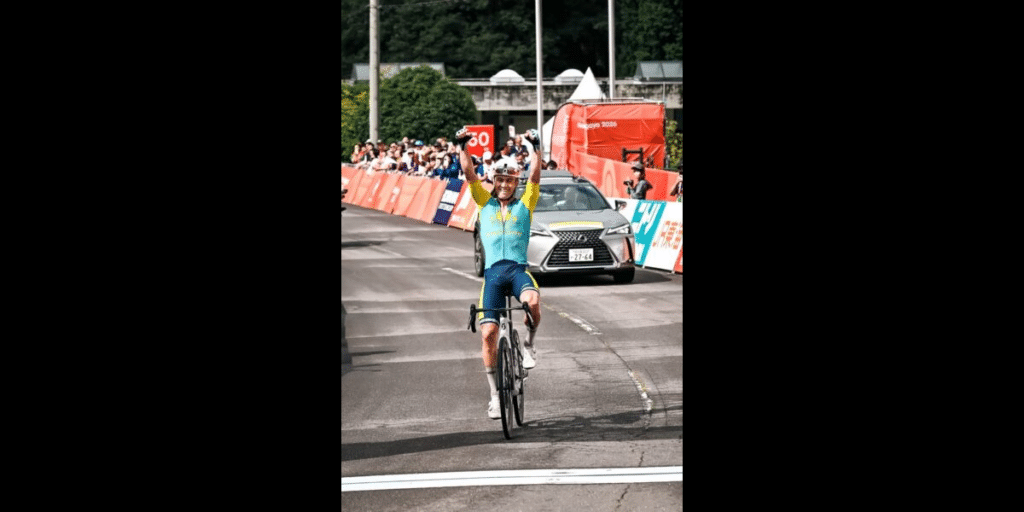
Kazakhstani cyclist Alexey Lutsenko won the men’s road race at the 2026 Asian Games in Aichi-Nagoya, Japan, becoming his country’s most successful athlete in Asian Games history. The victory gave the 34-year-old his sixth Asian Games gold medal as he prepares to end his professional career. On September 23, Lutsenko completed the 160.5-kilometer race in 4 hours, 13 minutes, and 11 seconds. His teammate Yevgeniy Fedorov finished second, 1 minute and 58 seconds behind. Another Kazakhstani rider, Nicolas Vinokurov, the son of Olympic champion Alexander Vinokurov, helped control the race for the team and finished seventh. His second gold at the current Games came on September 20, when he won the individual time trial for the fourth consecutive Games, a discipline in which riders race individually against the clock. Lutsenko covered the 32.4-kilometer course in 41 minutes, 24.05 seconds, beating silver medalist Shunsuke Imamura of Japan by more than a minute and a half. Before the Games in Japan, Lutsenko had won four Asian Games gold medals. He won the individual time trial in 2014, 2018, and 2022, and also took gold in the road race in Jakarta in 2018. His fifth gold brought him level with Kazakhstan’s previous record holder, canoeist Konstantin Negodyayev, who won three titles at the 1994 Asian Games in Hiroshima and two more at the 1998 Games in Bangkok. His sixth victory put Lutsenko alone at the top. “I did my job,” Lutsenko said after the race. “The Asian Games, like the Olympics, take place once every four years. As a national team athlete, I prepared responsibly for these events and didn’t think about any records. I did my maximum and brought a medal to the country. That is what matters most. I’m not such a young rider anymore, because cycling is now increasingly focused on youth. A new generation is coming through. But I’m glad they believed in me, gave me a chance, and I fully justified their trust.” Lutsenko plans to retire in the near future. He said he had made the decision at the end of last year. “Time passes. Cycling is changing. Young riders are coming through and producing strong results from an early age. I have done my maximum. Six Asian Games gold medals, stage wins at the biggest Grand Tours. I am proud of what I have done over 15 years in professional sport. Now I have won two gold medals. And this is the best moment to end my career in the near future,” he said. During his professional career, Lutsenko has won stages at two of cycling’s three Grand Tours, the sport’s most prestigious stage races: the Vuelta a España in 2017 and the Tour de France in 2020. By the evening of September 23, Kazakhstan was fourth in the medal standings with seven gold, four silver, and eight bronze medals, behind China, Japan, and South Korea. All five Central Asian countries had won medals at the Aichi-Nagoya Games. Tajikistan had won two gold medals and Uzbekistan...

Kazakhstan’s MMA Gold Medalist Comforts Tajik Opponent at Asian Games

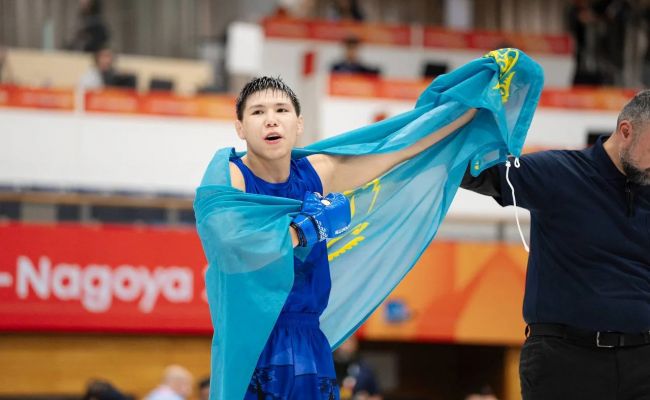
A mixed martial arts (MMA) fighter from Kazakhstan embraced and comforted his distressed Tajik opponent after defeating him to win gold at the Asian Games in Japan. It was one of the more striking scenes so far at the Games, which began on September 19 and run until October 4. China was at the top of the medal standings with 78 medals, including 48 golds, on Wednesday. Japan and South Korea were in second and third place, respectively. Kazakhstan was fourth with 19 medals, including seven golds. Kadyrbek Shynbayev, a 22-year-old MMA fighter from Kazakhstan, won Tuesday’s final in the up-to-71-kilogram weight category, beating 25-year-old Behruz Khurshedzoda of Tajikistan by a 3-0 judges’ decision. The fighters were competing in the “modern” variant of the combat sport, in which they wear shorts and a rash guard, or tight athletic shirt, instead of the traditional gi, which consists of a jacket, pants, and a belt. Shynbayev let out a roar of triumph after the result was announced, and his team celebrated on the sidelines. He paraded for a moment with a national flag wrapped around his shoulders, but then noticed Khurshedzoda on his knees on the competition mat, visibly overcome by his loss. Shynbayev, in blue, approached his red-clad adversary and embraced him. Still wearing their bulky gloves, the two men talked. Khurshedzoda tapped his own head with his glove. Then the pair stood up together and hugged one more time as videographers and photographers recorded the scene at the Nagoya City Inae Sports Center. The Sports.kz news portal described Shynbayev’s actions as a “beautiful gesture” and posted a video of the scene on Instagram. Kazakhstan’s Jibek Joly TV showed Shynbayev and other medal winners being welcomed at Almaty airport after returning from the Asian Games. Shynbayev also won the Asian MMA Championship title in January. At that time, Kazakhstan’s Ministry of Defense identified him as a military private. Tajik media, including the state-run Khovar news agency, reported on Khurshedzoda’s contested road to the final in Japan. In the semifinal, judges awarded victory to his opponent, Yryskeldi Duisheev of Kyrgyzstan, but Tajikistan’s delegation appealed, and the decision was reversed in Khurshedzoda’s favor. Duisheev received a bronze medal. MMA includes striking, grappling, throwing, and submission techniques. The sport made its debut at the 2026 Asian Games, which are being held across Aichi Prefecture, including Nagoya. The Asian Games are held every four years.

Uzbekistan Wins First Gold as Record Team Competes at Asian Games

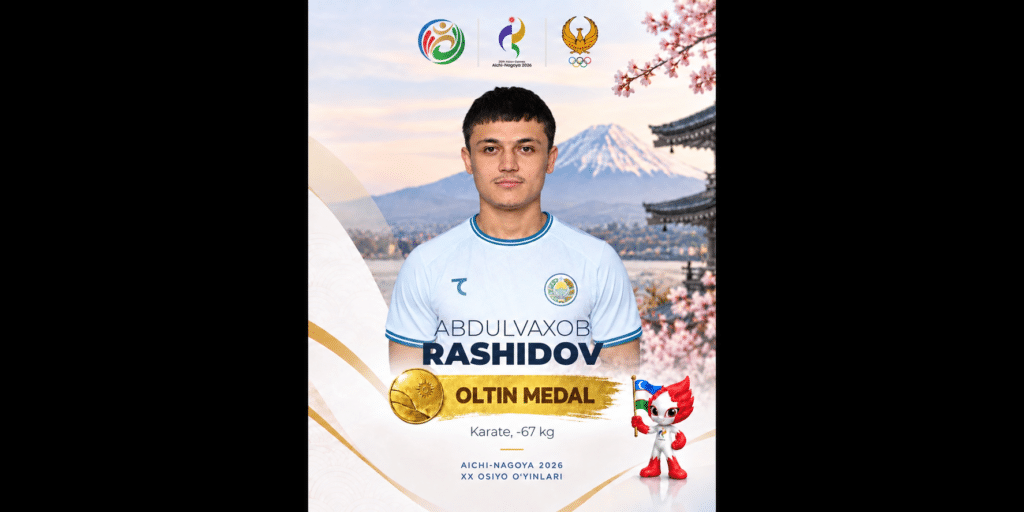
Uzbekistan has claimed its first gold medal at the Aichi-Nagoya Asian Games, where it is fielding its largest-ever delegation, according to the country’s National Olympic Committee. Abdulvakhob Rashidov won the men’s under-67kg karate title on September 21, defeating Japan’s Yugo Kozaki in the final. His victory opened Uzbekistan’s gold medal account at the competition in Japan. Further medals followed on September 22. Darya Latysheva took silver in wushu with a score of 19.413 points, securing her third career Asian Games medal. Firdavs Atamuradov also won silver in mixed martial arts, losing to Tajikistan’s Mirzobek Umarov in the under-60kg final. The early results come as Uzbekistan expands its participation in the continental competition. The NOC announced a team of 396 athletes across 42 sports, describing it as the country’s largest Asian Games squad. Its press release puts the delegation at 224 men and 172 women. The larger team follows Uzbekistan’s fifth-place finish at the previous Asian Games in Hangzhou, held in 2023. Uzbekistan won 71 medals, including 22 golds, after sending more than 370 athletes to compete across 38 sports. This year’s delegation therefore extends the country’s participation into four additional sports. The Aichi-Nagoya Games opened on September 19 and continue through October 4. Uzbekistan’s results over the remaining competition will determine whether its expanded delegation can improve on the Hangzhou medal haul. A separate Uzbek delegation of 153 athletes is due to compete at the Asian Para Games, according to the NOC’s press release. That competition will take place in Japan from October 18 to 24, with events across 18 Para sports.