• KZT/USD = 0.00221
  • TJS/USD = 0.10820
  • UZS/USD = 0.00008
  • TMT/USD = 0.29760
  • KZT/USD = 0.00221
  • TJS/USD = 0.10820
  • UZS/USD = 0.00008
  • TMT/USD = 0.29760
  • KZT/USD = 0.00221
  • TJS/USD = 0.10820
  • UZS/USD = 0.00008
  • TMT/USD = 0.29760
  • KZT/USD = 0.00221
  • TJS/USD = 0.10820
  • UZS/USD = 0.00008
  • TMT/USD = 0.29760
  • KZT/USD = 0.00221
  • TJS/USD = 0.10820
  • UZS/USD = 0.00008
  • TMT/USD = 0.29760
  • KZT/USD = 0.00221
  • TJS/USD = 0.10820
  • UZS/USD = 0.00008
  • TMT/USD = 0.29760
  • KZT/USD = 0.00221
  • TJS/USD = 0.10820
  • UZS/USD = 0.00008
  • TMT/USD = 0.29760
  • KZT/USD = 0.00221
  • TJS/USD = 0.10820
  • UZS/USD = 0.00008
  • TMT/USD = 0.29760
11 October 2026

Viewing results 1 - 6 of 4

Central Asia Wins 186 Asian Games Medals as Uzbekistan Finishes Fifth

Athletes from Central Asia’s five countries won 186 medals at the Asian Games in Japan, where Uzbekistan finished fifth overall and Kazakhstan claimed the region’s largest medal haul. The 20th Summer Asian Games were held from September 19 to October 4 in Aichi-Nagoya, Japan. China once again topped the medal table, followed by Japan and South Korea. Uzbekistan won 70 medals, including 21 golds, matching its fifth-place finish at the previous Games in Hangzhou. The result follows a 13th-place finish in the medal table at the 2024 Paris Olympics. Kazakhstan won 84 medals, including 12 golds, and finished eighth in the standings, up from 11th at the previous Asian Games. Among Kazakhstan’s champions was road cyclist Alexey Lutsenko, whose two victories took his Asian Games career tally to six golds, making him the country’s most successful athlete in the competition by number of gold medals. Boxers Torekhan Sabyrkhan and Aibek Oralbay also won gold. Kazakhstan’s men’s épée fencing team claimed another title, while Vladislav Yakovlev and Ivan Chernukhin took gold in the men’s pair rowing event. Kazakhstan’s Yasmina Toxanbayeva crossed the line first in the women’s marathon race walk, a 26.2-mile event, but was disqualified because her shoes did not comply with World Athletics requirements. The Kazakhstan Athletics Federation challenged the decision. Tajikistan won 16 medals and finished 22nd, surpassing its previous record of seven medals at a single Asian Games. Before the Japan Games, the country had won 35 medals in total across all previous Summer Asian Games appearances. Kyrgyzstan finished 26th with 14 medals, including one gold and three silvers. The country also won 10 bronzes, and all but one of its medals came in combat sports. Turkmenistan’s two silver medals went to karate athlete Davut Nazmyradov and weightlifter Shahzadbek Matyakubov. Matyakubov finished second in the men’s 110-kilogram category behind Uzbekistan’s Akbar Djuraev. The next Summer Asian Games will be held in Doha in 2030.
Alexey Lutsenko Makes Asian Games History With Sixth Gold

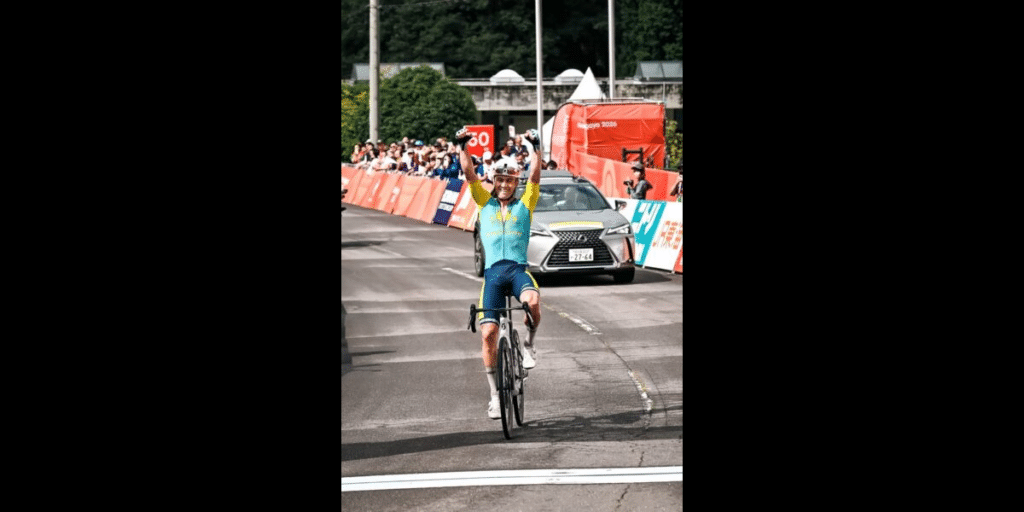
Kazakhstani cyclist Alexey Lutsenko won the men’s road race at the 2026 Asian Games in Aichi-Nagoya, Japan, becoming his country’s most successful athlete in Asian Games history. The victory gave the 34-year-old his sixth Asian Games gold medal as he prepares to end his professional career. On September 23, Lutsenko completed the 160.5-kilometer race in 4 hours, 13 minutes, and 11 seconds. His teammate Yevgeniy Fedorov finished second, 1 minute and 58 seconds behind. Another Kazakhstani rider, Nicolas Vinokurov, the son of Olympic champion Alexander Vinokurov, helped control the race for the team and finished seventh. His second gold at the current Games came on September 20, when he won the individual time trial for the fourth consecutive Games, a discipline in which riders race individually against the clock. Lutsenko covered the 32.4-kilometer course in 41 minutes, 24.05 seconds, beating silver medalist Shunsuke Imamura of Japan by more than a minute and a half. Before the Games in Japan, Lutsenko had won four Asian Games gold medals. He won the individual time trial in 2014, 2018, and 2022, and also took gold in the road race in Jakarta in 2018. His fifth gold brought him level with Kazakhstan’s previous record holder, canoeist Konstantin Negodyayev, who won three titles at the 1994 Asian Games in Hiroshima and two more at the 1998 Games in Bangkok. His sixth victory put Lutsenko alone at the top. “I did my job,” Lutsenko said after the race. “The Asian Games, like the Olympics, take place once every four years. As a national team athlete, I prepared responsibly for these events and didn’t think about any records. I did my maximum and brought a medal to the country. That is what matters most. I’m not such a young rider anymore, because cycling is now increasingly focused on youth. A new generation is coming through. But I’m glad they believed in me, gave me a chance, and I fully justified their trust.” Lutsenko plans to retire in the near future. He said he had made the decision at the end of last year. “Time passes. Cycling is changing. Young riders are coming through and producing strong results from an early age. I have done my maximum. Six Asian Games gold medals, stage wins at the biggest Grand Tours. I am proud of what I have done over 15 years in professional sport. Now I have won two gold medals. And this is the best moment to end my career in the near future,” he said. During his professional career, Lutsenko has won stages at two of cycling’s three Grand Tours, the sport’s most prestigious stage races: the Vuelta a España in 2017 and the Tour de France in 2020. By the evening of September 23, Kazakhstan was fourth in the medal standings with seven gold, four silver, and eight bronze medals, behind China, Japan, and South Korea. All five Central Asian countries had won medals at the Aichi-Nagoya Games. Tajikistan had won two gold medals and Uzbekistan...

From Almaty to Bali: Two Cyclists from Kazakhstan on Their Bicycle Journey

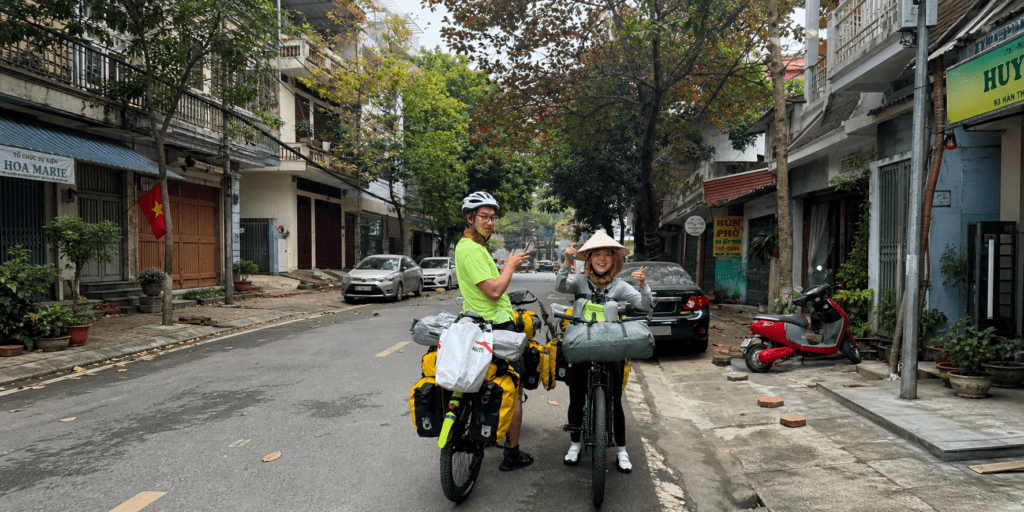
Alina and Maksim Pak, a young married couple from Almaty, have spent several months cycling from Kazakhstan to the Indonesian island of Bali, a journey of more than 8,000 kilometers across multiple borders. Their daily updates on Instagram have drawn widespread attention, turning them into social media personalities. The Times of Central Asia spoke with them about how they embarked on the journey, the challenges they faced, and how the experience has changed them. TCA: Cycling from Almaty to Bali sounds bold. Do you remember the moment when the idea became a plan? Who initiated it? Maksim: It’s been my dream since childhood back when I used to ride a BMX bike. I thought about it a lot, but it always seemed impossible. Then one day I realized: if not now, then when? Alina initially thought it was a joke, but eventually I convinced her. We mapped out the route in just three or four days, and preparation took 45 days. We found sponsors, posted videos every day, learned blogging along the way, and gradually gained support from people. [caption id="attachment_48398" align="aligncenter" width="225"] @instagram.com/alina_pakk[/caption] TCA: Were you scared at all? Alina: Very much so. But not on the road, at the beginning, during preparation. We had almost nothing, no proper gear, no clear plan, no certainty that it would work. It felt like we physically wouldn’t even be able to start, too many “buts” and too few resources. But every day we sat down and visualized how we would travel, what we would eat, who we would meet. The fear was there, yes. That’s exactly why we went. If it’s not scary, then the goal isn’t big enough. TCA: What does a typical day on the road look like? Are all days different? Maksim: Our routine formed quite quickly. We wake up around 7 a.m., nature doesn’t let you sleep longer, especially when the tent is in the sun. We have breakfast, pack up, and by 9 a.m., we’re already cycling. The first stretch is about three hours, then we take a mandatory lunch break and rest for an hour or so, otherwise the body doesn’t recover. After that, we ride again until 5 or 6 p.m., depending on how we feel and the road conditions. When we find a place to stop, we set up the tent, and then the second shift begins: we work, editing videos and replying to messages. The day ends around 10 p.m. And yet every day is completely different, new cities, new people, new landscapes. It never gets boring. TCA: You’ve already cycled through China, Vietnam, Thailand, and are now in Malaysia. Which country surprised you the most? Are people the same everywhere? Maksim: Honestly, every country surprised us in its own way. It’s impossible to single one out. In some places it’s the nature, in others the food, in others the way people treat strangers. Overall, people are very similar everywhere, despite different languages and cultures. Everyone has the same concerns, work, family,...

Astana Qazaqhstan Team’s Stellar Rise from the Ashes

On July 4, the official website of the National Olympic Committee of the Republic of Kazakhstan announced that Astana Qazaqstan Team member, Mark Cavendish, won the fifth stage of the Tour de France.  Winning the Tour for the 35th time, Cavendish surpassed the previous record set by Eddy Merckx and demonstrating the management's rise from recent troubles, his victory revived his team's former glory. Two names Alexander Vinokurov and Danial Akhmetov are the two cyclists who first turned the spotlight on the Astana Qazaqstan Team. In May 2006, "Operation Puerto", the code name of the Spanish police investigation into the doping system in cycling, led by Dr. Eufemiano Fuentes, resulted in a series of searches and arrests involving numerous cyclists. The implication of the Spanish team Liberty Seguros-Würth, of which Kazakh cyclists Alexander Vinokurov and Andrey Kashechkin were key members, led to its sponsors' withdrawal.  Vinokurov sought assistance from the then Prime Minister and head of the Cycling Federation of Kazakhstan, Danial Akhmetov. With support from the latter, the Astana team was established that year and Vinokurov celebrated by winning the Vuelta a España, with Kashechkin finishing third. Scandals, intrigues, investigations The first scandal broke out immediately. When the owner of the ProTour license, which belonged to Liberty Seguros-Würth, refused to sell it to Astana, the team submitted an application to the International Cycling Union. The initial response from the  IUW was that it could not guarantee the license until the 2007 Tour.  Meanwhile, organizers assured Astana that it would be allowed to participate  in major international competitions and on December 20, 2006, the team was granted a four-year license. In July 2007, a doping scandal broke at the Tour de France, at the centre of which, was Astana's team leader , Alexander Vinokurov. A test performed after his winning a stage of the classic race showed the presence of different types of red cells in his blood, indicative of a blood transfusion prior to competing, and Vinokourov was disqualified for two years. Andrei Kashechkin was similarly caught and during the second season, two more Astana athletes, suspected of doping, were likewise suspended from racing. All these troubles led to the Kazakh team's absence from the 2008 Tour de France season in the Giro d'I and other Grand Tours. By then, the team was under the direction of  Johan Brunel renowned for bringing on winner of the Tour de France, Alberto Contador, and many other strong riders. Both Johan Brunel and Alexander Vinokurov were connected with the doping scandal that followed in 2009.  As soon as his disqualification period had expired the famous rider intended to return to "Astana triumphantly." Brunel invited American cyclist Lance Armstrong to Astana to pair with Contador. He persistently objected, however, to the contract with Vinokurov and Kashechkin. Ultimately, he left the team, unable to withstand the confrontation with the famous Kazakh. Armstrong and most of the team went after him, and Contador's contract was delayed for another year. The outcome of the scandals forced...