• KGS/USD = 0.01143 0%
  • KZT/USD = 0.00207 0%
  • TJS/USD = 0.10465 0.1%
  • UZS/USD = 0.00008 0%
  • TMT/USD = 0.28571 0.28%
  • KGS/USD = 0.01143 0%
  • KZT/USD = 0.00207 0%
  • TJS/USD = 0.10465 0.1%
  • UZS/USD = 0.00008 0%
  • TMT/USD = 0.28571 0.28%
  • KGS/USD = 0.01143 0%
  • KZT/USD = 0.00207 0%
  • TJS/USD = 0.10465 0.1%
  • UZS/USD = 0.00008 0%
  • TMT/USD = 0.28571 0.28%
  • KGS/USD = 0.01143 0%
  • KZT/USD = 0.00207 0%
  • TJS/USD = 0.10465 0.1%
  • UZS/USD = 0.00008 0%
  • TMT/USD = 0.28571 0.28%
  • KGS/USD = 0.01143 0%
  • KZT/USD = 0.00207 0%
  • TJS/USD = 0.10465 0.1%
  • UZS/USD = 0.00008 0%
  • TMT/USD = 0.28571 0.28%
  • KGS/USD = 0.01143 0%
  • KZT/USD = 0.00207 0%
  • TJS/USD = 0.10465 0.1%
  • UZS/USD = 0.00008 0%
  • TMT/USD = 0.28571 0.28%
  • KGS/USD = 0.01143 0%
  • KZT/USD = 0.00207 0%
  • TJS/USD = 0.10465 0.1%
  • UZS/USD = 0.00008 0%
  • TMT/USD = 0.28571 0.28%
  • KGS/USD = 0.01143 0%
  • KZT/USD = 0.00207 0%
  • TJS/USD = 0.10465 0.1%
  • UZS/USD = 0.00008 0%
  • TMT/USD = 0.28571 0.28%

Viewing results 1 - 6 of 139

Trilateral Summit in Turkmenistan Focuses on Transport, Energy, and Trade

On August 22, a trilateral summit was held in Turkmenistan’s Avaza National Tourist Zone, bringing together Uzbekistan President Shavkat Mirziyoyev, Chairman of the Halk Maslahaty of Turkmenistan Gurbanguly Berdimuhamedov, and Azerbaijan President Ilham Aliyev. The leaders focused on strengthening cooperation in trade, the economy, transport, energy, and humanitarian affairs, while also emphasizing the development of political, cultural, and multilateral ties. Transport and Transit Mirziyoyev presented several initiatives aimed at expanding regional transport routes and maximizing the region’s transit potential. He highlighted the strategic importance of integrating existing and new corridors to better connect China with South Asia, the Middle East, and Europe. Construction of the China-Uzbekistan railway is underway, and a memorandum has been signed with Pakistan and Afghanistan to establish the Trans-Afghan Corridor. According to Mirziyoyev, these projects could significantly enhance infrastructure utilization across Azerbaijan, Turkmenistan, and Uzbekistan. The development of the Middle Corridor and the Zangezur Corridor was also discussed. The leaders agreed to collaborate on increasing the capacity of regional transport hubs, constructing modern logistics infrastructure at the ports of Turkmenbashi and Baku, implementing a unified tariff policy, and digitizing freight systems. Uzbekistan expressed its willingness to reduce tariffs on a reciprocal basis to facilitate improved access to global markets for regional businesses. Energy Cooperation Energy cooperation was another key focus. The participants emphasized the need to expand collaboration in energy exports and to explore new supply routes. A proposed project to export “green” energy to Europe was described as promising. Additionally, in the hydrocarbon sector, the leaders proposed deeper cooperation in geological exploration and offshore field development in the Caspian Sea. “Joint efforts in the fields of transport, transit, and logistics will be of great importance not only for our countries but also for the wider region,” said President Aliyev, stressing the strategic nature of trilateral cooperation. Aliyev also noted that Azerbaijan’s state oil company SOCAR has begun developing an oil field in Uzbekistan, with results expected in the coming years. Trade and Industry According to summit participants, mutual trade volume between Uzbekistan, Turkmenistan, and Azerbaijan has doubled in recent years, with industrial goods making up 40% of this trade. Talks included preparations for a Comprehensive Action Plan aimed at developing trade and logistics chains, establishing wholesale distribution centers, unifying phytosanitary standards, introducing digital product labeling, and launching joint online platforms. The leaders also underscored the importance of regional engagement and called for increased organization of trade fairs and business forums under the auspices of national chambers of commerce and industry. Summit Outcomes The summit concluded with the endorsement of a new trilateral program for cultural and tourism exchanges, aimed at boosting regional tourism and promoting shared cultural heritage. A joint presidential statement was issued, alongside memoranda of cooperation in the fields of transport and logistics, shipbuilding, and aviation. Additionally, an agreement was signed on cooperation between national commodity and raw material exchanges. To ensure implementation, President Mirziyoyev proposed the development of a roadmap and the institutionalization of regular ministerial meetings focused on key cooperation areas.

Opinion: Washington Meeting and the Shifting Geopolitics of the Caspian

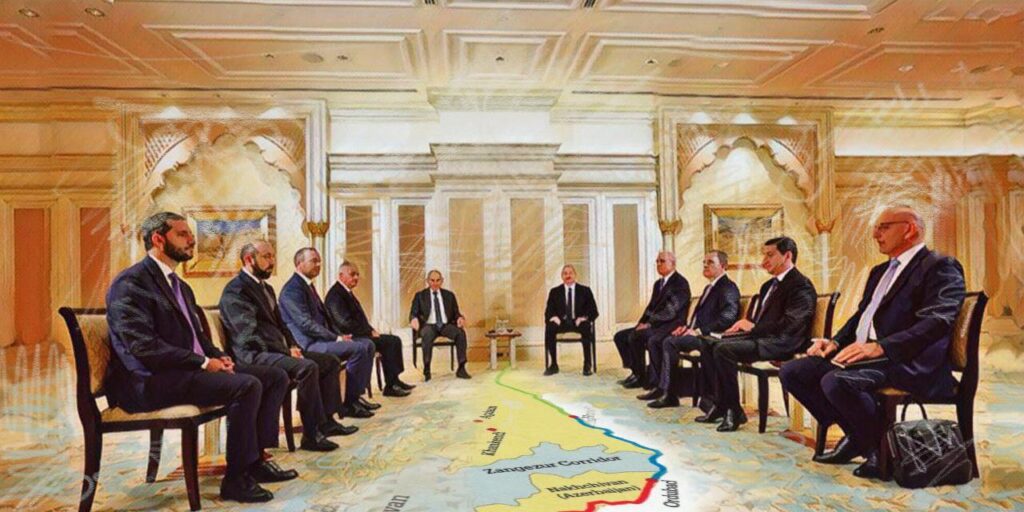
The Washington meeting between Armenia and Azerbaijan, hosted by President Donald Trump on August 8, 2025, may go down as a pivotal moment in the geopolitics of the Caspian and the wider Eurasian space. While on the surface the talks aimed to normalize relations between the two South Caucasus neighbors, the ripple effects extend far beyond bilateral reconciliation. For Azerbaijan, the meeting is not only about ending three decades of conflict with Armenia but also about positioning itself as a central bridge linking the Caspian Basin, Central Asia, and even Europe. The Caspian region has always been a security crossroads, where energy interests, military presence, and trade routes overlap. Russia’s war in Ukraine, the Iran-Israel conflict, and shifting Western engagement have made the region more volatile. In this context, a potential Armenia-Azerbaijan settlement offers a chance to stabilize the South Caucasus - the natural gateway between the Caspian and Europe. For Azerbaijan, peace with Armenia would solidify its position in the region where Baku has promoted several important transregional projects such as the Baku-Tbilisi-Ceyhan oil pipeline, the Southern Gas Corridor, and the Baku-Tbilisi-Kars railway. Azerbaijan is heavily investing in the development of the Caspian trade routes, energy infrastructure, and regional connectivity projects such as the Middle Corridor. Stability in the South Caucasus also makes it harder for external actors to exploit divisions - an especially significant factor given the previous attempt to exploit Armenia against Azerbaijan and Türkiye. That strategy brought no tangible results to Armenia, which remained regionally isolated and dependent on Russia. After the military defeats in 2020 and 2023, the Armenian leadership realized that peace and respect for the principle of territorial integrity is a much greater opportunity for the country rather than an irredentist project, which Prime Minister Nikol Pashinyan dubbed “mythical.” At the same time, a peace framework reduces the risk of military escalation spilling into the Caspian region. Naval modernization efforts by Russia and Iran in recent years have heightened anxieties. In short, normalization indirectly enhances Azerbaijan’s capacity to act as a stabilizing actor within the Caspian basin. Increasingly, Iran has also spoken about peace and cooperation, especially with Azerbaijan. Relations were tense a few years ago, but the incumbent President, Masud Pezeshkian, questioned the strategy employed previously by the Iranian clerics regarding Azerbaijan, which failed to gain any benefits. Perhaps the most significant geopolitical dividend for Azerbaijan lies eastward, across the Caspian. The Central Asian states - Kazakhstan, Uzbekistan, Turkmenistan, Kyrgyzstan, and Tajikistan - have long sought secure, diversified links to Europe. Russia’s war has made northern routes through its territory unreliable, while instability in the Red Sea undermines the traditional supply route. That leaves the Trans-Caspian link through Azerbaijan as promising. The Washington meeting, by promoting the peace agenda, reassures Central Asian partners that Baku is a reliable hub. Azerbaijan, Kazakhstan, and Uzbekistan signed an MOU about the transfer of alternative energy sources to Europe through another potential project – a Black Sea electricity cable from Georgia to Romania and Hungary. Azerbaijan...

How Armenia–Azerbaijan Peace Lowers Corridor Risk for Central Asia

The framework announced on 8 August 2025 in Washington for Armenia–Azerbaijan peace and development resets the security–economics equation in the South Caucasus and holds deep implications for Central Asia. At its core is the mutual recognition of territorial integrity, renunciation of force, and a transit arrangement under Armenian jurisdiction linking mainland Azerbaijan with its exclave of Nakhchivan across the Syunik province. For Central Asia, the immediate significance is the de-risking of the westbound Caspian–Caucasus–Anatolia artery centered on Azerbaijan’s Alat Port and the Baku–Tbilisi–Kars (BTK) rail route. As reported by Azerbaijan Railways, BTK’s operating capacity was lifted to 5 million tons/year (t/y) in May 2024 and has a path for expanding to 17 million tons in later phases. Alat currently lists 13 berths and dedicated ferry roll-on/roll-off (“ro-ro”) facilities. A dependable Armenian-jurisdiction link would create a second, legally unambiguous passage across the South Caucasus. Single-route dependence through Georgia would be reduced, as would the variance of end-to-end journey times. That reliability directly benefits Kazakhstan and Turkmenistan, whose westbound flows move by rail-ferry from Aktau/Kuryk to Alat and from Turkmenbashi to Alat before continuing overland toward Türkiye. Peace Reframes the Middle Corridor These developments also strengthen the business case for incremental investments in ports, ferries, rail paths, and energy interconnectors tied to the Middle Corridor, including swap-based energy routing already practiced between Azerbaijan and Kazakhstan. At Alat, confirmed as the hinge of the Middle Corridor, political risk converts into bankable time, which prices into contracts, which later in turn finances small but decisive capacity steps; bankable time begets bankable trade. Conflict risk in the South Caucasus has been a priced variable since 2020. A durable peace narrows that risk band and yields three operational effects with country-specific salience. First, marine war-risk and cargo premiums in nearby high-risk theaters such as the Gulf, typically ranging from 0.2–0.3% of hull value, rose to 0.5% during recent tensions. This figure offers a benchmark for how underwriters re-price routes as perceived closure risk changes. Second, forwarders can trim buffer time, improving asset utilization for rail paths and ro-ro (roll on, roll off) rotations pairing the Caspian ports (Alat, Aktau/Kuryk, Turkmenbashi). Third, carriers gain confidence to publish regular rotations and pre-position equipment; the Azerbaijan Caspian Shipping Company notes 1–2-day intervals in favorable conditions and shows multiple departures on a given day (e.g., August 15 listed Alat–Kuryk, Alat–Turkmenbashi, etc.). Lower variance is not cosmetic; it is collateral for contracts. Banks recognize collateral. Insurers do, too. When variability falls, rate discovery improves; as a result, multi-month slots or rail-path agreements become financeable. This is precisely the mechanism exporters from Kazakhstan and Turkmenistan need to secure predictable capacity into Azerbaijan and onward to Türkiye. Reliability also changes routing choices. At Alat, rail-ferry cargo arriving from Aktau/Kuryk or Turkmenbashi can be planned to run either via Georgia or via Syunik toward Kars, whichever route minimizes dwell time and schedule variance for the onward leg. Even where pure distance savings are modest, gains in reliability reduce movements of empty containers. They also...

How Could the Armenia-Azerbaijan Peace Accord Benefit Central Asia?

On August 8, Armenia and Azerbaijan signed a peace accord in Washington and committed to the construction of the Trump Route for Peace and Prosperity, a trade route that bisects Armenia, connecting the two parts of Azerbaijan. The deal may have far-reaching repercussions on the other side of the Caspian, potentially diversifying the Trans-Caspian Middle Corridor by allowing travel from Azerbaijan, through Armenia, and onwards to Turkey. The upbeat mood music may be premature, however. There remain numerous political hurdles to be jumped before any construction can commence, and the entry of the United States into a region where Russia, Iran, and Turkey all have interests could have unintended consequences. “It’s certainly an opportunity, but there are risks,” said Azerbaijani political analyst and non-resident fellow at the China-Global South Project, Yunis Sharifli. “The United States can be a stabilizing force, but it could go in the opposite direction. It can also create a spoiler.” The Problem Armenia and Azerbaijan have maintained ice-cold relations for almost their entire existence as independent states. For over three decades, they tussled over the status of Nagorno-Karabakh, a land which lies in the internationally recognized territory of Azerbaijan, but was, upon independence, populated mainly by Armenians. As well as costing thousands of lives and leading to hundreds of thousands of displaced persons, the enmity has also led to shuttered frontiers, which have choked trade across the South Caucasus. Armenia’s borders with both Azerbaijan and Turkey have been closed since 1993. While Armenia has been cut off from two of its four neighbors, Azerbaijan has also been severed in two, with the exclave of Nakhchivan, which borders Turkey, separated from the rest of the country by a sliver of Armenian territory, just 20 miles wide at its narrowest point. Conflicts in 2016, 2020, and 2023 saw Azerbaijan push Armenian troops from the region, with hundreds of thousands of Armenians fleeing Nagorno-Karabakh in fear of Azerbaijani reprisals. Since then, Baku has used its vast military superiority and geopolitical advantage to try to strongarm Armenia into accepting the construction of a corridor across its territory, threatening to use force on numerous occasions if Yerevan did not agree to its demands. The Solution Starting early this year, the United States began facilitating secretive negotiations between the pair, stepping into the vacuum left by Russia. The Kremlin has been sidelined from the process amid its deteriorating relations with both sides – many Armenians view Moscow as having betrayed them in the conflicts of 2020 and 2023, while Azeri-Russian relations have frayed significantly since the shooting down of Azerbaijan Airways Flight 8243 to Grozny earlier this year. The timing of the signing ceremony, on the anniversary of the Russian invasion of Georgia in 2008, was perhaps designed to reflect this shift in geopolitical alignment in the South Caucasus. Baku and Yerevan have signed up to a project which will see the construction of the corridor run by a U.S. private company, but under the laws of the Republic of Armenia. The...

Central Asia Sees Armenia-Azerbaijan Deal as a Step Forward

Central Asian countries have welcomed an agreement signed by Armenia and Azerbaijan at the White House, saying it is an important step toward peace in the South Caucasus and sets the stage for trade growth in the wider region. “We highly appreciate the efforts of all parties aimed at overcoming the long-standing conflict,” Uzbekistan’s Ministry of Foreign Affairs said on Saturday. “We are confident that the establishment of long-term peace and stability in the South Caucasus will pave the way for the launch of large transport and infrastructure projects for the benefit of all peoples of the vast region.” The leaders of Armenia and Azerbaijan signed the deal in a ceremony overseen by U.S. President Donald Trump on Friday, building on extensive dialogue between the two sides, though falling short of a comprehensive peace pact that would formally end decades of conflict. One of the terms of the Trump-backed deal is the opening of a South Caucasus trade corridor that would provide Azerbaijan – and Central Asian economies – with increased access to Turkey and Europe. Kazakhstan also praised the agreement and Trump’s role in making it happen, saying it “ended the long-standing military conflict between the two states and paved the way for establishing diplomatic relations and developing cooperation between them based on lasting peace,” presidential adviser Ruslan Zheldibay said on Telegram. President Kassym-Jomart Tokayev noted that Kazakhstan played a role in the rapprochement between Azerbaijan and Armenia because it hosted ministerial-level peace talks between the two sides in Almaty, according to Zheldibay. Tajikistan’s Ministry of Foreign Affairs said “the prompt legal consolidation” of the agreement signed in Washington will be a big step toward the full normalization of ties between the longtime adversaries and will contribute to regional stability and development. Kyrgyzstan has similarly expressed support for peace, offering earlier this year to host the signing of a peace agreement between Armenia and Azerbaijan. Turkmenistan, which pursues a stated policy of neutrality in foreign affairs, faces Azerbaijan across the Caspian Sea and is eager to develop trade routes.

Tentative Armenia-Azerbaijan Plan Could Boost the Middle Corridor for Central Asia

A tentative U.S.-facilitated agreement between Armenia and Azerbaijan could open a new transport route through Armenia’s southern Syunik region, linking mainland Azerbaijan to its exclave of Nakhchivan and onward to Türkiye. Armenian Prime Minister Nikol Pashinyan has confirmed that Washington proposed managing a 32-kilometer corridor through Syunik to connect the two Azerbaijani territories. While this outline has been discussed publicly, the legal and operational details remain undisclosed, and officials say more information will be released if the agreement is finalized. According to U.S. mediators and regional leaders, the route is part of ongoing efforts to normalize Armenia-Azerbaijan relations after decades of conflict. A U.S. official told reporters the plan could “open Armenia to the world” by providing new options for regional trade and transit. Both sides stress that key issues—such as governance, security, and financing—still need resolution. The corridor is one of the main sticking points in peace talks: Azerbaijan wants it free from exclusive Armenian control, while Armenia rejects any arrangement that would compromise its sovereignty. If realized, the route could become a new link in the Trans-Caspian “Middle Corridor”, which connects Central Asia to Europe via Kazakhstan, the Caspian Sea, Azerbaijan, Georgia, and Türkiye. It would offer Kazakhstan, Uzbekistan, and Turkmenistan an additional westward route, bypassing Russian and Iranian territory. Traffic along the Middle Corridor has grown rapidly as shippers sought alternatives to northern routes. Cargo volumes along the Middle Corridor increased markedly—from around 600,000 tons in 2021 to approximately 1.5 million tons in 2022, representing a 2.5-fold rise and climbed further to approximately 4.1 million tons by late 2024. The EU has committed billions of euros to upgrade ports, railways, and logistics hubs, and the World Bank forecasts the volumes potentially reaching up to 11 million tonnes per year. route’s freight volumes could triple by 2030. An Armenian segment could further cut transit times and build redundancy, improving supply chain resilience for Central Asia. The proposal’s framing as a U.S.-supported project signals a shift in South Caucasus diplomacy. Russia has long mediated between Armenia and Azerbaijan, but its influence has waned amid the war in Ukraine. Olesya Vartanyan, a South Caucasus expert at the International Crisis Group, told AP News, “Russia has been left on the sidelines, because the Kremlin has nothing to offer to Armenia and Azerbaijan.”  The initiative also concerns Iran, which fears losing its role as a north–south transit hub. For Central Asia, the corridor could add a politically diversified channel for exports, reinforcing “multi-vector” trade strategies. It would provide new access to Turkish and European markets, potentially strengthening regional bargaining power. The proposed corridor is expected to include rail transport as well as oil and gas pipelines and fiber‑optic cables, though construction would be carried out by private firms under a U.S.-negotiated lease agreement as reported by PanArmenian news service. This could allow Caspian energy exports from Kazakhstan and Turkmenistan to reach Türkiye and Europe more directly, and improve Central Asia’s digital connectivity by reducing reliance on Russian telecom routes. However, no technical designs...