• KZT/USD = 0.00223
  • TJS/USD = 0.10810
  • UZS/USD = 0.00009
  • TMT/USD = 0.29850
  • KZT/USD = 0.00223
  • TJS/USD = 0.10810
  • UZS/USD = 0.00009
  • TMT/USD = 0.29850
  • KZT/USD = 0.00223
  • TJS/USD = 0.10810
  • UZS/USD = 0.00009
  • TMT/USD = 0.29850
  • KZT/USD = 0.00223
  • TJS/USD = 0.10810
  • UZS/USD = 0.00009
  • TMT/USD = 0.29850
  • KZT/USD = 0.00223
  • TJS/USD = 0.10810
  • UZS/USD = 0.00009
  • TMT/USD = 0.29850
  • KZT/USD = 0.00223
  • TJS/USD = 0.10810
  • UZS/USD = 0.00009
  • TMT/USD = 0.29850
  • KZT/USD = 0.00223
  • TJS/USD = 0.10810
  • UZS/USD = 0.00009
  • TMT/USD = 0.29850
  • KZT/USD = 0.00223
  • TJS/USD = 0.10810
  • UZS/USD = 0.00009
  • TMT/USD = 0.29850
23 September 2026

Viewing results 1 - 6 of 31

International Space Station Marks 25 Years of Continuous Habitation

Two Russian cosmonauts and one American astronaut floated through a hatch into the International Space Station on Thursday, beginning an eight-month stay after arriving on a Russian spacecraft that launched from the Baikonur Cosmodrome in Kazakhstan. The Soyuz MS-28 craft that docked at the station, or ISS, on Thursday carried Russian commander Sergey Kud-Sverchkov on his second trip to space, as well as Russian Sergey Mikayev and Christopher Williams of NASA. Mikayev and Williams are on their first mission as part of a longstanding collaboration between NASA and Russian space agency Roscosmos that has kept the ISS continuously inhabited for 25 years. The first arrivals were in November 2000. Live video showed Kud-Sverchkov, Mikayev and Williams, who will conduct scientific experiments and spacewalks during their stay, being greeted with big smiles from the astronauts and cosmonauts already on board the ISS. There are now a total of 10 people on the station. Williams, who has worked as a clinical physicist and cancer researcher, recently talked about his relationship with his fellow travelers from Russia on a NASA-run program called Houston We Have a Podcast. “It’s a really great crew,” Williams said. The two Russians, he said, “are both just absolutely wonderful people, really kind, super interested, super intellectually curious, which is really fun. Had a lot of really, really great discussions, just talking and talking about things. And it’s been been wonderful to both spend some time with them over in Star City, and also to be able to spend some time with them in Houston through our training.” Star City is a facility in the Moscow area where cosmonauts train. Houston is home to NASA’s Johnson Space Center. “And so when I’m over there in Star City, we’re doing a lot of Soyuz simulations together,” Williams said. “So we’re spending a lot of time, sort of the three of us in a small capsule for, you know, several hours at a time, you know, in suits… running through sort of mock scenarios of of what would happen on launch, on rendezvous, on on on departing the station, as well as in the ISS trainers.” The training also included emergency scenarios that could unfold on the International Space Station.  
Mice in “Miniature Hotel” Poised for Space Launch from Baikonur

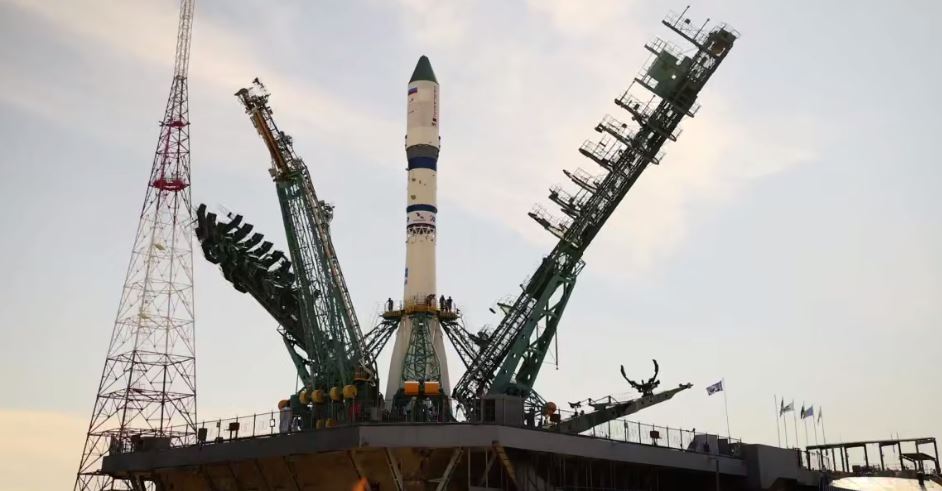
A crew of mice, flies, and ants, to be used for biomedical research in space, are on board a spacecraft that Russia is preparing to launch from the Baikonur Cosmodrome in Kazakhstan. On other missions, the rocket typically rolls to the launch pad a few days before launch. On this one, however, a Soyuz rocket that will hoist the Bion-M No. 2 biosatellite into orbit rolled out on Tuesday, one day ahead of the scheduled lift-off. “This is due to the preservation of the biological samples on board,” said Roscosmos, Russia’s space agency. “The goal is to reach weightlessness as quickly as possible.” The purpose of sending mice to space is to evaluate the impact of radiation and zero gravity on the rodents, including whether time in space affects their hormonal balance, immunity, reproductive processes, and metabolism. Russia has conducted similar missions in the past, including the Bion-M No.1 satellite launch in 2013 that ferried mice, gerbils, snails, and fish to space. The Bion-M No. 2 mission has been delayed multiple times in recent years. Such experiments could help prepare humans for long-term space travel. Mice have a genetic similarity to humans, and their short life cycle allows for the tracking of changes across generations, according to Roscosmos. During the 30-day mission of the Bion-M No. 2, “scientists will receive real-time data on the rodents' condition using special cameras and sensors inside the mouse boxes. Moreover, some individuals will have implanted chips,” the space agency said. It said the living conditions of the dozens of mice on the satellite resemble a “miniature hotel” in which they have feeding, lighting, ventilation, and waste disposal systems. The accommodation is more spacious than it was for the mice on the Bion-M No. 1 satellite more than a decade ago. Fruit flies, ants, tomato seeds and fungi are also on this week’s space-bound mission. The tomato seeds, part of an experiment being conducted by Russian and Belarusian schoolchildren, will be planted on Earth after the space mission to see how they grow.

Latest Baikonur Launch Pays Tribute to 1975 Apollo-Soyuz Mission

In July 1975, millions of people watched on television as a U.S. Apollo spacecraft docked with a Soviet Soyuz capsule in a crewed mission in orbit that symbolized collaboration between the two superpowers at the height of Cold War enmity. That remarkable moment 50 years ago is being commemorated on a Soyuz rocket carrying a Russian cargo spacecraft that launched from the Baikonur Cosmodrome in Kazakhstan – early on Friday, Baikonur time - and is scheduled to reach the International Space Station after a two-day trip. The spacecraft is loaded with more than 2.5 tons of fuel, drinking water, food, medicine, science equipment, and other supplies for the crew on the station. The Soyuz rocket currently heading to the ISS is painted white and blue and has an emblem marking the anniversary of the Soyuz-Apollo docking, which was the first international space mission. It had begun on July 15, 1975, when two Soviet cosmonauts launched from Baikonur and, hours later, three American astronauts blasted off from Cape Canaveral, Florida. The Russians and the Americans connected in space two days later, shaking hands, exchanging gifts, and sharing a meal. The show of comity in space contrasted with the intense competition between the two global rivals that was known as the “space race,” which included the Soviet launch of the Sputnik satellite into orbit in 1957 and the Apollo 11 landing of American astronauts on the moon in 1969. “I really believe that we were sort of an example … to the countries. We were a little of a spark or a foot in the door that started better communications,” Apollo astronaut Vance Brand had said, according to a NASA account of the Apollo-Soyuz mission. Tensions between Russia and the United States escalated after Moscow launched a large-scale invasion of Ukraine in 2022, though relations improved after U.S. President Donald Trump took office for a second term in January. The U.S. and Russian space agencies have continued to collaborate over the course of the protracted war. Roscosmos, the Russian space agency, refers to the cargo spacecraft currently in orbit as Progress MS-31, while the U.S. agency NASA uses the term Progress 92 because it’s the 92nd Russian resupply craft to launch in support of the International Space Station since its construction began in 1998. The Apollo-Soyuz mission has been described as a precursor of the ISS project.

Baikonur Fallout: Russia’s Cosmic Legacy Leaves Scars on Kazakhstan

“Every time there’s a rocket launch at Baikonur, you can’t see for days. The sand comes up off the ground, and doesn’t shift for a good while,” a waiter in Aralsk, a one-time fishing town on what was once the shore of the shriveled Aral Sea told The Times of Central Asia. Upon entering Baikonur, Russia’s gateway to outer space on the Kazakh steppe, the first thing you see is a billboard proudly displaying Vladimir Putin shaking hands with President Kassym-Jomart Tokayev. Beneath the façade, however, Russia’s presence here has spurred major economic inequalities and environmental degradation. Backwater to the Cosmos [caption id="attachment_32232" align="aligncenter" width="1512"] "Here on January 12, 1955, the first group of military engineers arrived, who laid the foundation for the creation of Baikonur Cosmodrome;” image: Thomas Hodgson[/caption] Stepping off the train at Töretam, the closest town to Baikonur proper, there is very little sense of occasion to be found. The only reference to the existence of rockets in the immediate vicinity is a tucked-away, red-starred plaque on the platform bearing the inscription: “Here on January 12, 1955, the first group of military engineers arrived, who laid the foundation for the creation of Baikonur Cosmodrome.” In 1961, Yuri Gagarin launched from Baikonur to become the first human being in outer space, propelling the complex’s status in history from an obscure backwater to a legendary, top-secret star city. ​In reality, “Baikonur” was a decoy name given by the Soviets to a town 300 kilometers away from the real launch site at Leninsk. Western newspapers reinforced the false story, and Baikonur entered the global popular consciousness. Kazakhstan’s government chose to sell the myth, finally renaming the actual cosmodrome settlement from Leninsk to Baikonur in 1995. With the collapse of the Soviet Union in 1991, Russia found overnight that its primary spaceport was in a foreign power’s possession. By 1994, Moscow struck a deal with the nascent Kazakh Republic to lease Baikonur at a rate of 7 billion rubles per year ($110 million). As of 2024, the Kazakh state has pulled in over $3 billion in revenue from the scheme. Living in the Shadow of Russia [caption id="attachment_32233" align="aligncenter" width="1512"] Image: Thomas Hodgson[/caption] The extent of Russia’s grip over the area, even outside of the “ring,” is clear in all aspects of daily life. In nearly every shop in Töretam, the ruble is accepted alongside the Kazakh tenge. This poses problems for the local economy, with the circulation of rubles effectively pricing out anyone who doesn’t receive a ruble salary from jobs in Baikonur itself. The Russian language is likewise used in tandem with Kazakh, even though the surrounding Kyzylorda region is less than 2% ethnically Russian and, by all appearances, overwhelmingly favors Kazakh. Poverty is widespread here, juxtaposed markedly with the hordes of affluent “space tourists” from around the world who head through Töretam into the “ring” every day. Tour agencies charge upwards of $1,000 per day for access to Baikonur, yet reinvestment in communities surrounding the “ring” seems non-existent,...

Baikonur Cosmodrome Gears Up for 70th Anniversary; Trespassers Detained

Two European tourists have been detained while trying to take photographs at the Baikonur Cosmodrome in Kazakhstan, Russian media reported on Thursday, as officials prepare to celebrate the 70th anniversary of the Russia-operated spaceflight center on June 2. “The men were trying to sneak to the Buran rocket and take photos," an unidentified law enforcement official told Russia’s state news agency TASS, which reported on Thursday that the men, who were from Czechia, also known as the Czech Republic, were released after being fined 5,000 rubles, or $60. The trespassers were the latest in a long list of space enthusiasts and adventure-seekers who have tried to get close to a Soviet-era facility that pioneered early space exploration and remains a vital if aging part of Russia’s space program. The disused Buran spacecraft, a space shuttle that was developed in the 1970s and 1980s by the Soviet Union, is an object of particular fascination. The Buran flew once in 1988, but the program was abandoned because of high costs and a lack of purpose. Russian and Kazakh media, meanwhile, are reporting on plans for anniversary celebrations at the cosmodrome, which is serviced by a city of the same name in the desert environment in southern Kazakhstan. Some rocket mock-ups will be on display and an open-air museum is being set up, the Kazinform news agency reported. One of the mock-ups is 22 meters high and is a model of the Soviet N1 lunar rocket that failed in its four test launches in the late 1960s and early 1970s. Space journalist Anatoly Zak was not impressed by the planned display, saying on X that he is concerned about reports that Russia is destroying “artifacts and documents” that illuminate the historical record of the Soviet space program. Another piece of Baikonur history occurred on Saturday when a Venus-bound lander probe, which launched from the cosmodrome in 1972 but never got out of Earth’s orbit, made an uncontrolled re-entry into Earth’s atmosphere. Russian space agency Roscosmos said the lander fell in the Indian Ocean west of Jakarta, though questions remain about its fate, including whether it burned up during re-entry or somehow remained intact.

Mysteries Remain Over Soviet Spacecraft That Reentered Earth’s Atmosphere

The saga of a Venus-bound lander probe that launched from Soviet-run Kazakhstan in 1972 and made an uncontrolled reentry into Earth’s atmosphere on Saturday had triggered wide international interest, partly because there was so much uncertainty about its return. Would the spacecraft make it through the atmosphere intact? Where exactly would it end up? One thing is for sure: the Cosmos 482 spacecraft is down (and no one has to worry anymore about the very remote possibility of an encounter with flying spacecraft debris). But the answers to some of the mysteries about the lander still appear to elude scientists, or at least are the subject of continuing debate. Russian space agency Roscosmos said on Telegram on Saturday that the lander “entered the dense layers of the atmosphere at 9:24 Moscow time, 560 km west of Middle Andaman Island, and fell in the Indian Ocean west of Jakarta.” The Russian statement was extensively reported by media organizations around the world. However, Dr. Marco Langbroek, a scientist based in the Netherlands, said on X that “it is not at all clear how accurate that position is and what it is based on, and whether it better represents the other estimates.” Some other space agencies and institutions had predicted other reentry points, including in the Pacific Ocean. “There is a planet-size discrepancy in some predictions about the Soviet Venus probe's impact point this morning, but everybody seems to agree it is down and it is in the ocean (our condolences to all "hope it is in my backyard" wishes),” space journalist Anatoly Zak wrote on Saturday. For its part, NASA concurred with Roscosmos that the lander probe had plunged into the ocean west of Jakarta, but the U.S. space agency didn’t say how it arrived at the conclusion. “Because the probe was designed to withstand entry into the Venus atmosphere, it is possible it survived reentry,” NASA said. The spacecraft had a titanium protective shell originally designed to get through the extreme atmosphere of Venus, which has the hottest surface of any planet in the solar system. There was also uncertainty at the European Space Agency, which said in its last update on Saturday that the spacecraft hadn’t been spotted over Germany as expected and that it hadn’t received “any reports on visual direct observations of the final re-entry, or on any impacts on the ground.” The Soviet Union launched Cosmos 482 from the Baikonur Cosmodrome in Kazakhstan, then a Soviet republic. The probe never got out of Earth’s orbit and moved closer to Earth’s atmosphere over the decades. Today, Russia operates the Baikonur Cosmodrome, which retains a popular allure for its role in early space exploration and is still a vital part of the Russian space program.