• KZT/USD = 0.00210
  • TJS/USD = 0.10820
  • UZS/USD = 0.00008
  • TMT/USD = 0.29760
  • KZT/USD = 0.00210
  • TJS/USD = 0.10820
  • UZS/USD = 0.00008
  • TMT/USD = 0.29760
  • KZT/USD = 0.00210
  • TJS/USD = 0.10820
  • UZS/USD = 0.00008
  • TMT/USD = 0.29760
  • KZT/USD = 0.00210
  • TJS/USD = 0.10820
  • UZS/USD = 0.00008
  • TMT/USD = 0.29760
  • KZT/USD = 0.00210
  • TJS/USD = 0.10820
  • UZS/USD = 0.00008
  • TMT/USD = 0.29760
  • KZT/USD = 0.00210
  • TJS/USD = 0.10820
  • UZS/USD = 0.00008
  • TMT/USD = 0.29760
  • KZT/USD = 0.00210
  • TJS/USD = 0.10820
  • UZS/USD = 0.00008
  • TMT/USD = 0.29760
  • KZT/USD = 0.00210
  • TJS/USD = 0.10820
  • UZS/USD = 0.00008
  • TMT/USD = 0.29760

Viewing results 1 - 6 of 87

China-Central Asia Trade Nearly Triples Since 2020

Trade between China and the countries of Central Asia reached $66.2 billion in 2024, nearly triple the 2020 level, according to the Eurasian Development Bank (EDB). Imports from China accounted for about 60% of total trade turnover. China’s largest trading partner in the region is Kazakhstan, with bilateral trade valued at $30.1 billion (46% of total China-Central Asia trade), followed by Uzbekistan at $18 billion (27%) and Turkmenistan at $10.6 billion (16%). China’s share in Central Asia’s overall trade turnover has risen sharply, from 17.7% in 2020 to 24.1% in 2024. However, the level of dependence on Chinese trade varies by country: Turkmenistan - 55% of its total trade is with China. Kyrgyzstan - around 35%. Kazakhstan, Uzbekistan, and Tajikistan - between 20-22%. The EDB estimates significant untapped trade potential of $39.3 billion, about 60% of the current turnover. This includes $32 billion in potential Chinese exports to Central Asia (such as automobiles, electronics, and consumer goods) and $7.3 billion in potential Central Asian exports to China (including copper products, gold, and uranium). With deepening economic ties and major infrastructure links through the Belt and Road Initiative, analysts expect China-Central Asia trade to continue expanding in the coming years.

Uzbek Trade Delegation Visits U.S. to Promote “Made in Uzbekistan” Exports

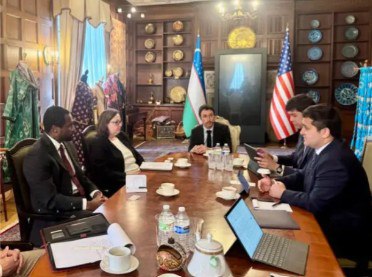
From July 23 to 29, a delegation from Uzbekistan’s Ministry of Investment, Industry and Trade (MIIT) visited the United States to promote Uzbek-produced goods, expand export channels, and strengthen bilateral trade ties, according to the ministry’s press service. As part of the mission, 25 Uzbek textile companies showcased their products under the national “Made in Uzbekistan” brand at three major trade exhibitions in New York: Texworld NYC, Apparel Sourcing USA, and Home Textiles Sourcing Expo. Delegates met with industry leaders and trade associations, including Bunzl plc, Levi Strauss & Co., PVH Corp., GIII Apparel Group, Kontoor Brands, American Eagle Outfitters, Tapestry Inc., Macy’s, the American Apparel & Footwear Association (AAFA), and the United States Fashion Industry Association (USFIA), to discuss integrating Uzbek brands into U.S. sourcing channels. In Washington, ministry representatives met with the U.S. Department of Commerce to explore opportunities for enhancing trade, reducing regulatory barriers, and increasing investment cooperation. They also engaged with the Commercial Law Development Program (CLDP) under the Commerce Department, agreeing to organize webinars and seminars aimed at helping Uzbek firms meet U.S. certification and packaging standards. A separate meeting with the U.S. Department of Agriculture and the U.S. Cotton Association addressed expanding Uzbekistan’s access to the GSM-102 export credit guarantee program, increasing credit limits, and launching a “Made from U.S. Cotton” initiative. The proposed initiative would allow processed Uzbek goods made from American cotton to carry the label in international markets. The delegation also explored ways to deepen investment cooperation with U.S. industry associations and develop mechanisms to integrate more Uzbek products into American retail and sourcing ecosystems. As previously reported by The Times of Central Asia, on April 30, U.S. Labor Secretary Lori Chavez-DeRemer announced the termination of more than $38 million in foreign aid programs during a cabinet meeting at the White House. This included funding for a labor rights initiative in Uzbekistan’s cotton sector. The program, launched in 2022 and scheduled to run through 2026, aimed to improve labor conditions and prevent forced labor. It received $2 million in its first year, with $1 million earmarked for 2025.

Kyrgyzstan Begins Dried Apricot Exports to China

Kyrgyzstan has launched exports of dried apricots to China, with the first 23-ton shipment dispatched on July 29. The delivery comes after Chinese authorities approved Kyrgyz dried apricots for import, following Kyrgyzstan’s successful compliance with Beijing’s sanitary and quarantine standards. According to the Kyrgyz Ministry of Water Resources, Agriculture and Processing Industry, this marks a significant step in expanding agricultural exports to China and sets the stage for broader trade in fruit and vegetable products. The milestone follows the July 11 signing of a bilateral agreement to construct a food safety and quarantine laboratory in Bishkek. The facility will test agricultural goods destined for China to ensure they meet the country’s stringent import regulations. Deputy Prime Minister Bakyt Torobayev noted that Kyrgyz-Chinese trade grew by 44.7% in 2024, reaching $5.3 billion. Exports from Kyrgyzstan to China surged to $2.04 billion, representing a 93-fold increase compared to 2023. Agriculture has emerged as a key area of bilateral cooperation. In 2024, trade in agricultural products between the two nations totaled $153.3 million, up by $33 million from the previous year. Kyrgyz authorities are now seeking to expand the list of approved exports. Negotiations are underway to finalize four additional protocols with China, covering dried fruits, cattle hides, meat, and animal feed. These efforts aim to diversify Kyrgyzstan’s agricultural exports and enhance its position in the Chinese market. Officials see China’s rising demand for agricultural imports as a major opportunity for Kyrgyz farmers and exporters, particularly as the country continues to invest in infrastructure and quality assurance systems to support trade growth.

China Overtakes Russia as Tajikistan’s Top Trading Partner for the First Time

For the first time in over two decades, China has become Tajikistan’s largest trading partner, surpassing Russia in bilateral trade volume, according to newly released data from the Tajikistan Statistics Agency. A New Leader in Foreign Trade Between January and May 2025, trade between Tajikistan and China reached $964 million, an increase of nearly 30% compared to the same period in 2024. China's share in Tajikistan’s total foreign trade stood at 24.8%, edging ahead of Russia’s 23.2%. This surge was driven largely by Chinese exports to Tajikistan, which totaled $787 million. Tajik exports to China reached $177 million, leaving a significant trade imbalance in China’s favor, though the overall volume of bilateral engagement continues to rise rapidly. Russia had held the position of Tajikistan’s leading trade partner for more than 20 years. However, during the first five months of 2025, total trade between the two countries reached approximately $900 million. Of that, only $42 million represented Tajik exports to Russia, while Russian imports totaled $858 million. Despite a 9.3% increase year-on-year, the growth was insufficient to maintain its top position. Uzbekistan Reemerges as a Key Player Historically, Uzbekistan was Tajikistan’s main trade partner during the 1990s. In 1995, trade between the two countries reached $250 million, double the combined trade volume with other post-Soviet states at the time. However, political tensions toward the end of the decade led to a sharp decline, with trade falling to just $13 million by 2014. Following the election of Shavkat Mirziyoyev as President of Uzbekistan in 2016, bilateral relations have markedly improved. Trade between Tajikistan and Uzbekistan is once again on the rise, reaching $238 million in the first five months of 2025. China: Tajikistan’s Leading Investor and Creditor China’s growing economic influence in Tajikistan extends beyond trade. It is now the country’s largest foreign investor, having overtaken Russia in 2017. According to the State Committee for Investment and State Property Management, accumulated Chinese investment in Tajikistan totaled $5.1 billion as of Q2 2025. In comparison, Russian investments stand at approximately $2 billion, less than half. China is also Tajikistan’s largest external creditor. As of early 2025, Dushanbe’s debt to Beijing stood at around $1 billion, representing nearly one-third of the country’s total external debt. This strategic pivot in Tajikistan’s economic orientation reflects a broader regional trend. Across Central Asia, Beijing continues to expand its footprint through a combination of trade, infrastructure investment, financial lending, and diplomatic engagement.

Kazakh Foreign Minister Visits Kabul, Signs $500M Railway Deal as Mining Push Gathers Momentum

In a major step toward deepening regional engagement, Kazakhstan’s Foreign Minister Murat Nurtleu arrived in Kabul this week, signaling a continuing shift towards pragmatic engagement in Astana’s policy towards Afghanistan. The visit resulted in significant diplomatic and economic developments, including the signing of a $500 million agreement on the Herat-Torghundi railway. During his visit, Nurtleu met with Afghanistan’s acting Foreign Minister Amir Khan Muttaqi and other senior officials in the Taliban-led government. In a joint statement, the two sides emphasized their commitment to expanding bilateral ties in transit, trade, education, and regional security. Nurtleu pledged Kazakhstan’s support for Afghanistan’s stabilization, food security, and comprehensive development, stating that Astana is seeking to expand its partnership with Kabul based on shared regional interests. A highlight of the visit was the signing of a memorandum of understanding for the construction of the Torghundi–Herat railway. The 115-kilometer line will link western Afghanistan to Turkmenistan, and is expected to extend connectivity into Iran and further south to the Arabian Sea. Afghanistan’s Deputy Prime Minister Abdul Ghani Baradar welcomed the agreement, stating that the deal will lay the foundation for establishing a logistics hub in Herat. As reported by Baradar’s office, discussions also covered the possibility of relaxing visa regulations for Afghan traders, resuming direct flights between Kabul and Astana, and increasing bilateral trade volumes. The two sides emphasized expanding economic collaboration through joint initiatives in key industries, including mining, transportation, communications, energy, and infrastructure. They also considered formalizing accords on agricultural product safety, cross-border logistics, and reduced transit costs — steps aimed at potentially raising trade between the countries to $3 billion. In parallel to these diplomatic overtures, Kazakhstan’s mining giant Kazakhmys Barlau is exploring Afghanistan’s untapped mineral resources. CEO Galym Nurzhanov confirmed that his team has already begun reconnaissance operations in the mineral-rich Nuristan Province. Nurzhanov described the terrain as a geological time capsule, stating that “For our geologists and miners, it’s like stepping into the 19th century. We looked at lead-zinc deposits, grades of nearly 39%, with concentrates reaching 41%. That’s ready ore, you can crush it and send it straight to the plant.” As previously reported by The Times of Central Asia, despite lingering tensions over issues such as Afghanistan’s controversial Qosh Tepa Canal project, Kazakhstan has emphasized an approach to relations with Kabul based on “practicality, not ideology,” highlighting the shared need for regional security, trade corridors, and energy development.

Kyrgyz President Visits Tajikistan, Opening New Era of Friendship

Kyrgyzstan’s President Sadyr Japarov just concluded a two-day visit to Tajikistan. Rarely has the visit of one Central Asian leader to another Central Asian country been as welcome as Japarov’s trip to Tajikistan was. The two countries engaged in brief, but intense and devastating conflicts in late April 2021 and mid-September 2022, the only clashes between the militaries of the two Central Asian countries since the five Central Asian states became independent in late 1991. Judging by Japarov’s warm reception in the Tajik capital Dushanbe, the worst of times have passed in Kyrgyz-Tajik relations. A Year of Firsts Japarov, who has been in power in Kyrgyzstan since late 2020, was making his first state visit to Tajikistan on July 8-9. Japarov traveled to Tajikistan in June 2021, nearly two months after the first outbreak of hostilities along the Kyrgyz-Tajik border, to speak with Tajik President Emomali Rahmon about easing tensions along their common frontier. That June, a meeting was hastily arranged as an exercise in damage control, not a state visit, and in any case, the talks between the two presidents failed to head off even worse fighting in September of the next year. This first state visit by Japarov followed President Rahmon’s visit to the Kyrgyz capital in March 2025, the first state visit by Rahmon to Kyrgyzstan in nearly 12 years. During Rahmon’s meeting in March, Kyrgyzstan and Tajikistan signed the agreement delimiting the final disputed sections of their border, which both sides hope will end more than a decade of violence and destruction in the border area. That agreement led to the first-ever summit of the presidents of the three Central Asian countries that share the Ferghana Valley. Uzbek President Shavkat Mirziyoyev joined Japarov and Rahmon on March 31 in the northern Tajik city of Khujand to celebrate the agreement on all three countries’ borders and talk about future cooperation. Pomp and Ceremony Rahmon was at the Dushanbe airport to meet Japarov when the latter arrived on July 8. Tajikistan’s Honor Guard played the national anthems of both countries, followed by a 21-gun salute for Japarov, before the two presidents made their way to the Tajik capital to hold talks. The two leaders also visited a Kyrgyz-Tajik trade exhibit and attended a concert featuring performers from both countries dedicated to “Eternal Friendship.” Moving Forward Ahead of the Japarov-Rahmon meeting, The Times of Central Asia reported that trade between the two nations is starting to increase again. The figure for January-May trade between the two countries this year was a modest $6.35 million, but that is 15 times more than the meager $405,100 of bilateral trade during the first five months of 2024. Less than a decade ago, there were years when Kyrgyz-Tajik bilateral trade topped $50 million. Following the border agreement in March, two border crossings were reopened along the western sections of the Kyrgyz-Tajik frontier. During the meeting between the two presidents, it was announced that a third crossing had opened, the Tajvaron-Karamyk post connecting Kyrgyzstan’s...