• KGS/USD = 0.01144 0%
  • KZT/USD = 0.00212 0%
  • TJS/USD = 0.10768 0.47%
  • UZS/USD = 0.00008 0%
  • TMT/USD = 0.28490 0%
  • KGS/USD = 0.01144 0%
  • KZT/USD = 0.00212 0%
  • TJS/USD = 0.10768 0.47%
  • UZS/USD = 0.00008 0%
  • TMT/USD = 0.28490 0%
  • KGS/USD = 0.01144 0%
  • KZT/USD = 0.00212 0%
  • TJS/USD = 0.10768 0.47%
  • UZS/USD = 0.00008 0%
  • TMT/USD = 0.28490 0%
  • KGS/USD = 0.01144 0%
  • KZT/USD = 0.00212 0%
  • TJS/USD = 0.10768 0.47%
  • UZS/USD = 0.00008 0%
  • TMT/USD = 0.28490 0%
  • KGS/USD = 0.01144 0%
  • KZT/USD = 0.00212 0%
  • TJS/USD = 0.10768 0.47%
  • UZS/USD = 0.00008 0%
  • TMT/USD = 0.28490 0%
  • KGS/USD = 0.01144 0%
  • KZT/USD = 0.00212 0%
  • TJS/USD = 0.10768 0.47%
  • UZS/USD = 0.00008 0%
  • TMT/USD = 0.28490 0%
  • KGS/USD = 0.01144 0%
  • KZT/USD = 0.00212 0%
  • TJS/USD = 0.10768 0.47%
  • UZS/USD = 0.00008 0%
  • TMT/USD = 0.28490 0%
  • KGS/USD = 0.01144 0%
  • KZT/USD = 0.00212 0%
  • TJS/USD = 0.10768 0.47%
  • UZS/USD = 0.00008 0%
  • TMT/USD = 0.28490 0%

Viewing results 1 - 6 of 18

Kazakhstan to Launch Direct Flights to Tokyo and New York Within Next 12 Months

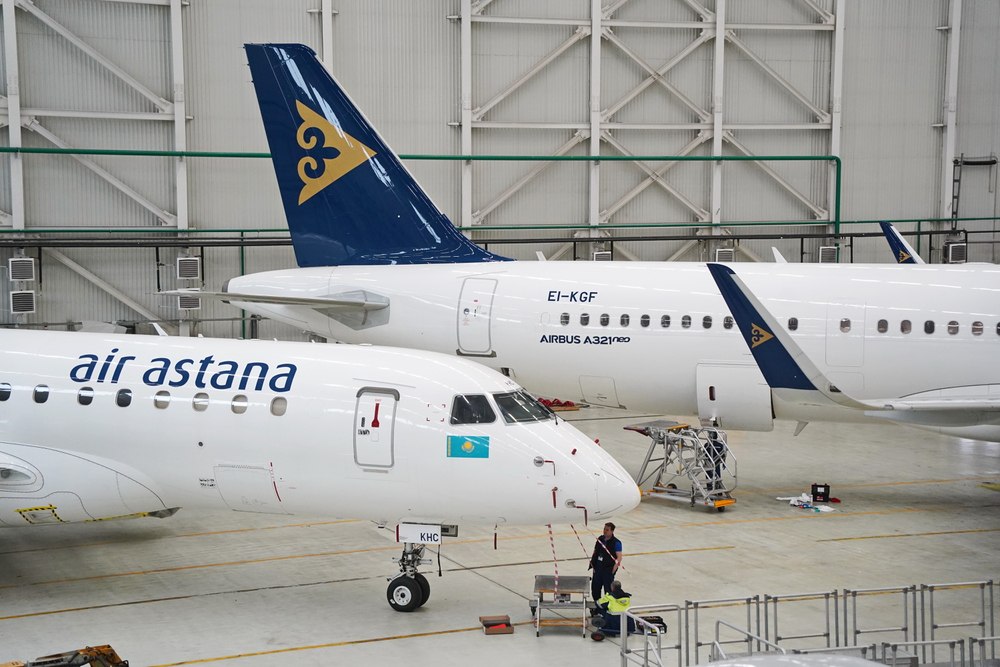
Kazakhstan plans to launch direct flights from Astana to Tokyo and New York within the next 12 months, Transport Minister Nurlan Sauranbayev said during a government meeting on Tuesday. Prime Minister Olzhas Bektenov reminded officials that the Ministry of Transport had previously pledged to open direct air links to Tokyo and New York but had yet to announce concrete results. “In the case of Tokyo, flights will begin in the fourth quarter of 2026, and flights to the United States will begin in the second quarter of 2027,” Sauranbayev said. He added that Astana currently operates 34 international routes. According to the minister, Kazakhstan has already opened four new international routes since the beginning of the year: Almaty-Shanghai, Astana-Yerevan, Atyrau-Tashkent, and Aktau-Yerevan. By the end of 2026, Kazakhstan's aviation authorities plan to open or resume 11 additional international routes, including Astana-Ulaanbaatar, Astana-Guangzhou, Astana-Issyk-Kul, Astana-Larnaca, Astana-Kashgar, Almaty-Tokyo, Almaty-Larnaca, Hanoi-Almaty-Prague, Almaty-Izmir, Almaty-Warsaw, and Kostanay-Tashkent. Meanwhile, Michael Daniel, CEO of the Aviation Administration of Kazakhstan (AAK), said work is ongoing to secure Category 1 status from the U.S. Federal Aviation Administration (FAA) under the International Aviation Safety Assessment (IASA) program, a prerequisite for launching direct flights to the U.S. Daniel said Kazakhstan has been addressing shortcomings identified during an FAA technical assessment conducted in August 2024. “We plan to invite the FAA IASA team to conduct an evaluation in September 2026. The FAA will assess Kazakhstan’s political commitment to complying with international aviation safety standards, including legislation, regulatory oversight, and practical implementation,” he said. “Our primary goal is to obtain FAA Category 1 status in November 2026,” Daniel added. Kazakhstan’s airline fleet is also expected to expand, with six additional aircraft scheduled to enter service by the end of this year. As previously reported by The Times of Central Asia, Kazakhstan’s civil aviation fleet consisted of 104 aircraft last year, with authorities aiming to increase that number to 216 by 2030. The government is also planning a major modernization of airport infrastructure over the next three years. “In accordance with the president’s instructions, work is underway on the construction of airports in the tourist zones of Katon-Karagay, Zaysan, and Kenderli, as well as the restoration of Arkalyk Airport,” Sauranbayev said. He added that aviation hub development is continuing at six major airports: Almaty, Astana, Aktau, Aktobe, Karaganda, and Shymkent. According to the minister, most airport modernization projects are being financed through private investment. As previously reported by The Times of Central Asia, Kazakhstan’s SCAT Airlines, in partnership with Boeing, has begun construction of a major aircraft maintenance, repair, and overhaul center in Shymkent.
Kazakhstan’s SCAT Airlines Adds Two Boeing 737 MAX 8 Aircraft

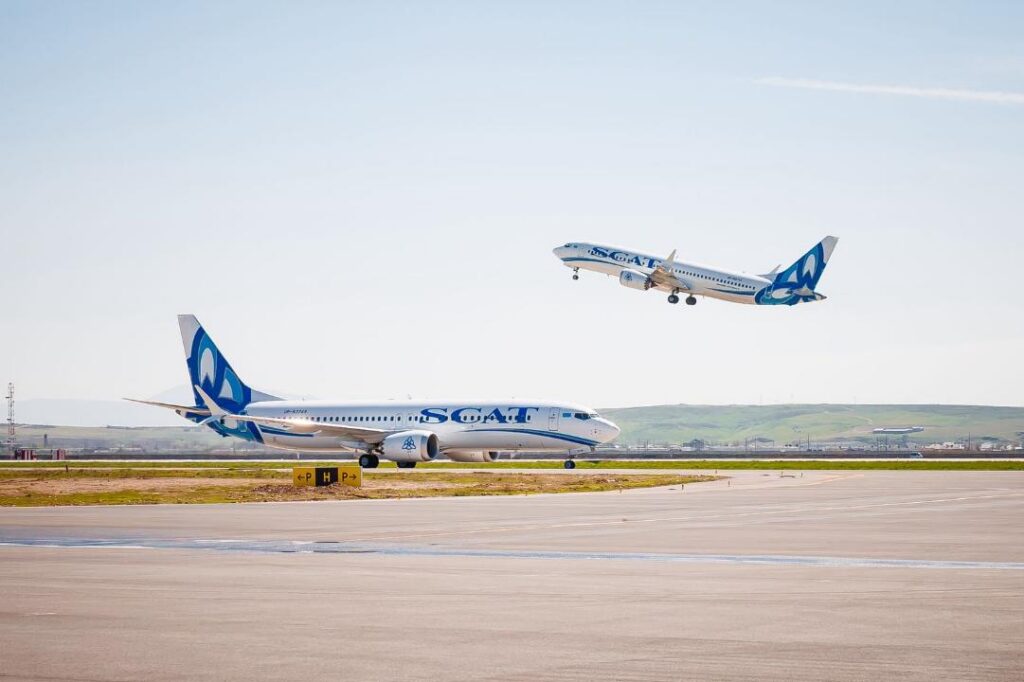
Kazakhstan-based SCAT Airlines has taken delivery of two new Boeing 737 MAX 8 aircraft. The planes were delivered directly from Boeing’s facility in Seattle, marking the first time the carrier has added two aircraft of this type to its fleet simultaneously. The fleet expansion is linked to the growth of the airline’s route network and the strengthening of existing flight programs. In 2026, SCAT launched new routes from Shymkent to Karaganda, Kostanay, Bishkek, Novosibirsk, St. Petersburg, and Tyumen, as well as a direct service from Astana to Ulaanbaatar. The new aircraft will support the development of a hub at Shymkent Airport, which is emerging as a key node in the airline’s network. “It is important for SCAT that the new aircraft will be used to develop the hub in Shymkent and expand the route network,” said company president Vladimir Denisov. The airline’s fleet currently consists of approximately 40 aircraft. In September 2025, the carrier received another Boeing 737 MAX 8, bringing the total number of aircraft of this type in its fleet to eleven. SCAT Airlines was founded in 1997. The company’s structure includes Aulie-Ata International Airport in Taraz, a 70% stake in Yuzhnoye Nebo Airlines, and a 40% stake in the Egyptian carrier Red Sea Airlines. The Times of Central Asia previously reported that SCAT Airlines, in partnership with Boeing, had begun construction of a new maintenance center in Shymkent. The facility will specialize in servicing Boeing aircraft, including the Boeing 737 (Classic, NG, and MAX), Boeing 757 and Boeing 767, as well as the wide-body Boeing 777. During a working visit to the United States, President Kassym-Jomart Tokayev met with Boeing executives. He noted that airlines including Air Astana, SCAT, and Vietjet Qazaqstan are interested in expanding joint projects that are important for the development of Kazakhstan’s aviation industry.

Kazakhstan Expands Aviation Hub with Focus on U.S. and Long-Haul Flights

Kazakhstan is preparing for an audit by the U.S. Federal Aviation Administration (FAA) that would allow the country to launch direct flights to the United States. To achieve this, the government must demonstrate the reliability of its aviation regulatory system, the presence of an independent and effective oversight body, and transparent airline certification procedures. The country is also planning to acquire modern long-haul aircraft and has begun construction of its first maintenance center to service them. The Times of Central Asia spoke with representatives of Kazakhstan’s aviation industry about the progress of these efforts, when direct flights to North America may begin, and what challenges remain. As part of efforts to expand international routes and strengthen Kazakhstan’s position as an aviation hub between Europe and Asia, Bauyrzhan Umiraliyev, head of the Aviation Safety Department at the Civil Aviation Committee, said the national carrier Air Astana plans to purchase 15 Boeing 787 Dreamliner aircraft, with deliveries scheduled between 2026 and 2035. “This is a strategically important decision that can significantly boost civil aviation, the economy, and the country’s international standing,” an aviation authority representative told The Times of Central Asia. “Long-haul aircraft will allow airlines to launch direct flights to destinations in North America, Europe, Asia, and Australia that were previously inaccessible or required layovers.” The aircraft will also enhance Kazakhstan’s attractiveness as a transit hub and tourist destination, while enabling airlines to compete internationally through improved efficiency, pricing, and service quality. The purchase of these aircraft, previously delayed twice since 2025 due to production backlogs at Boeing, is expected to open new opportunities for Kazakhstan’s aviation sector, particularly following the anticipated attainment of Category 1 (CAT-1) safety status, confirming compliance with international aviation standards. CAT-1: The Path to the U.S. In 2024, Kazakhstan’s aviation authorities and the FAA signed an agreement to conduct a technical assessment under the International Aviation Safety Assessment (IASA) program. According to Aslan Satzhanov, Acting Executive Director of the Aviation Administration of Kazakhstan, the assessment identified areas requiring improvement in flight safety oversight. “We are currently working on amendments to regulatory acts to implement modern safety procedures and standardize processes, with technical support from FAA experts,” Satzhanov said. In parallel, experts from the U.S. Transportation Security Administration have conducted preliminary assessments of airport security under the Export Control and Border Security Program. The first visit, in October 2021, resulted in a generally positive evaluation of Kazakhstan’s aviation security framework. A follow-up visit in August 2022 focused on screening procedures for passengers, baggage, and cargo at Astana Airport. “The capital’s airport received a positive assessment, and the coordinated work of aviation security personnel was noted,” Satzhanov said. According to preliminary information, the full IASA audit may take place after long-haul aircraft enter service and relevant infrastructure is fully prepared; though, it should be noted that Kazakhstan does not control the timing of the IASA audit. Industry Awaits New Aircraft Preparations for launching new international routes, including previously announced flights to New York and Tokyo, are already underway....

Largest Aircraft Maintenance Center in Central Asia Under Construction in Kazakhstan

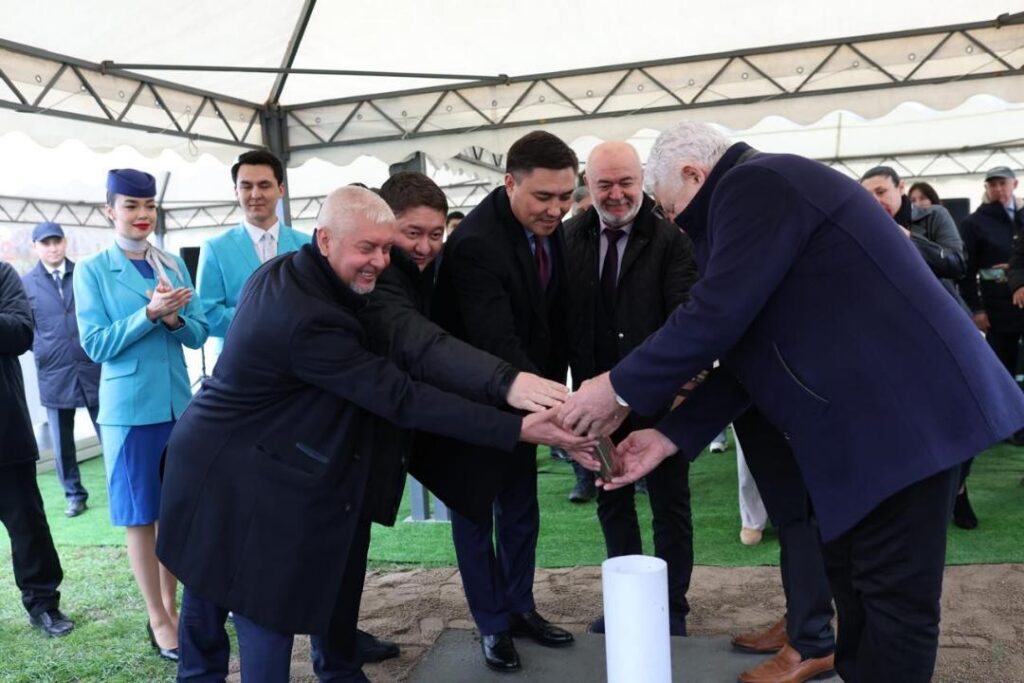
Kazakhstan’s SCAT Airlines, in partnership with Boeing, has begun construction of a new maintenance, repair, and overhaul (MRO) center in Shymkent. The facility is expected to become the largest aircraft maintenance complex in Kazakhstan and across Central Asia. The capsule-laying ceremony, held on February 27, was attended by Shymkent Mayor Gabit Syzdykbekov, Deputy Transport Minister Talgat Lastayev, and Boeing Vice President of Sales and Marketing for Eurasia, India, and South Asia Paul Righi. According to the Ministry of Transport, the center will specialize in servicing Boeing aircraft, including the Boeing 737 (Classic, NG, and MAX), Boeing 757 and 767 models, as well as the Boeing 777 widebody aircraft. The facility will occupy 10 hectares, with engineering and technical infrastructure covering 45,000 square meters. The aircraft parking area alone will span more than six hectares. The project is intended to establish a modern, internationally certified repair and maintenance base capable of servicing not only domestic carriers but also foreign airlines, thereby expanding Kazakhstan’s technical expertise and aviation services export potential. Kazakhstan’s civil aviation sector continues to demonstrate steady growth. According to the Ministry of Transport, in 2025 the country’s airports handled 31.8 million passengers, compared to 29.7 million in 2024. Cargo traffic reached 173,300 tons, up from 170,900 tons the previous year. Deputy Minister Talgat Lastayev stated that the growth in traffic has been accompanied by systematic efforts to strengthen safety oversight. Kazakhstan’s compliance with international aviation safety standards reached 95.7%, significantly exceeding global and regional averages and placing the country among the world’s top 20 performers in this category. Lastayev also noted that KazMunayGas-Aero LLP, a jet fuel supply subsidiary of the national oil and gas company KazMunayGas, has been granted direct access to airport infrastructure and has begun providing direct “into-plane” refueling services. This has reduced the average cost of jet fuel at Kazakh airports. According to the ministry, direct refueling without intermediaries has lowered jet fuel prices to below $1,000 per ton, compared to $1,200-$1,300 per ton in other countries. The new refueling mechanism was introduced on the instructions of the President of Kazakhstan to support the development of international air hubs by ensuring stable supplies of competitively priced aviation fuel. Officials say it is expected to improve the reliability of fuel supply for airlines and reinforce the country’s role as a key transit hub.

Tajikistan and the U.S. Sign Agreements Worth Over $3.2 Billion

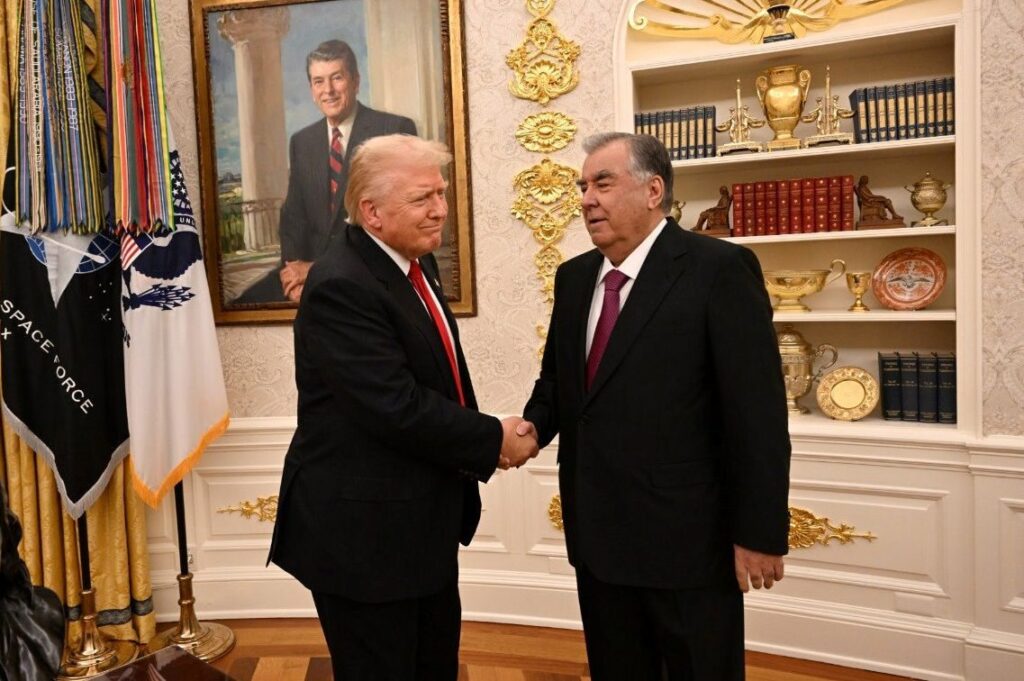
On the sidelines of the second Central Asia-U.S. Summit (C5+1) held in Washington, Tajikistan signed a series of agreements with American companies totaling more than $3.2 billion. The deals span the aviation, digital technology, artificial intelligence, energy, and manufacturing sectors. Landmark Agreement with Boeing The largest deal involves Tajik airline Somon Air, which plans to purchase 14 Boeing aircraft and aviation systems valued at $3.2 billion. The U.S. State Department described the agreement as a milestone that will “strengthen confidence in American aerospace technology” and noted it as the most significant aviation contract ever signed between the two countries. The second largest agreement was concluded with U.S. based Transparent Earth. The $32.5 million deal includes remote sensing technologies and technical assistance to improve efficiency in Tajikistan’s mining and agricultural sectors. In the digital sphere, Tajikistan reached an agreement with Starlink to expand satellite internet access. The initiative aims to enhance connectivity in the country’s remote mountainous. regions, facilitating digital inclusion and expanding online services. Artificial Intelligence, Infrastructure, and Industry A separate set of agreements focuses on artificial intelligence. U.S. tech firm Perplexity AI and Tajik startup zypl.ai signed a landmark agreement to develop the world’s first AI-based agent browser tailored for government use. According to the developers, this innovation is designed to boost the efficiency of public administration and solidify Tajikistan’s emerging role in digital governance. Additionally, SuperMicro, Cerebris, and zypl.ai will collaborate on the development of AI-powered data centers. To support this infrastructure, Tajikistan plans to build 1 GW of hydroelectric capacity, laying the groundwork for the country to evolve into a regional IT hub. In the manufacturing sector, Coca-Cola will invest $9 million in expanding its Dushanbe plant, boosting production and strengthening its market position in Tajikistan. According to the U.S. State Department, these agreements are expected to generate thousands of jobs and stimulate “billions of dollars in U.S. exports.” A New Chapter in Tajik-U.S. Relations On November 6, President Emomali Rahmon met with U.S. President Donald Trump in Washington. The two leaders discussed cooperation in critical minerals, digital technology, and aviation modernization, with a particular focus on boosting trade and investment. More than 70 U.S. affiliated companies are currently operating in Tajikistan. The summit also featured a C5+1 business conference, during which Tajikistan showcased its investment projects and export potential to an international audience. Following the forum, President Trump described the gathering as the start of “a wonderful new relationship between the United States and the countries of Central Asia,” and reiterated the strategic importance of the region, stating the U.S. is ready to “actively engage in Eurasia”.

Mirziyoyev Secures Spotlight During U.S. Visit

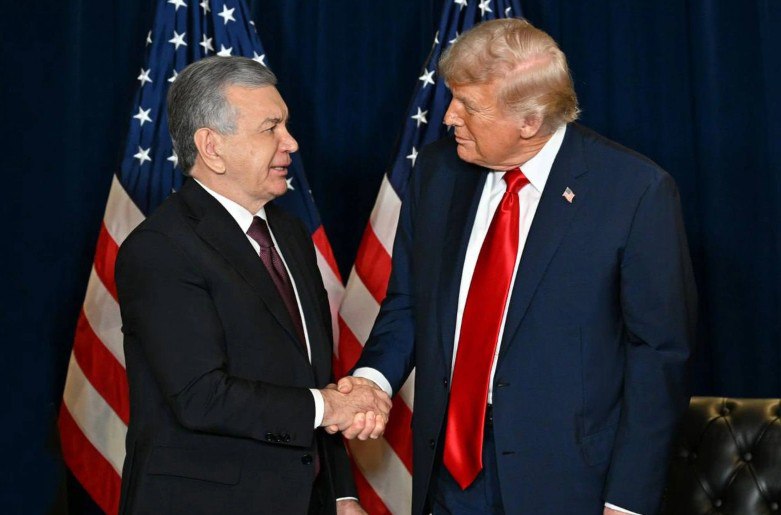
In a significant diplomatic breakthrough, Uzbekistan emerged as a standout player during this year’s United Nations General Assembly events in New York. President Shavkat Mirziyoyev not only secured a high-profile meeting with U.S. President Donald Trump, but also signed a landmark $8 billion deal with Boeing to purchase Dreamliner jets, a move that drew praise from Trump and captured the attention of the international business community. Trump publicly endorsed the agreement on social media, calling Mirziyoyev “a man of his word” and noting the deal would create “over 35,000 jobs” in the United States. Mirziyoyev’s visit included a high-level investment roundtable with executives from leading U.S. corporations and financial institutions. According to Forbes, trade between the two countries has quadrupled under Mirziyoyev’s leadership, with more than 300 American companies now active in Uzbekistan. Strategic sectors such as rare-earth metals and critical minerals took center stage during the discussions. Among the key meetings was one with the vice president of the Colorado School of Mines, who expressed support for establishing a research center in Uzbekistan. Other topics included joint initiatives in banking, information technology, transportation, and energy infrastructure. The scale of the Boeing deal served as a symbolic anchor to broader efforts: positioning Uzbekistan as a key connector between Central Asia and the Western economy. This aligns with a larger strategic pivot that analysts have long advocated. As U.S. engagement in Central Asia expands, countries like Uzbekistan are increasingly looking to diversify away from dependence on Russia and China. Forbes noted that the Trump administration is building on foundations laid by its predecessor by promoting regional initiatives such as the Zangezur Corridor, referred to as the “Trump Corridor”, aimed at linking Central Asia to global markets without passing through Russian territory. Mirziyoyev’s face-to-face meeting with Trump, followed by the public endorsement, also plays into shifting domestic narratives. It signals growing diplomatic credibility and a willingness to operate as an equal on the global stage. The convergence of political recognition and commercial investment may mark a turning point in Uzbekistan’s foreign policy, not just as a recipient of aid, but as a proactive economic actor. With the Boeing order and growing support from U.S. business leaders, Uzbekistan is staking its future on deepening ties with the West. Coupled with ongoing domestic reforms, the country is making a strategic bet that modernization and diversified partnerships will yield long-term dividends.