Middle Corridor Debate Shifts From Geopolitics to Commercial Viability
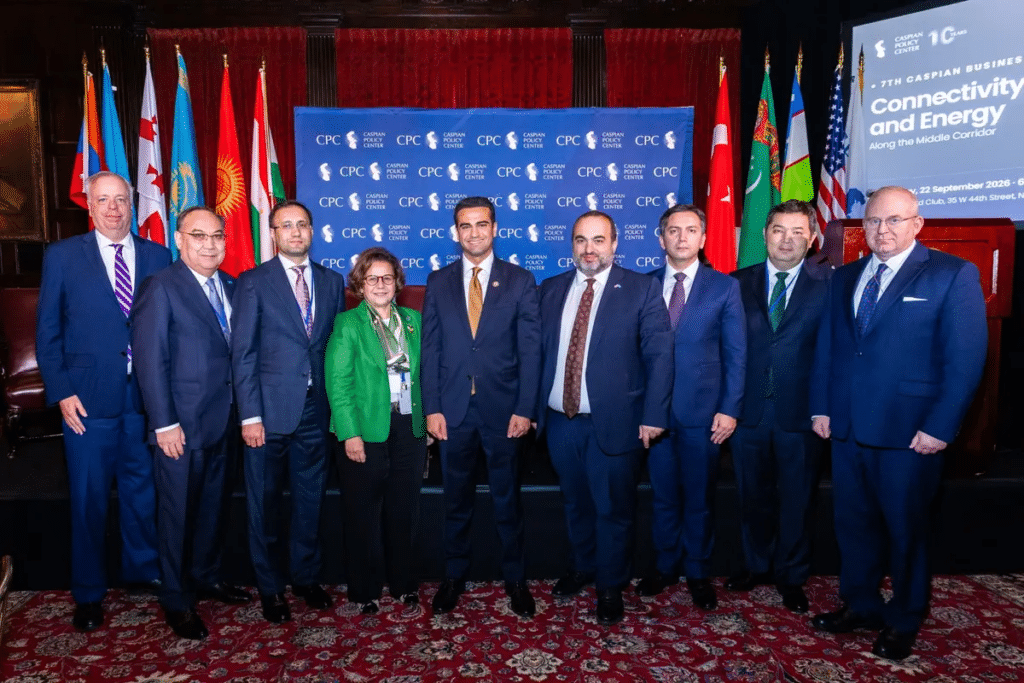
For several years, interest in the Middle Corridor has risen sharply amid the war in Ukraine, tensions around Iran, sanctions, instability on maritime routes, and governments’ efforts to diversify supply chains. The route runs through Central Asia, the Caspian Sea, and the South Caucasus. The way the issue is framed is now changing. The debate over whether this route is needed is moving into the background. A more important question is whether the Middle Corridor can develop from a politically attractive alternative into a sustainable transport and economic system that businesses will use not because of geopolitical circumstances, but because it is competitive. In this context, the 7th Caspian Business Forum, held in New York on September 22 and organized by the Caspian Policy Center (CPC), provided a useful snapshot of this shift. Representatives of the United States, Kazakhstan, Kyrgyzstan, Azerbaijan, Georgia, Turkey, and major businesses took part. The discussions focused on the Middle Corridor, the Trump Route for International Peace and Prosperity (TRIPP), energy, critical minerals, and attracting private capital. Freight volumes on the Trans-Caspian International Transport Route rose from 0.8 million tons to 4.5 million tons in the seven years to 2025, according to Kazakhstan’s Ministry of Transport. The route carried about 77,000 twenty-foot equivalent units of containerized cargo in 2025, and Kazakhstan aims to raise that total to 300,000 by 2029. These volumes are substantial, but they show the limits of the Middle Corridor’s current capacity. It has not yet become a replacement for all traditional overland routes between China and Europe. The World Bank has noted that the Middle Corridor is more than a transit bridge between China and the European Union (EU). Growth in trade among the countries along the route, as well as their trade with Europe, could be equally important. With the necessary investment and organizational reforms, it estimates, trade flows could triple and transport times could roughly halve by 2030. The route passes through several countries, crosses the Caspian Sea, requires transfers between different modes of transport, and depends on coordination among railway operators, ports, customs services, and tariff policies. A study of transport connectivity between Europe and Central Asia by the European Bank for Reconstruction and Development, at the request of the European Commission, identified 33 priority investment needs in physical infrastructure and seven soft-connectivity measures, ranging from the digitalization of transport documents to the harmonization of tariffs, customs, and border procedures. The CPC forum addressed these issues as well. CPC President Efgan Nifti put it this way: “For the Corridor to reach its full potential, it must increasingly function as one integrated system – with harmonized border procedures, coordinated ports and railways, and digitalized documentation.” Kazakhstan’s position reflects this approach. The country’s presidential representative for negotiations with the United States, Erzhan Kazykhan, called the Middle Corridor a “strategic investment in the future” connecting Kazakhstan with the South Caucasus, Turkey, and Europe. He said Astana views TRIPP as a logical extension of the system that could shorten the route to European markets...