The falling level of the Caspian Sea is becoming an economic problem for the Trans-Caspian International Transport Route (TITR), or Middle Corridor. Kazakhstan and other countries in the region are expanding ports and counting on growing freight traffic between China and Europe, but shallower waters are already forcing vessels to reduce their loads and ports to spend tens of millions of dollars on dredging and berth reconstruction.
The scale of the problem was illustrated on September 8 by Alakbar Azizli, Director of Sustainability and Emissions Management at Azerbaijan Caspian Shipping Company (ASCO). Speaking at Baku Climate Action Week, he said one of the company’s ferries can now carry only 80% of a full cargo load from Kazakhstan.
“This means 20% less cargo is transported,” Azizli said. According to him, vessels face similar restrictions in Kazakhstan, Turkmenistan, and Azerbaijan’s Port of Alat.
For now, the necessary depths are being maintained through dredging. But there are limits to how much dredging can be done around berths without risking damage to the structures. If the sea continues to retreat, Azizli said ports may eventually have to extend their berths so vessels can reach them at lower water levels.
Vessels Are Losing Part of Their Cargo Capacity
The Caspian is one of the most complex sections of the Middle Corridor. Freight from China travels by rail through Kazakhstan, is transferred to vessels at Aktau or Kuryk, crosses the sea to Azerbaijan, and is then transferred back onto rail.
Every transfer adds cost and time. Falling sea levels introduce an additional restriction: vessel draft, or how deep a loaded vessel sits in the water.
According to the Caspian Policy Center, some vessels on the Caspian can now be loaded to only 75–80% of capacity. At Aktau, re-berthing a grain vessel can cost around $2,200, while annual dredging expenses have been estimated at roughly $880,000.
A 20% reduction in cargo load means more voyages are needed to move the same volume of goods. Fuel, crew, and port-handling costs increase, while the effective capacity of the fleet declines.
The problem is emerging just as traffic along the corridor is expanding rapidly. Since Russia’s invasion of Ukraine, the Middle Corridor has gained additional importance as a China-Europe route that bypasses Russia. Freight volumes on the TITR increased from less than 1 million tons annually at the beginning of the decade to more than 4.5 million tons in 2024. Kazakhstan plans to raise the corridor’s capacity to 10 million tons a year by 2028. In the first five months of 2026, container traffic between China and Europe along the route increased by another 30%.
Growing freight volumes require new terminals, rail capacity, and vessels. At the same time, part of the investment has to be diverted simply to maintain existing fleet access to ports.
Aktau and Kuryk Deepen Their Waters
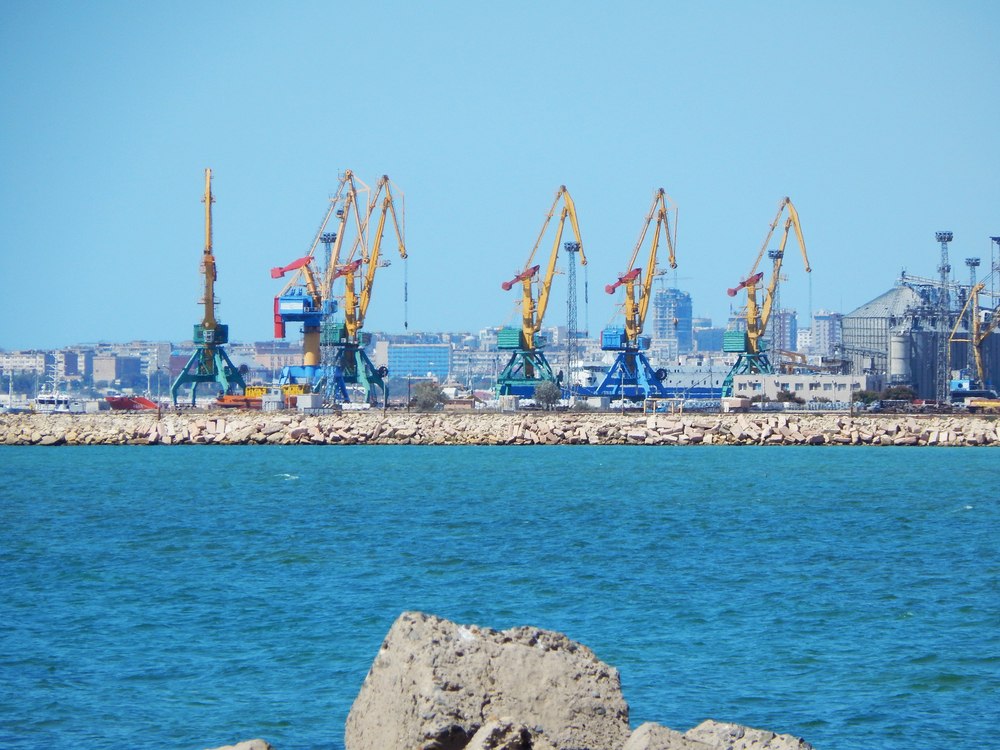
Large-scale dredging has already been completed at Kuryk. More than 1.7 million cubic meters of soil were removed from the port waters, turning basin, and access channel, increasing the operational depth to 8.5 meters.
According to the OECD, before the work was carried out, falling Caspian levels prevented vessels from being fully loaded, reducing transport efficiency and increasing costs. Dredging restored the port’s ability to load vessels to full capacity.
Kazakhstan’s infrastructure plan puts the cost of the Kuryk dredging project at approximately $56.8 million.
Similar work is now underway at Aktau. Around $39.8 million has been allocated for dredging the port waters. Another approximately $65.2 million is planned for the reconstruction of Berth No. 12 and extension of Berth No. 3. Separate dredging work is also planned at the Port of Bautino, at a cost of around $17.6 million.
Not all of these costs can be attributed to the shrinking Caspian. Kazakhstan is simultaneously modernizing its ports to accommodate rising freight volumes. But falling water levels are directly driving part of the work.
Once the current dredging project at Aktau is completed, the port is expected to accommodate vessel drafts of 6–7 meters, allowing ships to be fully loaded. The project is scheduled for completion by the end of 2026.
Dredging at Kuryk and Aktau alone is valued at approximately $96.6 million. Including the Aktau berth reconstruction and planned dredging at Bautino, the projects listed above total roughly $179 million. This is not the total cost of the Caspian’s falling water level, but it illustrates the scale of capital works required on Kazakhstan’s coast as the Middle Corridor expands.
The Sea Continues to Retreat
Dredging restores the depths ports need, but it is taking place as the Caspian continues to shrink.
Over the past five years, the Caspian Sea’s water level has fallen by more than half a meter. The changes are particularly visible in the shallow northeastern section. In one monitored area of the northeastern Caspian, water coverage declined from 15,194 square kilometers in 2001 to 8,183 square kilometers by the end of 2024, while the shoreline retreated by about 56 kilometers.
The OECD identifies further declines in the Caspian Sea level as a long-term risk to the competitiveness of the Trans-Caspian route. Under a moderate-emissions scenario, ports will require additional rounds of dredging and adaptations to berths. Under a high-emissions scenario, a more severe retreat could require new berthing infrastructure or the relocation of some port facilities.
Constraints are emerging on both sides of the Caspian. Increasing capacity at Aktau and Kuryk will not solve the problem entirely if vessels remain restricted by draft at Alat or other ports.
For international shippers, this means additional costs on a route where cargo already has to be transferred several times between rail and maritime transport.
When New Capacity Has to Replace Lost Capacity
Kazakhstan, Azerbaijan, Georgia, and Türkiye are investing in terminals, railways, port capacity, and digitalization to increase the capacity of the Middle Corridor. Kazakhstan’s ports are expected to become key hubs in that expansion.
But nominal port capacity and the actual volume of freight that can be moved increasingly depend on the depth of the sea. A new terminal may be able to handle more containers, but a ferry constrained by draft can carry only part of its designed load.
Kuryk demonstrates that engineering solutions can, at least for now, compensate for the falling water level. After more than 1.7 million cubic meters of material was removed, vessels were once again able to load to full capacity. Aktau is seeking a similar result.
How much it will cost to maintain those depths in the future will depend on how far the Caspian continues to fall. If the current trend persists, further dredging, berth adaptations, or shallower-draft vessels will be required.