• KGS/USD = 0.01143 -0%
  • KZT/USD = 0.00198 -0%
  • TJS/USD = 0.10899 0.93%
  • UZS/USD = 0.00008 0%
  • TMT/USD = 0.28490 -0.28%
  • KGS/USD = 0.01143 -0%
  • KZT/USD = 0.00198 -0%
  • TJS/USD = 0.10899 0.93%
  • UZS/USD = 0.00008 0%
  • TMT/USD = 0.28490 -0.28%
  • KGS/USD = 0.01143 -0%
  • KZT/USD = 0.00198 -0%
  • TJS/USD = 0.10899 0.93%
  • UZS/USD = 0.00008 0%
  • TMT/USD = 0.28490 -0.28%
  • KGS/USD = 0.01143 -0%
  • KZT/USD = 0.00198 -0%
  • TJS/USD = 0.10899 0.93%
  • UZS/USD = 0.00008 0%
  • TMT/USD = 0.28490 -0.28%
  • KGS/USD = 0.01143 -0%
  • KZT/USD = 0.00198 -0%
  • TJS/USD = 0.10899 0.93%
  • UZS/USD = 0.00008 0%
  • TMT/USD = 0.28490 -0.28%
  • KGS/USD = 0.01143 -0%
  • KZT/USD = 0.00198 -0%
  • TJS/USD = 0.10899 0.93%
  • UZS/USD = 0.00008 0%
  • TMT/USD = 0.28490 -0.28%
  • KGS/USD = 0.01143 -0%
  • KZT/USD = 0.00198 -0%
  • TJS/USD = 0.10899 0.93%
  • UZS/USD = 0.00008 0%
  • TMT/USD = 0.28490 -0.28%
  • KGS/USD = 0.01143 -0%
  • KZT/USD = 0.00198 -0%
  • TJS/USD = 0.10899 0.93%
  • UZS/USD = 0.00008 0%
  • TMT/USD = 0.28490 -0.28%
07 December 2025

Viewing results 1 - 6 of 12

Central Asian Leaders Welcome Azerbaijan’s Accession at Tashkent Summit

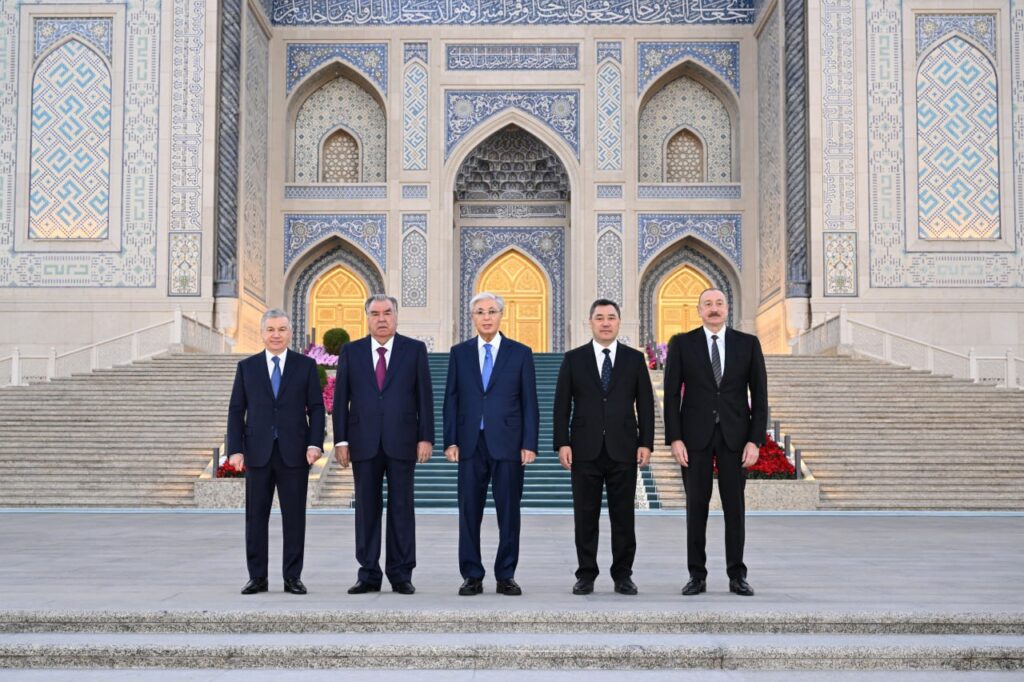
The leaders of Central Asia convened in Tashkent on November 16 for a high-level Consultative Meeting, marking a significant step toward deeper regional integration. The summit welcomed Azerbaijan as a full participant and endorsed a roadmap to formalize cooperation in trade, infrastructure, security, and water management. Hosted by Uzbekistan’s President Shavkat Mirziyoyev, the summit brought together the presidents of Kazakhstan, Kyrgyzstan, Tajikistan, Turkmenistan, and Azerbaijan, alongside a United Nations representative. Ahead of the meeting, Tashkent’s central streets were adorned with national flags and floral installations, underscoring the political and symbolic significance the Uzbek government placed on the event. Mirziyoyev hailed Azerbaijan’s accession as “a truly historic day,” as the country became a full member of the Consultative Meeting of the Heads of State of Central Asia. He proposed forming a “Community of Central Asia,” establishing a rotating Secretariat, appointing special presidential envoys for coordination, and creating a Council of Elders to promote cultural and humanitarian dialogue. [caption id="attachment_39410" align="aligncenter" width="1280"] Image: president.uz[/caption] Regional Economic and Connectivity Agenda Economic cooperation dominated the multilateral agenda. Leaders agreed to develop a Comprehensive Regional Program for Trade and Economic Cooperation through 2035 and to draft a Declaration on a Common Investment Space. “In essence, we will build a strong bridge between Central Asia and the South Caucasus and pave the way for the formation of a single space of cooperation, which will undoubtedly strengthen the strategic interconnectedness and stability of both regions,” said Mirziyoyev. Kazakhstan’s President Kassym-Jomart Tokayev also highlighted deepening bilateral ties with Uzbekistan. Trade between the two countries has reached $4 billion in 2025, with plans to increase it to $10 billion through expanded industrial cooperation and import substitution. Over 6,500 joint enterprises now operate between the two countries, with new projects worth more than $8 billion under development. Several initiatives, such as the Silkway Central Asia logistics center, new industrial facilities, and cultural programs, were launched in Tashkent during the visit. [caption id="attachment_39411" align="aligncenter" width="1280"] Image: president.uz[/caption] Tajikistan’s President Emomali Rahmon met with Mirziyoyev on the sidelines of the summit. The two leaders noted the steady growth in political dialogue and agreed to expand cooperation in energy, industry, agriculture, and innovation. Bilateral trade surpassed $440 million in the first nine months of 2025. They also discussed regional security, including collaboration against terrorism, extremism, cybercrime, and drug trafficking. Security, Water, and Cultural Cooperation To advance regional integration, Tashkent also hosted the first meeting of the Council of Ministers of Trade and Investment of Central Asian countries and Azerbaijan on November 13. Ministers discussed boosting trade, investment, and industrial cooperation, with the goal of increasing regional trade turnover to $20 billion. Plans were also made to develop joint production platforms under a “Made in Central Asia” label. Uzbekistan’s trade with Central Asian partners rose from $3.2 billion in 2017 to $6.9 billion in 2024, while trade with Azerbaijan has grown by 13% this year. Connectivity remained a focal point. Participants reaffirmed their commitment to the China-Kyrgyzstan-Uzbekistan railway and the Trans-Afghan corridor. Azerbaijan’s President...

Central Asia and Regional Integration: Logistics, Water, Energy

Central Asia is undergoing a profound transformation, where questions of domestic development and the region’s ability to act in a coordinated way are coming to the forefront. For many years, Central Asian states were viewed as fragmented, each pursuing separate strategies that often put them in competition. Today, however, shared challenges and growing interdependence are making gradual convergence increasingly likely. The region now confronts common pressures such as water scarcity, energy imbalances, environmental degradation, and the fallout of instability in Afghanistan -- issues that no single country can effectively address in isolation. Increasingly, regional platforms such as the Interstate Commission for Water Coordination (ICWC) are being leveraged to mediate water-energy tradeoffs, while joint initiatives in transport, transit, and energy infrastructure foster new integration. Moreover, leading actors like Kazakhstan and Uzbekistan are pushing coordinated strategies -- modernizing rail and aviation links, coordinating transboundary water allocations, and exploring nuclear cooperation -- that point toward a more interconnected regional future. Shared Challenges and Points of Convergence The region faces problems that no country can solve alone. These include water shortages, energy imbalances, environmental risks, and instability in Afghanistan. Such challenges can be seen as both threats and opportunities, since they also represent areas of overlapping interest. Joint action in these fields can deliver more than fragmented national strategies. Water is particularly important, remaining one of the most sensitive issues in interstate relations. Yet it also offers opportunities for coordinated action through existing regional platforms, such as the Interstate Commission for Water Coordination of Central Asia. The “water for energy” model is increasingly seen as a practical tool, already under discussion and applied in bilateral and multilateral projects. Environmental issues are similarly shared. The disappearance of the Aral Sea, land degradation, air pollution, and glacier melt create threats that transcend national borders. Joint monitoring, data exchange, and coordinated adaptation measures, particularly within the United Nations Regional Centre for the Sustainable Development Goals for Central Asia and Afghanistan, opened in August 2025 in Almaty, could become a new direction for regional cooperation. Afghanistan remains another risk factor that affects the security of the entire region. At the same time, transportation and energy projects linking Central Asia with South Asia through Afghan territory can turn a challenge into an opportunity. Reducing instability and integrating Afghanistan into regional trade and transit networks serves the interests of all Central Asian states. Kazakhstan and Uzbekistan as leading forces To understand how closer integration might work in practice, it is useful to examine the strategies of the region’s two key players: Astana and Tashkent. The major agreements concluded by Kazakhstan and Uzbekistan with the United States in transport and aviation should be viewed not as isolated deals, but as evidence of the complementary strengths of the two largest economies in Central Asia. Kazakhstan signed its largest locomotive contract to date with U.S. company Wabtec, a $4.2 billion agreement for 300 TE33A freight locomotives to be assembled at the Wabtec Kazakhstan plant in Astana, along with servicing support. This will modernize...

Japarov and Tokayev’s High-Level Reshuffles Usher in a New Political Season

Kyrgyzstan and Kazakhstan recently witnessed high-level political developments that drew attention beyond their borders. In Kyrgyzstan, the national parliament self-dissolved, while Kazakhstan underwent a series of administrative reshuffles. Though both events were driven by reform-oriented policies, observers have offered sharply contrasting interpretations. In Kyrgyzstan, the initiative to dissolve the Jogorku Kenesh (parliament) was led by a group of 32 deputies headed by Speaker Nurlanbek Turgunbek uulu. They cited logistical and financial concerns over the proximity of the next parliamentary and presidential elections, scheduled for November 2026 and January 2027, respectively. Holding two major elections in such a short span, they argued, would pose political and economic challenges. As a result, early parliamentary elections will now take place on November 30, under revised electoral rules. The new system divides the country into 30 constituencies, each electing three deputies. Political parties may nominate only one candidate per district, and the overall number of deputies will remain at 90. However, the majority of seats are now expected to go to independents, reducing the dominance of political parties in the electoral process. Some Kazakh observers, long accustomed to viewing Kyrgyzstan as a “democratic island” in the region, interpreted these changes as a move toward greater political openness. Former diplomat and public figure Kazbek Beysembayev contrasted Kyrgyzstan’s reforms with Kazakhstan’s political trajectory, where authorities are reportedly planning to eliminate single-mandate districts in favor of a fully party-based electoral system. He warned this would further consolidate the ruling party’s dominance. “Such a move might be acceptable if laws on political party registration had first been liberalized. But that hasn’t happened,” Beysembayev argued. However, not all analysts share this optimistic view. Central Asia expert Arkady Dubnov sees the Kyrgyz move as a calculated maneuver by the ruling elite. He argues that a political duumvirate, composed of President Sadyr Japarov and State Committee for National Security (SCNS) chief Kamchybek Tashiev, has increasingly consolidated control. According to Dubnov, the early elections are designed to cement this grip on power. “By extending the gap between the parliamentary and presidential elections to 14 months, the authorities are creating space for a politically engineered campaign,” Dubnov explained. “This may pave the way for General Tashiev’s eventual rise to the presidency. His image as the real power broker, from resolving the border conflict with Tajikistan to renaming his hometown Jalal-Abad to Manas, has been solidified. President Japarov would likely retain influence within a reconfigured leadership structure.” In Kazakhstan, meanwhile, administrative reshuffles have continued, drawing significant attention, particularly the replacement of Foreign Minister Murat Nurtleu with seasoned diplomat Yermek Kosherbayev. The change followed speculation in early September that Nurtleu had been detained by the National Security Committee, a claim that proved false but nevertheless added intrigue to his removal from the Foreign Ministry. He has since been appointed presidential aide for international investment and trade cooperation. Political analyst Daniyar Ashimbayev acknowledged that this role is technically a demotion but argued it still reflects political trust. “Tokayev doesn’t typically reappoint officials who have committed serious...

From Reform to Deals: Central Asia Steps Onto the Global Stage at UNGA-80

Ecology, global instability, and the need for UN reform dominated the speeches of all five Central Asian presidents at the 80th session of the UN General Assembly. Presenting a united front while emphasizing national priorities, the leaders made clear that Central Asia intends to play a pivotal role in shaping the global future. UN Reform Kazakh President Kassym-Jomart Tokayev was the first among the CIS leaders to address the assembly, speaking of a growing crisis of trust in multilateral institutions and calling for sweeping reforms. Tokayev emphasized the need to expand the UN Security Council, arguing that major powers from Asia, Africa, and Latin America must receive rotational representation, and that the influence of middle powers should be strengthened. “We need to create a new group of like-minded states that will professionally and decisively advance concrete proposals for reforming the UN so that it better responds to today’s challenges and tomorrow’s tasks,” he said, proposing Kazakhstan as a platform for these discussions. Uzbek President Shavkat Mirziyoyev echoed these concerns, highlighting the weakening of international institutions and the proliferation of global conflicts. He endorsed UN Secretary-General António Guterres’ UN-80 initiative and voiced support for the Pact for the Future, which sets out commitments to strengthen multilateral cooperation and address global challenges through 2045, the UN’s centenary. Mirziyoyev also advocated for an expanded Security Council to better represent developing countries. In his address, Kyrgyz President Sadyr Japarov called for a more just and representative Security Council, underscoring Africa’s right to greater participation. He also announced Kyrgyzstan’s candidacy for a non-permanent seat on the Security Council for 2027-2028, noting that his country has never before held such a position. Tajik President Emomali Rahmon warned of growing instability, uncertainty, and complexity in world affairs. Rahmon stressed the UN’s role as a platform for dialogue and cooperation and called for equal partnerships between large and small states to restore adherence to international law. Turkmen President Serdar Berdimuhamedov argued that the current global situation requires a "decisive shift toward coordinated interaction among states and international organizations to maintain peace and security.” He proposed declaring 2028 the Year of International Law to strengthen the legal foundations of global cooperation. Ecology and Finance On environmental issues, the Central Asian leaders focused on national and regional concerns. Tokayev addressed the ongoing shallowing of the Caspian Sea, while both he and Mirziyoyev raised the issue of the Aral Sea crisis, often described as "one of the world’s worst environmental disasters." Rahmon highlighted the rapid disappearance of glaciers, a point supported by Japarov, given the critical dependence of Kyrgyzstan and Tajikistan on mountain water resources. Berdimuhamedov, meanwhile, proposed establishing a regional center for combating desertification in Central Asia. Other initiatives included the proposed Caspian Environmental Forum in 2026 and continued advancement of the Caspian Environmental Initiative, originally introduced by Ashgabat. Financial concerns were also prominent. Rahmon called for reforms to international financial mechanisms, citing the continued suffering of vulnerable developing countries from the impacts of economic crises, poverty, disease, natural disasters,...

After Berdimuhamedov Sr.’s Visit, Azerbaijan to Gift Oil Tanker to Turkmenistan

On the sidelines of an investment forum in the Turkmen resort of Awaza, Azerbaijan’s Deputy Minister of Economy, Sahib Alekperov, announced that Baku will gift an 8,000-ton oil tanker to Turkmenistan. The gesture is intended as a symbol of goodwill and a marker of deepening relations between the two Caspian neighbors. From Symbolism to Infrastructure According to Alekperov, the tanker project is expected to be completed by the end of this year or early next. He emphasized that bilateral ties are increasingly rooted in practical cooperation. In August, Azerbaijan and Turkmenistan signed a memorandum to expand international air services, aiming to establish a reliable “air bridge” across the Caspian Sea. “This route will be in high demand among passengers,” said Alekperov, noting that better connectivity will benefit not only Azerbaijan and Turkmenistan but the broader Caspian region. Drawing a historical parallel, he added, “As it was once said that all roads lead to Rome, we can now claim that all roads lead through Turkmenistan, the shortest path between Europe and Asia.” He also noted that growing transport cooperation will enhance the investment climate and produce tangible outcomes, especially in light of the warm political ties at the highest level. Broadening Turkmen-Azerbaijani Cooperation The goodwill gestures extend beyond the tanker handover. On September 12, Turkmenistan announced plans to construct a mosque in the Azerbaijani city of Fuzuli. The Ministry of Construction and Architecture has since opened a tender for the project. Political dialogue has also intensified in recent months. In July, Gurbanguly Berdimuhamedov, Chairman of Turkmenistan’s Halk Maslahaty, paid an official visit to Azerbaijan, accompanied by his daughter Oguljahan Atabaeva, Vice President of the charitable foundation bearing his name. During meetings with Azerbaijan's President Ilham Aliyev, both sides discussed expanding transport and infrastructure cooperation, as well as boosting bilateral trade. Humanitarian collaboration was also a key topic. Atabaeva met with Leyla Aliyeva, Vice President of the Heydar Aliyev Foundation. At the conclusion of the visit, Berdimuhamedov delivered an official invitation from his son, President Serdar Berdimuhamedov, for Aliyev to visit Turkmenistan. In a statement, Aliyev’s office reaffirmed the strategic nature of the partnership: “Our nations are united by deep traditions of brotherhood, and these ties have grown even stronger during the years of independence. We are successfully cooperating in many areas,” said the Azerbaijani president.

Breaking Old Ties: Central Asia’s Delicate Dance Between Russia and the West

Central Asian countries are increasingly asserting their independence in foreign policy, distancing themselves from traditional centers of global influence. Recent developments highlight a nuanced balancing act as states in the region navigate growing tensions between Russia and the West. Kyrgyzstan Pushes Back In Kyrgyzstan, the recent arrest of Natalya Sekerina, an employee of the Russian House in Osh, marked a notable assertion of sovereignty. Sekerina was detained under Part 1 of Article 416 of the Criminal Code of the Kyrgyz Republic, which pertains to the recruitment, financing, and training of mercenaries for armed conflict or attempts to overthrow state authority. Earlier, Sergei Lapushkin, an employee of Osh city hall, and two others were also detained in connection with the case.  All suspects were later placed under house arrest. Nevertheless, the arrests are seen by observers as a clear signal that Kyrgyzstan is not simply aligning with Russian policy, despite its economic dependence on Moscow, particularly due to labor migration. The move was reportedly a response to the April 17 detention of over 50 Kyrgyz nationals in a Moscow bathhouse, where Russian security forces allegedly used excessive force. The Kyrgyz Ministry of Foreign Affairs issued a formal note of protest. Russia later stated that the detainees were in the country illegally and some were suspected of links to radical groups.  At the same time, Kyrgyzstan is scrutinizing Western influence as well. In February, U.S. President Donald Trump announced funding cuts and a wind-down of the U.S. Agency for International Development (USAID). The announcement triggered debate in Kyrgyzstan, where some voices argued that while USAID had supported civil society, it also fostered instability and economic dependency. Critics claim the agency promoted Western values and helped establish a network of NGOs that played outsized roles in the country’s politics.  Kazakhstan and Uzbekistan Seek Equilibrium In Kazakhstan, USAID also came under fire. Parliamentary Deputy Magherram Magherramov criticized the agency for promoting what he described as values alien to Kazakh society, referencing controversial events such as women’s rights marches and LGBTQ+ parades in Almaty. He called for a formal review of foreign-funded NGOs.  Meanwhile, Uzbekistan witnessed a diplomatic rift during an April visit by Russian Foreign Minister Sergey Lavrov to the “Grieving Mother” memorial in Samarkand. Lavrov commented on the absence of a Russian-language inscription, provoking widespread backlash on Uzbek social media. Sherzodkhon Kudratkhodzha, rector of the University of Journalism and Mass Communications, responded sharply: “We are not their colony.” He also cited ongoing discrimination against Uzbek migrants in Russia, which, he argued, has been met with silence from Russian officials.  A More Independent Foreign Policy Central Asian nations are increasingly holding intra-regional and international meetings, often excluding Russia. On April 25, intelligence chiefs from the region gathered in Tashkent to coordinate on regional security threats.  The following day, a meeting of foreign ministers from Central Asia and China took place in Almaty. It was attended by Kazakh Foreign Minister Murat Nurtleu, Chinese Foreign Minister Wang Yi, and counterparts from Kyrgyzstan, Tajikistan, Uzbekistan, and a...