
• KZT/USD = 0.00227
  • TJS/USD = 0.10820
  • UZS/USD = 0.00009
  • TMT/USD = 0.29850
  • KZT/USD = 0.00227
  • TJS/USD = 0.10820
  • UZS/USD = 0.00009
  • TMT/USD = 0.29850
  • KZT/USD = 0.00227
  • TJS/USD = 0.10820
  • UZS/USD = 0.00009
  • TMT/USD = 0.29850
  • KZT/USD = 0.00227
  • TJS/USD = 0.10820
  • UZS/USD = 0.00009
  • TMT/USD = 0.29850
  • KZT/USD = 0.00227
  • TJS/USD = 0.10820
  • UZS/USD = 0.00009
  • TMT/USD = 0.29850
  • KZT/USD = 0.00227
  • TJS/USD = 0.10820
  • UZS/USD = 0.00009
  • TMT/USD = 0.29850
  • KZT/USD = 0.00227
  • TJS/USD = 0.10820
  • UZS/USD = 0.00009
  • TMT/USD = 0.29850
  • KZT/USD = 0.00227
  • TJS/USD = 0.10820
  • UZS/USD = 0.00009
  • TMT/USD = 0.29850
29 September 2026

Viewing results 1 - 6 of 2

Opinion: Weaponizing Faith – The Cold War Roots of Central Asia’s Security Dilemma

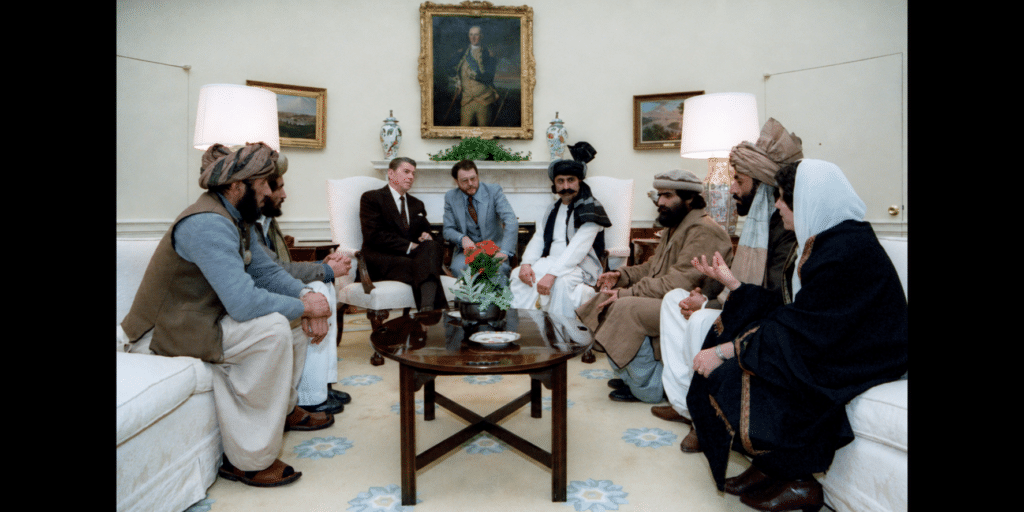
Central Asia’s contemporary security dilemma is partly rooted in Cold War strategies that transformed Muslim identity into a factor of geopolitical competition. Washington viewed Soviet Central Asia’s Muslim populations as a potential pressure point against Moscow. The Soviet Union itself mobilized Central Asian Muslim personnel during its intervention in Afghanistan. These policies did not alone create later radical movements, but they contributed to a regional environment where existing grievances, ideological narratives, and transnational networks could be redirected and intensified. The origins of Washington’s interest in Soviet Muslim populations as a strategic factor emerged during the final years of the Cold War. In 1977, the Nationalities Working Group, an interagency task force within the National Security Council, was established to examine vulnerabilities among the Soviet Union’s non-Russian nationalities. Declassified U.S. records show that American officials studied ethnic, cultural, and religious identities as possible sources of pressure against Moscow. Following the Soviet invasion of Afghanistan in December 1979, this approach became part of Washington’s broader effort to weaken Soviet influence. Through Pakistan’s Inter-Services Intelligence (ISI), the United States provided assistance to Afghan resistance organizations, while Saudi Arabia contributed significant financial support. Pakistan’s military government under General Zia-ul-Haq favored Islamist factions among Afghan resistance groups, helping connect military assistance with religious mobilization against Soviet forces. During his visit to the Khyber Pass in early February 1980, U.S. National Security Adviser Zbigniew Brzezinski addressed Afghan resistance fighters, declaring: "That land over there is yours. You will go back to it one day because your cause is right and God is on your side." The remarks reflected how the anti-Soviet struggle was framed not only in geopolitical terms but also through religious language and symbolism. [caption id="attachment_56711" align="aligncenter" width="2560"] Soviet T-62 tank leaving Afghanistan; image: U.S. Department of Defense.[/caption] The Afghan conflict was also fought through education and information campaigns. Between 1986 and 1992, the U.S. Agency for International Development (USAID) funded an approximately $50 million educational program through the University of Nebraska–Omaha’s Center for Afghanistan Studies for Afghan refugees and schools. Research has shown that some textbooks incorporated violent imagery, references to weapons and combat, and themes glorifying holy war and the duty of martyrdom. Produced for wartime Afghanistan, these materials reflected, and arguably helped sustain, a militarized ideological environment. Islamic religious life in Central Asia had its own deeper roots. Despite Soviet restrictions, religious learning survived through underground hujra networks and unofficial scholarship. Figures such as Muhammadjon Hindustoniy-Rustamov, born in the Fergana Valley and later one of Soviet Central Asia’s most influential unofficial Islamic scholars, shaped generations of students even as Afghanistan became an arena of international rivalry during the 1980s. Moscow also used Central Asian Muslim identity for strategic purposes. The 154th Separate Spetsnaz Detachment, known as the “Muslim Battalion,” was composed largely of Uzbek, Tajik, and Turkmen soldiers from the Soviet Turkestan Military District. The unit participated in Operation Storm-333 in December 1979, the Soviet operation that killed Afghan President Hafizullah Amin and installed Babrak Karmal. The selection of Central Asian...


Baikonur: An Alternative Journey Into Space

The moon landing is imprinted on the Western collective psyche, but Baikonur is not. Like most children growing up in the U.S., I watched William Shatner on Star Trek, and when we think of space, we think of Neil Armstrong and NASA, not Kazakhstan. However, on April 12, 1961, the first man in space, Yuri Gagarin, took off from the Baikonur Cosmodrome in what is now Kazakhstan. Like WWII, however, space is the subject of parallel narratives, and the “Space Race” was an integral part of the Cold War.   Baikonur Is a Place of Firsts Baikonur is a place of firsts - the first artificial satellite, Sputnik 1, the first dog, Laika, the first higher living organisms to survive a journey to outer space, Belka and Strelka, the first man, Yuri Gagarin, and the first woman, Valentina Tereshkova, all took off from Baikonur. Originally constructed during the Cold War as a missile test site, the area was chosen for several reasons; it’s isolation from densely populated areas and proximity to the equator made it easier to launch rockets, and the flat landscape ensured radio signals would not be disrupted. The battle for control over space between the U.S. and the Soviet Union was both ideological and military in nature. Baikonur was baptized in Cold War misinformation tactics. Located thirty kilometers south of the launch facilities, the closest town was originally known as Tyuratam. In 1961, Soviet officials swapped its name with a town located some 350 kilometers away, “Baikonur,” to misdirect Western intelligence. A fake spaceport constructed from plywood was erected in the “real” Baikonur to deceive enemy spy planes. In the early 1960s, the Soviet Union's covert actions allowed it to advance its space program faster than the United States, which faced public and media scrutiny. While U.S. space missions were broadcast live, exposing any failings, the USSR could operate clandestinely, protecting its missile technology and maintaining a strategic edge. A key example is the R7 rocket used to launch Yuri Gagarin into space; the largest intercontinental ballistic missile of its time, its details were closely guarded. [caption id="attachment_21512" align="aligncenter" width="1622"] Fifty year commemorative stamp of the first woman in space, Kazakhstan, 2013[/caption]   “Space Race” Propaganda Another tool of Cold War propaganda was the flight of Valentina Tereshkova, the “First Lady of Space.” Prior to her journey to the stars in June 1963, Tereshkova had worked on an assembly line in a textiles factory. Her parachuting experience with a local paramilitary flying club proved crucial in her selection. In her three-day flight, the every-woman clocked up more space hours than all American astronauts up to that time combined. Tereshkova may have been a propaganda tool dispatched for Western audiences as proof of gender equality in the USSR, but it would be a nineteen year wait for the next female cosmonaut. In 2007, at the age of seventy, Tereshkova volunteered for a one-way mission to Mars. Having turned to politics as her primary concern following her spaceflight, in...