• KGS/USD = 0.01144 0%
  • KZT/USD = 0.00215 0%
  • TJS/USD = 0.10599 -0.28%
  • UZS/USD = 0.00008 0%
  • TMT/USD = 0.28571 0%
  • KGS/USD = 0.01144 0%
  • KZT/USD = 0.00215 0%
  • TJS/USD = 0.10599 -0.28%
  • UZS/USD = 0.00008 0%
  • TMT/USD = 0.28571 0%
  • KGS/USD = 0.01144 0%
  • KZT/USD = 0.00215 0%
  • TJS/USD = 0.10599 -0.28%
  • UZS/USD = 0.00008 0%
  • TMT/USD = 0.28571 0%
  • KGS/USD = 0.01144 0%
  • KZT/USD = 0.00215 0%
  • TJS/USD = 0.10599 -0.28%
  • UZS/USD = 0.00008 0%
  • TMT/USD = 0.28571 0%
  • KGS/USD = 0.01144 0%
  • KZT/USD = 0.00215 0%
  • TJS/USD = 0.10599 -0.28%
  • UZS/USD = 0.00008 0%
  • TMT/USD = 0.28571 0%
  • KGS/USD = 0.01144 0%
  • KZT/USD = 0.00215 0%
  • TJS/USD = 0.10599 -0.28%
  • UZS/USD = 0.00008 0%
  • TMT/USD = 0.28571 0%
  • KGS/USD = 0.01144 0%
  • KZT/USD = 0.00215 0%
  • TJS/USD = 0.10599 -0.28%
  • UZS/USD = 0.00008 0%
  • TMT/USD = 0.28571 0%
  • KGS/USD = 0.01144 0%
  • KZT/USD = 0.00215 0%
  • TJS/USD = 0.10599 -0.28%
  • UZS/USD = 0.00008 0%
  • TMT/USD = 0.28571 0%

Viewing results 1 - 6 of 17

Food Spending Remains High in Kazakhstan Households

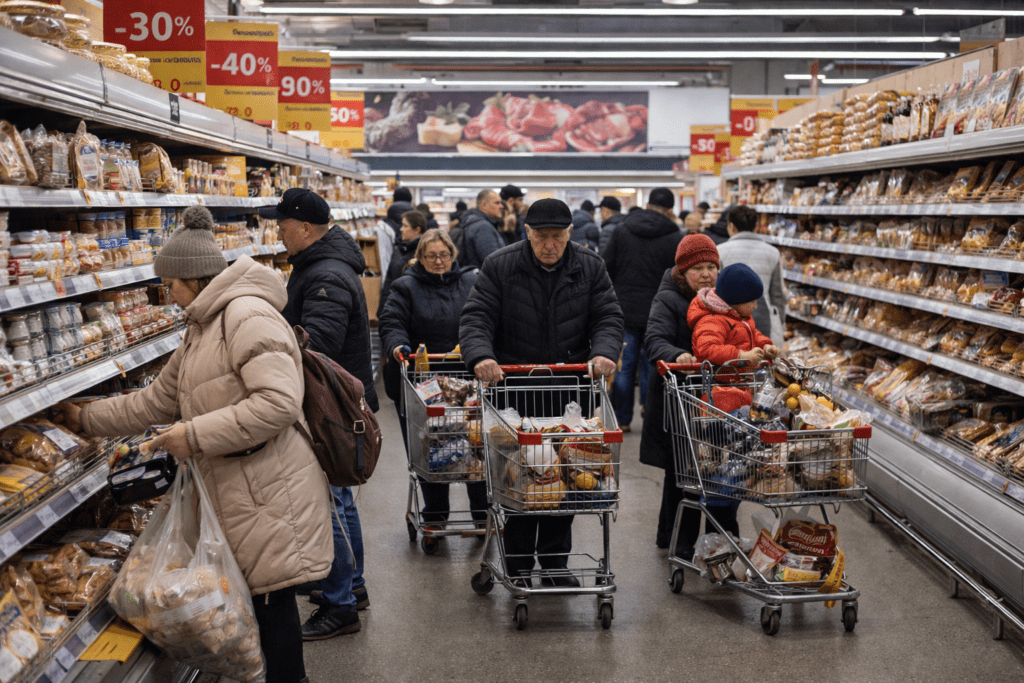
A high share of household spending on food remains a key indicator of living standards in Kazakhstan, according to analysts at Finprom.kz. By the end of 2025, average annual spending on food and non-alcoholic beverages reached $1,292 per person, up 13.9% year-on-year and nearly six times higher than in 2010. At the same time, the structure of spending has remained largely unchanged. In 2025, food accounted for 47.8% of total expenditures, only slightly below the pre-pandemic level of 50.4%. As a share of income, food expenditures rose to 42.5%, compared to 40.7% a year earlier, suggesting that income growth is being largely offset by inflation. Consumption patterns also remain relatively rigid. Meat and meat products account for 34.4% of food spending, approximately $444 per person, with prices in this category rising by 18.1% over the year. Bread and cereal products (14.7%) and dairy products (10.6%) also make up a significant share. Combined, these categories account for about 60% of total food expenditures. Spending on fruit and vegetables is increasing in absolute terms by 15.3% and 22.8%, respectively, but their shares remain relatively low at 9.1% and 7.7%, pointing to limited diversification in consumption. Fish and seafood account for 4.4% of spending, and eggs for 2.1%, further reflecting a concentration on staple foods. According to analysts, inflation remains the main driver of rising expenditures. In February 2026, prices for food and non-alcoholic beverages increased by 12.6% year-on-year, compared to 6.3% a year earlier. This level is close to the highest rates recorded over the past decade, with the exception of February 2023, when growth reached 26.4%. Analysts warn that if current inflation trends persist, the share of spending on food in 2026 could again exceed 50%, limiting households’ ability to spend on non-food goods and services and placing additional pressure on living standards.

Kazakhstan Targets Growth in Real Household Income

The government of Kazakhstan plans to increase real household income by 2–3% by 2029, according to the Ministry of National Economy. The program includes measures to stimulate employment, raise wages, support entrepreneurship, and create sustainable jobs. Key priorities include increasing wages for public utility workers, civil servants, and agricultural workers; expanding the share of wages in GDP; creating jobs in the manufacturing sector; supporting export-oriented enterprises; and reducing the financial burden on households. The ministry said 2026 will be a pivotal year for establishing sustainable income growth. A joint plan by the government, the National Bank, and the Agency for Regulation and Development of the Financial Market aims to reduce inflation to 9-11% in 2026, 5.5-7.5% in 2027, and 5-7% in 2028. Authorities expect that slowing inflation will increase the purchasing power of incomes. Inflation has already declined from 12.9% in September 2025 to 11% in March 2026. From April 1, tariff policy will be implemented more cautiously. The ministry estimates that tariff increases will add no more than 0.35 percentage points to inflation. At the same time, electricity and transportation tariffs for producers of socially significant goods are set to be reduced by up to 70%. The government also plans to limit the growth of budget expenditures, with their share of GDP expected to decline to 15.1% in 2026. Reductions in transfers from the National Fund will continue, and for the first time in five years, the budget is expected to be executed without targeted transfers. In 2025, targeted transfers from the fund amounted to approximately $6.9 billion, while the guaranteed transfer for 2026 has been set at $5.8 billion. According to the National Statistics Bureau, nominal household income grew by 10.2% in 2025, while real income declined by 1.1%. Average per capita income stood at approximately $506. The ministry noted that the decline in real incomes indicates that economic growth is not sufficiently translating into improved living standards, underscoring the need for additional measures to create jobs and raise wages. The Times of Central Asia previously reported that Prime Minister Olzhas Bektenov called for increasing the share of wages in GDP to 40%. 

Cost of Living in Uzbekistan Remains Moderate in Regional Context

Uzbekistan ranks third among Central Asian countries in terms of cost of living, according to the latest data from Numbeo. With an index score of 24.2 on a 100-point scale, Uzbekistan maintains relatively low living expenses by global standards, though costs remain lower than in Kyrgyzstan (25.4) and Kazakhstan (26.6). The estimated monthly expenses for a family of four in Uzbekistan, excluding rent, are approximately 21 million UZS ($1,743.31), while the average per-person cost stands at 5.6 million UZS ($464.88). Compared to the United States, Uzbekistan’s overall cost of living, including rent, is 65.2% lower. Rent alone is 71.1% cheaper. Regional Comparisons In a comparison of major cities, living in Almaty, Kazakhstan, is 6.8% more expensive than in Tashkent, excluding rent. Including rent, the cost difference narrows to 5.9%, with rent prices in Almaty 3.5% higher. Restaurant prices are 17.5% higher in Almaty, while grocery costs are 1.3% lower. Local purchasing power is 5.5% stronger than in Tashkent. Bishkek, Kyrgyzstan’s capital, is marginally cheaper than Tashkent, with the overall cost of living 0.5% lower excluding rent and 4.8% lower when rent is included. Rent in Bishkek is 15.7% cheaper, restaurant prices are 1.9% lower, and groceries cost 7.4% less. However, Bishkek’s local purchasing power is 21.3% lower than in Tashkent. In Dushanbe, the cost of living is 0.8% higher than in Tashkent without rent, but 7.7% lower when rent is included. Rent prices are 29% lower, restaurant prices are 13.4% cheaper, and groceries are 18.3% more expensive. Local purchasing power in Dushanbe is significantly lower, 50.9% below that of Tashkent. Ashgabat, the capital of Turkmenistan, stands out as the region’s most expensive city. The cost of living there is 261.4% higher than in Tashkent without rent and 208.5% higher when rent is factored in. Rent prices in Ashgabat are 77.6% higher, restaurant prices are 242.4% more expensive, and groceries cost 291.3% more. Despite the elevated costs, local purchasing power in Ashgabat is 58.5% lower than in Tashkent.

Almaty Named as the Most Expensive City in Central Asia

Analysts at Finprom.kz, citing the latest Numbeo report on global cost-of-living data, have identified Almaty as the most expensive city in Central Asia. Global Leaders and Regional Rankings Numbeo’s index is based on user-submitted data on the cost of food, transportation, utilities, and housing, benchmarked against New York City, which is assigned a baseline score of 100 (excluding rent). Scores above 100 indicate higher living costs than New York. Swiss cities once again dominated the top of the list. Zurich (112.5), Geneva (111.4), Basel (110.7), Lausanne (110.5), Lugano (108.4), and Bern (103.4) all surpassed New York, which came in seventh. Rounding out the global top ten were Reykjavik (96.2), Honolulu (94.4), and San Francisco (90.7). Almaty ranked 346th globally, with a score of 29.4, while Kazakhstan’s capital, Astana, placed 366th at 26.5. Astana’s cost of living aligns closely with Bishkek (26.8) and Tashkent (26.2). While the cost-of-living index measures expenses, Numbeo’s Purchasing Power Index reflects how well local wages cover those costs. Astana rose to 59.4 (up from 45.3 in 2020), and Almaty reached 55.9 (up from 36.3). Both cities now surpass their regional peers: Tashkent (49.3) and Bishkek (40.4). While Kazakhstan remains significantly more affordable than many developed countries, a factor that may appeal to tourists, the lower cost indexes also reflect modest local income levels. Nonetheless, the improved purchasing power in Astana and Almaty signals a positive economic trend, positioning them ahead of neighboring capitals.

High Praise, Empty Pockets: Turkmenistan May Scrap Benefit Hikes

It seems that average Turkmen citizens will again have to find ways to ration their spending in 2026, and beyond, thanks to a proposal from a member of the country’s Council of Elders. At a session of the Halk Maslahaty (People’s Council) on September 19, Elders’ Council member Yazmyrat Atamyradov, who, in fairness, probably drew the short straw before the session started, said that socio-economic conditions in Turkmenistan have reached such a high level that there is no longer a need for cost-of-living increases for salaries, pensions, stipends, and other benefits. "You are bestowing such blessings upon our people, Hero Arkadag!” Atamyradov said in his address. “Our sons and daughters, grandchildren, and great-grandchildren go to school and work without a care in the world. A peaceful, carefree life itself is a priceless treasure and a great asset.” Most of Turkmenistan’s people likely would not agree with Atamyradov’s suggestion, but his words were meant for only one person, Halk Maslahaty Chairman Gurbanguly Berdimuhamedov, who was in attendance and thanked Atamyradov for the recommendation. Most of the effusive praise for Turkmenistan’s alleged astounding socio-economic achievements was also directed at Berdimuhamedov, who served as Turkmenistan’s president from late 2006 until March 2022, when he stepped down and his son Serdar took the helm. Changes to Turkmenistan’s constitution in early 2023 made the Halk Maslahaty chairman the highest post in the country. A Deteriorating Economy There is no basis for Atamyratov’s assertion that living conditions are improving in Turkmenistan. The suggestion to cut annual payment increases more likely means the authorities can no longer afford to continue funding cost-of-living increases. Turkmenistan has the fourth largest reserves of natural gas in the world, and in the early years after independence, in late 1991, then-President Saparmurat Niyazov forecast the country would soon become a second Kuwait and everyone would be driving Mercedes. It has not worked out like that at all. Turkmenistan has a lot of gas, but only a few customers. The steep drop in gas prices in 2015 devastated Turkmenistan’s economy, which is about 80% dependent on revenue from gas sales, and has never recovered. The first food shortages independent Turkmenistan had ever seen started in 2016. Flour, cooking oil, sugar, eggs, and other basic goods were often not available at state stores where goods are sold at a subsidized price, but have always been available at privately-owned stores and at bazaars, where the price is two or three times more expensive. Eventually, rationing was introduced on bread. Customers were limited to two and sometimes only one churek (flat, round bread) per person. In some areas, police were tasked with monitoring sales to ensure no one bought more than their allotment. Often, there were more customers than bread, and in many places, including the capital, Ashgabat, lines started forming outside state stores before the sun came up. The authorities responded by telling people to line up behind the store so they could not be seen from the street. Fast forward to 2025, where in...

Kazakhstan to Freeze Minimum Wage in 2026 Despite Earlier Promises

Kazakhstan will maintain its current minimum wage of 85,000 KZT per month (approximately $157) in 2026, Deputy Prime Minister and Minister of National Economy Serik Zhumangarin confirmed at a recent press conference. This announcement contradicts earlier statements made in June by Minister of Labor and Social Protection Svetlana Zhakupova, who indicated that the government intended to raise the minimum wage from January 1, 2026. Finance Minister Madi Takiev had even suggested a possible increase to just over 90,000 KZT ($166). However, Zhumangarin stated that the proposed adjustment has been scrapped. “We currently have no plans to increase the minimum wage. As of today, it remains at 85,000 KZT, and we are not considering an increase at this time,” he said. Zhumangarin noted that while pensions and benefits are indexed annually to inflation, the government has allocated 800 billion KZT ($1.4 billion) in the 2026 budget to cover these costs. Takiev added that while calculations had been made for a potential increase, “given the current situation,” the decision was made to leave the wage unchanged. The minimum wage was last raised in January 2024, from 70,000 KZT ($135 at the time) to its current level. Some members of parliament have called for a broader review of the minimum wage, the minimum subsistence level, and the structure of the official food basket. In response to a reporter’s question, Zhumangarin acknowledged that he himself could not live on 85,000 KZT per month under current market conditions but stressed that the issue must be approached cautiously. According to the Ministry of Labor, approximately 170,000 people in Kazakhstan currently earn the minimum wage, while another 160,000 earn around 100,000 KZT monthly. As of the first quarter of 2025, the total number of employed individuals in the country stood at 9.3 million. Over the summer, AMANAT parliamentary faction leader Yelnur Beisenbayev criticized government statistics, particularly the official average salary figure of 423,000 KZT ($830). “In our country, three million people earn around 200,000 KZT, of whom 1.8 million live on the minimum wage of 85,000 KZT. So the question arises: who earns 423,000? I believe the government calculates it like this: if Asan earns 1 million KZT, and Yessen and Usen earn 100,000 each, then the average among them is 400,000,” he remarked.