• KGS/USD = 0.01144 0%
  • KZT/USD = 0.00206 0%
  • TJS/USD = 0.10736 -0.19%
  • UZS/USD = 0.00008 0%
  • TMT/USD = 0.28571 0%
  • KGS/USD = 0.01144 0%
  • KZT/USD = 0.00206 0%
  • TJS/USD = 0.10736 -0.19%
  • UZS/USD = 0.00008 0%
  • TMT/USD = 0.28571 0%
  • KGS/USD = 0.01144 0%
  • KZT/USD = 0.00206 0%
  • TJS/USD = 0.10736 -0.19%
  • UZS/USD = 0.00008 0%
  • TMT/USD = 0.28571 0%
  • KGS/USD = 0.01144 0%
  • KZT/USD = 0.00206 0%
  • TJS/USD = 0.10736 -0.19%
  • UZS/USD = 0.00008 0%
  • TMT/USD = 0.28571 0%
  • KGS/USD = 0.01144 0%
  • KZT/USD = 0.00206 0%
  • TJS/USD = 0.10736 -0.19%
  • UZS/USD = 0.00008 0%
  • TMT/USD = 0.28571 0%
  • KGS/USD = 0.01144 0%
  • KZT/USD = 0.00206 0%
  • TJS/USD = 0.10736 -0.19%
  • UZS/USD = 0.00008 0%
  • TMT/USD = 0.28571 0%
  • KGS/USD = 0.01144 0%
  • KZT/USD = 0.00206 0%
  • TJS/USD = 0.10736 -0.19%
  • UZS/USD = 0.00008 0%
  • TMT/USD = 0.28571 0%
  • KGS/USD = 0.01144 0%
  • KZT/USD = 0.00206 0%
  • TJS/USD = 0.10736 -0.19%
  • UZS/USD = 0.00008 0%
  • TMT/USD = 0.28571 0%

Viewing results 1 - 6 of 16

Kazakhstan and Hungary Reach Preliminary Deal on Oil Supply via Druzhba Pipeline

Kazakhstan and Hungary have reached a preliminary agreement on the supply of Kazakh crude oil to Hungary via the Druzhba (Friendship) oil pipeline system through Russia. According to Kazakhstan’s Ministry of Energy, the agreement was reached during a meeting in Astana on February 17 between Kazakhstan’s Minister of Energy Almasadam Satkaliyev and Hungarian Minister of Foreign Affairs and Trade Péter Szijjártó. The two sides agreed to conduct test oil shipments in 2025. Kazakhstan already supplies oil to Germany through the Druzhba pipeline. The ministers also discussed cooperation between Kazakhstan’s national oil and gas company, KazMunayGas, and Hungary’s MOL Group in developing the Rozhkovskoye gas condensate field in western Kazakhstan. MOL Group has invested $200 million in the development of this major field and has previously expressed interest in processing Kazakh oil at Hungarian refineries. On the same day in Astana, Szijjártó held talks with Kazakhstan’s Deputy Prime Minister and Minister of Foreign Affairs Murat Nurtleu. The foreign ministers reviewed trade and economic relations, noting that bilateral trade turnover increased by 4.4% last year, reaching nearly $200 million. Both sides agreed to take additional measures to achieve the goal set by their leaders, to expand trade to $1 billion, according to Kazakhstan’s Foreign Ministry. Key topics of discussion included: The opening of Hungarian bank branches in Kazakhstan The construction of a multimodal cargo terminal in Budapest Expanding exports of Kazakh uranium and critical minerals The ministers also highlighted plans to launch a direct air connection between Shymkent, Kazakhstan’s third-largest city, and Budapest in May 2025. The new route is expected to further strengthen economic and cultural ties between the two nations. Since 2005, Hungarian direct investments in Kazakhstan have exceeded $370 million, reflecting the deepening economic partnership between the two countries.

Kazakhstan to Offset Oil Overproduction in 2024

Kazakhstan has pledged to compensate for excess oil production in 2024, reaffirming its commitment to the OPEC+ agreements. At the 58th meeting of the Joint Ministerial Monitoring Committee, Kazakh representatives confirmed the country's readiness to take necessary measures in 2025 and 2026 to meet its obligations under the OPEC+ framework. "Despite increased production this year due to the expansion of the Tengiz field, Kazakhstan remains committed to the OPEC+ agreement and will engage in negotiations with partners in accordance with international law," the Ministry of Energy stated. OPEC+ Efforts to Stabilize the Market The February 3 meeting marked the first OPEC+ gathering of 2025. Participating ministers emphasized that voluntary production cuts, implemented by several member states in December 2024, have contributed to oil market stability. Previously, on December 5, 2024, OPEC+ agreed to extend voluntary oil production limits of 2.2 million barrels per day (bpd) for the first quarter of 2025. The decision was made in response to a seasonal slowdown in demand during the winter months. A gradual easing of restrictions is expected to continue until September 2026. The next OPEC+ monitoring committee meeting is scheduled for April 5.

Kazakhstan Revises 2025 Oil Production Target Amid OPEC+ Commitments

Kazakhstan’s Ministry of Energy has lowered its 2025 oil production target by one million tons as part of the country’s commitment to meeting its obligations under the Organization of the Petroleum Exporting Countries (OPEC+) agreements. In 2024, Kazakhstan had already reduced oil production by 2.5 million tons compared to its original plan. The revised target for 2025 now stands at 96.2 million tons, down from the 97.2 million tons announced in December 2024. Despite the reduction, Prime Minister Olzhas Bektenov has instructed the Energy Ministry to implement stronger measures to increase natural gas and oil production to meet planned output levels. Frequent revisions to production forecasts in 2024 highlighted the ongoing challenges in achieving production stability. The lowered forecast is attributed to several factors, including extended maintenance shutdowns at major oilfields. The Tengiz oilfield experienced shutdowns in May and August, totaling 50 days, while the Kashagan oilfield underwent maintenance for 21 days. Additionally, an unscheduled shutdown occurred at the Karachaganak field. Production was further impacted by limitations on gas intake at the Orenburg gas processing plant, which affected operations at Karachaganak. Planned maintenance at the Caspian Pipeline Consortium (CPC)—the primary route for Kazakh oil exports—also constrained transportation capacity. Compliance with OPEC+ agreements added to the reductions in production. In mid-2024, Kazakhstan, alongside Russia and Iraq, submitted compensation schedules to OPEC to fulfill their obligations to cut oil production after exceeding quotas under the OPEC+ agreement. Under this plan, Kazakhstan began reducing production by 18,000 barrels per day in July and further cut output by 265,000 barrels per day in October 2024. These reductions will continue until September 2025. Oil export revenues in 2024 amounted to approximately 2 trillion KZT ($3.8 billion), while total budget revenues from the oil sector exceeded 2.3 trillion KZT ($4.4 billion). As previously reported by The Times of Central Asia, the National Bank of Kazakhstan recently lowered its forecast for oil prices in 2025, reducing the projected cost from $82.5 to $70 per barrel. This, combined with the revised production volumes, is expected to further impact revenues from the oil sector.

Kazakhstan Seeks to Increase Oil Transit Through Azerbaijan

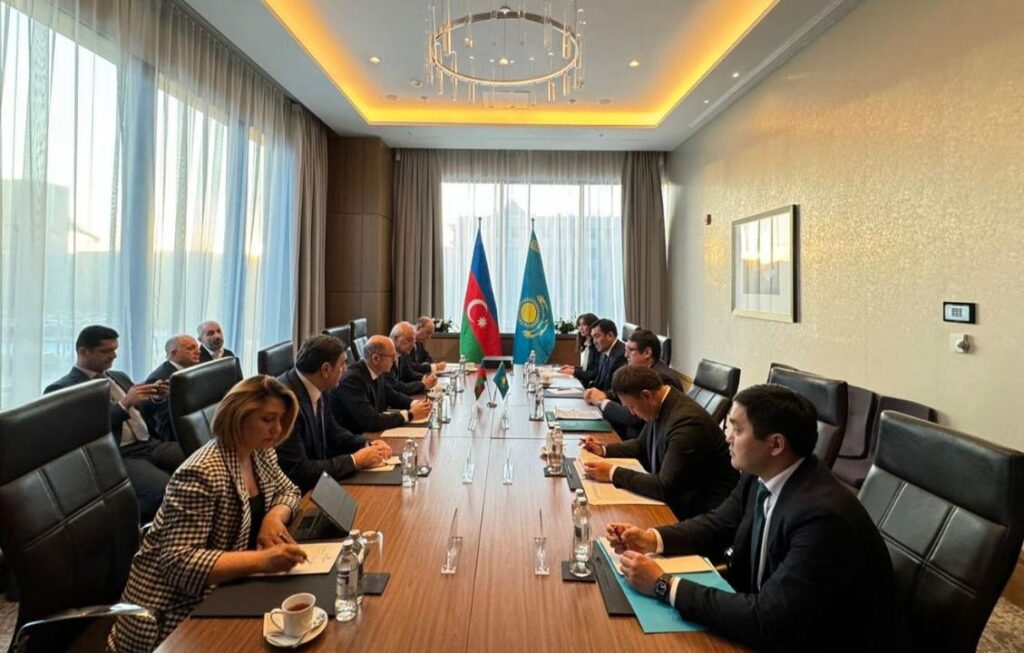
With the production of crude oil set to rise in Kazakhstan, the country plans to increase shipments across the Caspian Sea and through Azerbaijan. On March 6th, Kazakhstan’s Minister of Energy Almasadam Satkaliev met his Azerbaijan counterpart, Parviz Shahbazov, to discuss cooperation between their countries regarding the transit of Kazakh oil and the implementation of large-scale renewable energy projects. Back in 2022, Kazakhstan’s President Kassym-Jomart Tokayev ordered an increase in the volume of oil transported across the Caspian Sea. In response, Kazakhstan’s national oil and gas company KazMunayGas and the state oil company of Azerbaijan, SOCAR, entered into an agreement to transport up to 1.5 million tons of oil per year from Kazakhstan’s Aktau port through the Baku-Tbilisi-Ceyhan oil pipeline. In 2023 Kazakhstan’s shipment of crude oil from the Caspian port of Aktau grew to almost 1.4 million tons and this year, is expected to rise to 1.5 million tons. Major expansion projects are currently underway at Kazakhstan’s Tengiz, Karachaganak, and Kashagan oil fields to increase the future output of crude oil. Today, most of the country’s oil is exported via the pipeline managed by the Caspian Pipeline Consortium (CPC) which runs to the Russian Black Sea port of Novorossiysk. The throughput capacity of the Kazakh section of the Caspian Pipeline Consortium (CPC) pipeline has increased from 54 million to 72.5 million tons per year. The Kazakh and Azeri energy ministers also discussed a forthcoming project to connect the Caucasus region and Central Asia’s energy systems through the installation of a deep-sea cable in the Caspian Sea.