Viewing results 1 - 6 of 3
Uzbek law enforcement authorities have dismantled two illegal call centers in Tashkent that were part of a transnational fraud network targeting victims across Europe and North America, according to the country’s Ministry of Internal Affairs. The operation, carried out jointly by the Interior Ministry’s Cybercrime Department and the State Security Service, targeted offices located in the Yashnabad and Yakkasaray districts of the Uzbek capital. Authorities found 97 people, including five foreign nationals, at the first location, while 34 more, including three foreigners, were apprehended at the second site. According to investigators, the call centers conducted fraudulent phone calls and mass messaging campaigns using spoofed telephone numbers. Operators posed as financial advisers and investment brokers, persuading victims to purchase cryptocurrencies and invest in purported high-yield investment schemes. The group also created multiple phishing websites designed to imitate legitimate investment platforms, promising returns of up to 70% per month. The Interior Ministry said the organizers recruited university students in Tashkent with foreign-language skills to communicate with overseas victims. Employees operated under aliases and underwent specialized training that emphasized strict operational security. Access to the offices was tightly controlled. Criminal proceedings have been opened by the Cybercrime Department’s investigative division. Authorities said investigative and operational measures are continuing with respect to the remaining 111 individuals found at the two facilities. The Interior Ministry added that its International Cooperation Department and Uzbekistan’s National Central Bureau of Interpol are preparing requests for assistance to law enforcement agencies in Europe and North America. Officials described the operation as the result of “hundreds of hours of surveillance, digital forensic analysis, and international cooperation.” The case follows a series of major anti-fraud operations in Uzbekistan. Earlier this year, the State Security Service dismantled three call centers that targeted Russian citizens by promising compensation for allegedly defective dietary supplements and then demanding advance “tax” payments before victims could receive the fictitious reimbursements. In another operation in June, the Uzbek authorities uncovered multiple fraud schemes across six regions involving false promises of employment in South Korea. In one case, the head of a private company allegedly demanded approximately $384,000 from a group of 48 people in exchange for arranging overseas jobs.
The U.S. Department of the Treasury’s Office of Foreign Assets Control (OFAC) has imposed sanctions on an Uzbek citizen over alleged involvement in cybercrime activities linked to Russian actors, according to an official press release published on the agency’s website. OFAC reported that Azizjon Mamashoyev, a citizen of Uzbekistan born in 1987, was added to the sanctions list under regulations related to Russia-linked activities. U.S. authorities allege that he participated in cyber operations and maintained connections with individuals suspected of conducting malicious cyber activities. The announcement included identifying details, listing Mamashoyev’s date of birth as February 20, 1987, and confirming his Uzbek nationality. The designation was issued under the Ukraine-/Russia-Related Sanctions Regulations and forms part of measures targeting cyber-enabled threats. According to OFAC, Mamashoyev is linked to Sergey Zelenyuk, who has also been associated with cybercrime investigations. The sanctions were introduced pursuant to authorities under the Countering America’s Adversaries Through Sanctions Act (CAATSA) and a cyber-related sanctions program identified as CYBER4. The U.S. Treasury also designated Advance Security Solutions, a company reportedly connected to Mamashoyev. The firm, described as operating in computer programming, is registered in Dubai’s Jumeirah Living Marina Gate area and also lists operations in Tashkent. U.S. officials stated that the company was established in 2025 and may have engaged in activities posing secondary sanctions risks. Under OFAC sanctions, designated individuals and entities are generally subject to asset freezes within U.S. jurisdiction, and U.S. persons are typically prohibited from engaging in transactions with them.
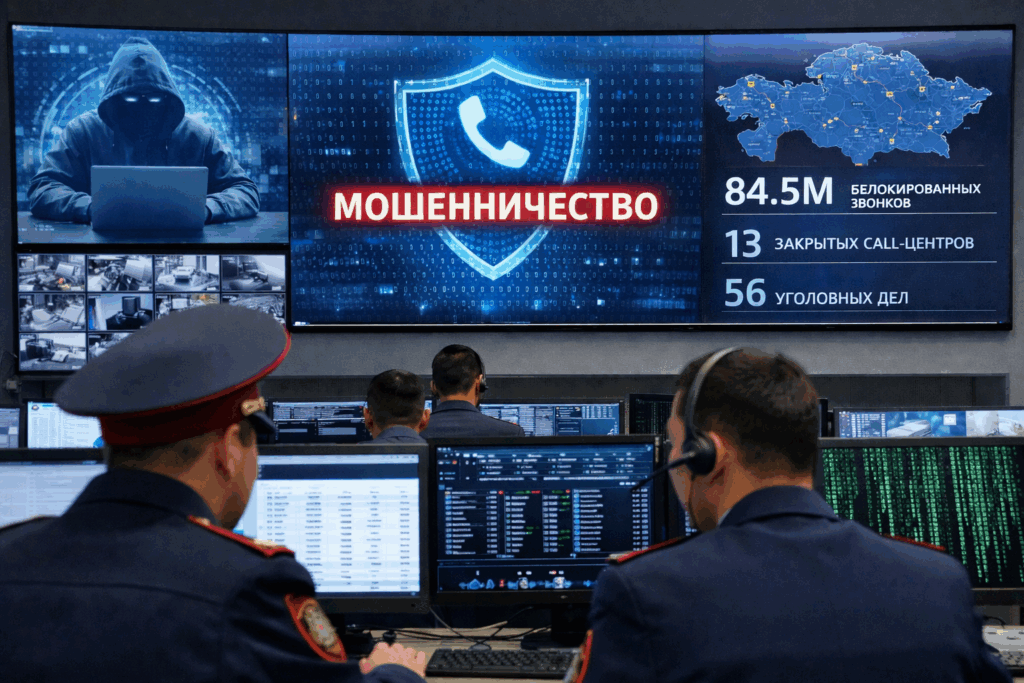
Kazakhstan’s law enforcement agencies blocked approximately 85 million fraudulent phone calls in 2025, according to Interior Minister Yerzhan Sadenov. The announcement was made during a meeting of the Ministry of Internal Affairs. “Systematic work continues to combat cybercrime and internet fraud,” Sadenov stated. “A total of 84.5 million fraudulent calls were blocked, helping to prevent significant financial losses and reduce citizen exposure to fraudulent schemes. Thirteen call centers were shut down, including some located abroad. Fifty-six criminal cases have been launched against individuals involved in so-called ‘dropperism,’ aiding internet fraudsters.” Sadenov also highlighted Kazakhstan’s signing of the United Nations Convention on Combating Cybercrime, which he said will strengthen international cooperation in addressing cross-border digital crimes. As part of its broader digital transformation, Kazakhstan introduced the Law and Order service last autumn, a new tool enabling citizens to interact with law enforcement agencies. Integrated into eGov Mobile, the government’s digital services platform, as well as the Kaspi.kz and Halyk Bank mobile apps, the service is accessible nationwide. In addition to reporting offenses, users can submit complaints against police officers and send text, voice, photo, and video messages. Every report submitted through the service is automatically registered in the Ministry’s information system, with users receiving real-time updates on the status of their submissions. To support these initiatives, the Ministry of Internal Affairs has established a Department of Digitalization and Artificial Intelligence. The department is tasked with integrating smart technologies into law enforcement. One of its flagship projects is the National Video Monitoring System, which uses video analytics to enhance street and public safety, including the ongoing development of the Safe City initiative. As previously reported by The Times of Central Asia, engineers in Karaganda unveiled three prototype unmanned aerial vehicles last year aimed at improving public safety across Kazakhstan.