• KGS/USD = 0.01144 0%
  • KZT/USD = 0.00213 0%
  • TJS/USD = 0.10699 0%
  • UZS/USD = 0.00008 0%
  • TMT/USD = 0.28571 0%
  • KGS/USD = 0.01144 0%
  • KZT/USD = 0.00213 0%
  • TJS/USD = 0.10699 0%
  • UZS/USD = 0.00008 0%
  • TMT/USD = 0.28571 0%
  • KGS/USD = 0.01144 0%
  • KZT/USD = 0.00213 0%
  • TJS/USD = 0.10699 0%
  • UZS/USD = 0.00008 0%
  • TMT/USD = 0.28571 0%
  • KGS/USD = 0.01144 0%
  • KZT/USD = 0.00213 0%
  • TJS/USD = 0.10699 0%
  • UZS/USD = 0.00008 0%
  • TMT/USD = 0.28571 0%
  • KGS/USD = 0.01144 0%
  • KZT/USD = 0.00213 0%
  • TJS/USD = 0.10699 0%
  • UZS/USD = 0.00008 0%
  • TMT/USD = 0.28571 0%
  • KGS/USD = 0.01144 0%
  • KZT/USD = 0.00213 0%
  • TJS/USD = 0.10699 0%
  • UZS/USD = 0.00008 0%
  • TMT/USD = 0.28571 0%
  • KGS/USD = 0.01144 0%
  • KZT/USD = 0.00213 0%
  • TJS/USD = 0.10699 0%
  • UZS/USD = 0.00008 0%
  • TMT/USD = 0.28571 0%
  • KGS/USD = 0.01144 0%
  • KZT/USD = 0.00213 0%
  • TJS/USD = 0.10699 0%
  • UZS/USD = 0.00008 0%
  • TMT/USD = 0.28571 0%

Viewing results 1 - 6 of 6

Kazakhstan Central Bank Chief Eyes Deeper U.S. Investment Links

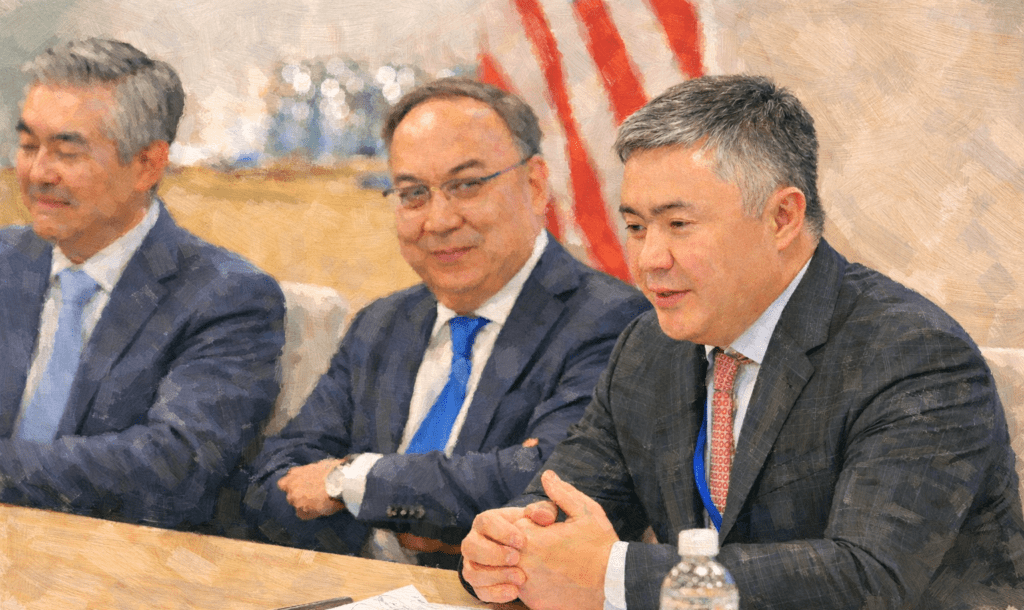
Addressing senior executives from more than a dozen Fortune 100 companies active in Kazakhstan at a U.S. Chamber of Commerce-hosted event in Washington, D.C., on April 14, Timur Suleimenov, Governor of the National Bank of Kazakhstan, laid out the country’s economic outlook and later spoke with The Times of Central Asia on a range of related issues. He was accompanied by Erzhan Kazykhan, President Kassym-Jomart Tokayev’s Special Representative for Negotiations with the United States, Deputy Foreign Minister Alibek Kuantyrov, and Kazakhstan’s Ambassador to the United States, Magzhan Ilyassov. [caption id="attachment_47306" align="aligncenter" width="1536"] Timur Suleimenov, Governor of the National Bank of Kazakhstan, with Javier Piedra[/caption] Kazakhstan’s U.S. Financial Stakes Amid Growth and Inflation Suleimenov offered a compelling case for Kazakhstan’s economy, citing steady growth, higher investment flows, and a deepening consumer market. Kazakhstan’s economy expanded 6.5% in 2025, marking a third straight year of growth above 5%. GDP per capita surpassed $15,000 – compared to approximately $3,162 in Uzbekistan and about $2,420 in Kyrgyzstan. Fixed-income investments rose 15% year-on-year, and foreign direct investment climbed to 20.5% (from 14.5%), broadening beyond oil. Suleimenov emphasized the Central Bank’s strong stewardship, citing a new tax and budget code to enhance fiscal discipline and monetary policy that supports investment, stressing that, “We will deal with inflation pressures and external shocks simultaneously while managing cryptocurrencies and private digital payments systems, which can weaken central bank control over money and policy transmission. The markets suggest that we have been doing an excellent job in a complex environment.” The government, Suleimenov said, is on track to consolidate the budget, with the deficit projected at 2.5% this year, 1.7% next year, and 0.9% by 2028, adding that this will strengthen fiscal-monetary coordination, and noting Kazakhstan’s debt-to-GDP ratio of 24% remains low compared with countries such as the United States (125%), Japan (230%), Italy (137%). As inflation declined to 11% in March 2026 from 11.7% the previous month, Suleimenov reassured TCA that officials regard it as transitory, saying that “inflation was driven by resilient domestic demand backed by fiscal and quasi-fiscal stimulation, external price pressures (Russian inflation, global food prices), increasing regulated prices (utilities and fuel), and tax reform (a VAT increase from 12% to 16%), with volatile and elevated inflation expectations. For these reasons, we responded with rate hikes and liquidity tightening, bringing inflation down to about 11%, with a further easing expected to single digits by the end of this year.” Suleimenov reaffirmed that “the United States is integral to Kazakhstan’s financial system and long-term asset strategy.” He noted that Kazakhstan manages approximately $190 billion in long-term assets, including some $75 billion in National Bank reserves, $60 billion in the National Fund, and $55 billion in the unified pension fund. Around one-third of these assets are invested in U.S. securities, while roughly $50 billion is managed by American firms, underscoring deep financial ties beyond industrial investment. TCA asked how U.S. sanctions and export controls affect Kazakhstan, a concern that was especially acute in the initial stages of the Russo-Ukrainian...

Kazakhstan to Establish International Computing Hub in Pavlodar Region

Kazakhstan plans to develop an international computing hub centered in the Pavlodar region, based on the emerging “data center valley” in Ekibastuz, one of the country's key energy production zones. The announcement was made by Deputy Prime Minister and Minister of Artificial Intelligence and Digital Development Zhaslan Madiev during an expanded government meeting. The government had earlier unveiled plans to establish a cluster of high-performance data centers in Ekibastuz, a city that hosts extensive coal-fired power generation and robust energy infrastructure. Madiev now says the project will evolve beyond a national cluster into a full-fledged international computing hub. According to Madiev, two critical enablers for the project are affordable electricity and cross-border telecommunications infrastructure. A land plot has already been designated for development, and 300 megawatts of power capacity have been reserved at Ekibastuz GRES-1. Negotiations are ongoing with international investors. AI Center to Anchor Digital Expansion The hub’s anchor facility will be a 50 MW AI-focused data processing center currently under construction by national telecom provider Kazakhtelecom. Scheduled for commissioning in mid-2027, the new facility is expected to be ten times more powerful than Kazakhstan’s recently launched state supercomputer facility. Astana is already home to Central Asia’s most powerful supercomputer, unveiled earlier this year, marking a significant step in the country’s digital infrastructure ambitions. Officials envision this computing expansion as the foundation for a new economic model driven by artificial intelligence and big data. Concerns Over Domestic AI Model Usage At the same government session, President Kassym-Jomart Tokayev expressed dissatisfaction with the uptake of the national large language model, KazLLM. He noted that public interest remains limited, with many users favoring international platforms such as ChatGPT. Madiev acknowledged that while KazLLM is used by approximately 600,000 people, about 3% of the population, foreign AI tools enjoy far broader adoption. He emphasized the importance of ongoing training and updates to local AI models, aligning with global best practices. In addition to KazLLM, a second model, Alem LLM, is also under development. Both systems have already been integrated into numerous digital platforms, including search engines and services targeted at students and IT enterprises.