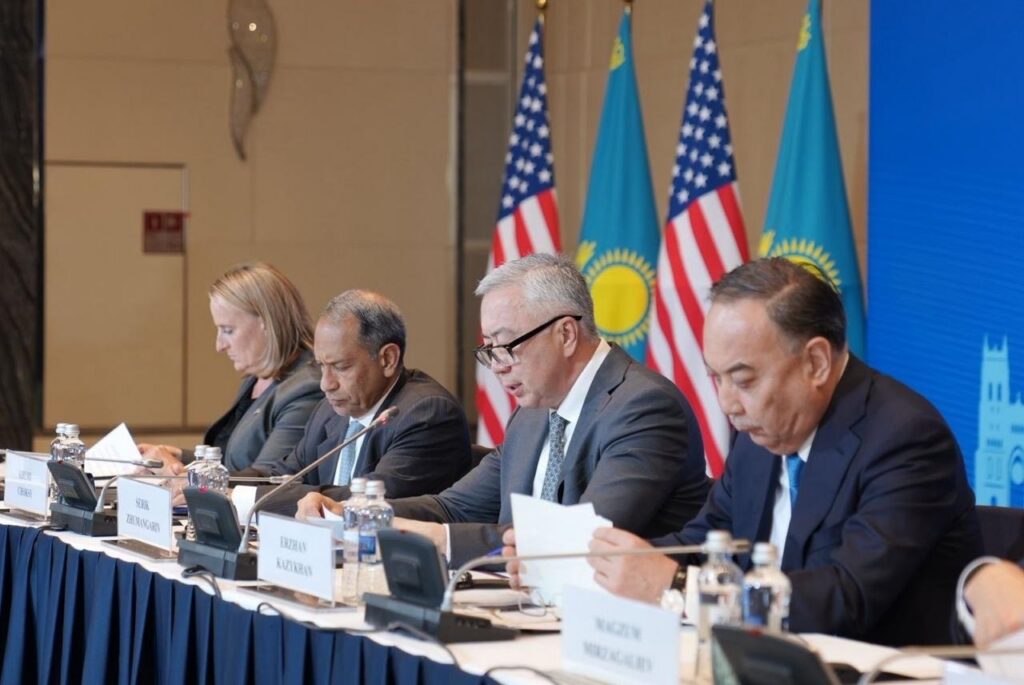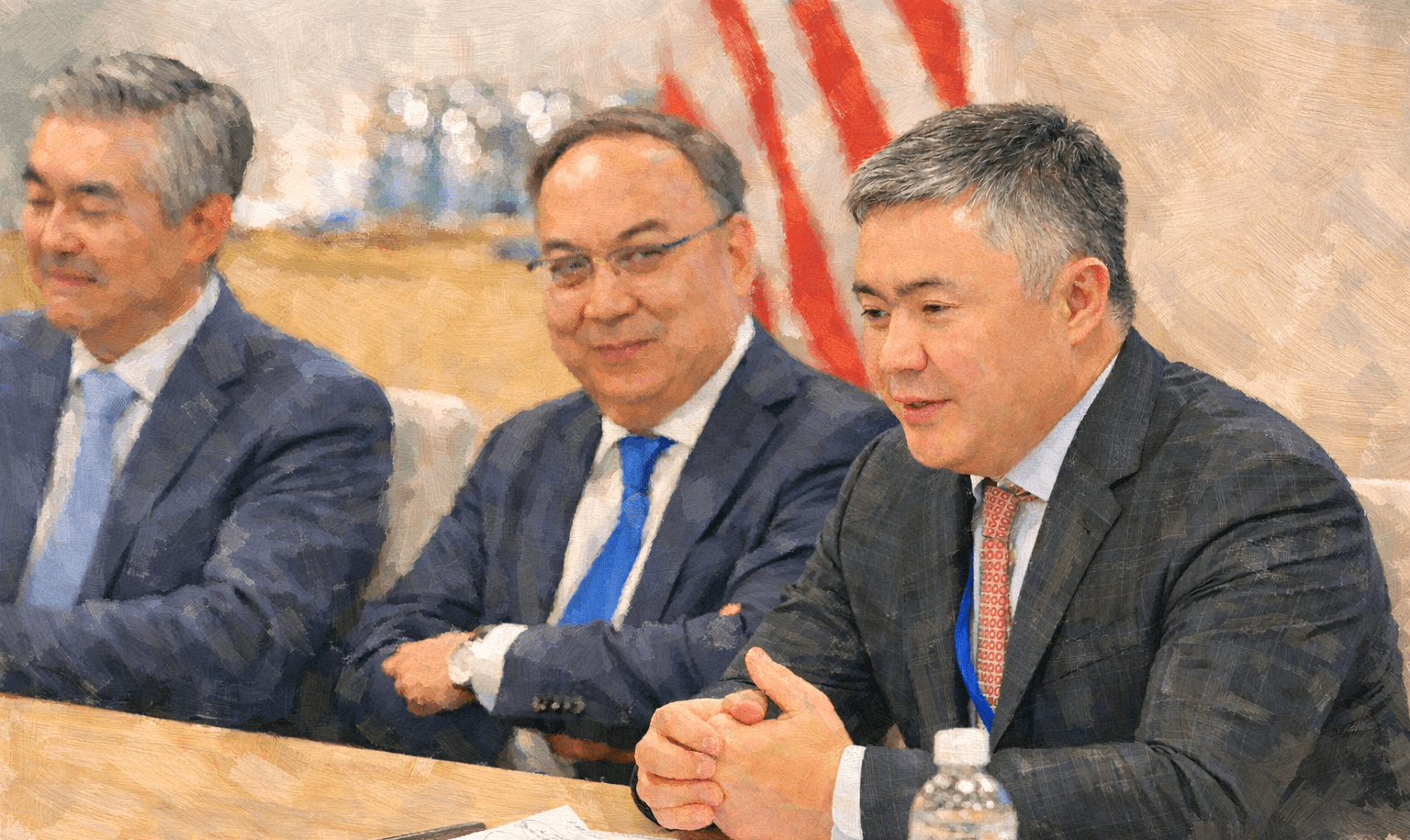
Addressing senior executives from more than a dozen Fortune 100 companies active in Kazakhstan at a U.S. Chamber of Commerce-hosted event in Washington, D.C., on April 14, Timur Suleimenov, Governor of the National Bank of Kazakhstan, laid out the country’s economic outlook and later spoke with The Times of Central Asia on a range of related issues. He was accompanied by Erzhan Kazykhan, President Kassym-Jomart Tokayev’s Special Representative for Negotiations with the United States, Deputy Foreign Minister Alibek Kuantyrov, and Kazakhstan’s Ambassador to the United States, Magzhan Ilyassov.
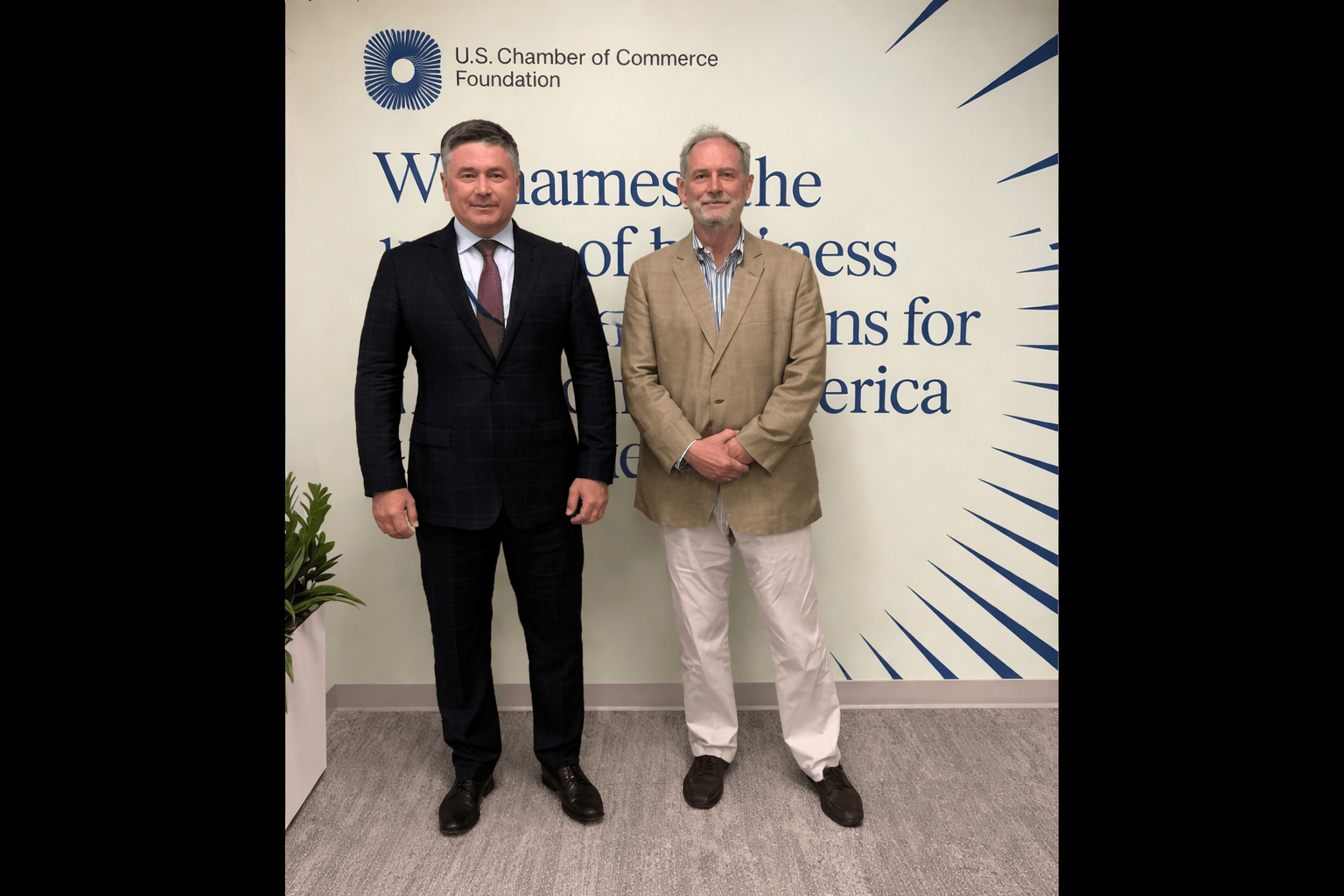
Timur Suleimenov, Governor of the National Bank of Kazakhstan, with Javier Piedra
Kazakhstan’s U.S. Financial Stakes Amid Growth and Inflation
Suleimenov offered a compelling case for Kazakhstan’s economy, citing steady growth, higher investment flows, and a deepening consumer market. Kazakhstan’s economy expanded 6.5% in 2025, marking a third straight year of growth above 5%. GDP per capita surpassed $15,000 – compared to approximately $3,162 in Uzbekistan and about $2,420 in Kyrgyzstan. Fixed-income investments rose 15% year-on-year, and foreign direct investment climbed to 20.5% (from 14.5%), broadening beyond oil.
Suleimenov emphasized the Central Bank’s strong stewardship, citing a new tax and budget code to enhance fiscal discipline and monetary policy that supports investment, stressing that, “We will deal with inflation pressures and external shocks simultaneously while managing cryptocurrencies and private digital payments systems, which can weaken central bank control over money and policy transmission. The markets suggest that we have been doing an excellent job in a complex environment.”
The government, Suleimenov said, is on track to consolidate the budget, with the deficit projected at 2.5% this year, 1.7% next year, and 0.9% by 2028, adding that this will strengthen fiscal-monetary coordination, and noting Kazakhstan’s debt-to-GDP ratio of 24% remains low compared with countries such as the United States (125%), Japan (230%), Italy (137%).
As inflation declined to 11% in March 2026 from 11.7% the previous month, Suleimenov reassured TCA that officials regard it as transitory, saying that “inflation was driven by resilient domestic demand backed by fiscal and quasi-fiscal stimulation, external price pressures (Russian inflation, global food prices), increasing regulated prices (utilities and fuel), and tax reform (a VAT increase from 12% to 16%), with volatile and elevated inflation expectations. For these reasons, we responded with rate hikes and liquidity tightening, bringing inflation down to about 11%, with a further easing expected to single digits by the end of this year.”
Suleimenov reaffirmed that “the United States is integral to Kazakhstan’s financial system and long-term asset strategy.” He noted that Kazakhstan manages approximately $190 billion in long-term assets, including some $75 billion in National Bank reserves, $60 billion in the National Fund, and $55 billion in the unified pension fund. Around one-third of these assets are invested in U.S. securities, while roughly $50 billion is managed by American firms, underscoring deep financial ties beyond industrial investment.
TCA asked how U.S. sanctions and export controls affect Kazakhstan, a concern that was especially acute in the initial stages of the Russo-Ukrainian War. Suleimenov responded that, “Kazakhstan is more deeply integrated into global financial markets than other Central Asian economies, making its custodial banking relationships and broader access to the international financial system especially important. As we said, Kazakhstan can’t risk severing trade ties with its neighbors given its deep economic integration, especially amid tougher Western sanctions; and yet banks have taken steps to tighten compliance around trade with sanctioned countries.”
Digital Finance and New Infrastructure
Suleimenov told TCA that Kazakhstan is leveraging digitalization to upgrade tax systems and improve oversight of state finances. He pointed to the digital tenge, launched in pilot form in 2023, as now fully operational and central to this effort, emphasizing its traceable, programmable nature for ensuring transparent and efficient public expenditure, particularly as budgets come under pressure from various sources. It is not designed to compete with private retail payment providers.
Kazakhstan’s President Tokayev signed a bill this year to create a new banking framework. The reforms simplify regulation via a two-tier licensing model— basic and full—with Kazakhstan, Suleimenov said, drawing inspiration from the U.S. for those financial institutions that fall into the lighter oversight category. The tenge, the national currency, was also codified into the constitution – a further step towards underscoring sovereign autonomy.
According to Suleimenov, “Kazakhstan is following the U.S. approach in digital finance— studying the GENIUS Act and moving quickly to complete our digital asset bylaws. By May, a comprehensive framework covering crypto, real-world tokens, and tokenized assets should be in place, ensuring the sector operates within clear regulation rather than in a gray zone.”
Kazakhstan wants to become a fully digitized country within three years, and is backing that goal with large-scale infrastructure plans. The Governor of the Central Bank has highlighted a proposed “Data Centers Valley” initiative in northern Kazakhstan, arguing that the region’s cool climate, existing power base and planned energy modernization make it well-suited for digital infrastructure. “The aim is to convert those advantages into computing capacity that can serve both domestic needs and foreign clients,” he stated, underscoring that Kazakhstan is already in talks with major U.S. firms such as Microsoft and Amazon Web Services, and that planned Trans-Caspian internet links would strengthen the country’s appeal as a regional hub for digital investment.
Alatau City, Suleimenov continued, is a planned special-status hub between Almaty and Konayev, which will serve as a new center of growth for Kazakhstan’s economy. Designed as a digitally driven jurisdiction with independent governance, tax, and regulatory systems—building on the Astana International Financial Center model—it aims to foster innovation and advanced tech, extending those strengths into a new smart city. He noted that early investors would gain a first-mover advantage as the city is still under development.
New investment tools are being introduced to broaden the financial system and address investor fears, such as a national crypto fund and a new alternative portfolio in the unified pension fund.
Balancing Openness and Data Protection
“Kazakhstan is seeking the right balance between an open digital economy and safeguarding personal information,” Suleimenov assured the chamber members, and that’s why partnering with tech giants matters. “In this regard, hyperscalers can state their required safeguards, and Kazakhstan will weigh them against its own interests. Our aim is innovation without losing security or compromising privacy. Kazakhstan already has a dedicated law on personal data protection, and that framework rests on the Constitution’s broader guarantees of personal privacy and individual rights rather than on a blind acceptance of impersonal market forces or a separate data code.”
On whether Kazakhstan would follow stricter European data rules or looser U.S./UK models, he said Astana will keep regulations relatively open. He acknowledged periodic calls for tighter controls over digital platforms but said the framework is still flexible, citing Kaspi Bank’s successful model that has accelerated cashless payments but maintains privacy.
The Next Phase of Kazakhstan’s Investment Story
Taken together, Suleimenov’s message was that Kazakhstan is trying to present itself not simply as a resource economy, but as a more disciplined, digitized, and institutionally ambitious investment destination. From fiscal consolidation and inflation management to banking reform, digital finance, and new infrastructure projects, he cast the country’s agenda as one aimed at widening the appeal to international capital while preserving macroeconomic stability. For U.S. investors in particular, Suleimenov’s pitch is that Kazakhstan is far beyond the start-up phase: “We already maintain strong financial ties with the United States and its capital markets, and are now aiming to deepen them through our ongoing reforms and expanded investment under Kazakhstan’s New Constitution.”