• KGS/USD = 0.01144 0%
  • KZT/USD = 0.00215 0%
  • TJS/USD = 0.10562 0%
  • UZS/USD = 0.00008 0%
  • TMT/USD = 0.28530 0%
  • KGS/USD = 0.01144 0%
  • KZT/USD = 0.00215 0%
  • TJS/USD = 0.10562 0%
  • UZS/USD = 0.00008 0%
  • TMT/USD = 0.28530 0%
  • KGS/USD = 0.01144 0%
  • KZT/USD = 0.00215 0%
  • TJS/USD = 0.10562 0%
  • UZS/USD = 0.00008 0%
  • TMT/USD = 0.28530 0%
  • KGS/USD = 0.01144 0%
  • KZT/USD = 0.00215 0%
  • TJS/USD = 0.10562 0%
  • UZS/USD = 0.00008 0%
  • TMT/USD = 0.28530 0%
  • KGS/USD = 0.01144 0%
  • KZT/USD = 0.00215 0%
  • TJS/USD = 0.10562 0%
  • UZS/USD = 0.00008 0%
  • TMT/USD = 0.28530 0%
  • KGS/USD = 0.01144 0%
  • KZT/USD = 0.00215 0%
  • TJS/USD = 0.10562 0%
  • UZS/USD = 0.00008 0%
  • TMT/USD = 0.28530 0%
  • KGS/USD = 0.01144 0%
  • KZT/USD = 0.00215 0%
  • TJS/USD = 0.10562 0%
  • UZS/USD = 0.00008 0%
  • TMT/USD = 0.28530 0%
  • KGS/USD = 0.01144 0%
  • KZT/USD = 0.00215 0%
  • TJS/USD = 0.10562 0%
  • UZS/USD = 0.00008 0%
  • TMT/USD = 0.28530 0%

Viewing results 1 - 6 of 31

Kazakhstan Turns from Pipelines to Processors

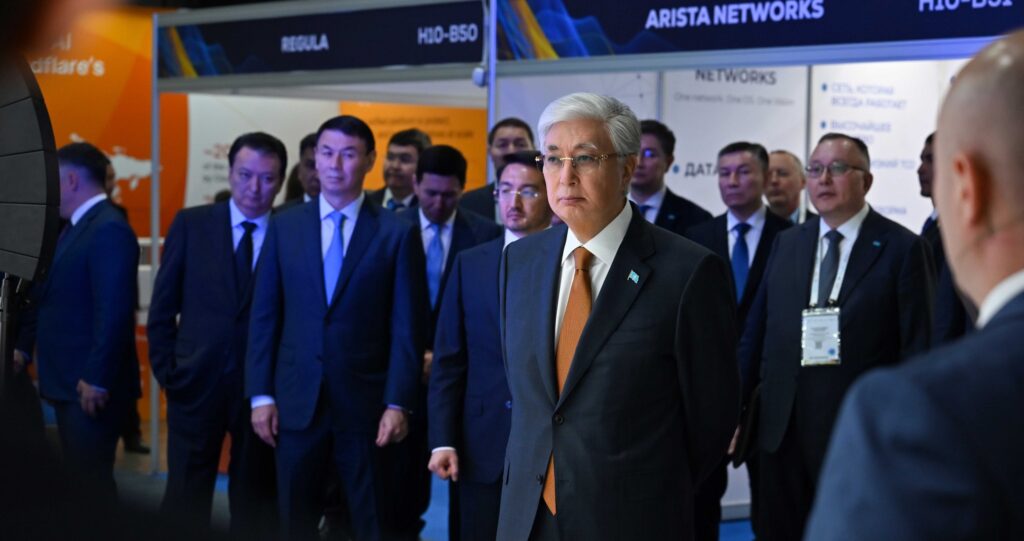
Kazakhstan’s strategic plan for advanced computing represents a diversification of its traditional oil, gas, and transit profile and of the wider national economy. A $2 billion Nvidia-linked initiative now turns on three main elements. First is a national supercomputer using Nvidia H200 chips, with headline AI performance around 2 exaflops. Second is a planned 100 MW data-center campus, designed to expand capacity for commercial users over several years. Third is a “sovereign AI hub” concept that promises long-term chip access for sensitive public-sector workloads. Prior to this package, Kazakhstan had already moved unusually quickly to build high-end AI and computing infrastructure, treating digital capacity as central to its development policy. The national supercomputer is now the most powerful system in Central Asia and is housed in a Tier III state data center intended for use by universities, startups, and corporate tenants. The hardware push accompanies a wider digital policy agenda, including new training programs with Nvidia to expand the country’s AI talent base. Parallel initiatives with the United States seek to anchor Kazakhstan more firmly within Western regulatory and connectivity frameworks, as part of a broader attempt to move beyond hydrocarbons and build domestic capability in computation-heavy activities. Kazakhstan’s New AI Statecraft Astana is presenting the Nvidia package as an economic instrument, not just a hardware upgrade. Senior officials now describe advanced computing as a new pillar of national development, on a par with hydrocarbons and transit. Recent policy statements frame AI and digital infrastructure as central, not a side theme of “innovation” policy. In parallel, the long-running “Digital Kazakhstan” agenda has moved from e-government and broadband roll-out into a second phase where data centers, national platforms, and specialized training come to the foreground. Within that shift, “sovereign AI” is becoming a core organizing idea. Officials and local specialists talk about national language models that can handle Kazakh, Russian, and other regional languages, and about keeping sensitive public-sector data on infrastructure under national jurisdiction. The new supercomputer and the sovereign AI hub are presented as the place where that work will happen at scale: training and serving models for government services, regulatory tasks, and domestic firms, rather than relying entirely on foreign platforms. The Nvidia partnership is therefore framed as a way to secure long-term access to leading chips for these “sovereign” workloads, even as global export rules tighten. The same initiative also underwrites a shift in Kazakhstan’s self-presentation from a “pipeline corridor” to Kazakhstan as a corridor for data and high-end digital services. The government has begun to link the sovereign AI hub and supercomputer to a set of fiber-optic projects across the Caspian that aim to tie Central Asia more tightly into Eurasian data routes. The same geography that once made Kazakhstan a crucial link for oil, gas, and rail freight can now make it a regional conduit for digital traffic and AI-enabled services. Kazakhstan is also using the package to deepen a specific diplomatic track with the United States. Joint announcements and working groups on digital transformation,...

Opinion: Kazakhstan Bets Big on AI to Power Local and Global Growth

A bold vision for Kazakhstan’s future In his recent State of the Nation address, the President of Kazakhstan articulated a bold and ambitious future for the country. He presented a new vision, central to which was the announcement of artificial intelligence adoption and digitization as new national priorities, positioning them as essential for the country’s economic modernization and long-term competitiveness. The speech marked a significant moment for the government. Historically, much of its policy focus has been on managing risk and navigating regulatory uncertainty. Now, the administration is pivoting to focus instead on high-growth, innovation-led initiatives to build a more competitive and resilient Kazakhstan that can thrive in a rapidly changing global economy. In his address, President Tokayev announced the creation of the Ministry of Artificial Intelligence and Digital Development. Its initial mandate is to develop the Digital Code, a comprehensive framework that will set out how every sector of the economy, from finance and energy to education and healthcare, will integrate AI and digital tools in a structured and sustainable way. Leapfrogging into the digital economy Kazakhstan is embracing leapfrog innovation to harness tools such as AI and blockchain technologies to help accelerate economic growth and diversify its economy. This bet will ensure that the nation remains competitive for generations to come in a digital-led global landscape where technology leadership increasingly defines prosperity. Central to the project’s long-term success is the evolution of Kazakhstan’s educational system, and the country has recently approved its first national framework for integrating AI into its curriculum, signaling a major shift toward future-ready learning. This initiative covers areas including ethics, legal regulation, personal data protection, and academic integrity. Kazakhstan is now one of the first countries to adopt its own national approach in this field, having drawn on the recommendations of UNESCO, OECD, and the EU’s work to ensure global best practices. Building tomorrow’s AI leaders today From the 2025–2026 academic year, AI is being integrated throughout the curriculum with the aim of converting classrooms into technology-literate talent pipelines. Students will benefit from new online courses, while teachers will be supported with professional development programs (with over 11,000 teachers already trained and more to follow). Globally, the adoption of AI in education is surging. According to AllAboutAI, in 2025, 86% of students worldwide use AI in their studies, and half of all teachers will leverage AI for lesson planning. The market for AI in education is projected to reach over $2.7 trillion by 2033, having been valued at $177 billion in 2023. With nearly 30% of Kazakhstan’s population under the age of 15 and a median age of just 29, the country is well placed to transform its students into a new generation of professionals ready to contribute to the country’s technological evolution and global competitiveness. Universities such as the Astana IT University (AITU), International Information Technology University, and the Kazakh-British Technical University, all part of the NNEF ecosystem, are at the forefront of integrating AI across their curricula, ensuring that students gain the skills they need for the digital economy and innovation-driven...

Kyrgyzstan and Binance Strengthen Partnership in Digital Economy Development

Kyrgyzstan and Binance, the world’s largest cryptocurrency exchange, have reaffirmed their commitment to deepening cooperation in the development of a secure and innovative digital economy. On October 6, Kyrgyz President Sadyr Japarov met in Bishkek with Binance Chief Marketing Officer Rachel Conlan to discuss ongoing and future collaboration. Japarov emphasized the country’s strategic priorities, noting that the National Council for the Development of Virtual Assets and Blockchain Technologies is currently working on a new digital asset, the KGST, which will be pegged to the national currency, the som. Concurrently, the National Bank of Kyrgyzstan is developing the digital som, a national digital currency, with plans to integrate it with the KGST to expand both domestic and cross-border applications. Conlan highlighted Binance’s global reach and extensive partner network as key assets in accelerating Kyrgyzstan’s digital transformation. She underscored the company's long-term commitment to supporting digital projects and educational initiatives in the country. The recent visit by Binance founder Changpeng Zhao to Kyrgyzstan brought international attention to the growing partnership. On May 3, Japarov and Zhao met to discuss the future of digital assets and blockchain in Kyrgyzstan. The agenda included the development of a national digital asset ecosystem, the integration of blockchain into public administration, and the strengthening of cybersecurity frameworks. During the meeting, Zhao agreed to support Kyrgyzstan’s digital transition by providing consultation and training for specialists working on the digital som project. He was also appointed public adviser to the President on digital asset development. The following day, Japarov chaired the first session of the National Council for the Development of Virtual Assets and Blockchain Technologies, where Zhao was officially confirmed as a Council member. The Council was established to shape unified state policies on virtual assets and advance their integration into governance and key economic sectors. In parallel, the National Investment Agency of Kyrgyzstan signed a Memorandum of Cooperation with Zhao. Under the agreement, Binance will support the development of blockchain infrastructure, the creation of a national cryptocurrency reserve, and training programs focused on blockchain technology, digital asset management, and cybersecurity. This growing partnership positions Kyrgyzstan as a regional leader in digital economy innovation, leveraging blockchain and virtual asset technologies to enhance public administration, economic governance, and global competitiveness.

Pavel Durov’s Telegram Launches AI Laboratory at Alem.ai in Astana

Telegram founder Pavel Durov has announced the launch of a dedicated artificial intelligence laboratory in Astana, housed within the newly inaugurated International Artificial Intelligence Center, Alem.ai. The Alem.ai center was officially opened on Thursday during the Digital Bridge 2025 forum in Kazakhstan’s capital. At the opening ceremony, President Kassym-Jomart Tokayev described the center as a future global hub for the effective and ethical application of artificial intelligence. The initiative will bring together both domestic and international developers, with Telegram among the first companies to establish operations at the site. “A year ago, we opened our first regional office in Kazakhstan, and today we are pleased to launch a specialized AI laboratory inside Alem.ai,” Durov said. “This is a joint project between Telegram and Kazakhstan’s national supercomputer cluster, established by the Ministry of Artificial Intelligence. The technology will allow more than one billion people to use AI functions privately, transparently, and efficiently. We hope that Kazakhstan’s supercomputer cluster will become the first major provider of computing power for this network.” As previously reported by The Times of Central Asia, Kazakhstan launched the region’s most powerful supercomputer earlier this year. At the Digital Bridge 2025 forum, President Tokayev announced plans for a second cluster. On the sidelines of the event, he also met with Pavel Durov to discuss cooperation in education, artificial intelligence, and cybersecurity, according to the presidential press service. “The President highly appreciated Telegram’s contribution to advancing Kazakhstan’s digital agenda: the company officially joined Astana Hub, opened an office in Kazakhstan, and launched AI laboratories at Alem.ai,” the statement said. “For his part, Pavel Durov briefed Tokayev on prospects for joint projects in artificial intelligence.” Tokayev also discussed venture investment opportunities and the development potential of Kazakhstani AI startups with Stanford University professor Ilya Strebulaev. In addition, Tokayev held meetings with Omar Al Olama, UAE Minister of State for Artificial Intelligence, Digital Economy, and Remote Work Applications, and Mansoor Ibrahim Al Mansoori, Chairman of Abu Dhabi’s Department of Health and former COO of G42. The talks focused on expanding Kazakh-Emirati cooperation in AI, including the ongoing Smart City project, which Tokayev called a milestone in bilateral relations. Tokayev also announced plans to establish an Artificial Intelligence University in Kazakhstan, with a strong focus on research and development. According to the presidential press service, he noted the importance of drawing on the UAE’s experience, where the world’s first IT-focused university is already in operation.

$15 Billion in Crypto Withdrawn from Kazakhstan Amid Calls for Tighter Controls

Approximately $15 billion worth of cryptocurrency has been withdrawn from Kazakhstan, a figure disclosed by Berik Sholpankulov, Deputy Chairman of the National Bank. The exodus highlights systemic issues in the country's digital finance regulations. Billions in the “Gray Zone” According to Sholpankulov, the primary driver of this significant capital outflow has been the absence of robust regulatory frameworks governing digital finance. "Today, the volume of crypto assets withdrawn from the country amounts to $15 billion. The fact is that there was insufficient administrative and legal regulation in place to allow citizens to invest safely,” he stated during a briefing. In response, the National Bank plans to introduce sweeping changes, including administrative and criminal penalties for the illegal circulation of cryptocurrencies and their unauthorized transfer abroad. Sholpankulov also indicated that the authorities may soon begin naming individuals involved in illicit transactions. “Perhaps we will also hold a briefing and announce by name who spent what in the ‘gray’ zone. But [there] will already be administrative and criminal prosecution,” he stated. Transparency and Licensing: Key Reforms Legislative amendments are currently under development to legitimize and open Kazakhstan’s digital asset market. The initial step will involve licensing all market participants, such as cryptocurrency exchanges and digital service providers, through the Astana International Financial Center (AIFC). Licensed entities operating through the AIFC will enable residents to legally buy and sell digital assets. All transactions will be monitored and transparent, giving the state tools to prevent illegal financial flows. A dedicated platform is also being launched under the National Bank to test emerging digital technologies and services before a broader rollout. Strategic Shift Toward a Digital Economy These reforms extend to Kazakhstan's cryptocurrency mining sector. Large-scale operators will be permitted to build independent power plants to reduce their reliance on the national power grid, thus improving operational stability and economic feasibility. Deputy Minister of Digital Development Kanysh Tuleushin emphasized that establishing a legal market for digital assets marks a pivotal phase in the country's economic transformation. The relevant authorities aim to implement a fully regulated and transparent cryptocurrency market by the end of 2025. Kazakhstan's competitive advantages, including affordable electricity, vast space, and a supportive legal infrastructure, position it well to attract investment and build a robust digital ecosystem. If fully realized, the reform package could elevate Kazakhstan to a leading position in the region for legal cryptocurrency operations, stimulating job creation, and curbing shadow capital outflows. Previously, The Times of Central Asia reported that MP Olzhas Kuspekov had proposed strengthening state controls over cryptocurrency circulation, including blocking access to unlicensed exchange platforms.