• KGS/USD = 0.01144 0%
  • KZT/USD = 0.00191 0%
  • TJS/USD = 0.10850 0%
  • UZS/USD = 0.00008 0%
  • TMT/USD = 0.28490 0%
  • KGS/USD = 0.01144 0%
  • KZT/USD = 0.00191 0%
  • TJS/USD = 0.10850 0%
  • UZS/USD = 0.00008 0%
  • TMT/USD = 0.28490 0%
  • KGS/USD = 0.01144 0%
  • KZT/USD = 0.00191 0%
  • TJS/USD = 0.10850 0%
  • UZS/USD = 0.00008 0%
  • TMT/USD = 0.28490 0%
  • KGS/USD = 0.01144 0%
  • KZT/USD = 0.00191 0%
  • TJS/USD = 0.10850 0%
  • UZS/USD = 0.00008 0%
  • TMT/USD = 0.28490 0%
  • KGS/USD = 0.01144 0%
  • KZT/USD = 0.00191 0%
  • TJS/USD = 0.10850 0%
  • UZS/USD = 0.00008 0%
  • TMT/USD = 0.28490 0%
  • KGS/USD = 0.01144 0%
  • KZT/USD = 0.00191 0%
  • TJS/USD = 0.10850 0%
  • UZS/USD = 0.00008 0%
  • TMT/USD = 0.28490 0%
  • KGS/USD = 0.01144 0%
  • KZT/USD = 0.00191 0%
  • TJS/USD = 0.10850 0%
  • UZS/USD = 0.00008 0%
  • TMT/USD = 0.28490 0%
  • KGS/USD = 0.01144 0%
  • KZT/USD = 0.00191 0%
  • TJS/USD = 0.10850 0%
  • UZS/USD = 0.00008 0%
  • TMT/USD = 0.28490 0%
10 November 2025

Viewing results 1 - 6 of 4

After U.S. Bombs Iran, Central Asia Calls for Diplomacy and Restraint

In the early hours of June 22, the United States launched airstrikes on Iran’s nuclear facilities, triggering widespread concern across Central Asia. Despite the potential economic upside for Kazakhstan, with the possibility of rising oil prices, the region’s governments have uniformly called for restraint and a peaceful resolution. The operation, dubbed “Midnight Hammer” by the U.S. Department of Defense, reportedly targeted facilities in Fordow, Natanz, and Isfahan. While Washington claimed success, the Iranian authorities asserted they had evacuated uranium from the Fordow site in advance, calling the mission a failure. Military experts continue to debate the extent of the damage. Coordinated Responses from Central Asian Capitals The foreign ministries of Kazakhstan, Uzbekistan, Kyrgyzstan, Turkmenistan, and Tajikistan issued similarly worded statements expressing concern over the rapidly deteriorating situation. Kazakhstan’s Ministry of Foreign Affairs stated that the U.S. airstrikes marked a dangerous escalation and emphasized the need for negotiations grounded in the UN Charter. “Kazakhstan is part of the group of Caspian countries and is developing cooperation with Iran in various areas. Our country believes that all disagreements, including nuclear issues, should be resolved through negotiations,” the statement said. It also urged international efforts to prevent nuclear proliferation and establish security guarantees for nations adhering to the non-proliferation regime. Uzbekistan’s Foreign Ministry echoed this sentiment and advised citizens to avoid traveling to Israel and Iran. It also urged those currently in those countries to leave high-risk areas where possible. Kyrgyzstan called on all parties to exercise “maximum restraint” and avoid steps that could exacerbate the crisis. Turkmenistan reaffirmed its policy of "positive neutrality," stressing the importance of diplomacy and adherence to international law. Ashgabat stated that it “does not accept the use or threat of force as a means of resolving political and other disputes”. Tajikistan, meanwhile, issued the strongest statement, condemning the U.S. and Israeli strikes outright and warning that the conflict could lead to a prolonged regional war. Dushanbe called on the UN, IAEA, and other global bodies to prevent violations of international law and work towards peace and environmental safety. The Economic Subtext: Rising Oil Prices While official reactions were uniformly cautious, analysts in Kazakhstan noted the economic implications. Expert Olzhas Baidildin pointed out that shares in KazMunayGas surged by 11% following the strikes, with its market capitalization rising to 10.3 trillion KZT ($19.8 billion). Baidildin previously argued that Iran is unlikely to follow through on threats to block the Strait of Hormuz. Nevertheless, he noted that such a move would dramatically increase the strategic importance of Kazakhstan and other Central Asian energy producers to major consumers such as China and India. Financial analyst Andrei Chebotarev agreed, stating: "Iran’s threat to close the Strait of Hormuz is no longer the ace it once was. The West has diversified away from Gulf oil, while the real impact would fall on China, the region’s largest importer. Meanwhile, the U.S. could benefit from a price surge through its shale exports". It is estimated that China purchases approximately 90% of Iran's oil exports...

Kazakhstan Seeks to Mitigate Impact of U.S. Tariffs

Kazakhstan is working to minimize the economic damage from newly imposed U.S. tariffs, the highest levied on any Central Asian country. The government is assessing the scope of potential losses and pursuing diplomatic efforts to reverse or reduce the trade measures. A New Front in the Trade War On April 2, U.S. President Donald Trump announced sweeping new tariffs on imports from over 180 countries. Kazakhstan was subjected to a 27% tariff rate. In contrast, most other post-Soviet countries, including Uzbekistan, Kyrgyzstan, Armenia, and Tajikistan, were assigned a 10% tariff, described by the U.S. administration as the “base rate” for countries that “trade fairly” with the United States. Russia and Belarus, whose trade with the U.S. is effectively suspended due to sanctions, were exempt from the increase. Only Moldova, which reportedly imposes a 61% duty on U.S. goods, received a higher rate than Kazakhstan. According to Washington, Kazakhstan applies a 54% tariff on U.S. imports, prompting a reciprocal response, though the methodology behind the administration’s calculations has been questioned by many analysts. Moldova’s higher rate of 61% led to a 31% U.S. tariff. Limited Exposure for Key Exports U.S. President Trump announced a 90-day reprieve for affected countries on April 9, allowing time for negotiations to take place. While the move signals potential flexibility, the economic impact remains uncertain. Kazakh Trade Ministry representative Serik Ashitov stated on April 29 that only 4.8% of Kazakhstan’s exports to the U.S. would be affected by the tariffs. Crucially, major exports, such as oil, uranium, silver, and ferroalloys stand to remain untouched. These commodities account for approximately 90% of Kazakh shipments to the U.S. Despite fears of a broader economic fallout, Kazakhstan's stock market showed resilience in the first quarter of 2025, according to financial news channels. However, the trade conflict has had a deflationary effect on key exports. Oil prices have dropped below projected baselines amid concerns about declining global demand driven by slowing industrial activity, especially in Asia. “We’re observing falling oil prices and reduced global trade. The tariffs are cutting into industrial output in China and other key consumers of raw materials, which affects oil demand directly,” noted a representative of the Kazakhstan Stock Exchange. As of late April, Brent crude was trading at approximately $64 per barrel. Negotiations and Constraints In response, Kazakhstan has initiated diplomatic talks with the United States and plans to raise the issue at the World Trade Organization (WTO). “At present, there is no reason to believe these measures will significantly affect our exports. Nonetheless, we will continue working with American counterparts to mitigate the consequences of these unilateral measures,” Ashitov said during a press briefing. However, analysts caution that Kazakhstan may face structural limits in attempting to resolve this dispute. As a member of the Eurasian Economic Union (EAEU), Kazakhstan does not set its tariff policy independently. “Our customs duties are EAEU duties,” economist Almas Chukin explained. “If we wanted to unilaterally lower tariffs for the U.S., as Israel did, it would require the approval...

Russian Foreign Minister Sergey Lavrov: Kazakhstan Is Our Ally and Partner

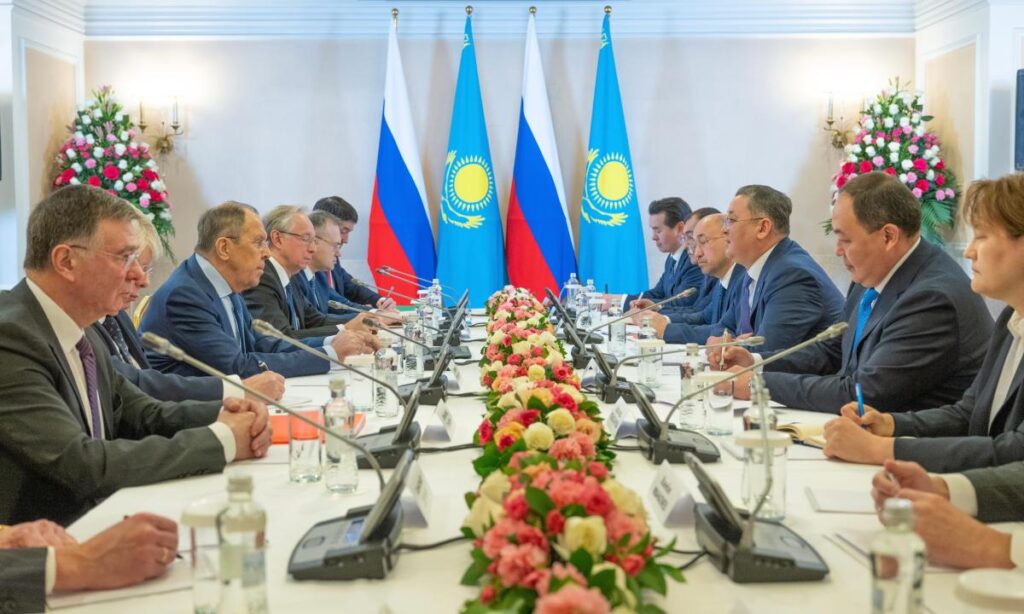
Russian Foreign Minister Sergey Lavrov arrived in Almaty this week to participate in two significant diplomatic events: a meeting of the CIS Council of Foreign Ministers and the eighth gathering of foreign ministers from Russia and Central Asia. On April 10, Lavrov held a bilateral meeting with Kazakh Foreign Minister Murat Nurtleu, during which both sides reviewed the implementation of earlier high-level agreements and discussed expanding cooperation in political, economic, and humanitarian spheres. “Maintaining the high dynamics of political dialogue and the consistent implementation of the agreements reached remain priorities in our bilateral cooperation. This is the direction set by our presidents,” Nurtleu stated. Lavrov, for his part, emphasized the depth of the strategic partnership between the two countries: “Kazakhstan is our reliable ally and neighbor. We traditionally support each other both at the bilateral level and on the international stage.” The foreign ministers also gave particular attention to strengthening trade and economic ties. On April 11, Lavrov will participate in a CIS Council of Foreign Ministers meeting. According to Russian Foreign Ministry Spokeswoman Maria Zakharova, the ministers will discuss major international and regional issues, including preparations for the 80th anniversary of Victory in the Great Patriotic War, and matters related to cultural and humanitarian cooperation, as well as border security. Later that day, Lavrov is expected to take part in the eighth meeting of foreign ministers of Russia and Central Asian states, Kazakhstan, Kyrgyzstan, Tajikistan, Turkmenistan, and Uzbekistan. The agenda includes political and economic priorities, joint humanitarian initiatives, and measures aimed at enhancing regional stability. Discussions will also focus on global challenges, particularly the coordination of security efforts in Central Asia. Lavrov's last visit to Kazakhstan was in November 2024, as part of preparations for President Vladimir Putin’s official visit to the country. Earlier, in 2023, Foreign Minister Nurtleu had met Lavrov in Moscow, highlighting the ongoing diplomatic engagement between the two nations.

EU Expands Engagement with Turkmenistan Amid Regional Focus

The European Union (EU) is deepening its engagement with Turkmenistan, as demonstrated by the recent visit of Eduards Stiprais, the newly appointed EU Special Representative for Central Asia. Stiprais arrived in Ashgabat from March 4 to 6, just three days after his appointment, highlighting the EU’s commitment to strengthening ties with Turkmenistan and the broader Central Asian region. High-Level Diplomatic Talks According to the EU Delegation to Turkmenistan, Stiprais held a series of high-level meetings to discuss EU-Turkmenistan cooperation, regional stability, and multilateral engagement. He met with Turkmenistan’s Minister of Foreign Affairs, Rashid Meredov, to exchange views on the current state and future prospects of their bilateral relationship. Discussions focused on economic cooperation, security, and regional collaboration. The Turkmen Foreign Ministry reported that Meredov and Stiprais also explored joint efforts in energy, transport and connectivity, and environmental protection. Key topics included methane emission reduction initiatives and the development of renewable energy sources. Both sides emphasized the importance of expanding trade and economic ties, advancing humanitarian and educational projects, and fostering stronger collaboration between Turkmen and European institutions and scientific centers. Upcoming Visit of European Commissioner Jozef Síkela The EU Delegation to Turkmenistan has announced that next week, European Commissioner for International Partnerships Jozef Síkela will visit Turkmenistan as the first stop on his March 12-18 tour of the five Central Asian countries. His trip is aimed at strengthening the EU-Central Asia partnership ahead of the first-ever EU-Central Asia Summit, scheduled for April 3-4, 2025. During his visit, Síkela will meet with government officials and private sector representatives and will tour Turkmenbashi Port, a key hub for the development of the Trans-Caspian Transport Corridor. Commenting on the visit, Síkela stated: “Central Asia is an important partner for the European Union, and our cooperation offers great potential for the future. More than ever, current global challenges emphasize the need for solid partnerships, and that is exactly what I aim to strengthen during my mission. My goal is to focus on key Global Gateway projects, which the EU and Central Asian partners are advancing together to create quality jobs, unlock new business opportunities, and improve essential services, from education to modern infrastructure.”