• KGS/USD = 0.01144 0%
  • KZT/USD = 0.00205 0%
  • TJS/USD = 0.10785 0.09%
  • UZS/USD = 0.00008 0%
  • TMT/USD = 0.28571 0.28%
  • KGS/USD = 0.01144 0%
  • KZT/USD = 0.00205 0%
  • TJS/USD = 0.10785 0.09%
  • UZS/USD = 0.00008 0%
  • TMT/USD = 0.28571 0.28%
  • KGS/USD = 0.01144 0%
  • KZT/USD = 0.00205 0%
  • TJS/USD = 0.10785 0.09%
  • UZS/USD = 0.00008 0%
  • TMT/USD = 0.28571 0.28%
  • KGS/USD = 0.01144 0%
  • KZT/USD = 0.00205 0%
  • TJS/USD = 0.10785 0.09%
  • UZS/USD = 0.00008 0%
  • TMT/USD = 0.28571 0.28%
  • KGS/USD = 0.01144 0%
  • KZT/USD = 0.00205 0%
  • TJS/USD = 0.10785 0.09%
  • UZS/USD = 0.00008 0%
  • TMT/USD = 0.28571 0.28%
  • KGS/USD = 0.01144 0%
  • KZT/USD = 0.00205 0%
  • TJS/USD = 0.10785 0.09%
  • UZS/USD = 0.00008 0%
  • TMT/USD = 0.28571 0.28%
  • KGS/USD = 0.01144 0%
  • KZT/USD = 0.00205 0%
  • TJS/USD = 0.10785 0.09%
  • UZS/USD = 0.00008 0%
  • TMT/USD = 0.28571 0.28%
  • KGS/USD = 0.01144 0%
  • KZT/USD = 0.00205 0%
  • TJS/USD = 0.10785 0.09%
  • UZS/USD = 0.00008 0%
  • TMT/USD = 0.28571 0.28%

Viewing results 1 - 6 of 28

Kazakhstan Hosts Meeting of Council of Foreign Investors

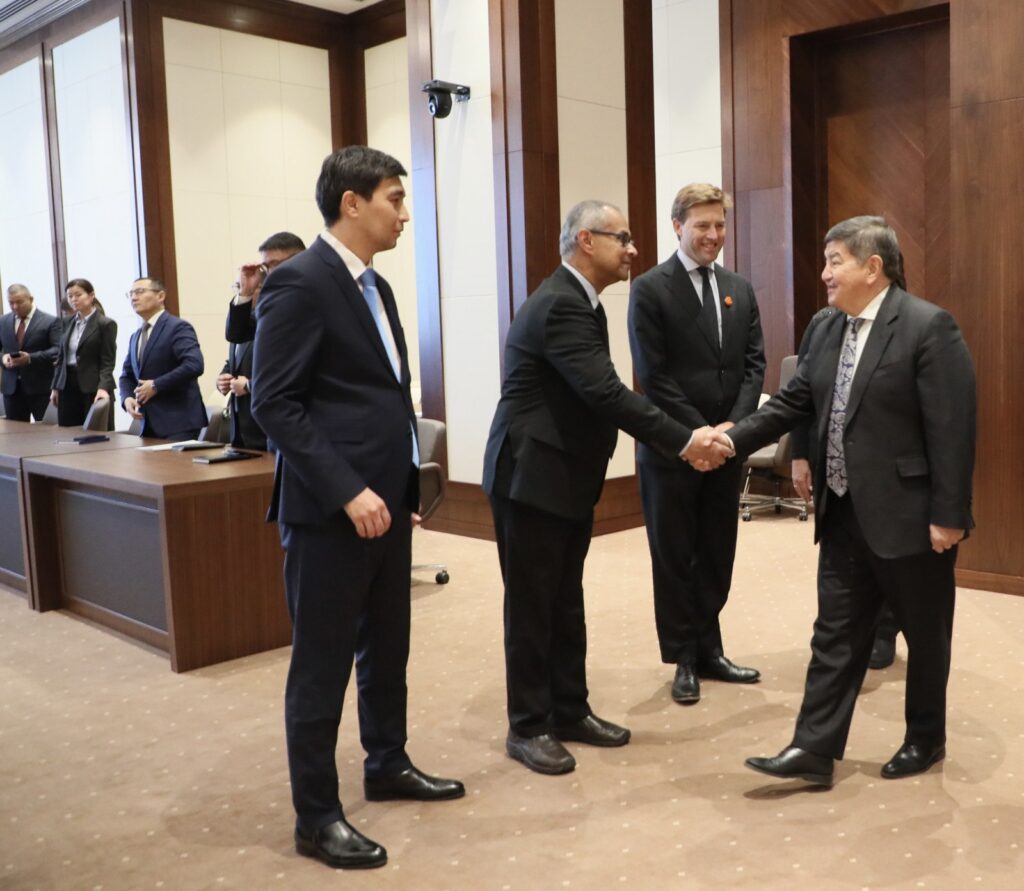
Astana's Palace of Independence hosted the 36th meeting of the Foreign Investors Council. Kazakhstan's President Kassym-Jomart Tokayev and Prime Minister Olzhas Bektenov attended the event. This year's central theme was “Kazakhstan's New Investment Cycle.” The meeting discussed strategies for the new investment cycle and the development of Kazakhstan's attractiveness to investors. Citing data from the International Institute for Management Development (IMD), Tokayev emphasized that Kazakhstan has become one of the world's top 35 competitive countries. “We set ourselves a rather ambitious goal: to attract $150 billion of foreign direct investment by 2029. To realize this goal, the Investment Headquarters under the Government is endowed with expanded powers to solve emerging problems promptly,” said the president. Tokayev noted the merits of international oil companies, which have played an essential role in the country's development. “Foreign investors have invested capital and provided advanced technologies and highly skilled labor. Their investments have contributed to the growth of our energy industry: over the past 30 years, oil production has tripled. Thanks to this, Kazakhstan has become one of the five countries with the highest oil production growth rates. Speaking about the future, we set a goal to overcome the threshold of 100 million tons per year,” he said. The meeting focused on increasing investment attractiveness in the “clean energy” sector. Specific agreements were reached with world companies such as Total, Svevind, ACWA Power, and Masdar on realizing 43 GW of “green” projects in Kazakhstan. In addition, Kazakhstan has a vast potential for developing nuclear energy, so creating an international consortium to realize the NPP construction project is under consideration. Kazakhstan focuses on the work of the Astana International Financial Center to strengthen cooperation in the financial sector. Tokayev spoke of the importance of continuing the dialog between the Council members and government agencies to improve the country's investment climate and implement new initiatives and specific projects. The meeting also included Odile Renaud-Basso, President of the EBRD; Nurlan Dosymbekov, Deputy Prime Minister and Minister of National Economy; Zhang Daowei, Chairman of the Board of the Kazakh Association “Baibazarov” and the Yerstanign Investors; Nikolai Podguzov, chairman of the EDB; Andrew Deleoni, president of Alstom for Africa, the Middle East, and Central Asia; and Vadim Vorobyov, Chief Executive Officer of PJSC Lukoil. Established in 1998, the Council of Foreign Investors is a platform for foreign investors and the government of Kazakhstan to discuss strategic objectives and find solutions to improve the business climate. From the Kazakhstani side, the Council is attended by government members and heads of several national companies and development institutions. Foreign participants include representatives of major international corporations and organizations, underscoring the global interest in investing in Kazakhstan. Last year's 35th Plenary Meeting of the Foreign Investors Council was also chaired by President Tokayev. The main topic of the meeting was “Digital Transformation of the Economy.” At the time, Tokayev emphasized that digitalization is a tremendous technological breakthrough and opportunity. The growth of digitalization is already dramatically impacting economic development and changing the game's...

World Bank Allocates $800 Million to Support Uzbekistan’s Market Economy Transition

The World Bank has allocated $800 million to accelerate Uzbekistan's transition to an inclusive and stable market economy. The government’s reform program, supported by the World Bank, aims to improve Uzbekistan’s business environment, increase agriculture, railways, and energy efficiency, improve public finance management, expand social services, and enhance readiness for environmental risks. Finance provided by the World Bank through highly concessional loans, is reported to offer the government low-cost, long-term repayment options "more favorable than those available in international financial markets." The financial package aims to achieve concrete results in the social protection system, combating gender-based violence, land security for farmers, business environment, public finance management, tackling climate change, water resource management, and environmental and climate assessment. It also includes reforming climate-sensitive investment in the railway and energy sectors. Uzbekistan has received $100 million from the World Bank in May to develop social protections. On 21 June, it was announced that Uzbekistan is the first country worldwide to receive payment from the World Bank for reducing carbon emissions through a policy crediting program and to date, has been awarded a $7.5 million grant for cutting 500,000 tons of carbon emissions.

Kyrgyzstan Proposes Banning Foreign Currencies in Domestic Transactions

Members of Kyrgyzstan's Parliament, the Jogorku Kenesh, have proposed that the national currency, the som, be established as the only means of payment in the country. The draft bill establishes that the som must be used in all domestic transactions, except for those related to export and import. It is seen as a step to reduce Kyrgyzstan's dependence on foreign currency, and stabilize the country's financial system. The draft law emphasizes that using foreign currencies -- especially in real estate, vehicle purchasing, and lending transactions -- creates additional risks for citizens. Sharp fluctuations in exchange rates make it more difficult for borrowers to repay debts. Similar measures have also been taken in Turkmenistan, where using foreign currency for everyday payments is almost entirely outlawed. Iraq has banned all domestic transactions to strengthen and stabilize the local currency, the Iraqi dinar.

World Bank Supports Economic Reforms in Kazakhstan

Approval was granted on March 14th for the loan of $600 million to Kazakhstan by the World Bank’s Board of Executive Directors. The loan will be used to implement the first phase of a series of reforms aimed to promote sustainable growth in the country and support Kazakhstan's transition to a more competitive, greener, and inclusive economy. As a carbon-intensive economy, Kazakhstan has ambitions to scale-up action on tackling climate change and reduce reliance on the extraction of natural resources. The reforms aim to increase renewable energy generation, gradually phase out fossil fuel subsidies, improve energy efficiency, and protect poor and vulnerable households. These measures are integral to Kazakhstan’s Nationally Determined Contributions, which are committed to reducing harmful emissions by 25 percent by 2030. “This new partnership with the Government of Kazakhstan supports tangible measures to advance a low-emissions development strategy as part of the global fight against climate change,” said Andrei Mikhnev, World Bank Country Manager for Kazakhstan. Funding provided by the World Bank, with a low-cost and long-term repayment option, will support the government’s reforms in the following areas: In developing greener and more efficient energy, the program implements key recommendations by the Country Climate and Development Report (CCDR) to support the reduction of Kazakhstan’s carbon footprint and contribute to global efforts to combat climate change. In developing more competitive digital and financial markets and promoting transparent procurement practices, the program aims to enable more firms to provide digital services, develop safeguards essential for a digital economy, allocate credit to support productivity and increase transparency in procurement practices. In targeting the poor and supporting regional development, reforms aim to strengthen the social protection system and enhance regional development, as part of broader efforts to enhance inclusion and provide greater opportunities nationwide.