
• KGS/USD = 0.01144 0%
  • KZT/USD = 0.00207 0%
  • TJS/USD = 0.10463 0%
  • UZS/USD = 0.00008 0%
  • TMT/USD = 0.28490 0%
  • KGS/USD = 0.01144 0%
  • KZT/USD = 0.00207 0%
  • TJS/USD = 0.10463 0%
  • UZS/USD = 0.00008 0%
  • TMT/USD = 0.28490 0%
  • KGS/USD = 0.01144 0%
  • KZT/USD = 0.00207 0%
  • TJS/USD = 0.10463 0%
  • UZS/USD = 0.00008 0%
  • TMT/USD = 0.28490 0%
  • KGS/USD = 0.01144 0%
  • KZT/USD = 0.00207 0%
  • TJS/USD = 0.10463 0%
  • UZS/USD = 0.00008 0%
  • TMT/USD = 0.28490 0%
  • KGS/USD = 0.01144 0%
  • KZT/USD = 0.00207 0%
  • TJS/USD = 0.10463 0%
  • UZS/USD = 0.00008 0%
  • TMT/USD = 0.28490 0%
  • KGS/USD = 0.01144 0%
  • KZT/USD = 0.00207 0%
  • TJS/USD = 0.10463 0%
  • UZS/USD = 0.00008 0%
  • TMT/USD = 0.28490 0%
  • KGS/USD = 0.01144 0%
  • KZT/USD = 0.00207 0%
  • TJS/USD = 0.10463 0%
  • UZS/USD = 0.00008 0%
  • TMT/USD = 0.28490 0%
  • KGS/USD = 0.01144 0%
  • KZT/USD = 0.00207 0%
  • TJS/USD = 0.10463 0%
  • UZS/USD = 0.00008 0%
  • TMT/USD = 0.28490 0%

Viewing results 1 - 6 of 7

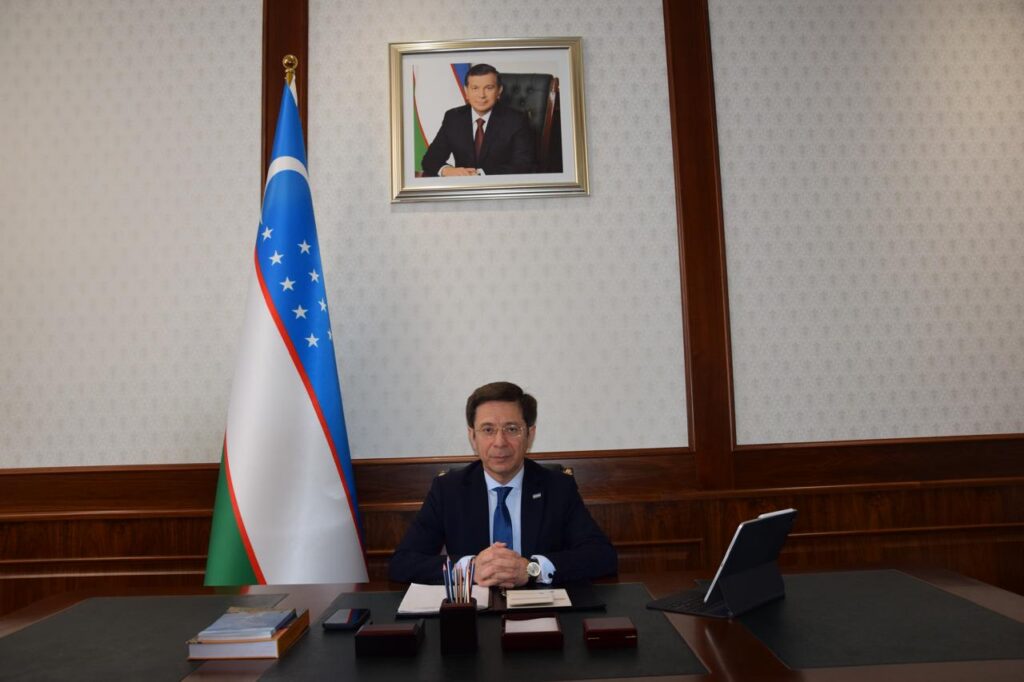
Uzbekistan’s Ambassador to Kazakhstan on Regional Integration and a Shifting Global Order

Amid shifting regional dynamics and an evolving global order, Uzbekistan has emerged as one of Central Asia’s most proactive diplomatic and economic actors. Since 2016, Tashkent has pursued an ambitious reform agenda at home while expanding cooperation with its neighbors and major global powers. In a wide-ranging interview with TCA, His Excellency Bakhtiyor Ibragimov, Ambassador Extraordinary and Plenipotentiary of the Republic of Uzbekistan to Kazakhstan, discusses regional integration, strategic partnerships, Afghanistan, China, and the future of economic diplomacy in Central Asia. TCA: Mr. Ambassador, Uzbekistan has demonstrated significant economic progress in recent years. What do you see as the key drivers behind this success? Ambassador Ibragimov: First of all, welcome to the Embassy of the Republic of Uzbekistan in Astana. We are familiar with your publication. We read it often, follow it, and analyze it. I would start with President Shavkat Mirziyoyev taking office at the end of 2016. It is no secret that until 2016, the Republic of Uzbekistan, despite its potential, was a fairly closed country. Our president always asks us, his representatives abroad, to speak openly about this. You cannot rewrite history or hide it. Relations with our neighbors were, frankly, at a very low level, and with some, there were no relations at all. The end of 2016 was a turning point, when reforms were not only declared but implemented and are now yielding results. One of President Mirziyoyev’s first foreign-policy priorities was normalization, and I want to emphasize this: normalization and then improving relations with neighbors. There is a saying in Uzbekistan: "If your neighbor is doing well, then you will also do well." Today, nearly a decade later, we can see that this policy is yielding results. Please note: this is not my personal assessment, but the assessment of international experts who recognize that the President has managed to achieve what once seemed impossible. I am speaking about regional integration with our neighbors. For example, a key issue for Central Asia is water. Many analysts warn that competition for water resources could, in the future, become a potential source of conflict. Two main rivers feed the region. Unfortunately, due to climate change, water volumes are not increasing year by year, while consumption is rising. We have managed to resolve almost all issues to date. In particular, based on the level of accumulation in the autumn-winter period in the upper reaches of the Amu Darya and Syr Darya rivers, and taking into account irrigation needs during the growing season, our water specialists jointly agree on and ensure the necessary water discharge within an agreed time frame. Uzbekistan, as you know, is located in the very center of Central Asia, bordering all Central Asian states, as well as Afghanistan. Today, border issues have largely been resolved. The final chord was struck on March 31, 2025, when the leaders of Uzbekistan, Tajikistan, and Kyrgyzstan signed an agreement on the border junction point, confirming the point of convergence of the three countries’ state borders. It should also be...

Jackson-Vanik Repeal Gains Momentum as U.S. Courts Central Asia

For many years, U.S. relations with Central Asia were primarily political in nature, while economic ties developed slowly. However, in the past year, engagement has intensified significantly, with recent agreements suggesting the U.S. is poised to strengthen its economic presence in the region. A recent statement by U.S. Secretary of State Marco Rubio reinforces this outlook. Calls to repeal the outdated Jackson-Vanik trade restrictions have been framed by U.S. officials as a way to facilitate trade with Central Asia and strengthen U.S. energy security. The Jackson-Vanik Amendment The Jackson-Vanik Amendment, enacted in 1974, restricts trade with countries that limit their citizens’ right to emigrate. At the time of its passage, Central Asia was still part of the Soviet Union.  The amendment prohibits granting most-favored-nation (MFN) status, government loans, and credit guarantees to countries that violate their citizens’ right to emigrate, and allows for discriminatory tariffs and fees on imports from non-market economies. The amendment was repealed for Ukraine in 2006, and for Russia and Moldova in 2012. However, it remains in effect for several countries, including Azerbaijan, Kazakhstan, Tajikistan, Turkmenistan, and Uzbekistan, which continue to receive only temporary normal trade relations. In May 2023, a bill proposing the establishment of permanent trade relations with Kazakhstan, which included repealing the Jackson-Vanik Amendment, was introduced in the U.S. Congress. A follow-up bill with similar provisions was submitted in February 2025. Then-nominee and now Secretary of State Marco Rubio previously noted that some policymakers viewed the amendment as a tool to extract concessions on human rights or to push Central Asian states toward the U.S. and away from Russia. However, he characterized such thinking as outdated, stating that, “In some cases, it is an absurd relic of the past.”  Rubio has consistently supported expanding U.S. ties with Central Asia. Expanding Cooperation In 2025, relations between the U.S. and Central Asia deepened significantly, particularly with Kazakhstan and Uzbekistan, which are seen by analysts as the primary beneficiaries of this cooperation. In late October 2025, U.S. Deputy Secretary of State Christopher Landau and U.S. Special Representative for South and Central Asia Sergio Gor visited Kazakhstan and Uzbekistan. One of the year’s major events was the Central Asia-U.S. (C5+1) summit held in Washington on November 6. Leaders of the five Central Asian states met with President Donald Trump and members of the U.S. business community. Uzbekistani President Shavkat Mirziyoyev also met with U.S. Senator Steve Daines, co-chair of the Senate Central Asia Caucus, with both sides focusing heavily on economic cooperation. At the summit, Uzbekistan finalized major commercial agreements with U.S. companies, including aircraft orders by Uzbekistan Airways and deals spanning aviation, energy, and industrial cooperation. Kazakhstan signed agreements worth $17 billion with U.S. companies in sectors including aviation, mineral resources, and digital technologies. This included a deal granting American company Cove Kaz Capital Group a 70% stake in a joint venture to develop one of Kazakhstan’s largest tungsten deposits, an agreement valued at $1.1 billion.  Further agreements were signed on critical minerals exploration. Kazakhstan and the...

Kyrgyzstan and China to Launch New Air Route as Part of Air Silk Road

Kyrgyzstan’s State Civil Aviation Agency has reached an agreement with China’s aviation authorities to open a new air route to Kashgar, located in China’s Xinjiang Uygur Autonomous Region. This will become the second direct air link between Central Asia and western China. According to the agency, the route will form part of the broader Air Silk Road initiative, an economic air corridor designed to facilitate freight and passenger connectivity between China and Europe. The new link is expected to significantly improve logistics, enhance flight safety, and create fresh opportunities for both cargo and passenger transportation across the region. The planned route is also anticipated to deepen Kyrgyzstan’s trade and economic relations with China, stimulate tourism, and further integrate the country into the international aviation network. The Air Silk Road, launched in 2014, is a component of China’s broader Belt and Road Initiative. Initially focused on air freight, the corridor now connects more than 100 cities in over 20 countries across Asia, Europe, and the Americas.
