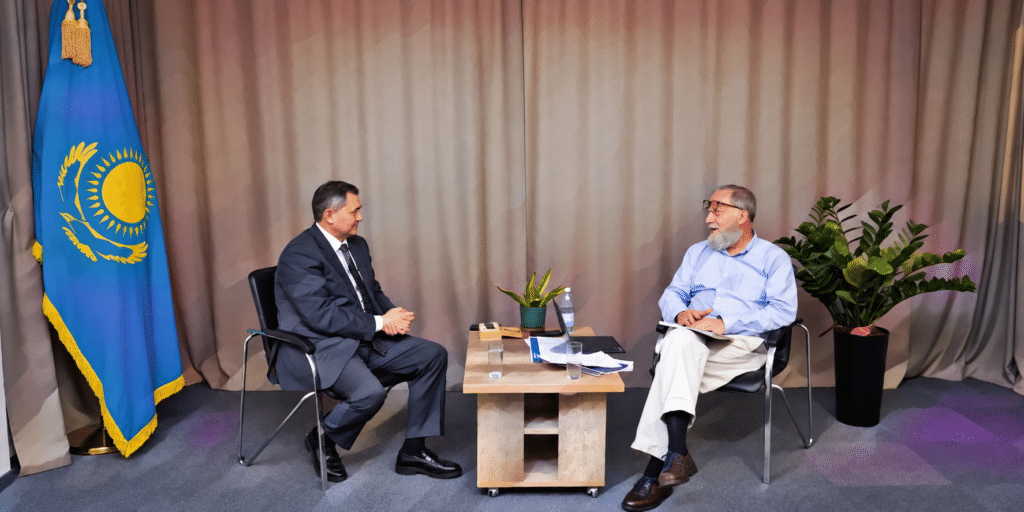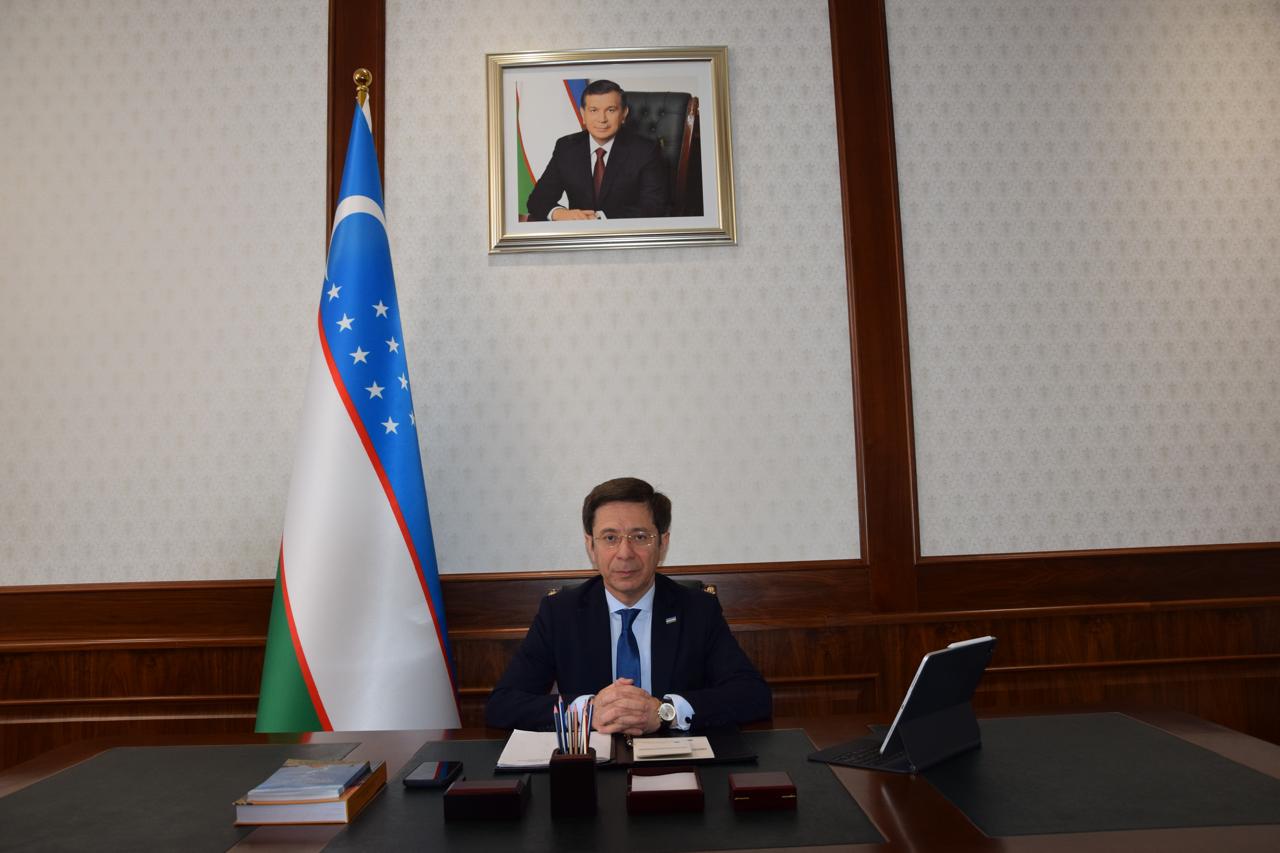
Amid shifting regional dynamics and an evolving global order, Uzbekistan has emerged as one of Central Asia’s most proactive diplomatic and economic actors. Since 2016, Tashkent has pursued an ambitious reform agenda at home while expanding cooperation with its neighbors and major global powers. In a wide-ranging interview with TCA, His Excellency Bakhtiyor Ibragimov, Ambassador Extraordinary and Plenipotentiary of the Republic of Uzbekistan to Kazakhstan, discusses regional integration, strategic partnerships, Afghanistan, China, and the future of economic diplomacy in Central Asia.
TCA: Mr. Ambassador, Uzbekistan has demonstrated significant economic progress in recent years. What do you see as the key drivers behind this success?
Ambassador Ibragimov: First of all, welcome to the Embassy of the Republic of Uzbekistan in Astana. We are familiar with your publication. We read it often, follow it, and analyze it.
I would start with President Shavkat Mirziyoyev taking office at the end of 2016. It is no secret that until 2016, the Republic of Uzbekistan, despite its potential, was a fairly closed country. Our president always asks us, his representatives abroad, to speak openly about this. You cannot rewrite history or hide it.
Relations with our neighbors were, frankly, at a very low level, and with some, there were no relations at all. The end of 2016 was a turning point, when reforms were not only declared but implemented and are now yielding results. One of President Mirziyoyev’s first foreign-policy priorities was normalization, and I want to emphasize this: normalization and then improving relations with neighbors.
There is a saying in Uzbekistan: “If your neighbor is doing well, then you will also do well.” Today, nearly a decade later, we can see that this policy is yielding results.
Please note: this is not my personal assessment, but the assessment of international experts who recognize that the President has managed to achieve what once seemed impossible. I am speaking about regional integration with our neighbors.
For example, a key issue for Central Asia is water. Many analysts warn that competition for water resources could, in the future, become a potential source of conflict. Two main rivers feed the region. Unfortunately, due to climate change, water volumes are not increasing year by year, while consumption is rising. We have managed to resolve almost all issues to date. In particular, based on the level of accumulation in the autumn-winter period in the upper reaches of the Amu Darya and Syr Darya rivers, and taking into account irrigation needs during the growing season, our water specialists jointly agree on and ensure the necessary water discharge within an agreed time frame.
Uzbekistan, as you know, is located in the very center of Central Asia, bordering all Central Asian states, as well as Afghanistan.
Today, border issues have largely been resolved. The final chord was struck on March 31, 2025, when the leaders of Uzbekistan, Tajikistan, and Kyrgyzstan signed an agreement on the border junction point, confirming the point of convergence of the three countries’ state borders.
It should also be noted that, on the initiative of our leader, a format was created: the Consultative Meeting of the Heads of State of Central Asia. This is a unique mechanism that allows our leaders to meet once a year to consider priorities, discuss regional and global geopolitical issues, and develop a common position. There is a saying that one person alone is not a warrior, but when there are several of you, in this case five states, then you are a force. Today, we see confirmation of this: the Central Asian platform is now recognized worldwide.
We also have Central Asia+ formats. Today, there is already a queue – requests to hold meetings – and we approach these thoughtfully based on our priorities. There is no point in meeting for the sake of meeting. This is the position of our leaders. We meet to discuss real, priority projects. All five leaders say their main priority is improving the well-being and standard of living of their people. Therefore, if we agree to certain formats and join them, we expect concrete results aimed at improving the quality of life in the region.
In November 2025, the seventh Consultative Meeting of the Heads of State of Central Asia was held in Tashkent. This became a landmark event because Azerbaijan joined this consultative format as a full participant. In this case, we went beyond strict geography, but we proceeded from the principle that together we are stronger. We have common goals, faith, culture, traditions, and history, and therefore a common view of the current situation in the world and in the region. We are ready to expand cooperation in formats that deliver practical results.
TCA: How do you assess current political and economic relations between Uzbekistan and Kazakhstan, and what priority areas of cooperation do you foresee in the coming years?
Ambassador Ibragimov: I would like to emphasize one important point: today, we understand that we are not competitors.
Kazakhstan and Uzbekistan are partners. This attitude comes from our leaders. It is time to leave old stereotypes in the past.
Today, Uzbekistan and Kazakhstan are the leading economic powers in the region. At the end of 2025, Kazakhstan’s GDP amounted to over $300 billion, while Uzbekistan’s GDP was $147 billion. Together, that is roughly $450 billion, almost half a trillion dollars. This is a significant figure.
Our partners and brothers in the region understand that the region’s economic stability will depend on the prosperity of its two leading economies. If you are economically weak, you will be treated accordingly on the international stage.
We can all see the geopolitical reality. The infrastructure of the global political system built after World War II is undergoing a major transformation. Frankly, the law of the strong is again coming to the fore.
I will not say that this is right; that is my personal view. There are international institutions; there are rules no one has rewritten. Nevertheless, today, despite appeals from the international community, the law of the strong, unfortunately, is again prevailing.
The political well-being of the region depends on economic conditions in Kazakhstan and Uzbekistan. We are aware of our responsibility and have therefore joined forces to ensure, first and foremost, the implementation of economic projects for the prosperity of Central Asia.
In 2012, trade turnover between Uzbekistan and Kazakhstan was about $2 billion. By the end of 2025, it had reached nearly $5 billion, a 2.5-fold increase over 10-12 years.
Our presidents have set a medium-term goal: to reach $10 billion by 2030. That would mean doubling trade turnover from current levels. It is ambitious, but we believe it is achievable because the prerequisites are already in place, and we have full political support.
If we speak about specific examples of industrial and investment cooperation, I would start with the Allur plant in the Kostanay region. Our Uzbek partner, UzAuto Motors JSC, supplies Chevrolet car kits from Uzbekistan, and we assemble the vehicles in Kostanay and sell them on the Kazakh market. In October 2025, Chevrolet was the best-selling brand in Kazakhstan.
This is gratifying and creates new incentives to deepen cooperation.
The second project is Silk Road Electronics in Karaganda, based on a similar concept. Components are supplied from Uzbekistan and assembled in Karaganda into vacuum cleaners, refrigerators, microwave ovens, and other home appliances.
Another project is the Central Asia International Center for Industrial Cooperation (CAIIC), located on the border between our two countries, in the Turkestan region on the Kazakh side and the Syr Darya region on the Uzbek side. Each country has allocated 50 hectares. There are no internal border controls within the center; the boundary is moved to the perimeter. At the initiative of our presidents, production facilities are being created there that are needed by the economies of Kazakhstan and Uzbekistan. First, we meet domestic needs, and only then do we export to regional and foreign markets.
This model creates a win-win situation because it reduces transportation costs, a very important issue for Uzbekistan. We have some commodity categories where transportation accounts for 70-80% of the cost structure, which is simply unreasonable.
This is a flagship project. We have nearly completed its initial implementation. A list of enterprises has been drawn up, auctions for land plots have been held, and construction is underway. The two presidents have tasked their governments with further expanding this project.
TCA: What role does China play in Uzbekistan’s economy? Some observers describe increasing competition among the United States, Europe, and China in Central Asia, particularly in areas such as trade, investment, and resources. There are also public concerns about growing economic dependence on China. How do you assess these perceptions?
Ambassador Ibragimov: I will express my personal opinion, but I think it aligns with our state policy. You’re right that China has been consistent in our region, unlike some Western countries. There is an explanation for this: in modern diplomacy, there is the concept of cross-cultural difference.
The East and the West can be very different in their approaches. Chinese and Eastern philosophy does not imply sudden movements; it implies gradual entry, the consistent establishment of partnerships, and, most importantly, respect for one’s partner. Dialogue should be on equal terms. In that sense, the Chinese model is closer to our spirit, because we are also an Eastern people. This is why the West may view it with some apprehension.
Unlike some Western countries, China does not only focus on the current economic situation. It enters economic relations designed for the long term. I am not saying the Chinese model is perfect, but in its basic principles, China respects its partners’ positions. This matters because Uzbekistan’s modern foreign policy and economic doctrine is based on the postulate that we advocate mutually respectful relations. If someone tries to force their position on us or lobby for their interests, it becomes difficult to negotiate.
China is more pragmatic in this regard. China is one of the world’s leading economies, yet it does business with us on equal terms. Today, China is Uzbekistan’s largest trading and investment partner, which is logical.
I have worked in the West and in the East and try to assess the situation in a balanced way. I am not saying one is good and the other is bad. The West has its approach, and the East has its own.
From a practical standpoint, it can take us a year, if not more, to consider an investment project or obtain a loan in the West. Sometimes there are requirements that are simply unrealistic. We are discussing an economic project, and we are asked, for example, when we will hold democratic elections, or why human rights were violated in a certain city, instead of discussing the financial model or economic indicators of the project.
With Chinese partners, within a year we can complete a feasibility study, sign agreements, and in some cases begin construction. In other words, it is no longer an amorphous idea: we understand that in two or three years, people living in the area will see real economic benefits.
China has a similar approach to our neighbors. China is also a major investment and trading partner for Kazakhstan, Tajikistan, Kyrgyzstan, and Turkmenistan.
I will give one example of Chinese pragmatism. Last summer, we held the second China–Central Asia summit in Astana. President Xi Jinping came, and all our presidents gathered to discuss pressing issues.
During the summit, the Chinese side raised a point: this is our second summit; we have met and agreed, but there is not enough movement. We asked what they proposed. They said: establish a permanent secretariat. Some may call this bureaucracy, but a secretariat has practical functions. They proposed taking on financing for the initial phase and locating the secretariat in Xi’an. What we agree would be monitored regularly, with periodic reports. The secretariat would include representatives from each country on a proportional basis, taking into account contributions.
Today, the secretariat is operational. Every three months, we receive information in Tashkent, and I’m sure it’s the same in other capitals, on the progress of approved projects. By the next summit, our leaders will have concrete information on what is working, what is not, and what requires attention.
I’ve discussed this with colleagues, ambassadors from a number of countries, and the China-Central Asia format is pragmatic.
We also have Central Asia-EU, Central Asia-Germany, Central Asia-Italy formats, and others. Some have existed for years. Summits are held, declarations are made, loud statements are issued, and then nothing happens.
Society has changed. People hear everything and track everything. After two or three months, they start asking questions.
For example, at the EU-Central Asia summit in Samarkand last year, it was announced that the EU would allocate €12 billion to Central Asia in four areas: green energy, critical minerals, transport, and digital infrastructure. But almost a year has passed, and the public is beginning to ask questions. We still cannot say much. My colleagues acknowledge this in private conversations.
TCA: What strategies do you consider most effective for strengthening Uzbekistan’s diplomatic and economic ties with Afghanistan, taking into account the interests of its neighbors in the region?
Ambassador Ibragimov: To understand Afghanistan and build the right relationship, you need to know its history.
Unfortunately, countries that are far away often do not learn from the past. I am not an expert on Afghanistan; I will express my personal view.
Over the past 200 years, no state or nation has been able to “break” these proud people, to put it simply. First, there were the British, then the Russian Empire, then the Soviet Union, and finally the United States. The whole world saw how the Americans left Afghanistan in 2021. From a power perspective, it is useless to talk to Afghanistan.
In 2021, as you know, there was a change of regime. Uzbekistan was among the first countries to establish a constructive, mutually beneficial dialogue with the new Afghan authorities on economic issues.
We also, and we say this openly, do not like, for example, their policy toward women and girls. What should we do? We do not live across the ocean. When all this is happening in your closest neighbor’s country, you must take that reality into account. Yes, we have not recognized them politically, but we are working closely with them on the economic agenda.
Uzbekistan has provided humanitarian aid 13-14 times since 2021. I will not talk about volumes now; the approach is what matters.
We have established a large cargo center in Termez through which international organizations, including the UN, the main donor, deliver humanitarian supplies.
At the beginning of last year, we launched the International Trade Center on the border between Uzbekistan and Afghanistan. Returning to Uzbek-Kazakh cooperation: the format was modeled on the Khorgos International Center for Boundary Cooperation, and we learned from the experience of our Kazakh brothers.
Today, the International Trade Center is operating profitably. The complex covers about 40 hectares. We created it as a humanitarian project, but it has become commercially successful. We did not expect this. We built a medical complex, and there is a queue; people sign up a week in advance. It is mainly used by Afghan citizens because they can stay there without a visa for 30 days. We were also surprised to see that women are coming; women make up 30-40% of those seeking medical services.
There is also a shopping complex where the Kazakh company KazTrade is represented. Food products, essential goods, household appliances, jewelry, and traditional Afghan carpets and stones are in demand.
Trade missions from Uzbekistan to Afghanistan are organized regularly, as are Afghan trade missions to Uzbekistan. At the end of last year, trade turnover amounted to $1.6 billion. These are significant figures.
On investment cooperation: Uzbekistan has traditionally supplied electricity to Afghanistan. A high-voltage line is being built between Surkhan and Pul-e Khumri, with a length of 250–300 kilometers. It is intended to cover 100% of the electricity needs of Kabul and the northern provinces.
Another project is the Tuti-Maidan gas field. It has been discussed for a long time and was known during the Soviet era. Today, its estimated reserves are more than one trillion cubic meters. If confirmed, and the chances are high, it would be among the largest fields in the region. Uzbek oil and gas companies have signed investment agreements with the Afghan authorities for joint exploration and development.
Of course, when we talk about Afghanistan, I must mention the mega-project: the Trans-Afghan Railway. This project is a priority for us. There are only two “double landlocked” countries in the world, meaning that to reach the sea, you must transit at least two countries, and Uzbekistan is one of them.
Uzbekistan is located in the center of Central Asia. The geographically closest port is Bandar Abbas in Iran, but Iran is under sanctions, and that region could become a hot spot at any moment. The Black Sea, as you can see, is in turmoil. The northern corridor toward Baltic and Russian ports is also under sanctions.
The only working corridor is through China’s ports, if but before these events average transit times for Uzbek cargo were 20-22 days, today, due to congestion, it is 50-60 days in the best-case scenario, and there are delays of up to 90 days. Therefore, the Trans-Afghan railway is of priority economic importance.
Preliminary estimates suggest that with this project, we could reach Pakistani ports such as Karachi and Gwadar in three to five days. Once the route reaches commercial capacity, 15-20 million tons of cargo could be transported annually. The project is ambitious because there is virtually no railway infrastructure in Afghanistan today.
The feasibility study is being prepared, and we expect it to be ready by summer. The study is being financed by the governments of Uzbekistan and Pakistan.
I repeat: the project is ambitious and costly, but we have no alternative. We will build this road no matter what. We are open about this with partners. Some acknowledge the project is interesting and would like to participate, but they raise political questions because the Taliban are not recognized. We believe that with political will, a practical solution can be found.
We are working actively with our Kazakh partners on this project. We share the understanding that a railway connecting Central Asia with the Arabian Sea via Afghanistan and Pakistan must be built, and we are moving confidently toward this goal.
I would reiterate that we call on the current Afghan authorities to ensure that basic human values are respected. While dialogue continues in the political arena, we are building cooperation on the economic track. Afghans are grateful for this constructive approach.
TCA: The President of Uzbekistan recently visited the United States, where major agreements were reached on cooperation in various sectors. Particular attention was paid to the joint development of rare earth elements. What prospects are opening up in this area for the countries of the region?
Ambassador Ibragimov: Again, I will express my point of view. The main focus today in relations with any country is the economic component. President Trump, as you know, has a policy of making deals. We also take a pragmatic approach: if we are interested, we sit down and talk.
We understand that the United States has strong technology, investment opportunities, and financial resources.
In any case, we are open to cooperation with everyone. If, at a later stage, a country or company wants to join a consortium, we are ready to discuss such proposals. Today, such models reduce economic risks. The more equal partners there are in terms of financial and technological capabilities, the more sustainable and economically promising a project is. That’s why we are ready for cooperation and dialogue.
We’re working actively with our Kazakh partners in this regard because we understand that the future is here and we must build strong, interconnected economies.
In Uzbekistan today, the largest enterprise in terms of critical minerals is Uzbek Technological Metals JSC (TMK), located in Chirchik. They work closely with Kazakhstan. I initiated the first contacts, and we traveled to the East Kazakhstan region, where three large enterprises have historically operated in this sector: Ulba Metallurgical Plant JSC, KazZinc LLP, and Ust-Kamenogorsk Titanium-Magnesium Plant JSC.
At the end of January, representatives of the Ulba plant were in Tashkent meeting with TMK and relevant ministries. Discussions continued on promising investment projects and mechanisms for implementation.
I want to emphasize once again: regional economic interests between our countries have been, are, and will remain a priority. At the same time, we are ready and willing to work in close cooperation with the world’s leading economic powers, including the United States, the European Union, and Japan.