• KGS/USD = 0.01144 0%
  • KZT/USD = 0.00211 0%
  • TJS/USD = 0.10832 0.18%
  • UZS/USD = 0.00008 0%
  • TMT/USD = 0.28490 0%
  • KGS/USD = 0.01144 0%
  • KZT/USD = 0.00211 0%
  • TJS/USD = 0.10832 0.18%
  • UZS/USD = 0.00008 0%
  • TMT/USD = 0.28490 0%
  • KGS/USD = 0.01144 0%
  • KZT/USD = 0.00211 0%
  • TJS/USD = 0.10832 0.18%
  • UZS/USD = 0.00008 0%
  • TMT/USD = 0.28490 0%
  • KGS/USD = 0.01144 0%
  • KZT/USD = 0.00211 0%
  • TJS/USD = 0.10832 0.18%
  • UZS/USD = 0.00008 0%
  • TMT/USD = 0.28490 0%
  • KGS/USD = 0.01144 0%
  • KZT/USD = 0.00211 0%
  • TJS/USD = 0.10832 0.18%
  • UZS/USD = 0.00008 0%
  • TMT/USD = 0.28490 0%
  • KGS/USD = 0.01144 0%
  • KZT/USD = 0.00211 0%
  • TJS/USD = 0.10832 0.18%
  • UZS/USD = 0.00008 0%
  • TMT/USD = 0.28490 0%
  • KGS/USD = 0.01144 0%
  • KZT/USD = 0.00211 0%
  • TJS/USD = 0.10832 0.18%
  • UZS/USD = 0.00008 0%
  • TMT/USD = 0.28490 0%
  • KGS/USD = 0.01144 0%
  • KZT/USD = 0.00211 0%
  • TJS/USD = 0.10832 0.18%
  • UZS/USD = 0.00008 0%
  • TMT/USD = 0.28490 0%

Viewing results 1 - 6 of 5

Kyrgyzstan Expands Domestic Drone Production

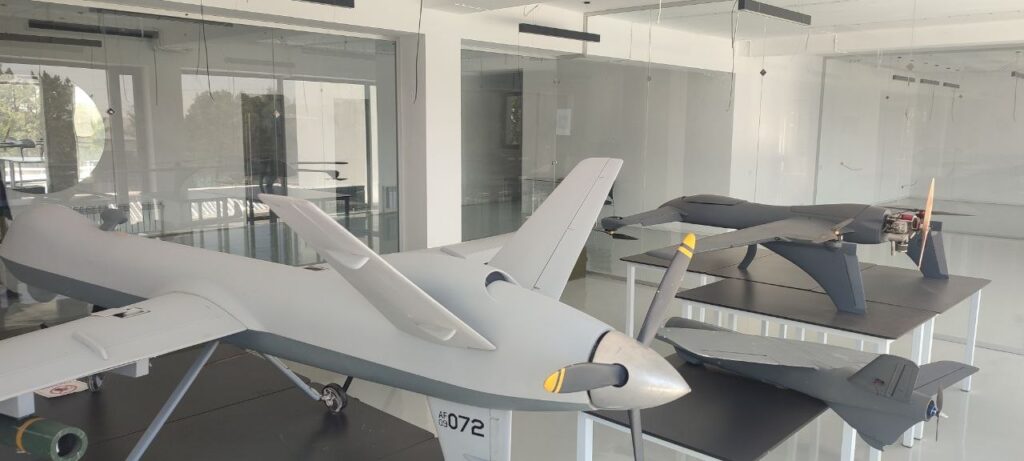
A private research center near Bishkek is expanding production of unmanned and robotic systems as Kyrgyzstan invests more heavily in drones, robotics, and military modernization. The Times of Central Asia previously reported that Kyrgyzstan’s armed forces have expanded alongside sharp increases in defense spending, with drones receiving particular attention since Bishkek acquired its first combat drones in late 2021. The Nanospace Research Center, which operates with private funding, was established with support from Kyrgyz President Sadyr Japarov, who allocated land for the facility and helped its founders establish cooperation with the country’s armed forces. According to Nanospace Director Ulan Salamatov, the center now holds a license to manufacture military-grade unmanned systems. “We assemble FPV drones, long-range reconnaissance drones, and ground robotic systems here. These machines can provide fire support or place explosives under enemy tanks,” Nanospace Director Ulan Salamatov told The Times of Central Asia. “Of course, we hope there will be no war, but in any case, we must be prepared.” Salamatov said the center initially copied foreign drone models before developing its own long-range reconnaissance drone, the SAARA-02. He claimed the drone was tested in Batken and used to support Kyrgyz forces during the 2021 Kyrgyz-Tajik border clashes. He said the center is now capable of independently producing high-altitude reconnaissance drones, with most parts manufactured in-house using 3D printers. Only chips and microprocessors are imported, while circuit boards and electronic systems are assembled at the facility. The center also produces FPV drones, though Salamatov said mass production remains limited by a lack of industrial machinery and equipment. In addition to aerial drones, Nanospace is building small, unmanned ground vehicles designed to deliver ammunition and supplies to frontline positions or evacuate wounded soldiers. Salamatov said the center is also working under contract with the Kyrgyz special forces to build the Kabylan combat vehicle, a robotic platform that can be equipped with machine guns or serve as a mobile drone-launching base. [caption id="attachment_50418" align="aligncenter" width="1280"] @TCA[/caption] Salamatov said the center plans to begin training students this autumn, opening its facilities to young engineers interested in robotics. The program will combine theoretical classes in the morning with practical training alongside the center’s engineers. Rocket engineering is another focus for the facility. Several prototype rockets developed by the team have already reached altitudes of two kilometers, Salamatov said. Engineers are now working on a rocket capable of reaching the stratosphere. If successful, he said, the center plans to launch a dedicated rocket engineering faculty next year.

Kazakh Robotics Team Wins Top Judged Award at U.S. Tech Event

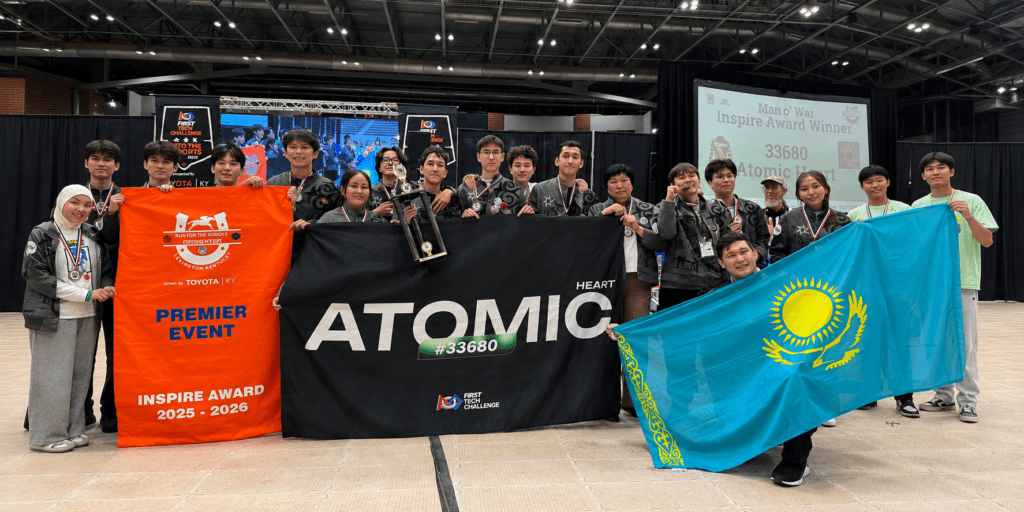
SHYMKENT — A school robotics team from southern Kazakhstan has won the Inspire Award in its division at a FIRST Tech Challenge Premier Event in the United States, giving Kazakhstan another international youth technology success. Atomic Heart, Team #33680 from NIS Shymkent Abai, won the Inspire Award at the Run for the Robots Premier Event - Man o' War Division, held May 28-30 at the Alltech Arena at the Kentucky Horse Park in Lexington, Kentucky. FIRST's official results list Atomic Heart as the division's Inspire Award winner, ahead of U.S. teams from Missouri and Pennsylvania. [video width="832" height="464" mp4="https://timesca.com/wp-content/uploads/2026/06/first_13_seconds_no_watermark.mp4"][/video] The Inspire Award is a judged prize rather than a match result. It recognizes a team that performs strongly across robot design, engineering documentation, presentation, outreach, and teamwork. For Atomic Heart, the result was notable because FIRST lists the team as a 2025 rookie team. "The first INSPIRE on Premier Event in KZ history," Asylbek Myrzakhmet, founder of Asylbek Robotics, said, describing the scale of the result for Kazakhstan's robotics community. Atomic Heart's route to Kentucky followed a difficult first season. The team competed in official events in Kazakhstan before reaching the U.S. event. Its early tournaments included technical failures and defeats, but those setbacks helped the students improve their robot and engineering process before the Premier Event. [caption id="attachment_50379" align="aligncenter" width="1774"] The robot ATOM[/caption] The competition also required the students to present their work in English to international judges, adding a public-speaking and project-defense challenge to the engineering task. Team member Alisultan Otan said the trip to Kentucky also brought an unexpected cultural connection. "When we arrived in Kentucky, I was surprised by how strong the horse culture is here," he said. "It immediately reminded me of Kazakhstan, where the horse is an integral part of our history and lifestyle. Despite the distance, it made us feel deeply connected to the place." FIRST Tech Challenge is a youth robotics program for students aged 12-18, in which teams design, build, and program robots for an annual game. FIRST says the program combines engineering, STEM skills, community outreach, and teamwork. Kazakhstan has placed growing emphasis on technical and digital skills in schools, including reforms focused on vocational education and digital technologies. Atomic Heart's result points to the value of school-level robotics programs that give students early exposure to engineering, programming, and international competition.

Kazakhstan Faces Shortage of Doctors and IT Specialists

Kazakhstan continues to face labor shortages in healthcare, information technology, engineering, and the creative industries, according to the Ministry of Labor and Social Protection. The ministry published a list of the country’s most in-demand professions based on data from state information systems and the Enbek.kz employment portal. The most acute shortages remain in the medical sector. According to the ministry, there are only around 100 job seekers’ resumes for 469 vacancies for obstetricians and gynecologists. For pediatricians, 448 vacancies were recorded against 139 resumes, while anesthesiologists and intensive care specialists accounted for 300 vacancies and only 75 resumes. “Shortages are also observed among oncologists, neonatologists, and endocrinologists,” the ministry said. Demand also remains high for information technology specialists. More than 500 vacancies are currently open for software application developers, while around 355 vacancies are available for graphic designers. According to the Unified System for Recording Labor Contracts, more than 45,000 employment contracts have been signed since the beginning of 2026 in the country’s most in-demand professions. The largest number of contracts, around 8,000, involved software developers. Obstetricians-gynecologists, pediatricians, and application programmers were also actively recruited. The ministry acknowledged that Kazakhstan is partially addressing labor shortages by attracting foreign specialists. “To attract valuable personnel, Kazakhstan operates a simplified employment procedure for foreign specialists,” the ministry said. According to officials, the list of in-demand professions includes more than 50 occupations and allows highly qualified foreign workers to obtain permanent residence permits in Kazakhstan. This year, 55 labor contracts have been signed with foreign specialists, primarily in the automation sector. The ministry said that, overall, the domestic labor market covers demand for most key professions, although shortages in the healthcare sector remain persistent. The Times of Central Asia previously reported that Kazakhstan’s small and medium-sized businesses are also facing a severe labor shortage.

Ancient Water Pipeline Unearthed on 65-Meter Hill in Tajikistan

Archaeologists in Tajikistan have uncovered a remarkable ancient water pipeline system atop a 65-meter hill at the Mugtepa settlement, believed to have been constructed approximately 1,500 years ago. The site, towering above the city at the height of a modern twenty-storey building, once hosted fortresses of the rulers of Uratyube across various historical periods. For nearly three decades, however, the archaeological site remained neglected. Construction in 2017-2018 further compromised its integrity, leading many to assume its secrets were lost forever. That changed in the summer of 2025, when an expedition from the Department of Archaeology, Ethnography, and Religious Studies at Khujand State University, led by Professor Nabijon Rakhimov, began new excavations. The project, supported by staff from the Kalai Mug Historical and Cultural Complex under Mirzo Olimov, proceeded without official funding but succeeded thanks to the contributions of students and specialists. Between June 18 and July 18, the team examined three segments of the aqueduct system. Water was drawn from a spring at the base of a nearby hill and transported via ceramic pipes known as kuburs, each approximately 40 cm in length. The pipes were joined using waterproof alabaster mortar and laid in trenches 85 cm wide and 20 cm deep. Small pools, or hauzes, were found along the route, likely used for water collection. All components of the system were uniformly manufactured, suggesting the existence of specialized production workshops. Unearthing Everyday Life In soil layers dating to the 5th to 8th centuries, researchers discovered pottery, stone grain grinders, and spindle whorls, evidence of a thriving agricultural and textile economy. Deeper strata revealed artifacts from earlier eras, ranging from the 1st-3rd centuries CE to the Achaemenid and Hellenistic periods (6th-1st centuries BCE). Notable finds included fragments of tall-stemmed goblets, cup-shaped vessels, and red-slip bowls. “Archaeological monuments are not just stones and shards; they are material evidence of our history. Without protection and careful treatment, they can disappear,” said Rakhimov. The team now plans to petition the Agency for the Protection of Monuments under the Government of Tajikistan to secure official support for continued excavations and preservation efforts at Mugtepa. Other Significant Finds in the Region This discovery follows several notable archaeological breakthroughs in Tajikistan in recent years. In 2023, a 7th-century sewer system was uncovered in Istaravshan by architect Amindjonov Khomid and Professor Rakhim Nabiev. The structure, approximately 1,300 years old, highlights the advanced engineering of the period. A rare 6th-century jug, made of concrete and coated in clay, was found nearby. In May 2025, archaeologists from the National Museum of Tajikistan discovered a Kushan-era clay vessel near the village of Sarband, inscribed in the Bactrian language. The inscription read, “This water jug belongs to a woman named Sagkina,” offering a rare glimpse into ancient literacy and social life. And in November 2024, an international team led by Professor Yossi Zeidner of the Hebrew University reported the discovery of artifacts dating back 150,000 years at the Soyi Khavzak site in the Zeravshan Valley. Finds included stone tools, animal bones,...

German University Launches Bachelor’s Programs in Kazakhstan

Germany’s Anhalt University of Applied Sciences has opened a branch campus in Almaty, marking a new milestone in German-Kazakh educational cooperation. The new campus, based at Energo University, is now accepting applications for bachelor’s programs in Biomedical Engineering and Electrical Engineering and Information Technology. The initiative is supported by Kazakhstan’s Ministry of Science and Higher Education and the German Consulate General in Almaty. According to the ministry, the programs were selected to align with current demands in Kazakhstan’s labor market. Graduates will receive dual diplomas, one from Anhalt University and one from a Kazakhstani institution. A total of 100 state-funded scholarships will be awarded to students who qualify through a competitive selection process. The Almaty campus features modern classrooms and laboratories equipped for practical and research-based instruction in electronics, biomedical science, and information technology. “This is a large-scale initiative for young people in Kazakhstan who are eager to learn,” said Jörg Bagdahn, President of Anhalt University. “They now have the opportunity to obtain a German engineering degree without leaving their country.” Courses will be taught by faculty from Germany, and German language instruction is included in the curriculum. “Partnership with Anhalt University is a strategic step for Energo University,” said Rector Gani Cosmetology. “We are creating a platform to deliver top-tier European education locally.”