
• KZT/USD = 0.00214
  • TJS/USD = 0.10810
  • UZS/USD = 0.00008
  • TMT/USD = 0.29760
  • KZT/USD = 0.00214
  • TJS/USD = 0.10810
  • UZS/USD = 0.00008
  • TMT/USD = 0.29760
  • KZT/USD = 0.00214
  • TJS/USD = 0.10810
  • UZS/USD = 0.00008
  • TMT/USD = 0.29760
  • KZT/USD = 0.00214
  • TJS/USD = 0.10810
  • UZS/USD = 0.00008
  • TMT/USD = 0.29760
  • KZT/USD = 0.00214
  • TJS/USD = 0.10810
  • UZS/USD = 0.00008
  • TMT/USD = 0.29760
  • KZT/USD = 0.00214
  • TJS/USD = 0.10810
  • UZS/USD = 0.00008
  • TMT/USD = 0.29760
  • KZT/USD = 0.00214
  • TJS/USD = 0.10810
  • UZS/USD = 0.00008
  • TMT/USD = 0.29760
  • KZT/USD = 0.00214
  • TJS/USD = 0.10810
  • UZS/USD = 0.00008
  • TMT/USD = 0.29760
10 August 2026

Viewing results 1 - 6 of 2

Pakistan and Uzbekistan Turn to China for Transit Trade Amid Regional Security Risks

Pakistan and Uzbekistan have agreed in principle to reroute some of their bilateral transit trade through China. The move follows worsening security that closed traditional routes through Afghanistan and disrupted alternatives through Iran, according to Pakistan Today. The two governments are expected to formalize the decision by signing amendments to the Pakistan-Uzbekistan Transit Trade Agreement during the visit of Uzbekistan’s deputy prime minister to Pakistan on July 21. Under the revised agreement, the China corridor will become an official transit route, allowing cargo to travel through Pakistan’s Sost Dry Port, cross western China, and continue into Central Asia. “The protocol is aimed at expanding transit options and ensuring uninterrupted movement of goods between the two countries despite evolving regional security challenges,” a Pakistani official familiar with the negotiations told Pakistan Today on condition of anonymity. The arrangement will provide Pakistan with an additional route to Central Asian markets while allowing Uzbekistan to maintain access to Pakistani seaports despite growing instability across the region. The decision marks a significant shift in regional trade planning. For years, the shortest and most commercially attractive route between Pakistan and Uzbekistan passed through Afghanistan. That corridor was also expected to become part of the planned Uzbekistan-Afghanistan-Pakistan railway linking Central Asia with ports on the Arabian Sea. Those plans have largely stalled following the sharp deterioration in relations between Islamabad and Kabul. Pakistan closed its main border crossings, including Torkham and Chaman, after cross-border clashes in October 2025. Trade through the crossings has remained suspended amid continuing security tensions and disagreements over militant groups operating from Afghan territory. The disruption has affected not only transit cargo but also Pakistan’s direct exports to Afghanistan, traditionally an important market because of its limited domestic manufacturing base. Pakistani companies supply cooking oil, cement, soap, pharmaceuticals, aluminum cans, food products, and other consumer and construction goods to Afghanistan. Business groups cited by Pakistan Today estimated earlier this year that the prolonged border closure was costing Pakistani exporters around $177 million every month, while warning that customers in Afghanistan and Central Asia could permanently shift to suppliers using other regional transport routes. Pakistan initially sought to compensate by expanding transport links through Iran. In April, Islamabad operationalized new transit corridors through both Iran and China, including an Iranian route connecting Pakistani ports with Central Asian markets while bypassing Afghanistan. However, renewed military confrontation between Iran and the United States has raised fresh concerns about that option. Continuing attacks on infrastructure and commercial shipping around the Strait of Hormuz have increased freight costs, insurance premiums, and energy-related risks, reducing the corridor’s reliability. Routing trade through China would allow both countries to bypass security problems affecting routes through Afghanistan and Iran. It would also advance Pakistan’s long-term plan to extend the China-Pakistan Economic Corridor toward Central Asia. The new route, however, is expected to come with trade-offs. Transporting goods through China will involve longer distances, additional border procedures, higher handling costs, and extended transit times. As a result, the corridor is expected to...

Opinion: The Southern Dimension of the Middle Corridor – Afghanistan’s Role in Eurasia’s New Logistics Landscape

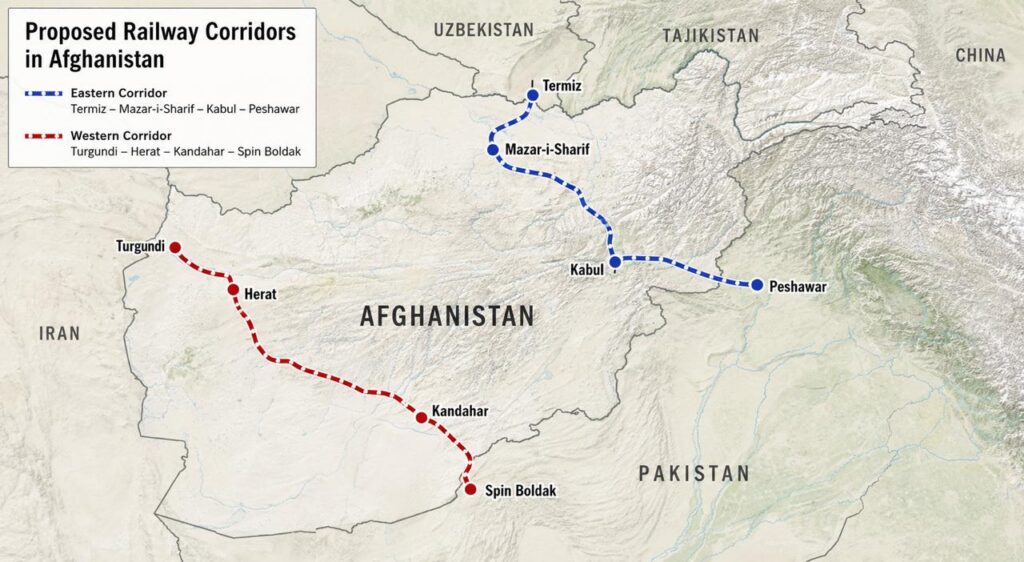
Afghanistan’s integration into the Trans-Caspian International Transport Route (TITR) is extending beyond local logistics and evolving into one of Eurasia’s key geo-economic projects. Amid the global transformation of supply chains, Central Asia has an opportunity to move beyond its role as a transit periphery and become an active participant in shaping new economic corridors, creating a full-fledged “southern dimension” of Eurasian connectivity. Two Routes: Strategic and Operational Two main directions for Afghanistan’s integration into the Eurasian transport system are currently under discussion, each reflecting a distinct development logic: strategic and pragmatic. The “Eastern Branch” (Termez-Mazar-i-Sharif-Kabul-Peshawar) is traditionally viewed as the primary trans-Afghan route. Its key advantage is direct access to the ports of Karachi and Gwadar, providing the shortest connection between Central Asia and the Indian Ocean. At the same time, geography makes the project highly complex. The route passes through the central and eastern regions of Afghanistan, including the Hindu Kush mountain range, where long tunnels and bridges would be required. This would sharply increase construction and maintenance costs, extend implementation timelines, and heighten security and infrastructure risks. According to available estimates, the project could cost around $5 billion and handle 15-20 million tons of cargo annually. However, the lengthy investment cycle and dependence on political stability mean implementation remains a long-term prospect. The “Western Branch” (Turgundi-Herat-Kandahar-Spin Boldak) represents an alternative logistics corridor based on more favorable geography. Western Afghanistan is characterized by predominantly flat, semi-arid terrain, reducing the need for complex engineering structures and allowing the project to be implemented in phases. This significantly lowers capital costs, shortens construction timelines, and reduces infrastructure risks. The western route’s initial capacity is estimated at 7-10 million tons of cargo annually, making it the more realistic option for medium-term planning. An additional advantage is its geo-economic flexibility. Via Herat, the route could be integrated not only southward through Pakistan, but also westward through Iran, providing access to Persian Gulf ports. This would transform it into a multi-directional corridor capable of serving several logistics flows simultaneously. The Eastern Branch, therefore, remains the strategic option offering the shortest route to the ocean but requiring substantial investment and time. The Western Branch, meanwhile, presents a more pragmatic solution: faster to implement and more flexible from a geo-economic standpoint. The Role of Turkmenistan and Kazakhstan in the “Western Maneuver” The implementation of the western trans-Afghan corridor depends on close coordination between two key regional players, Kazakhstan and Turkmenistan, which form the northern foundation of the future route by providing access to the Caspian Sea and, beyond it, global markets. Astana and Ashgabat are effectively creating a new geo-economic framework that could transform Central Asia from an isolated region into a strategic crossroads linking the Caspian Sea with the Indian Ocean. In 2026, Kazakhstan moved toward deeper institutionalization of the initiative, making the route through Herat and Kandahar a government priority. Astana’s strategy is multifaceted. In addition to establishing a permanent interdepartmental commission, Kazakhstan is actively seeking to attract international operators such as the Emirati AD...