• KZT/USD = 0.00226
  • TJS/USD = 0.10830
  • UZS/USD = 0.00009
  • TMT/USD = 0.29760
  • KZT/USD = 0.00226
  • TJS/USD = 0.10830
  • UZS/USD = 0.00009
  • TMT/USD = 0.29760
  • KZT/USD = 0.00226
  • TJS/USD = 0.10830
  • UZS/USD = 0.00009
  • TMT/USD = 0.29760
  • KZT/USD = 0.00226
  • TJS/USD = 0.10830
  • UZS/USD = 0.00009
  • TMT/USD = 0.29760
  • KZT/USD = 0.00226
  • TJS/USD = 0.10830
  • UZS/USD = 0.00009
  • TMT/USD = 0.29760
  • KZT/USD = 0.00226
  • TJS/USD = 0.10830
  • UZS/USD = 0.00009
  • TMT/USD = 0.29760
  • KZT/USD = 0.00226
  • TJS/USD = 0.10830
  • UZS/USD = 0.00009
  • TMT/USD = 0.29760
  • KZT/USD = 0.00226
  • TJS/USD = 0.10830
  • UZS/USD = 0.00009
  • TMT/USD = 0.29760
27 September 2026

Viewing results 1 - 6 of 7

Astana Finance Days: Rewiring Finance at Institutional Scale – The Case for Deeper Financial Markets

Kazakhstan needs deeper financial markets and a system less dependent on banks, senior financial officials told Astana Finance Days on September 9, 2026. Speakers at the Astana International Financial Centre (AIFC) explored how digital finance could support that shift during the plenary session, "Innovation at Institutional Scale: Rewiring the Architecture of Finance." The turnout was standing-room only. Over the next fifty minutes, the panelists discussed Kazakhstan’s ambitions as a financial hub and the conditions needed to advance them. Moderator Sallianne Taylor, Bloomberg's EMEA Head of Government Relations, opened by asking what is fundamentally changing in the architecture of global finance, and what it means for Kazakhstan. There were five panelists: Timur Suleimenov, Governor of the National Bank of Kazakhstan; Renat Bekturov, Governor of the AIFC; Timur Turlov, Chief Executive of Freedom Holding Corp.; Sergio Mello, Global Head of Stablecoin Solutions at Anchorage Digital; and Balaji Srinivasan, founder of Network School and bestselling author of The Network State. The Governor's Priority: Stability Before Speed Governor Suleimenov began by naming "geopolitical tension" as the backdrop to today's discussions. "This is the elephant in the room, which we cannot ignore," he said, without further comment. He then described trade and finance flows as changing fundamentally, pointing to "division across the Atlantic. We're seeing trade wars, semi-trade wars across the world." He explained that "finance has always been a partner with trade, investment and finance." That atmosphere of uncertainty "reshapes financial flows," he said. Turning to technology, he noted that "with the invention of blockchain, cryptocurrencies, stablecoins, and everything in between, the traditional financial system has started to undergo very fundamental change. I think we're still in the rule-setting phase." As a result, he said, "There is no set of global rules for decentralized finance, for digital finance, crypto finance. Many countries are looking to strike the right balance between the traditional financial institutions such as banks or commodities or securities markets, and the new ways of doing finance that the market is offering." For Kazakhstan specifically, he argued the moment favors the country rather than threatens it. "I think for Kazakhstan, it's more of an opportunity," he said, pointing to its standing as the region's largest economy by GDP and GDP per capita, and its position as "the biggest financial system, the best financial system, the most capitalized" in Central Asia. That confidence carried into the moderator's next question: "As a central banker, how do you balance innovation with preserving that financial stability and trust?" Suleimenov called it "a never-ending story," then offered the line that framed the whole session: "When you see something new, and you don't have the rules for it, of course you have to evaluate it based on its merits and based on principles rather than rules, and then you come up with rules." He was candid about the risk that comes with new financial technology, but just as quick to put it in proportion. "What we've been seeing in Kazakhstan, I mean, it's 90% positive," he said, acknowledging...
Astana Finance Days 2026 to Draw Global Investors to Kazakhstan

Astana will host the ninth Astana Finance Days on September 9–10. This year, organizers expect more than 5,500 participants from over 80 countries, and the geography of the guests reflects the markets Kazakhstan has increasingly looked to for capital: the United States and Europe, China and Hong Kong, the Gulf states, and its Central Asian neighbors. The announced speakers include representatives of BlackRock, Goldman Sachs, Brookfield, FTSE Russell, Bloomberg, Hong Kong Exchanges and Clearing, the Shanghai Stock Exchange, and China International Capital Corporation. Representatives of Binance, Mastercard, and Telegram/TON are also expected. Kazakhstan will be represented by National Bank Governor Timur Suleimenov, Minister of Artificial Intelligence and Digital Development Zhaslan Madiyev, Freedom Holding Corp. CEO Timur Turlov, and others. This year’s agenda reflects the region’s continuing search for new sources of financing: capital markets, investment products, financing for the real economy, regulation, financial technology, and cross-border investment. The forum will be held under the theme “Delivering Impact. Capital in Action.” Astana Finance Days was launched in 2018 alongside the establishment of the Astana International Financial Centre (AIFC). The first forum was closely linked to the creation of Kazakhstan’s new financial hub, but the range of participants has expanded considerably over the past eight years. Last year, AFD attracted more than 5,500 participants from 82 countries. They included representatives of investment firms managing approximately $1.5 trillion in combined assets. Over two days, the forum hosted 40 events featuring 160 speakers, while the Astana International Exchange announced four listings and seven agreements were signed. China and Hong Kong stand out in the 2026 guest list. Representatives of the Hong Kong Investment Corporation, the Hong Kong and Shanghai Stock Exchange, and CICC are expected in Astana. BlackRock, Goldman Sachs, and Brookfield are also represented. Kazakhstan has increasingly sought investment from the West, China, and the Middle East, so the range of institutions represented may be more significant than the overall attendance figure. There is another reason AFD goes beyond a conventional financial conference. The AIFC was established as a separate jurisdiction with its own court, regulator, and legal framework based on the principles of English common law. Kazakhstan designed it to make it easier for foreign businesses to enter the local market and raise capital. Thousands of companies from dozens of countries are now registered with the AIFC, and Astana Finance Days has effectively become an annual meeting point between businesses operating within this system and potential investors and new partners. Investment will not be the only subject under discussion in September. The program includes digital asset regulation, new financial technologies, capital markets, and corporate financing. A separate AFD Exhibition will bring together banks, asset managers, investment firms, and fintech projects.   The Times of Central Asia is a media partner of Astana Finance Days 2026. Special coverage coming soon.

Uzbekistan to Host Inaugural Silk Road Finance & Technology Forum in August

Uzbekistan is set to host the inaugural Silk Road Finance and Technology Forum in August, a new international event aimed at advancing the country’s role as a regional hub for financial technology and innovation. According to a joint announcement by the Central Bank of Uzbekistan and the Global Finance & Technology Network (GFTN), the forum will take place in Tashkent from August 24 to 26, 2026. The event will be held at Central Asian Expo Uzbekistan and the Islamic Civilization Centre. It is expected to bring together policymakers, regulators, investors, entrepreneurs, and technology leaders from Central Asia and beyond. The organizers describe the forum as Uzbekistan’s flagship platform for discussions on finance, innovation, and public policy. It is being launched as the country pursues an ambitious strategy to become a leading fintech center in the region. Uzbekistan’s financial technology sector has expanded rapidly in recent years, driven by growing digital adoption and a young population of more than 37 million people. According to the organizers, nearly 70% of the population now uses digital services, creating favorable conditions for the development of financial technologies. The forum comes as Uzbekistan implements a presidential strategy for the sector through 2030. The plan includes attracting $1 billion in foreign investment, training more than 5,000 specialists, licensing more than 200 market participants, supporting more than 100 startup graduates from incubation programs, and testing digital currencies and stable tokens. The Central Bank has also announced plans to expand the country’s financial innovation infrastructure. These initiatives include the creation of a globally accessible Regulatory Sandbox 2.0, the Q-FINEX Quantum Finance Testbed, and a dedicated $50 million venture fund for fintech development. Authorities are also working on regulatory frameworks covering open banking, digital payments, buy now, pay later services, and cybersecurity resilience. The three-day forum will be organized around five main themes: open banking, digital assets and stablecoins, cross-border payments, Islamic finance, and innovation and investment. The event’s theme, “Al-Jabr,” references the Arabic concept of “bringing parts together,” which gave rise to algebra, and honors the legacy of the ninth-century scholar Al-Khwarizmi, who was born in Khwarezm, in present-day Uzbekistan. Organizers say the theme points to the forum’s goal of linking finance with technology policy. The forum is being co-hosted with Ant International and joins GFTN’s global network of events, which includes the Singapore FinTech Festival, the Point Zero Forum in Zurich, GFTN Forum Japan, and the Black Swan Summits. “Innovation flourishes when trust, talent and capital converge,” said Sopnendu Mohanty, group CEO of GFTN. He said the forum would help connect global expertise with regional ambitions and support Central Asia’s emergence as a center for financial innovation. GFTN is a Singapore-based not-for-profit organization established by the Monetary Authority of Singapore in 2024. It promotes financial innovation and inclusion through partnerships with public- and private-sector institutions.

INMerge Tashkent Showcases Rise of Uzbekistan as Regional Innovation Hub

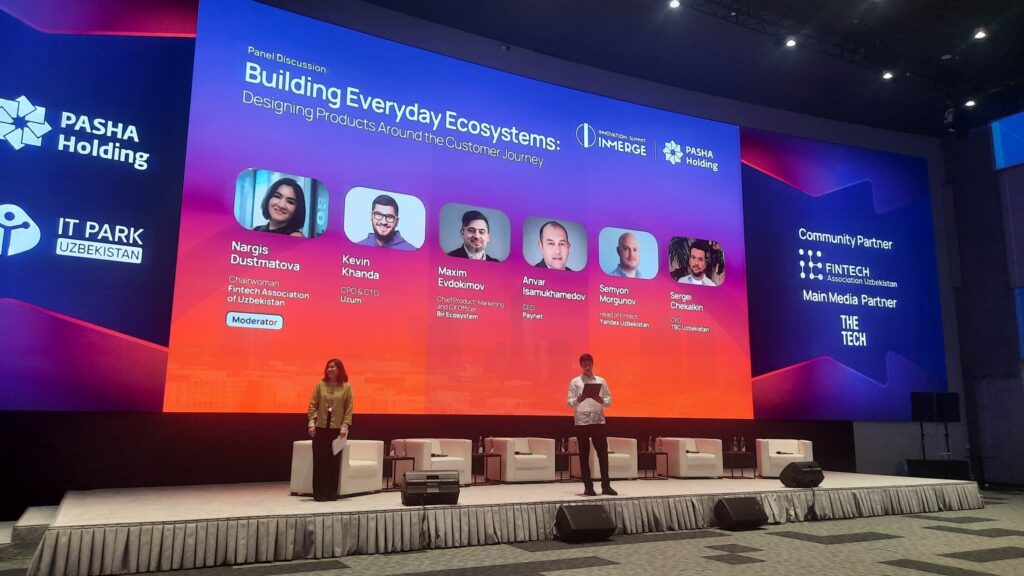
On April 30, investors, founders and corporate leaders gathered in Uzbekistan’s capital, Tashkent, for the latest incarnation of the INMerge Innovation Summit. The traveling series followed an earlier session in Istanbul and will lead into the main summit scheduled for October 8-9 in Baku. In Tashkent, discussions centered on a question that continues to define Uzbekistan’s digital trajectory: how to turn rapid growth into a sustainable, interconnected ecosystem capable of competing beyond national borders. Two core discussions framed the agenda. The first focused on how companies are building digital ecosystems around everyday user needs. The second addressed a more structural issue: whether capital alone is enough to build what some participants called a “Digital Silk Road,” or whether deeper foundations are required. A Rising Regional Star The series of summits has been organized by PASHA Holding, an Azerbaijani conglomerate owned by the ruling Aliyev and Pashayev families. For Tughra Musayeva, Head of Innovations at PASHA Financial Holding and Managing Partner at INMerge Ventures, Uzbekistan stands out as a "rising star of the region". “It’s rich in human talent and capital, and increased political support for innovation and tech infrastructure is already showing results," she told The Times of Central Asia on the sidelines of the event. "In the coming years, we’re going to see many interesting startups and projects emerging from Uzbekistan.” Musayeva challenged a common assumption about emerging tech markets – that they remain dependent on foreign expertise. In her view, Tashkent already has most of the elements needed to sustain growth internally. “What we see right now is a very self-sufficient platform. There is infrastructure and the right actors are in place. The next step is about scaling, especially across borders,” she said, pointing to her ambition to increase cross-border collaboration between Central Asia and the Caucasus. A similar emphasis on connectivity came from her colleague Ulviyya Mehraliyeva, innovation events manager at PASHA Financial Holding and a member of the INMerge team. For her, the Tashkent gathering was part of a broader effort to link ecosystems that often develop in isolation. “What differentiates us is our focus on connecting ideas, people, ecosystems, and talent with opportunities," she told TCA. “We believe Tashkent has huge potential. There has been significant investment and development in the startup ecosystem.” To her, the city is already emerging as a regional hub, but she cautioned that Uzbekistan still has a lot to learn from outside. “It’s both building your own ecosystem while also learning from others. This is a stage of development. Every region goes through it,” she said. “We believe that collaboration between countries like Azerbaijan and Uzbekistan will only strengthen that.” [caption id="attachment_48170" align="aligncenter" width="2560"] Image: TCA[/caption] The View from the Ground Practitioners working within Uzbekistan’s tech sector were more circumspect. Dalerkhon Nodirov, CEO of IT Park Ventures, offered a more measured view of the country’s technological independence, particularly in the field of artificial intelligence. “We don’t yet have our own AI models,” he said. “At this stage, we still depend...

Digital Tenge: Kazakhstan Becomes a Testing Ground for Programmable Money

While developed economies from the Federal Reserve to the European Central Bank, continue to debate the risks of introducing central bank digital currencies (CBDCs), Kazakhstan has already moved into large-scale commercial deployment. By early 2026, the volume of the digital tenge in circulation had reached 336.6 billion KZT (about $700 million), positioning Central Asia as a significant testing ground for programmable money for international investors and the global fintech community. The digital tenge is already being used in tax administration, subsidy distribution, and other state-backed financial operations, extending its role beyond a purely technical innovation. This is not merely a technological upgrade of the financial system, but a fundamental shift in the interaction between the state, business, and capital. Algorithms Instead of Bureaucrats For international businesses and investors, bureaucracy has long been a major barrier in emerging markets, often freezing liquidity for extended periods. The introduction of the digital tenge aims to address this by enabling faster transactions through smart contracts. One of the most notable pilot cases in 2025-2026 was the implementation of a “digital VAT” mechanism. Traditionally, exporters waited up to 90 days for value-added tax refunds, often relying on short-term borrowing to bridge cash flow gaps. With the integration of the digital tenge into tax administration, the VAT refund period has been reduced to five business days. A smart contract analyzes the digital supply chain and, if no discrepancies are identified, initiates payment automatically without the involvement of tax officials. For multinational companies, improved liquidity enhances Kazakhstan’s attractiveness as a manufacturing destination. Similar mechanisms have also been introduced for distributing government business subsidies through development institutions. Financial Bridge: The Digital Silk Road Bypassing SWIFT The current international money transfer system remains relatively slow and costly, as transactions pass through multiple intermediary banks, each charging fees. Under sanctions pressure, such transfers may also carry additional risks. In this context, the role of the digital tenge extends beyond the domestic market. Kazakhstan is positioning its CBDC as a tool that could reshape the architecture of Eurasian trade. Research by the Bank for International Settlements suggests that digital currencies can significantly accelerate cross-border payments. Given Kazakhstan’s substantial trade with China, which is advancing its digital yuan (e-CNY), the creation of direct digital payment corridors between the two countries appears increasingly plausible. For global markets, this could enable near-instant, round-the-clock settlements between Asia and Europe, reducing reliance on traditional systems such as SWIFT. Kazakhstan is thus seeking to position itself as an emerging digital financial hub, with the potential to lower transaction costs and mitigate certain external risks. The Flip Side of the Digital Coin One of the most debated aspects of Kazakhstan’s digital currency initiative is the level of transparency enabled by “coloring” (or marking) technology. This system allows authorities to track how funds are used and ensure they are spent for their intended purpose. If budget funds are allocated for infrastructure or agricultural equipment, their use can be limited accordingly. At the macroeconomic level, this could help reduce Kazakhstan’s...

Kazakhstan Adopts Pragmatic AI Regulation in Financial Sector

As of early 2026, the global financial market faces a strategic choice: impose tighter restrictions on artificial intelligence or allow the technology to evolve within existing regulatory frameworks. While the European Union has opted for comprehensive regulation, Kazakhstan has adopted a more pragmatic approach. According to the National Bank of Kazakhstan, approximately 75% of the country’s banks already use AI technologies— a share that has risen steadily over the past year — and 88% plan to expand their use. This indicates that AI integration is no longer experimental but systemic within the financial sector. Banks are increasingly deploying AI in credit underwriting, fraud detection, and anti-money-laundering transaction screening Madina Abylkasymova, Chair of the Agency for Regulation and Development of the Financial Market, articulated the principle of technological neutrality as early as 2025: the regulator does not intend to introduce artificial constraints until uniform global standards for AI are established. In her view, existing regulatory frameworks remain sufficient. Cybersecurity requirements, data protection standards, and risk management rules continue to apply regardless of whether decisions are made by humans or algorithms. Accountability and oversight remain unchanged. Infrastructure Before Regulation At the same time, the market faces significant structural barriers. These include a shortage of specialists at the intersection of finance and data science, the absence of unified data standards, and the high cost of computing infrastructure. The introduction of additional “European-style” restrictions could disproportionately burden smaller market participants and potentially force them out of the sector. Over the past twelve months, discussions have shifted from pilot experimentation to operational scaling across core banking functions. Some market participants have privately expressed concern that regulatory lag could eventually create supervisory blind spots as AI models grow more complex. Recognizing the high cost of entering the AI ecosystem, the state is assuming an infrastructural role. Timur Suleimenov, Governor of the National Bank of Kazakhstan, operating within the broader digital modernization agenda supported by President Kassym-Jomart Tokayev has outlined a strategic objective: to establish secure and scalable infrastructure to support AI development in the financial sector. This includes the launch of domestic data centers and the expansion of partnerships with global technology companies. The stated goal is to strengthen technological sovereignty and ensure the protection of citizens’ personal data. In practical terms, the regulator aims to create a sovereign “sandbox” in which fintech companies can test algorithms without transferring sensitive information to foreign servers. Supervisory Modernization The rapid expansion of AI also requires a transformation of supervisory practices. Currently, 39% of financial organizations in Kazakhstan use neural networks in some capacity. Over the past year, the number of companies that have progressed from pilot projects to partial implementation has nearly doubled. International institutions, including the Bank for International Settlements and the International Monetary Fund, argue that AI does not generate fundamentally new categories of risk. Rather, it accelerates and amplifies existing risks, credit, market, and operational. This suggests that regulators do not need to rewrite foundational rules but must enhance the speed, scale, and depth of...