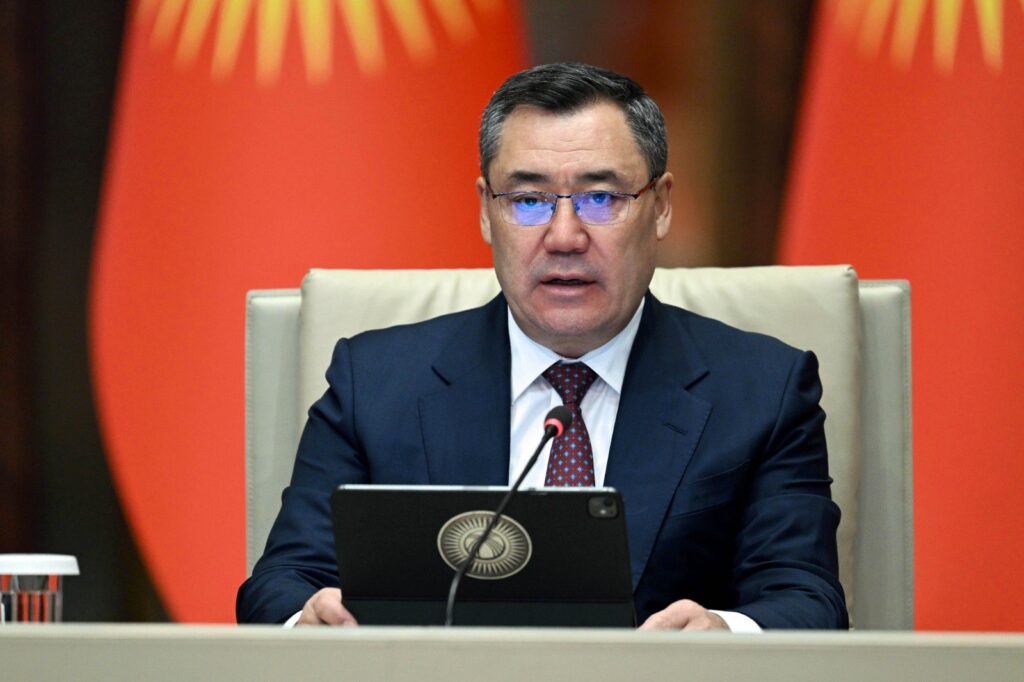
Kazakhstan needs deeper financial markets and a system less dependent on banks, senior financial officials told Astana Finance Days on September 9, 2026. Speakers at the Astana International Financial Centre (AIFC) explored how digital finance could support that shift during the plenary session, “Innovation at Institutional Scale: Rewiring the Architecture of Finance.”
The turnout was standing-room only. Over the next fifty minutes, the panelists discussed Kazakhstan’s ambitions as a financial hub and the conditions needed to advance them.
Moderator Sallianne Taylor, Bloomberg‘s EMEA Head of Government Relations, opened by asking what is fundamentally changing in the architecture of global finance, and what it means for Kazakhstan. There were five panelists: Timur Suleimenov, Governor of the National Bank of Kazakhstan; Renat Bekturov, Governor of the AIFC; Timur Turlov, Chief Executive of Freedom Holding Corp.; Sergio Mello, Global Head of Stablecoin Solutions at Anchorage Digital; and Balaji Srinivasan, founder of Network School and bestselling author of The Network State.
The Governor’s Priority: Stability Before Speed
Governor Suleimenov began by naming “geopolitical tension” as the backdrop to today’s discussions. “This is the elephant in the room, which we cannot ignore,” he said, without further comment.
He then described trade and finance flows as changing fundamentally, pointing to “division across the Atlantic. We’re seeing trade wars, semi-trade wars across the world.” He explained that “finance has always been a partner with trade, investment and finance.” That atmosphere of uncertainty “reshapes financial flows,” he said.
Turning to technology, he noted that “with the invention of blockchain, cryptocurrencies, stablecoins, and everything in between, the traditional financial system has started to undergo very fundamental change. I think we’re still in the rule-setting phase.”
As a result, he said, “There is no set of global rules for decentralized finance, for digital finance, crypto finance. Many countries are looking to strike the right balance between the traditional financial institutions such as banks or commodities or securities markets, and the new ways of doing finance that the market is offering.”
For Kazakhstan specifically, he argued the moment favors the country rather than threatens it. “I think for Kazakhstan, it’s more of an opportunity,” he said, pointing to its standing as the region’s largest economy by GDP and GDP per capita, and its position as “the biggest financial system, the best financial system, the most capitalized” in Central Asia.
That confidence carried into the moderator’s next question: “As a central banker, how do you balance innovation with preserving that financial stability and trust?” Suleimenov called it “a never-ending story,” then offered the line that framed the whole session: “When you see something new, and you don’t have the rules for it, of course you have to evaluate it based on its merits and based on principles rather than rules, and then you come up with rules.”
He was candid about the risk that comes with new financial technology, but just as quick to put it in proportion. “What we’ve been seeing in Kazakhstan, I mean, it’s 90% positive,” he said, acknowledging that “with any new technologies, with any new financial tools, instruments, there is some percentage of that being used for something beyond the law, something in a darker area,” which is where, he noted, the country’s financial monitoring agency steps in. Still, he insisted, “the vast majority of that is white [legitimate],” and not “a formidable test that we need to tackle.”
AIFC’s Role in Financial Innovation
Bekturov, taking the floor next, stated that, “I think that the competitive advantage of Kazakhstan is in its people,” and credited Suleimenov by name as an official “open for innovation and open for new ideas,” willing to treat risky new instruments on their merits rather than banning them outright; “as he said, they are risky, but it depends on how you think about it.”
He described AIFC as a laboratory for the wider Kazakh financial system: “The value of AIFC is providing that optionality and opportunity to test that which you are not yet ready to test within the whole system.” He also said the model was attracting interest beyond Kazakhstan’s borders: “We see that [our] model is becoming more popular in many countries to try to replicate”.
New Competition, Warmly Received
The discussion turned to competition from international and regional financial firms.
Turlov, whose Freedom Holding enterprise spans brokerage, banking, and payments, put it plainly: “On our relational market, we are facing competition from European firms, from U.S. firms, from other Central Asian firms, from big cryptocurrency global exchanges which exist everywhere and nowhere simultaneously.” He argued that competition pushes Kazakhstan’s own firms to mature faster. “If you’re already competitive in your country and you’re facing global competition, it’s very logical to scale out.”
Srinivasan offered a broader vision of digital finance. Casting the internet as “a new continent” people commute to daily, he argued that money, property, and trust are all migrating on-chain, meaning onto blockchain networks, and that Kazakhstan, landlocked by geography, could turn that liability into an asset. “The market size is not 21 million anymore; it’s 8 billion,” he said, describing every person on earth as a potential customer once assets and trust can be represented as code rather than paper. His pitch for the country’s future brand: “cloud first, land last, but not land never,” with Astana positioned, in his words, as “the land of the cloud.”
Everything not built this way, he suggested, is a target: “The only secure systems will be on-chain… and so smart contract chains are going to be the only secure backends because everything else will get hacked.” That was his prediction, rather than an established security guarantee. Smart contracts also face security vulnerabilities.
Mello, closing the substantive debate, struck a calmer note but landed on similar ground: the technology, he said, has already left the experimental stage. “It’s an instrument that is no longer an experiment,” he said of stablecoins, adding that “regulation can absolutely propel innovation in a country and we’ve seen it here. The success of Kazakhstan in the last decade is not because of lack of regulation, but it’s because the regulators have been very proactive.”
Five Closing Priorities
The moderator closed the session with one question put to each panelist in turn: “If we were to meet again in Astana Finance Days, say, in three years’ time, what’s the one change that you’d like to see in Kazakhstan’s financial system by then?”
Suleimenov went first. “That’s a tough one,” he admitted. Pressed to pick just one, he said: “I would like to see a less bank-centered financial system. If it was just for one change, I would like to see both the securities markets in all its kinds and shapes to play a bigger role in our financial system than today.”
Bekturov identified a constraint: “The depth of liquidity in our financial system.” He was candid that it isn’t a lever AIFC can simply pull. “This is one thing that is out of our control, right? We have influence, but we don’t have control.”
Turlov’s answer looked outward rather than inward: “I want to see financial institutions much more global than now and playing a much bigger role in global finance.”
Srinivasan, characteristically, went furthest. He wanted, he said, “every valuable asset and document and credential represented on-chain, because that will actually get you the liquidity that you want.” He argued that this would increase global market access while lowering costs, and position Kazakhstan as more than just “the leader in crypto,” but as “the internet first country.”
Mello brought the round back to fundamentals: A “very diverse supply of foreign direct investment and participants from all over the world that consider this a neutral ground to growth.”
The Road Ahead
The discussion showed a shared appetite for financial innovation, alongside recognition of the need for deeper markets. Suleimenov emphasized judging new technologies on their merits, while developing the rules to govern them. For AIFC, the ambition is to provide room for that experimentation, even as the liquidity constraint remains beyond its direct control.
For more on our special coverage of Astana Finance Days, click here.